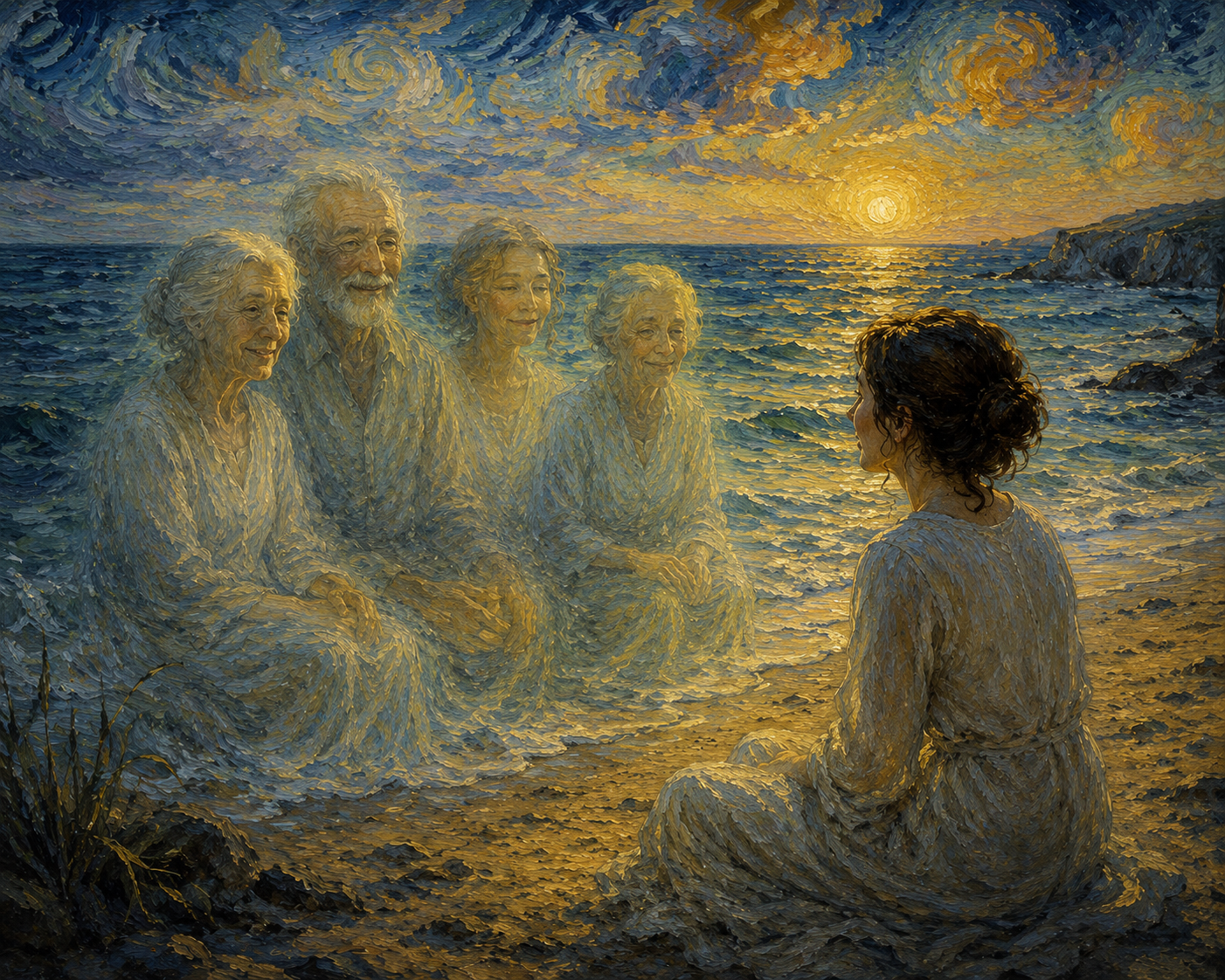
‘I SEE THOSE THAT HAVE DEPARTED THIS PHYSICAL REALM,
YET- WHEN I AWAKE
THEY ARE NEVER MORE JUST A MEMORY TO REFLECT UPON!’
-J. Dreamzzz
Seeing the Dead Within Dreams: Religious, Cultural, and Historical Perspectives
Dreams involving deceased individuals are among the oldest and most universally reported dream experiences in human history. Across civilizations, religions, and cultures, people have described dreams in which departed family members, friends, historical figures, or even unknown individuals appear vividly. These dreams have often been interpreted as messages, expressions of grief, reminders of mortality, spiritual encounters, or reflections of the dreamer’s emotional life. While modern psychology generally views such dreams through the lens of memory, emotion, and the subconscious mind, many religious and cultural traditions have attributed profound spiritual significance to encounters with the dead during sleep.
Historical Perspectives
Dreams of the deceased have been documented for thousands of years.
Ancient civilizations believed that dreams could serve as bridges between the living and the dead. Archaeological evidence and historical writings suggest that many cultures regarded dreams as meaningful experiences worthy of careful interpretation.
Ancient Egypt
The ancient Egyptians believed that death marked the beginning of another phase of existence rather than the end of life. Dreams involving deceased relatives were sometimes viewed as opportunities for communication with the spirit world. Tomb inscriptions, funerary texts, and religious writings indicate that Egyptians believed the dead could offer protection, guidance, or warnings through dreams.
Ancient Mesopotamia
Mesopotamian civilizations considered dreams to be important messages from gods, spirits, or deceased ancestors. Clay tablets dating back more than 4,000 years contain dream records and interpretations, including accounts of encounters with those who had died.
Ancient Greece
The Greeks regarded dreams as potential messages from both the gods and the dead. Temples dedicated to Asclepius, the god of healing, encouraged individuals to sleep within sacred spaces in hopes of receiving healing dreams or divine instruction. Greek literature, including Homer’s Odyssey, contains accounts of the living encountering departed souls through dreams and visions.
Ancient Rome
Roman society inherited many Greek beliefs concerning dreams. Philosophers, historians, and religious leaders debated whether dreams involving the deceased represented genuine spiritual encounters, symbolic warnings, or reflections of memory and emotion.
Religious Perspectives
Many of the world’s major religions acknowledge that dreams can possess spiritual significance, although interpretations differ considerably.
Christianity
The Bible contains numerous examples of God communicating through dreams. Although Scripture does not specifically teach that all dreams of deceased individuals represent actual contact with the dead, Christians have historically interpreted such dreams in different ways.
Many Christian theologians emphasize discernment, suggesting that dreams involving deceased loved ones may reflect grief, cherished memories, or personal comfort rather than direct communication. Others acknowledge that God may occasionally use dreams to encourage, comfort, or remind believers of spiritual truths.
Christian tradition generally discourages attempts to deliberately seek communication with the dead, emphasizing prayer, faith in God, and reliance upon biblical teaching.
Judaism
Judaism has long regarded dreams as potentially meaningful while recognizing that many dreams arise naturally from daily thoughts and experiences.
Rabbinic literature discusses dreams extensively, including dreams involving deceased relatives. Some Jewish traditions regard such dreams as symbolic, while others acknowledge that certain dreams may provide spiritual encouragement or reflection. Jewish teachings generally emphasize interpreting dreams with humility and caution.
Islam
Islam recognizes that some dreams may contain spiritual meaning.
Classical Islamic scholarship distinguishes between truthful dreams from God, ordinary dreams arising from daily life, and disturbing dreams that should not be interpreted as divine messages.
Islamic scholars have historically discussed dreams involving deceased individuals, often considering the appearance, condition, and behavior of the deceased as potentially meaningful while emphasizing that all interpretations remain subject to God’s ultimate knowledge.
Hinduism
Hindu traditions often understand dreams within the broader framework of karma, rebirth, and the continuing journey of the soul.
Dreams involving deceased ancestors may be viewed as reminders of family obligations, expressions of unresolved emotions, or occasions to honor one’s ancestors through prayer and remembrance.
Buddhism
Buddhism generally views dreams as expressions of the mind rather than objective supernatural events. Dreams of deceased loved ones may arise from attachment, compassion, grief, memory, or ongoing emotional connections.
Some Buddhist traditions also acknowledge that dreams may encourage reflection upon impermanence, compassion, and the transient nature of earthly existence.
Cultural Perspectives
Throughout the world, dreams of the deceased have inspired numerous traditions and beliefs.
Many cultures believe deceased relatives visit dreams to:
- Offer comfort.
- Provide guidance.
- Express reassurance.
- Deliver warnings.
- Encourage forgiveness.
- Say farewell.
- Strengthen family bonds.
- Remind the living to honor their ancestors.
In many Indigenous traditions, dreams involving ancestors are regarded as opportunities to receive wisdom accumulated across generations.
In East Asian cultures influenced by ancestor veneration, dreams of deceased family members are sometimes viewed as reminders to maintain respect for one’s lineage and continue traditional memorial practices.
In Mexico’s Día de los Muertos (Day of the Dead) tradition, dreams of departed loved ones are often welcomed as meaningful reminders that emotional bonds continue beyond death.
Across Africa, Oceania, and many Indigenous societies, ancestral dreams frequently occupy an important place within spiritual and community life, reinforcing family identity and cultural continuity.
Psychological and Social Perspectives
Modern psychology generally explains dreams of deceased individuals as natural expressions of memory, attachment, and emotional processing.
People may dream about someone who has died:
- During periods of grief.
- On anniversaries.
- Following major life changes.
- During emotional stress.
- When seeking guidance.
- After encountering reminders of the person.
- While processing unresolved emotions.
Research on bereavement suggests that dreams of deceased loved ones are common and often emotionally significant. Many individuals report these dreams as comforting, while others experience sadness, longing, or unresolved grief. The meaning of such dreams is highly personal and may differ greatly from one individual to another.
Cultural Symbolism
Across literature, folklore, and art, seeing the dead in dreams often symbolizes:
- Remembrance.
- Grief.
- Wisdom.
- Legacy.
- Unfinished emotional matters.
- Personal transformation.
- Reflection on mortality.
- Family heritage.
- Spiritual contemplation.
Rather than being viewed solely as frightening experiences, dreams of the deceased have frequently been regarded as opportunities for emotional healing, reconciliation, remembrance, or personal reflection.
Conclusion
Throughout history, dreams involving the deceased have occupied a unique place in human thought. Ancient civilizations often regarded them as messages from ancestors or the spiritual world, while major religions have offered diverse perspectives ranging from symbolic reflection to possible spiritual significance. Modern psychology generally understands these dreams as natural expressions of memory, attachment, and emotional processing. Regardless of one’s beliefs, dreams of the dead continue to be among the most meaningful dream experiences reported across cultures, reminding humanity of enduring relationships, the reality of loss, and the universal desire to understand life, death, and what may lie beyond.
Bibliography
- Bulkeley, Kelly. Dreaming in the World’s Religions: A Comparative History. New York University Press, 2008.
- Eliade, Mircea. Shamanism: Archaic Techniques of Ecstasy. Princeton University Press, 1964.
- Freud, Sigmund. The Interpretation of Dreams. 1900.
- Garfield, Patricia. The Universal Dream Key. HarperCollins, 2001.
- Hillman, James. The Dream and the Underworld. Harper & Row, 1979.
- Jung, C. G. Dreams. Princeton University Press, 1974.
- Lewis, Ioan M. Religion in Context: Cults and Charisma. Cambridge University Press, 1996.
- Oppenheim, A. Leo. The Interpretation of Dreams in the Ancient Near East. American Philosophical Society, 1956.
- Van de Castle, Robert L. Our Dreaming Mind. Ballantine Books, 1994.
- The Holy Bible (New Revised Standard Version or other recognized translation).
- The Qur’an (translated by M. A. S. Abdel Haleem or another scholarly translation).
- The Babylonian Talmud, Berakhot (selected passages on dreams).

Sigmund Freud on Dreaming of the Dead

Sigmund Freud did not give every appearance of a deceased person in dreams one fixed meaning. He believed that the meaning of the dead person must be discovered through the dreamer’s memories, emotional relationship with the deceased, recent experiences, unresolved wishes, guilt, grief, and personal associations.
Within Freud’s theory, dreaming of someone who has died is not automatically a prediction, warning, or supernatural visitation. The deceased figure belongs to the dreamer’s own psychological production. It may represent longing, grief, guilt, unresolved conflict, a desire for reunion, or a thought that the dreamer has placed into the voice or appearance of the dead person.
Freud would therefore ask:
- Who was the deceased person?
- What was the relationship like while that person was alive?
- How did the person appear in the dream?
- Did the dreamer know that the person was dead?
- Did the deceased person know?
- What did the person say or do?
- Was the dreamer comforted, frightened, angry, or guilty?
- What recent event brought the deceased person to mind?
- What unfinished wish was satisfied by the meeting?
- What conflict remained unresolved at the time of death?
The dream’s meaning would emerge from these details rather than from the appearance of death alone.
The Deceased Person Who Appears Alive
Freud directly addressed dreams in which a deceased loved one returns to life. He observed that these dreams often continue for a considerable period after a loss.
He described them as compromises between two opposing facts:
- The dreamer consciously knows that the person is dead.
- The dreamer wishes for the person to be alive again.
Because these two positions cannot easily coexist in waking consciousness, the dream may construct an unusual situation in which the deceased person is both dead and alive. The person may be alive without knowing that they are dead, partly alive, temporarily restored, or present under conditions that prevent the dreamer from fully acknowledging the death.
The apparent contradiction is not meaningless. It allows the dreamer to preserve the loved person for a little longer while still retaining some knowledge of reality.
Example
A woman dreams that her deceased mother is preparing dinner in the family home. The woman knows that her mother died, but she does not mention it because she fears that the mother will disappear.
The dream may express a wish to restore an ordinary moment from family life. The dreamer’s silence protects the reunion. Admitting the death would end the dream and cause the mother to vanish again.
Example
A man dreams that his deceased brother has returned but is permitted to remain alive for only one day.
The time limit may represent a compromise. The wish restores the brother, while the dreamer’s knowledge of death prevents the restoration from becoming permanent.
Freud’s Special Category of Mourning Dreams
Freud considered dreams of deceased loved ones a recognizable category. He explained that the dreamer’s wish to recall the deceased to life can express itself through strange and seemingly illogical arrangements.
The deceased may appear:
- Alive but unaware of having died.
- Dead but still able to speak.
- Sick but not completely dead.
- Living in another house or country.
- Present only at night.
- Visible to the dreamer but invisible to everyone else.
- Temporarily released from the grave.
- Alive under a new identity.
- Young and healthy despite having died at an older age.
These conditions allow the dream to satisfy the desire for reunion without completely eliminating the knowledge of loss. Freud cautioned against dismissing such dreams as nonsense merely because their logic differs from waking reality.
The Wish to Bring the Dead Back to Life
The most direct Freudian meaning of many bereavement dreams is the wish that the deceased person were still alive.
This wish may be simple and affectionate:
- “I want to see you again.”
- “I want to hear your voice.”
- “I want one more conversation.”
- “I want you to come home.”
- “I want to correct what happened.”
- “I want to know that you are all right.”
- “I want to feel protected by you again.”
- “I want the family to be as it was before.”
The dream creates a temporary experience in which that wish is fulfilled.
Example
A bereaved daughter dreams that her father telephones and says that reports of his death were mistaken.
The dream reverses the loss. The telephone allows the father’s voice to return, while the explanation that the death was a mistake removes the painful event from reality.
Example
A widower dreams that his wife enters the bedroom and says, “I never left.”
The dream may directly fulfill the wish that the separation never occurred. It may also express the continued emotional presence of the relationship in the dreamer’s mind.
The dream does not demonstrate that the deceased has literally returned. Within Freud’s theory, it reveals the strength of the dreamer’s wish to undo the loss.
Knowing and Not Knowing That the Person Is Dead
A frequent feature of these dreams is confusion about whether the deceased is truly dead.
The dreamer may know and not know at the same time. This divided knowledge reflects a conflict between acceptance and denial.
One part of the dreamer recognizes reality. Another part refuses the loss and continues to expect the person’s return.
Example
A man sees his deceased mother shopping in a store. He thinks, “She is dead, but I should not embarrass her by telling her.”
The unusual reasoning protects the mother’s continued existence. If she learns that she is dead, she may disappear.
Example
A dreamer speaks to a deceased friend but suddenly remembers the funeral. The friend begins fading as soon as the memory returns.
The fading dramatizes the return of reality. The wish can maintain the reunion only while the knowledge of death remains partly suspended.
Freud’s Dream of the Exhumed Father
Freud presented a dream from a man whose father had died years earlier:
The father was dead, had been exhumed, appeared ill, and continued living. The dreamer attempted to prevent the father from realizing what had happened.
The analysis revealed that the dream had condensed the father with a painful tooth. After the father’s funeral, the dreamer had developed a toothache. The dentist killed the tooth’s nerve but temporarily retained the tooth before removing the dead material.
The dream-work combined the dead-but-retained tooth with the dead-but-living father. This produced the strange image of a father who had been exhumed and continued to live.
Freud also connected the dream with mixed feelings experienced during the father’s prolonged illness. The son consciously emphasized his devotion and care, but Freud concluded that he had also experienced an unconscious wish for the painful, expensive illness to end. The dream therefore included love, longing, irritation, guilt, childhood conflict, and the wish to restore the father to life.
This example demonstrates that a deceased person can represent several layers simultaneously:
- The desire to bring the person back.
- A recent or bodily association.
- Guilt concerning thoughts experienced before the death.
- Childhood feelings toward the deceased.
- Unresolved conflict.
- A play on words or images.
- A wish to conceal something from the deceased.
The dream cannot be interpreted by looking at the dead figure alone.
Grief and the Refusal to Accept Loss
Freud described the death of a close relative, spouse, child, sibling, or friend as a loss that can cause the survivor’s hopes, wishes, and desires to feel buried with the deceased.
Dreaming restores what waking reality has removed. During sleep, the deceased person can return to the home, resume ordinary activities, offer affection, or participate in family life.
This can make the dream deeply comforting but also painful upon awakening.
Example
A mother dreams that her deceased child is asleep in the usual bedroom. She awakens believing for several seconds that the child is alive.
The dream may temporarily suspend the reality of the loss. The child’s presence fulfills the mother’s longing for the family’s former condition.
Example
A dreamer sees the deceased sitting silently at the breakfast table.
The ordinary setting may be more important than any symbolic message. The dream restores a familiar routine that the loss interrupted.
The pain felt upon awakening results partly from the renewed confrontation with reality after the wishful reunion ends.
Unfinished Conversations
The dead may appear in dreams because something remained unsaid.
The dreamer may wish to:
- Apologize.
- Forgive.
- Ask a question.
- Reveal a secret.
- Express anger.
- Say goodbye.
- Receive approval.
- Correct a misunderstanding.
- Ask why the person acted in a certain way.
- Tell the person about an important event.
The dream can provide the conversation that reality no longer permits.
Example
A daughter dreams that she finally tells her deceased mother about years of resentment. The mother listens without interrupting.
The dream may satisfy the wish to speak honestly without fear of argument or rejection.
Example
A man dreams that his deceased father tells him, “I am proud of you.”
The words may express approval the dreamer wanted but did not receive while the father was alive. The dream places the desired statement into the father’s voice.
Within Freud’s method, the dreamer should ask whether the statement represents something genuinely remembered, something deeply wished for, or a judgment the dreamer is trying to give to themselves.
The Dead Person Delivering a Message
A deceased person may give instructions, warnings, advice, or predictions in a dream.
Freud would not automatically regard the message as coming from an external spirit. Because the dream is the dreamer’s psychical act, the message may express a thought, fear, wish, memory, or judgment belonging to the dreamer but represented through the authority of the deceased figure.
The dreamer may be more willing to accept advice when it appears in the voice of a respected parent, grandparent, spouse, teacher, or religious figure.
Example
A deceased father tells the dreamer to leave an unhealthy job.
The message may express a conclusion the dreamer has already reached but feels unable to act upon. The father’s authority gives force to the dreamer’s own judgment.
Example
A deceased mother warns the dreamer that the family is falling apart.
The warning may reflect tensions the dreamer has noticed but has not consciously admitted.
Example
A dead relative predicts that something terrible will happen.
The prediction may represent anxiety, guilt, or fear associated with an approaching event. Within Freud’s framework, the dream should not automatically be accepted as prophecy.
Its meaning must be sought in the dreamer’s present concerns and associations.
The Deceased as a Voice of Conscience
A dead parent or authority figure may appear when the dreamer feels guilty, judged, or morally conflicted.
The person may represent an internalized standard that continues to influence the dreamer after death.
The deceased may:
- Criticize the dreamer.
- Demand an explanation.
- Express disappointment.
- Remain silent while looking accusingly.
- Discover a secret.
- Refuse forgiveness.
- Examine the dreamer’s home or behavior.
Example
A man who has broken a promise dreams that his deceased father silently shakes his head.
The father may represent the dreamer’s conscience or the standards learned from him. The silence allows the dreamer’s own guilt to supply the accusation.
Example
A woman hides money when her deceased mother enters the room.
The dream may concern shame, dishonesty, inheritance, family expectations, or fear of maternal judgment.
The personal history between the dreamer and deceased person determines which interpretation fits.
Love and Hostility Toward the Dead
Freud argued that close emotional relationships frequently contain ambivalence: love can coexist with irritation, resentment, rivalry, dependence, or hostility.
After death, conscious grief may become intensified because hostile feelings are unacceptable and difficult to acknowledge. Freud connected some fears and guilt surrounding the dead with the projection of the survivor’s own hostile impulses onto the deceased.
The dreamer may then experience the dead person as:
- Angry.
- Punitive.
- Accusing.
- Dangerous.
- Pursuing the dreamer.
- Refusing to leave.
- Seeking revenge.
- Attempting to take someone away.
The frightening dead figure may represent not the deceased person’s hostility, but the dreamer’s guilt about their own anger, relief, or unresolved conflict.
Example
A caregiver dreams that the deceased patient returns angrily and accuses them of causing the death.
The dream may express guilt over moments of exhaustion, impatience, or the wish for the suffering to end.
Example
A dreamer runs from a deceased parent who appears threatening.
The fear may originate in actual memories of the parent. It may also arise from guilt about hostile wishes the dreamer held toward the parent.
Freud believed that conscious tenderness and unconscious hostility can exist toward the same person without either feeling completely canceling the other.
Relief Following a Death
A person can genuinely love someone and still experience relief when a long illness, difficult relationship, or caregiving burden ends.
Such relief may produce guilt because the survivor interprets it as evidence of cruelty or disloyalty.
The dead person may then return in dreams as though demanding an explanation.
Example
After years of caring for an ill relative, a dreamer sees the deceased standing beside an empty hospital bed and asking, “Are you happier now?”
The dream may express guilt over relief from caregiving demands.
Example
A woman dreams that her deceased controlling spouse tries to reenter the house, but she locks the door.
The dream may reveal both fear and a wish to preserve the freedom that followed the death.
Freud’s approach would not reduce these dreams to simple hatred. They may contain affection, grief, guilt, resentment, relief, and fear at the same time.
The Dead Appearing Healthy and Young
A deceased person may appear younger, stronger, or healthier than they were near the end of life.
This may represent the wish to remove the illness, aging, or suffering associated with the person’s death.
The dream restores the person to the form in which the dreamer most wants to remember them.
Example
A woman dreams of her deceased grandmother as a young woman dancing.
The image may preserve the grandmother as alive and free from the weakness of old age. It may also connect the grandmother with stories, photographs, or family memories of her youth.
Example
A father who died after a long illness appears healthy and says that the illness was only a misunderstanding.
The dream undoes both the disease and the death.
The Dead Appearing Sick or Injured
The deceased may instead continue to appear sick, wounded, or dying.
This may occur when the dreamer’s memory remains attached to the final period of illness or to the traumatic manner of death.
The dream may repeat:
- Hospital scenes.
- Attempts at rescue.
- Medical decisions.
- The moment bad news arrived.
- The person’s suffering.
- The funeral.
- The last conversation.
- The dreamer’s inability to help.
Example
A dreamer repeatedly finds the deceased relative alive but still unable to breathe.
The dream may reflect traumatic memories, guilt about not preventing the death, or the wish to attempt the rescue again.
In his later work, Freud recognized that dreams following trauma may repeatedly return the person to the distressing event as the mind attempts to gain control over an experience that originally overwhelmed it.
Such a dream may therefore be more than straightforward wish fulfillment. It can be part of an effort to repeat, understand, or master the traumatic scene.
Saving the Deceased
A dreamer may return to the moment of death and successfully prevent it.
The dream may allow the person to:
- Call an ambulance in time.
- Stop an accident.
- Provide medicine.
- Warn the deceased.
- Change a medical decision.
- Prevent a violent act.
- Arrive earlier.
- Say something that causes the person to remain alive.
Example
A man dreams that he stops his father from entering the vehicle involved in the fatal accident.
The dream fulfills the wish to reverse the event and remove the helplessness associated with it.
Example
A mother repeatedly dreams that she rescues her deceased child from water.
The dream may represent an attempt to undo the loss and master the feeling of having been unable to protect the child.
The rescue may temporarily satisfy the wish, even when the dreamer consciously knows that the actual event cannot be changed.
The Deceased Dying Again
A person who is already dead may die again within the dream.
This apparently redundant event may represent the repeated emotional experience of loss.
The dreamer first regains the person through the dream and then loses them again.
Example
A deceased spouse returns home, lives with the dreamer for several days, and then dies again.
The dream creates both reunion and renewed separation. It may reflect the dreamer’s repeated movement between longing and acceptance.
Example
A deceased parent dies differently each time the dream recurs.
The changing deaths may represent different fears, memories, guilt, or attempts to understand what the loss means.
The emotional reaction to the second death is especially important. It may reveal grief that remains active or a new stage of accepting the loss.
The Silent Dead
A deceased person may appear but refuse or be unable to speak.
Silence may represent:
- The finality of death.
- The impossibility of receiving an answer.
- Something left unsaid.
- The dreamer’s fear of what the person might say.
- Emotional distance that existed while the person was alive.
- The dreamer’s inability to put grief into words.
- A memory based more upon presence than conversation.
Example
The dreamer asks a deceased parent for forgiveness, but the parent remains silent.
The dream may express uncertainty about whether forgiveness is possible. Because no answer can now be received in waking life, the dream preserves the question.
Example
A deceased child sits peacefully without speaking.
The silence may provide comfort rather than judgment. The dreamer may simply wish to experience the child’s presence again.
The dreamer’s emotional response determines whether silence means rejection, peace, mystery, or irreparable absence.
The Dead Person Refusing to Stay
The deceased may visit briefly and then insist upon leaving.
This may represent the dreamer’s growing recognition that the person cannot permanently return.
Example
A deceased mother embraces the dreamer and says, “I cannot stay here.”
The dream fulfills the wish for reunion but also acknowledges the reality of separation.
Example
The dreamer attempts to hold a deceased friend, but the person disappears.
The failed attempt may express the painful limits of memory and longing.
Such dreams may combine comfort with gradual acceptance. The unconscious wish produces the meeting, while reality determines its temporary nature.
Following the Dead
A deceased person may invite, command, or lead the dreamer somewhere.
Within Freud’s framework, this should not automatically be treated as a prediction of the dreamer’s death.
It may represent:
- A wish for reunion.
- Desire to return to the past.
- Grief so intense that ordinary life feels empty.
- Identification with the deceased.
- Fear of sharing the person’s fate.
- A wish to escape present responsibilities.
- Curiosity about death.
- An unresolved attachment.
Example
A grieving spouse dreams that the deceased partner asks them to enter a train.
The train may represent joining the deceased, leaving the present life, returning to a shared memory, or escaping loneliness.
Example
The dreamer refuses to follow and returns home.
The refusal may indicate a renewed attachment to present responsibilities, relationships, or life among the living.
A dream of following the dead must be understood emotionally and psychologically rather than obeyed literally.
Receiving Objects From the Dead
The deceased may give the dreamer a photograph, key, letter, piece of clothing, money, food, or another object.
The object’s personal associations are more important than any universal definition.
A Key
A key may represent access to a memory, home, secret, responsibility, or family role connected with the deceased.
A Letter
A letter may represent words the dreamer wishes the person had written or an attempt to give form to unfinished communication.
Clothing
Clothing may represent identification with the deceased, inheritance of a role, or the wish to become more like that person.
Money
Money may connect with inheritance, obligation, dependence, value, guilt, or unfinished financial matters.
Example
A deceased father gives the dreamer his work tools.
The dream may concern inheriting the father’s responsibilities, occupation, abilities, or identity.
Example
A deceased mother gives the dreamer a locked box.
The box may represent family memories, secrets, questions, or emotions that remain unopened.
Freud would ask what thoughts immediately occur to the dreamer when considering the object.
The Dead Taking Something Away
A deceased person may remove a possession, take another person, close a door, or leave with an object belonging to the dreamer.
This may express fear of further loss.
Example
A deceased grandmother takes all the family photographs.
The dream may represent fear that family memories are disappearing.
Example
A deceased parent takes the dreamer’s child by the hand.
The dream may express anxiety about the child’s safety, fear that death will repeat within the family, or a wish that the deceased could meet and protect the child.
The scene should not automatically be regarded as a prediction that the child will die.
Deceased Parents
Dreams of dead parents can revive childhood dependence, authority, protection, rivalry, guilt, and unresolved family conflict.
A deceased parent may appear when the dreamer:
- Needs guidance.
- Faces a decision the parent would have influenced.
- Becomes a parent.
- Reaches the age at which the parent died.
- Experiences a family crisis.
- Feels guilty about surpassing or disappointing the parent.
- Wishes to recover childhood security.
- Resents the parent’s continued psychological authority.
Example
A deceased father appears whenever the dreamer receives a promotion.
The father may represent a wish for approval, guilt about surpassing him, or fear of assuming greater authority.
Example
A deceased mother returns when the dreamer becomes pregnant.
The dream may express the wish for maternal guidance, renewed identification with the mother, or anxiety about entering the role the mother once occupied.
Deceased Children
Dreams of a deceased child may express especially intense longing, guilt, helplessness, identification, and attempts to reverse the loss.
The child may appear:
- Alive and older.
- Still the age at death.
- As a baby again.
- Waiting at home.
- Asking why the parent left.
- Reassuring the parent.
- Needing rescue.
- Playing peacefully.
- Returning for a family event.
Example
A parent dreams of the child growing into adulthood.
The dream fulfills the wish to witness the life that was lost—the birthdays, development, achievements, and relationships that could not occur.
Example
The child tells the parent, “It was not your fault.”
The statement may express reassurance the parent desperately needs but cannot fully give themselves.
The dream may help reveal the depth of guilt, even when that guilt is not justified by the actual circumstances.
Deceased Spouses and Partners
A dead spouse may return in dreams because the emotional and daily bond remains active.
The dream may restore:
- Physical closeness.
- Conversation.
- Shared routines.
- Sexual intimacy.
- Emotional support.
- Conflict.
- Jealousy.
- Household responsibilities.
- The sense of being part of a couple.
Example
A widow dreams that her husband becomes angry because she is dating again.
The anger may represent her own guilt about moving forward rather than the deceased husband’s actual judgment.
Example
A deceased wife helps her husband prepare the house for visitors.
The dream may restore the shared domestic partnership and express the dreamer’s wish for assistance and companionship.
Recurring Dreams of the Dead
Recurring appearances may indicate that the wish, grief, guilt, or conflict connected with the deceased remains emotionally active.
The dreamer should observe whether the dreams change over time.
Questions include:
- Does the deceased appear healthier?
- Does the person speak more clearly?
- Does the dreamer finally express anger or love?
- Does the deceased remain longer or leave sooner?
- Does the dreamer stop trying to prevent the departure?
- Does a frightening figure become peaceful?
- Does the setting move from a hospital to a home?
- Does the dreamer become able to say goodbye?
Example
At first, the dreamer repeatedly tries to revive the deceased. Later, the deceased appears healthy and says goodbye peacefully.
The change may reflect movement from desperate reversal of the loss toward a more tolerable internal relationship with the person’s memory.
Questions for Freudian Analysis
A Freudian examination of a dream involving the dead would ask:
- What was my relationship with this person?
- What did I love about them?
- What anger, resentment, or disappointment also existed?
- Did I feel relief when their suffering or demands ended?
- What guilt followed the death?
- What remained unsaid?
- What would I most want to tell them?
- What would I most want them to tell me?
- Did the dream restore them to life?
- Did I know they were dead?
- Did they know?
- What strange condition allowed them to remain alive?
- What recent event reminded me of them?
- What age and condition did they have in the dream?
- What object did they give or take?
- Did they resemble another living person?
- What decision am I currently facing?
- What wish did the reunion fulfill?
- What fear was expressed through their return?
- What childhood memory is connected with them?
- Did the dream repeat a traumatic death scene?
- What part of my own thought was spoken through their voice?
The useful interpretation comes from the dreamer’s associations, not from a fixed dream dictionary.
Conclusion
Within Sigmund Freud’s dream theory, dreaming of the dead most commonly arises from the continuing emotional relationship between the dreamer and the deceased.
Freud specifically described dreams in which knowledge of death forms a compromise with the wish to bring the loved person back to life. The deceased may therefore appear alive but unaware of being dead, half alive, temporarily restored, or present under strange conditions that protect the reunion.
These dreams may fulfill wishes for affection, conversation, approval, forgiveness, rescue, or one more opportunity to say goodbye. They may also reveal guilt, resentment, relief, rivalry, or unresolved hostility existing alongside love.
An angry or threatening dead person may embody the dreamer’s projected guilt or hostile feelings. A comforting deceased person may speak words the dreamer longs to hear. A silent figure may represent unanswered questions. A healthy and youthful appearance may remove the illness associated with death. Repeated sickness or dying may reproduce traumatic memories. The deceased giving an object may represent inheritance of a role, responsibility, memory, or emotional quality.
Freud did not treat the appearance of the dead as proof of supernatural communication. The figure is part of the dreamer’s psychical production and may speak with the authority, personality, or emotional importance associated with the person in life.
The essential question is not merely why the deceased appeared, but what their return made possible. Did the dream restore affection? Resolve an argument? Provide approval? Express guilt? Reverse a traumatic death? Preserve a family bond? Or allow the dreamer to begin accepting that the person cannot permanently return?
For Freud, the dream of the dead is a place where grief, memory, longing, guilt, love, hostility, and the wish to undo loss can meet within a single scene.
Bibliography
Freud, Sigmund. The Interpretation of Dreams. Translated by A. A. Brill. New York: Macmillan, 1913. Originally published as Die Traumdeutung in 1900. This work presents Freud’s theories of wish fulfillment, manifest and latent content, dream-work, condensation, displacement, childhood wishes, and dreams involving the death of loved relatives.
Freud, Sigmund. Introductory Lectures on Psycho-Analysis. Originally delivered between 1915 and 1917. Freud discusses the special dreams produced after the loss of a loved person and describes the compromise between knowing that the person is dead and wishing to recall the person to life.
Freud, Sigmund. A General Introduction to Psychoanalysis. Translated by G. Stanley Hall. New York: Boni and Liveright, 1920. This edition includes Freud’s detailed analysis of the dream involving a deceased father who had been exhumed and continued living.
Freud, Sigmund. Totem and Taboo: Resemblances Between the Psychic Lives of Savages and Neurotics. Translated by A. A. Brill. New York: Moffat, Yard and Company, 1918. Originally published in 1913. Freud examines emotional ambivalence toward the dead, unconscious hostility, guilt, projection, mourning, and fear of returning spirits.
Freud, Sigmund. Reflections on War and Death. Translated by A. A. Brill and Alfred B. Kuttner. New York: Moffat, Yard and Company, 1918. Originally written in 1915. Freud discusses denial of death, the survivor’s intense response to losing close loved ones, and the unconscious difficulty of accepting mortality.
Freud, Sigmund. Beyond the Pleasure Principle. Translated by C. J. M. Hubback. London: International Psycho-Analytical Press, 1922. Originally published in 1920. The work discusses traumatic dreams, repetition compulsion, and the mind’s attempt to gain control over overwhelming experiences by repeatedly returning to them.
Freud, Sigmund. “Mourning and Melancholia.” In The Standard Edition of the Complete Psychological Works of Sigmund Freud, vol. 14. Translated and edited by James Strachey. London: Hogarth Press, 1957. Originally published in 1917. The essay examines mourning, attachment to a lost loved object, withdrawal of emotional investment, ambivalence, guilt, and melancholic reactions to loss.
Carl Jung on Dreaming of the Dead

Carl Jung approached dreams of deceased people as psychologically significant experiences that could express grief, unresolved relationships, inherited family patterns, archetypal imagery, or the continuing inner influence of someone who had died. He did not reduce every deceased dream figure to a single explanation, nor did he claim that every such dream proved communication with the afterlife.
Jung acknowledged the central uncertainty directly: an apparent encounter with a deceased person might be connected with the actual dead person, but it might also be a psychic projection or an expression of knowledge contained within the unconscious. He believed that psychology should take the experience seriously while remaining honest about what could and could not be proven.
A Jungian examination would therefore ask:
- Who was the deceased person?
- What did that person mean to the dreamer?
- What qualities did the person possess?
- What remained unresolved between them?
- How did the deceased behave in the dream?
- What did the dreamer feel?
- What happened immediately before and after the encounter?
- What present situation resembles the relationship?
- Did the dream concern personal grief, or did it possess a larger archetypal atmosphere?
The deceased person may be connected with the actual relationship, but the figure may also personify something within the dreamer’s own psyche.
Dreams as Natural Expressions of the Unconscious
Jung regarded dreams as spontaneous expressions of unconscious psychic activity. A dream does not merely repeat the conscious mind’s existing opinions. It may compensate for a one-sided conscious attitude, reveal neglected emotions, or present a perspective that the dreamer has not yet considered.
He advised interpreters to establish the personal context of every important image. Dreams with unusual beauty, emotional force, or mythic structure may also belong to what he called “big” or meaningful dreams, which often arise during critical periods of life, including major loss and the approach of death.
A dream of the dead may therefore arise from several levels of the psyche:
- Personal grief and memory.
- An unresolved relationship.
- A family complex.
- An internalized parental image.
- A neglected part of the dreamer’s personality.
- An archetypal encounter with ancestry, death, or transformation.
- A response to an important stage of psychological development.
The dream’s personal and archetypal meanings may coexist.
The Objective and Subjective Levels
Jung’s method permits a dream figure to be examined on both an objective level and a subjective level.
On the objective level, the deceased person refers primarily to the actual individual and the dreamer’s relationship with them. A dream of a deceased mother may concern grief, childhood memories, maternal care, conflict, guilt, or something that remained unsaid between mother and child.
On the subjective level, the same figure may personify qualities that now exist within the dreamer’s psyche. The deceased mother might represent the dreamer’s own capacity for care, emotional protection, criticism, control, intuition, or dependence.
Jung described the dream as an inner drama in which its figures may be approached as personified features of the dreamer’s personality. However, he also warned that a subjective interpretation can become inappropriate when an important real relationship is the central source of the dream.
The two levels should therefore be held together rather than treated as mutually exclusive.
The Deceased Person as an Inner Image
A person does not disappear psychologically merely because they have died. Their image, influence, values, voice, emotional power, and remembered behavior may continue to operate within the survivor.
Jung distinguished the actual person from the imago—the internal psychic image formed through experiences, perceptions, emotions, expectations, and projections. The dream figure is therefore not a photographic copy of the deceased. It is a living psychic representation shaped by both the actual relationship and the dreamer’s inner life.
A deceased father may continue inwardly as:
- A source of authority.
- A moral standard.
- An encouraging voice.
- A critical judge.
- A model of masculinity.
- A symbol of protection.
- A representation of weakness or failure.
- A link with family history.
A deceased mother may remain as:
- A source of comfort.
- An internal critic.
- A representation of emotional security.
- A symbol of family belonging.
- A model of caregiving.
- A force of control or dependence.
- A connection with the body, home, or childhood.
The deceased person’s psychological role may become clearer in dreams because ordinary waking distractions are reduced.
Jung’s Dreams of His Father
Six weeks after Jung’s father died, Jung dreamed that his father returned from a holiday. His father appeared to have recovered and was coming home. Jung felt ashamed because he had believed him to be dead. The dream repeated two days later and made such a powerful impression that Jung began seriously considering questions about survival after death.
Psychologically, the dream restored the father to life and challenged the finality of the loss. It also occurred while Jung was moving into his father’s room, assuming additional family responsibilities, and confronting changes in his studies and finances.
The father’s return could therefore be understood through several interconnected themes:
- Continuing attachment after death.
- Difficulty accepting that the father was permanently absent.
- Guilt about occupying the father’s place.
- Assumption of adult and household responsibilities.
- The continuing inner presence of paternal authority.
- Questions about whether the personality survives physical death.
Jung did not force the dream into a purely personal or purely metaphysical interpretation. He allowed it to remain psychologically and philosophically meaningful.
A Deceased Person Returning From a Journey
The dead frequently appear in dreams as though they have been traveling rather than deceased.
They may say that they:
- Were away on holiday.
- Lived in another country.
- Were recovering in a hospital.
- Had been completing important work.
- Had gone somewhere inaccessible.
- Were now returning home.
A journey provides the psyche with an image of absence that does not require complete annihilation. The person has been away but remains capable of returning.
Hypothetical example
A woman dreams that her deceased brother returns from a long voyage carrying an unopened suitcase.
On the objective level, the dream may express longing for her brother and curiosity about the life he could have continued living.
On the subjective level, the suitcase may contain qualities, memories, or responsibilities associated with him that the dreamer has not yet examined.
The important question is what the brother brings back from his journey.
Grief and the Continuing Relationship
Dreams of the dead can preserve a relationship after its outward form has ended. The dreamer may speak with the deceased, receive comfort, resume ordinary routines, or experience the person as vividly present.
Jung did not treat psychological development after bereavement as the simple erasure of the relationship. The task may involve developing a new relationship with the deceased as an inner presence rather than continuing to expect the former external relationship.
A dream may help this process by allowing the dreamer to:
- Remember the deceased as healthy.
- Complete a conversation.
- Express anger or forgiveness.
- Receive imagined reassurance.
- Recognize the person’s continuing influence.
- Accept that the person cannot return physically.
- Discover qualities that must now be carried inwardly.
- Separate the deceased person from the dreamer’s projections.
A peaceful dream encounter may show that grief is becoming more integrated. A disturbing encounter may indicate that unresolved emotional material remains active.
The Dead as the “Unanswered” and “Unresolved”
Jung described the dead within his inner experiences as voices of the “Unanswered, Unresolved, and Unredeemed.” For him, these figures expressed questions and demands that had not received adequate answers in the outer world and therefore emerged from the inner world.
A deceased person in a dream may consequently represent an unfinished psychological task.
The unresolved matter may involve:
- A family secret.
- An inherited conflict.
- A promise that was never fulfilled.
- A pattern repeated across generations.
- A question the deceased person could not answer.
- A talent or calling that remained undeveloped.
- A relationship that ended without reconciliation.
- A moral problem passed to the survivor.
- A life lesson the dreamer has not yet understood.
Hypothetical example
A deceased grandfather repeatedly asks the dreamer, “What happened to the house?”
The house may refer to literal family property, but it may also represent the family’s emotional foundation, traditions, identity, or unresolved history.
The dreamer should investigate both possibilities.
The Deceased Asking Questions
The dead do not always appear as wise beings possessing complete knowledge. In Jung’s personal reflections, they sometimes appeared to be seeking knowledge from the living.
Jung dreamed of a deceased friend who, while alive, had maintained a conventional and psychologically unreflective worldview. In the dream, the friend listened intently while his daughter explained psychology. Jung interpreted the scene as suggesting that the friend now had to confront the psychic reality he had failed to recognize during life.
This dream illustrates an important theme: the deceased may appear not to provide answers but to seek them.
Hypothetical example
A dead father asks his daughter why he was always angry.
The dream may represent the daughter’s attempt to understand him after his death. It may also show that the internal paternal image is changing from an unquestioned authority into a figure capable of examination.
The daughter may now possess insight that was unavailable within the living relationship.
Unfinished Work
A deceased person may appear to be continuing work that was interrupted by death.
About a year after his wife died, Jung awoke with the vivid conviction that he had spent a day with her in Provence, where she was studying the Grail. The image was especially meaningful to him because she had died before completing work on that subject. Jung regarded the possibility of her continuing spiritual development as reassuring, while acknowledging that such ideas could not be expressed with literal scientific precision.
A similar dream might involve a deceased person:
- Writing a book.
- Building a house.
- Teaching a class.
- Finishing artwork.
- Caring for a garden.
- Studying a religious subject.
- Repairing a family object.
- Completing a journey.
Psychologically, the unfinished work may now belong partly to the dreamer.
Hypothetical example
A deceased mother is sewing an unfinished garment and asks the dreamer to complete one sleeve.
The garment may represent family life, personal identity, caregiving, or a responsibility left incomplete. The dream does not necessarily instruct the person to copy the mother’s life. It may ask what part of her work should be continued and what part should be changed.
Receiving Guidance From the Dead
The dead may offer instructions, warnings, blessings, or advice. Jung’s method would require the dreamer to avoid both extremes: blindly obeying the message or dismissing it as meaningless.
The message should be examined in relation to:
- The deceased person’s character.
- The dreamer’s present problem.
- The emotional atmosphere.
- The message’s ethical consequences.
- The dreamer’s own conscious judgment.
- Later dreams that may confirm or correct it.
A deceased parent may speak with powerful authority because the parental image remains psychologically influential. The message may represent wisdom, but it may also repeat a restrictive family expectation.
Hypothetical example
A deceased father tells the dreamer to reject an important opportunity.
The dreamer should ask whether the father represents genuine caution or an inherited fear that has repeatedly limited the family. The authority of the dead figure does not make the instruction automatically correct.
The Dead as Guides
A benevolent deceased person may serve as a guide through unfamiliar psychological territory. Such a figure can resemble the archetypal psychopomp, a mediator between conscious life and the deeper unconscious.
The deceased may guide the dreamer:
- Through a dark house.
- Across a bridge.
- Into a forest.
- Through an underground passage.
- Across water.
- Toward a child or hidden object.
- To a forgotten family location.
- Back to the world of the living.
The guide may embody qualities of experience, wisdom, endurance, or familiarity with transition.
Hypothetical example
A deceased grandmother guides the dreamer through a dark forest but refuses to cross the final bridge.
The grandmother may help the dreamer approach a difficult transition, but the refusal could indicate that the remaining step belongs to the dreamer alone.
Ancestral Dreams
Some dreams of the dead concern more than one personal relationship. They may connect the dreamer with ancestors, family history, or collective patterns that existed before the dreamer’s birth.
Jung associated the unconscious symbolically with the mythic land of the dead and the realm of the ancestors. He understood ancestral figures as expressions of collective psychic contents that can become personified within dreams and visions.
An ancestral dream may include:
- A gathering of deceased relatives.
- An unknown person wearing old family clothing.
- A family house from an earlier generation.
- A procession of ancestors.
- An inherited object.
- A repeated family tragedy.
- A deceased relative accompanied by an unfamiliar child.
- Instructions concerning the family name.
Such dreams may arise when the dreamer is confronting inherited emotional patterns.
These might include:
- Secrecy.
- Abandonment.
- Addiction.
- Violence.
- Religious conflict.
- Migration.
- Poverty.
- Family loyalty.
- Repeated loss.
- Unfulfilled ambition.
- Emotional silence.
Hypothetical example
Several deceased women from the dreamer’s family stand beside a locked room and ask her to open it.
The room may represent experiences, abilities, or traumas that earlier generations could not consciously address. The dreamer may now be in a position to confront the inherited material.
Archetypal Encounters With the Dead
A dream of the dead may possess an intensity far beyond ordinary memory. The deceased person may appear surrounded by unusual light, mythic animals, sacred landscapes, music, temples, stars, or powerful natural forces.
Such a dream may place the personal loss within a larger archetypal pattern involving:
- Death and rebirth.
- Descent and return.
- Reunion with ancestors.
- Judgment.
- Sacrifice.
- Transformation.
- Initiation.
- The union of opposites.
- The journey of the soul.
Jung’s own dream surrounding his mother’s death used mythic imagery of the Wild Huntsman and ancestral powers. He interpreted it as portraying her movement into a larger territory of psychic wholeness rather than simply as an image of destruction. He also described experiencing both terrible grief and an opposing sense of festivity, as though death could be viewed simultaneously as catastrophe and as a movement toward completion.
This does not mean that every mythic death dream describes an objective afterlife. It means that the psyche may use ancient and collective images when ordinary personal language is insufficient.
The Dead Appearing Younger or Healthier
A deceased person may appear in the prime of life rather than as they looked near death.
This may indicate that the dreamer’s inner image is separating from memories of illness, aging, or physical decline.
The healthier appearance may represent:
- Recovery of the person’s essential character.
- Release from the final period of suffering.
- The dreamer’s preferred memory.
- A renewed and transformed inner relationship.
- A quality of vitality now needed by the dreamer.
Jung’s deceased father appeared rejuvenated in a later dream and no longer carried the same authoritarian appearance. The altered father image reflected a changed psychological relationship rather than a simple reproduction of the father as he had been in life.
Hypothetical example
A deceased mother who died after a long illness appears young, strong, and dressed for travel.
The dream may show that the maternal image is no longer confined to the traumatic memories of the illness. Her readiness to travel may also signal that the dreamer’s relationship with her memory is entering a new stage.
The Dead Appearing Sick or Wounded
The deceased may instead continue to appear ill, injured, trapped, or dying.
This may indicate:
- Traumatic memories of the death.
- Guilt about not preventing the loss.
- An unresolved caregiving experience.
- A relationship that remains psychologically wounded.
- A part of the dreamer associated with the deceased that needs attention.
- A family problem that continues beyond the person’s death.
Hypothetical example
A deceased brother repeatedly appears with the same injury that caused his death and asks for help.
The dream may express the dreamer’s continuing helplessness and need to process the traumatic event. On the subjective level, the injured brother may also represent a wounded quality within the dreamer—perhaps courage, companionship, or trust—that became damaged through the loss.
Angry or Threatening Dead Figures
Not every dream of the dead is comforting. A deceased person may accuse, pursue, attack, curse, or attempt to take the dreamer somewhere.
The threatening figure may represent:
- Actual fear associated with the person.
- Unresolved anger.
- Guilt.
- A controlling internalized authority.
- A harmful family pattern.
- The shadow of the relationship.
- The dreamer’s fear of death.
- Resistance to separating from the past.
The dreamer should not assume that the dead person is literally angry. The figure may embody an emotional complex that has acquired a degree of psychological autonomy.
Hypothetical example
A deceased father chases the dreamer through the childhood home while demanding obedience.
The dream may show that the father’s controlling influence remains active within the dreamer. The task may involve establishing an adult relationship to the internal paternal authority rather than continuing to obey it automatically.
The Silent Dead
A deceased person may appear without speaking.
Silence can indicate:
- Peaceful presence.
- Emotional distance.
- The finality of death.
- An unanswered question.
- Something beyond the reach of ordinary language.
- The dreamer’s fear of what the person might say.
- A relationship based more on presence than conversation.
The emotional tone determines whether the silence feels comforting, accusing, empty, or sacred.
Hypothetical example
A deceased child sits beside the dreamer and watches the sunrise without speaking.
The silence may be the central meaning. The dream may provide companionship without explanation and allow grief to exist without forcing it into words.
The Dead Giving Objects
An object offered by a deceased person may represent an inheritance that is psychological, emotional, practical, or spiritual.
A deceased person may give:
- A key.
- A book.
- Clothing.
- Jewelry.
- Money.
- Food.
- A photograph.
- A tool.
- A seed.
- A letter.
- A family heirloom.
The meaning depends upon the dreamer’s associations.
Hypothetical examples
A key: Access to a memory, family secret, neglected capacity, or new stage of life.
A book: Knowledge, family history, unfinished study, or a worldview inherited from the deceased.
Clothing: Identification with the deceased person’s role or qualities.
A seed: A possibility that must be cultivated by the living.
A tool: An ability, responsibility, occupation, or practical approach associated with the deceased.
The gift should not merely be admired. The dreamer should ask what must be done with it.
The Dead Taking Something
A deceased person may take an object, animal, child, or possession away.
Such imagery can express fear that the death will cause further losses.
The dead person may take:
- Family photographs.
- A wedding ring.
- A house key.
- The dreamer’s clothing.
- Another family member.
- A cherished possession.
- A vehicle.
- Food from the home.
Hypothetical example
A deceased mother removes all the photographs from a family album.
The dream may express fear that memories are disappearing or that the family’s history is being lost. It could also suggest that the dreamer’s image of the mother must change rather than remain fixed in old photographs.
A deceased person leading away a living relative should not automatically be treated as a prediction of death. It may express anxiety about losing that person or recognition that the relationship is changing.
The Dead Returning Home
The deceased may enter the family home, sit in a familiar chair, prepare food, or behave as though nothing has changed.
The homecoming may express:
- Longing for the former family structure.
- The continuing psychological presence of the person.
- A family issue associated with the deceased.
- The return of a forgotten memory.
- The reactivation of an inherited role.
- A need for the dreamer to reclaim something once projected onto the deceased.
Hypothetical example
A deceased mother returns and begins organizing everyone’s belongings.
The dream may restore a familiar maternal activity. It may also show that the dreamer still carries an internalized controlling or organizing maternal voice.
The emotional response—comfort, irritation, fear, or relief—helps identify the meaning.
The Deceased Refusing to Stay
A dead person may visit but announce that they must leave.
This can represent a developing acceptance that the relationship cannot return to its former physical form.
Hypothetical example
A deceased spouse spends the evening with the dreamer but leaves at sunrise.
The dream may allow reunion while preserving the boundary between memory and waking life. The sunrise may indicate renewed consciousness and the necessity of returning to present responsibilities.
The departure may be painful, but it can also help the dreamer form a new relationship with the memory of the spouse.
Being Invited to Follow the Dead
A deceased person may ask the dreamer to follow them through a door, onto a train, across water, or into another landscape.
Jung’s approach would not treat this automatically as a prophecy or command.
The invitation may symbolize:
- Longing for reunion.
- Withdrawal from ordinary life.
- Identification with the deceased.
- Desire to return to the past.
- Fear of sharing the same fate.
- A psychological descent into grief.
- The need to explore unconscious material.
- An approaching transformation.
The destination and the dreamer’s response are crucial.
Hypothetical example
A deceased sister invites the dreamer onto a train, but the dreamer remembers that a child is waiting at home and steps back.
The dream may portray the tension between grief and continued responsibility to life. Refusing the train does not reject the sister; it recognizes that the dreamer’s present journey remains unfinished.
Dreams of Groups of Dead People
A crowd of dead people may indicate that the dream concerns collective or ancestral material rather than one relationship.
The group may represent:
- Previous generations.
- Forgotten family members.
- Historical trauma.
- Social values that have lost vitality.
- Neglected traditions.
- Unanswered collective questions.
- Parts of the personality excluded from conscious life.
Jung’s inner experiences of the dead became connected with questions that he felt demanded answers from the living. The figures were not merely passive memories; they represented unresolved contents seeking conscious engagement.
Hypothetical example
A crowd of deceased relatives waits outside the dreamer’s new home.
The dream may ask whether the new life being built includes, rejects, or remains unconsciously governed by the family’s inherited values.
Premonitory Dreams and Jung’s Caution
Jung reported dreams and experiences that he believed corresponded closely with deaths or events that he had not consciously known about. These included a dream involving his wife’s relative, a garden-party dream containing deceased figures, and dreams surrounding his mother’s death.
Nevertheless, he did not claim that every dream of the dead predicts a death. He repeatedly emphasized the limits of knowledge. He considered it possible to form hypotheses from dreams and mythic images while acknowledging that they could not provide scientifically demonstrable certainty about life after death.
A responsible Jungian approach would therefore avoid declaring:
- That the deceased literally visited.
- That the dream predicts another death.
- That every message should be obeyed.
- That a frightening dream guarantees danger.
- That one interpretation is unquestionably correct.
The dream should be taken seriously without being treated as infallible.
Recurring Dreams of the Dead
Recurring dreams may show that the relationship or psychological issue remains active.
The dreamer should compare the sequence:
- Does the deceased become healthier?
- Does the person move closer or farther away?
- Does conversation become possible?
- Does anger decrease?
- Does the setting change?
- Does the dreamer finally receive or return an object?
- Does the deceased leave peacefully?
- Does the dreamer become less frightened?
- Does another family member appear?
A series of dreams is often more informative than a single dream because later dreams can correct or clarify an earlier interpretation.
Hypothetical progression
First dream: The dreamer searches desperately for the deceased father.
Second dream: The father appears but refuses to speak.
Third dream: The father hands the dreamer a map.
Fourth dream: The dreamer travels alone using the map.
The sequence may show movement from grief and dependence toward recognition that the father’s guidance has become an inner resource.
Questions for Jungian Examination
A Jungian examination of a dream involving the dead would ask:
- Who was the deceased person in waking life?
- What qualities did I associate with them?
- What did I love, fear, resent, or admire?
- What remained unresolved?
- What role did they play in the family?
- What did they say or request?
- Did they appear healthy, injured, young, old, peaceful, or threatening?
- What did they give or take?
- Where did the meeting occur?
- Was the location personal, ancestral, religious, or mythic?
- Did the figure resemble the actual person?
- What quality of mine might the figure personify?
- What current situation resembles my relationship with them?
- What family pattern continues through me?
- Did the dream possess an ordinary or numinous atmosphere?
- Was the deceased seeking answers or providing them?
- What changed after the encounter?
- What conscious action might respectfully respond to the dream?
- Can the interpretation honor both psychological meaning and uncertainty?
Conclusion
Within Carl Jung’s analytical psychology, dreaming of the dead may express grief, memory, unfinished relationships, inherited family patterns, psychological transformation, or contact with a deeper archetypal dimension of the psyche.
The deceased person may be understood objectively as the actual loved one with whom the dreamer still has an emotional relationship. The figure may also be approached subjectively as an inner image representing qualities, conflicts, values, or possibilities within the dreamer.
A dead parent may embody authority, care, judgment, protection, or an inherited role. A deceased spouse may represent the continuing bond, unfinished shared work, or a quality once carried by the relationship. A dead friend may return because something within that friendship remains unresolved. Ancestors may appear when the dreamer confronts patterns extending beyond one lifetime.
The dead may offer guidance, but they may also ask questions. They may represent what previous generations left unanswered or what the dreamer must now bring into consciousness. Gifts from the dead may symbolize inherited abilities or responsibilities. Threatening dead figures may personify guilt, fear, controlling family influences, or unresolved shadow material.
Jung regarded such dreams with seriousness and openness, but he did not present them as automatic proof of supernatural communication. He acknowledged that a deceased figure might represent the person, a psychic projection, knowledge within the unconscious, or a combination that psychology could not completely resolve.
The essential question is therefore not simply whether the deceased person “really visited.” The dreamer should also ask what the encounter reveals about grief, identity, family inheritance, psychological development, and the relationship between conscious life and the deeper psyche.
Bibliography
Jung, C. G. Memories, Dreams, Reflections. Recorded and edited by Aniela Jaffé. Translated by Richard and Clara Winston. New York: Pantheon Books, 1963. This work contains Jung’s personal dreams of his deceased father, mother, wife, friend, ancestors, and other dead figures, as well as his reflections on survival after death.
Jung, C. G. “On Life After Death.” In Memories, Dreams, Reflections. Jung discusses dreams of deceased people, the uncertainty surrounding apparitions, psychic projection, continuing development, and the limits of psychological knowledge concerning survival after death.
Jung, C. G. Dreams. Translated by R. F. C. Hull, with a foreword by Sonu Shamdasani. Princeton: Princeton University Press, 2010. This collection gathers Jung’s major writings on dreams from volumes 4, 8, 12, and 16 of the Collected Works.
Jung, C. G. “General Aspects of Dream Psychology.” In The Structure and Dynamics of the Psyche, Collected Works of C. G. Jung, vol. 8. Translated by R. F. C. Hull. Princeton: Princeton University Press.
Jung, C. G. “On the Nature of Dreams.” In The Structure and Dynamics of the Psyche, Collected Works of C. G. Jung, vol. 8. The essay discusses the contextual interpretation of dreams, their compensatory function, meaningful dreams, and the dramatic organization of dream imagery.
Jung, C. G. “The Soul and Death.” In The Structure and Dynamics of the Psyche, Collected Works of C. G. Jung, vol. 8. Jung considers mortality, the psychological development of the second half of life, and the importance of forming a conscious relationship with death.
Jung, C. G. The Archetypes and the Collective Unconscious. Collected Works of C. G. Jung, vol. 9, part 1. Translated by R. F. C. Hull. Princeton: Princeton University Press, 1969.
Jung, C. G. Jung on Death and Immortality. Selected and edited by Jenny Yates. Princeton: Princeton University Press, 1999. This collection brings together Jung’s writings and reflections concerning death, immortality, rebirth, resurrection, and the psychological meaning of the afterlife.
Ibn Sirin on Dreaming of the Dead

Within the traditional dream interpretations attributed to Ibn Sirin, seeing a deceased person in a dream can carry meanings involving remembrance, religious responsibility, unresolved debts, inheritance, guidance, relief from hardship, the continuation of a family legacy, or the revival of something the dreamer believed was permanently lost.
The appearance of the deceased does not possess one universal interpretation. Meaning depends upon the deceased person’s appearance, words, actions, clothing, emotional condition, relationship to the dreamer, and whether the dreamer follows, embraces, receives something from, or gives something to the deceased.
The traditional interpreter would consider:
- Whether the deceased appeared peaceful or distressed.
- Whether the person spoke.
- What the deceased gave or requested.
- Whether the dreamer followed the deceased.
- Whether the deceased returned to life.
- Whether the deceased was a parent, spouse, child, relative, or stranger.
- Whether the dreamer was healthy, sick, frightened, indebted, or experiencing hardship.
- Whether the dream was peaceful, coherent, confusing, or terrifying.
These details determine whether the dream is understood as reassurance, warning, instruction, remembrance, or a reflection of the dreamer’s own condition.
An Important Historical Qualification
Muhammad ibn Sirin was a respected early Muslim scholar who became strongly associated with the interpretation of dreams. However, scholars have questioned whether the large dream dictionaries later published under his name were personally written by him. The surviving works appear to preserve a broader Islamic interpretive tradition gathered and expanded over time. The interpretations below are therefore best described as material traditionally attributed to Ibn Sirin.
This distinction is important because it prevents later compiled statements from being presented as verified quotations directly spoken or written by Ibn Sirin.
Not Every Dream of the Dead Requires Interpretation
In the Islamic framework, dreams can arise from more than one source. A dream may be good news, a frightening experience, or a reflection of thoughts and concerns already present in the dreamer’s mind. A disturbing dream should therefore not automatically be treated as a prophecy or certain message.
Someone who has recently attended a funeral, lost a loved one, visited a grave, discussed death, or spent the day thinking about the deceased may dream about that person because the subject remains active in the mind.
If the dream is terrifying, Islamic guidance advises seeking refuge in God and not assuming that the disturbing imagery will cause harm.
The Appearance of the Deceased
The physical appearance of the deceased is among the most important features in the attributed tradition.
A deceased person who appears smiling, peaceful, well dressed, or wearing clean white or green clothing is traditionally understood as appearing in a favorable condition. A deceased person who appears disheveled, dirty, ill, frowning, or crying is treated as an image of distress requiring attention, prayer, forgiveness, or the fulfillment of unresolved obligations.
This does not mean that every detail must be taken as a literal report about the afterlife. The dream should still be approached with humility, particularly because dreams may also reflect grief, memory, fear, or the dreamer’s own concerns.
Example: The Deceased Appears Peaceful
A woman dreams that her deceased father enters the house wearing clean clothing. He smiles, sits comfortably, and tells the family not to worry.
Within the attributed tradition, his pleasant condition may be received as reassurance. The dream may also comfort the family and reduce fear surrounding his death.
Example: The Deceased Appears Distressed
A man dreams that his deceased brother appears exhausted, wearing torn clothing and repeatedly searching for something.
The dream may encourage the dreamer to investigate whether the brother left debts, promises, trusts, or family obligations unresolved. It may also prompt prayer and charitable acts on his behalf.
Seeing a Deceased Person Sick
A deceased person appearing sick is traditionally connected with accountability, neglected obligations, debts, or religious duties left incomplete.
The particular part of the body that hurts may be treated as a clue. The compiled dictionary associates complaints involving different body parts with different duties or relationships from the person’s lifetime. More generally, sickness indicates that something connected with the deceased may require attention.
The dreamer might responsibly consider whether there are:
- Unpaid debts.
- Unreturned property.
- Unfulfilled promises.
- Unresolved disputes.
- A will that has not been followed.
- People who should be asked for forgiveness.
- Family members requiring reconciliation.
- Charitable or religious obligations that remain unfinished.
The dream alone does not establish that such an obligation exists. Any action involving money, property, or accusations should be verified through real evidence.
Example
A deceased mother appears with pain in her hands and asks why something has not been returned.
The dreamer might investigate whether she had borrowed property, held something in trust, or made a promise involving another person. The dream should inspire responsible inquiry rather than unsupported assumptions.
What the Deceased Says
The later tradition gives unusual importance to the speech of the deceased. The compiled dictionary states that what a deceased person truthfully says about their own condition should be taken seriously because the person has entered what it calls the “abode of truth.”
This statement belongs to the attributed dream tradition and should not be transformed into a rule that every statement heard in a dream is unquestionably true. The same source acknowledges confused and disturbed dreams. Islamic teaching also recognizes that dreams may arise from the dreamer’s thoughts or from frightening influences.
A message from the dead should therefore be evaluated carefully:
- Does it agree with Islamic moral teaching?
- Does it ask for something lawful?
- Does it concern an obligation that can be independently verified?
- Does it produce responsible reflection rather than panic?
- Could it arise from grief, guilt, fear, or recent thoughts?
- Does it accuse someone without evidence?
A dream should not be used by itself to condemn a living person, transfer property, establish guilt, or make a major legal or financial decision.
Example: Advice From a Deceased Parent
A deceased father tells the dreamer to reconcile with a sibling.
The message encourages a lawful and constructive action. The dream may remind the person of the father’s concern for family unity and prompt a sincere attempt at reconciliation.
Example: An Unverifiable Accusation
A deceased relative appears and accuses a family member of stealing money.
The dream alone is not evidence that theft occurred. It may reflect existing suspicion, unresolved conflict, or anxiety surrounding the estate. Real-world evidence would be necessary before accusing anyone.
The Deceased Returning to Life
Seeing a deceased person return to life is generally treated as an image of revival and relief. The compiled tradition states that it can signify the recovery of something the dreamer considered dead or hopeless, the end of adversity, or benefits reaching the deceased person’s descendants through something left behind.
The revived matter could be:
- A relationship.
- A business.
- A source of income.
- A family tradition.
- An abandoned project.
- A lost opportunity.
- Hope after prolonged hardship.
- Knowledge or property inherited from the deceased.
- A reputation or good work that continues benefiting others.
Example: Revival of a Lost Opportunity
A dreamer sees a deceased grandfather return and reopen a family business that had been closed for years.
The dream may indicate renewed interest in the business, the revival of the grandfather’s methods, or an opportunity arising from knowledge he passed down.
Example: Relief After Hardship
A person facing a severe problem dreams that a deceased mother returns, takes their hand, and leads them into daylight.
The return of the mother is especially associated in the attributed material with relief from distress and the removal of fear.
Deceased Parents Returning
A deceased father or mother returning to life traditionally carries a strong meaning of relief, reassurance, and release from fear. The attributed dictionary gives particular strength to the appearance of a deceased mother.
Parents may also represent:
- Protection.
- Family stability.
- Guidance.
- Authority.
- Livelihood.
- The home.
- Inherited knowledge.
- A moral or religious example.
- Responsibilities the dreamer must now assume.
Deceased Mother
A deceased mother appearing calm and affectionate may signify comfort after distress. She may also remind the dreamer of family responsibilities, compassion, prayer, or a need to restore peace within the home.
Deceased Father
A deceased father may represent guidance, authority, financial responsibilities, family leadership, or a promise made before his death.
Example
A deceased father gives his child a set of keys and says, “Protect the house.”
The keys may represent responsibility for the family home, property, family unity, or values entrusted to the dreamer.
Receiving Something From the Dead
Receiving something beneficial from a deceased person is generally interpreted favorably in the attributed tradition.
The dictionary treats food received from the deceased as lawful earnings from an unexpected source. Honey may represent profit or gain. A cloak or adorned shirt may signify receiving some portion of the deceased person’s knowledge, wealth, honor, blessings, or social position. It broadly describes useful gifts received from the dead as good news.
The exact object must be considered.
Receiving Food
Food may indicate unexpected provision, lawful income, support, or benefit arising from a source connected with the deceased.
Receiving Clothing
Clothing may represent dignity, protection, status, livelihood, knowledge, or assumption of the deceased person’s role.
Receiving a Book
A book may symbolize inherited knowledge, religious learning, family history, or unfinished intellectual work.
Receiving Money
Money may concern inheritance, financial obligations, value, responsibility, or unexpected income. Actual inheritance rights must still be determined through applicable law and verified estate documents.
Receiving a Tool
A tool may represent a trade, skill, duty, or practical ability learned from the deceased.
Example
A deceased grandmother gives the dreamer bread and tells them to share it with the family.
The bread may signify provision, while sharing it may point toward family support, charity, or the continuation of the grandmother’s generous example.
Giving Something to the Dead
Giving food, drink, clothing, or another possession to a deceased person is traditionally treated more cautiously. The compiled dictionary associates giving food or drink to the deceased with material loss, and giving clothing with illness or adversity.
Symbolically, the deceased takes the item away from the world of the living. The dream may therefore represent fear of loss, declining resources, separation, or concern that something valuable is disappearing.
However, the dream should not automatically be treated as a guaranteed prediction of financial loss or illness.
Example
A merchant gives a deceased friend all the goods from a store.
The dream may express anxiety about business losses or fear that the merchant’s livelihood is being depleted.
Example
A dreamer gives the deceased a family photograph.
The dream may reflect fear that memories are fading or that the family’s connection with the deceased is weakening.
The Deceased Asking for Clothes to Be Washed
The attributed tradition gives special meaning to a deceased person asking someone to wash their clothing. It connects this request with the need for prayer, forgiveness, repayment of a debt, fulfillment of a will, or asking people harmed by the deceased to forgive them.
Washing represents the removal of burdens or impurities.
Example
A deceased man gives the dreamer a stained shirt and asks that it be cleaned.
The dreamer may consider whether the man left behind debts, unresolved conflicts, or a request that was never fulfilled. Offering prayer or charity may also provide a constructive response.
Any alleged debt or property obligation should be verified before payment is made.
The Dead Giving Their Shroud
A shroud is treated differently from ordinary useful clothing. The attributed dictionary states that being given the deceased person’s own shroud to wear carries a severe meaning connected with death.
Such an alarming dream should not be interpreted as a certain announcement that the dreamer will die. Islamic teaching expressly recognizes frightening dreams and directs the believer to seek refuge in God rather than live in fear of them.
A shroud dream may also arise from:
- Fear of mortality.
- Recent bereavement.
- Illness anxiety.
- Attendance at a funeral.
- Guilt.
- Awareness of aging.
- Concern about religious accountability.
Walking With a Deceased Person
Walking with the dead can have different meanings depending upon the direction, destination, and whether the dreamer returns.
Walking behind a deceased person may signify following their path, profession, beliefs, customs, or family traditions. Walking in the deceased person’s company can also represent a long journey or benefit arising from travel.
Following the Deceased’s Footsteps
If the deceased was known for good conduct, knowledge, charity, or a useful trade, following them may signify continuing those beneficial practices.
If the deceased was associated with harmful conduct, the dream may warn the dreamer against repeating the same behavior.
Example
A dreamer follows a deceased teacher into a library but later returns home carrying a book.
The dream may represent continuing the teacher’s learning or receiving benefit from the knowledge they left behind.
Entering an Unknown House With the Dead
The compiled tradition treats following a deceased person into an unknown house and failing to return as an especially serious image. If the dreamer follows but does not enter, or enters and later returns, the outcome is interpreted differently.
Because this is an alarming dictionary entry, it should not be treated as a certain prediction. The unknown house may also reflect fear of death, illness, grief, an unfamiliar transition, or anxiety about following the deceased.
Example
A sick person follows a deceased relative toward an unknown building but turns back before entering.
In the attributed tradition, turning back may signify approaching danger followed by recovery.
Being Called by the Deceased
The dictionary gives a severe interpretation to answering the call of a deceased person. However, the dream’s context remains essential, and such an image should never be treated as a reliable announcement of death.
A deceased person calling the dreamer may instead express:
- Longing for reunion.
- Grief.
- Fear of dying.
- Identification with the deceased.
- A memory of the person’s voice.
- Desire to return to the past.
- A reminder of an unfinished duty.
If the dream causes fear, the appropriate response is prayer, seeking refuge in God, and avoiding panic—not assuming that death is imminent.
Holding Hands With the Dead
A deceased person taking the dreamer by the hand and walking with them is associated in the compiled material with receiving money or assistance from an unexpected source.
The hand can represent help, agreement, guidance, support, or a transferred responsibility.
Example
A deceased grandfather takes the dreamer by the hand and leads them toward farmland.
The dream may concern inherited property, agricultural income, family work, or practical knowledge associated with the grandfather.
Talking With the Dead
Talking with deceased people is associated with longevity in one portion of the attributed dictionary, although another entry connects excessive conversation with ingratitude toward living family or friends. These apparently different interpretations demonstrate how heavily meaning depends upon context.
A meaningful conversation may concern remembrance, knowledge, reassurance, or unfinished matters. Constantly preferring the company of the dead to the living may instead suggest withdrawal from present relationships and responsibilities.
Example
A dreamer spends the entire dream speaking with deceased relatives while ignoring living family members who ask for help.
The dream may warn that attachment to the past is interfering with duties toward people who remain alive.
Kissing the Deceased
Kissing a respected deceased person may signify receiving benefit from their knowledge, wisdom, inheritance, or descendants. The dream may represent affection, respect, remembrance, or the continuation of the deceased person’s influence.
The attributed dictionary distinguishes between the condition of a healthy and sick dreamer when interpreting such an image. Its severe statements should not be taken as medical predictions.
Example
A student kisses the hand of a deceased scholar and receives a book.
The dream may represent benefit from the scholar’s knowledge or a desire to continue studying their work.
Sleeping Beside the Deceased
Sleeping beside a deceased person is traditionally associated with longevity. The attributed material also describes the deceased sleeping peacefully as an image of rest and comfort.
Example
A dreamer sleeps peacefully beside a deceased spouse and awakens within the dream feeling safe.
The dream may provide reassurance, express continuing affection, or revive the security once associated with the marriage.
The emotional atmosphere matters. Peaceful sleep differs greatly from feeling trapped, frightened, or unable to awaken.
The Deceased Performing Good or Bad Actions
The compiled tradition states that seeing a deceased person performing a good action encourages the dreamer to do the same. Seeing the deceased perform a bad action is treated as a warning against that conduct.
The deceased figure may therefore serve as a moral example.
Example: A Good Action
A deceased mother distributes food to poor families.
The dream may encourage charity, family generosity, or the continuation of the mother’s good example.
Example: A Bad Action
A deceased relative angrily destroys family property.
The dream may warn the dreamer not to repeat destructive behavior associated with that person or may reflect unresolved family conflict.
Being Struck or Corrected by the Dead
A deceased person striking the dreamer is treated in the attributed tradition as a warning that the dreamer has committed an objectionable act and should repent.
The act may symbolically represent correction, moral discomfort, or the remembered disapproval of the deceased.
Example
A deceased father strikes the dreamer after discovering dishonestly obtained money.
The dream may reflect guilt, fear of the father’s moral judgment, or a call to correct the dishonest conduct.
The Dead Asking for Prayer or Forgiveness
Requests from the deceased for prayer, forgiveness, debt repayment, or completion of a will are prominent themes in the attributed tradition. Funeral prayer in a dream is connected with interceding for the deceased, seeking forgiveness, visiting graves, or caring for people in need.
Constructive responses may include:
- Offering sincere prayer for the deceased.
- Giving lawful charity in their memory.
- Verifying and paying legitimate debts.
- Carrying out a valid will.
- Returning entrusted property.
- Seeking reconciliation with people the deceased harmed.
- Continuing beneficial work they began.
The dream should inspire lawful and verifiable action, not superstition or unsupported accusations.
A Deceased Person Dying Again
Seeing someone who is already dead die again can symbolize a new event affecting the deceased person’s family or descendants.
The attributed dictionary states that if a funeral and mourning accompany the second death, it may indicate another death within the family. If the second death occurs without crying or sorrow, it may signify a marriage among the person’s descendants.
Because such predictions are highly specific and potentially distressing, they should be treated cautiously rather than as certain forecasts.
Example
A deceased grandfather dies again, but the family immediately changes into wedding clothing.
The dream may point toward a marriage or major family transition involving his descendants.
The Dead Emerging From Their Graves
Dead people emerging from graves can carry collective meanings. The attributed dictionary connects their return to their homes with the release of prisoners or the revival of barren land.
This imagery may symbolize:
- General relief.
- Restoration.
- Freedom.
- Revival of a community.
- Return of absent people.
- Renewal after hardship.
- Recovery of abandoned land or resources.
Example
The dead rise peacefully and begin cultivating an abandoned field.
The dream may represent renewed prosperity, restored productivity, or hope returning to a community.
Expanded Examples
The following examples apply the principles traditionally attributed to Ibn Sirin. They are illustrations rather than recorded interpretations personally delivered by him.
Example One: A Smiling Deceased Parent
The dreamer’s deceased mother appears in clean white clothing and smiles.
Possible meaning: Reassurance, peace, relief from fear, or comfort following distress.
Example Two: A Deceased Relative Requests Repayment
A deceased uncle repeatedly points toward an unpaid bill.
Possible meaning: A debt, financial obligation, or trust may require verification and settlement.
Example Three: The Dead Give Food
A deceased grandmother gives the dreamer fresh bread.
Possible meaning: Unexpected lawful provision, family benefit, or continuation of the grandmother’s generosity.
Example Four: The Dreamer Gives Away Clothing
The dreamer gives a valuable coat to a deceased friend who carries it away.
Possible meaning: Fear of material loss, vulnerability, or separation from something that provides protection or status.
Example Five: The Deceased Returns to Life
A dead brother returns and repairs a family business.
Possible meaning: Revival of an abandoned project, relief from adversity, or renewed benefit from the brother’s knowledge or legacy.
Example Six: Following a Deceased Teacher
The dreamer follows a dead teacher to a school and returns with books.
Possible meaning: Continuing the teacher’s path and benefiting from their knowledge.
Example Seven: The Deceased Appears Ill
A deceased parent complains about an unfinished obligation.
Possible meaning: The dream may encourage investigation of debts, promises, trusts, or religious duties left unresolved.
Example Eight: The Dead Perform Charity
A deceased relative distributes food and asks the dreamer to help.
Possible meaning: Encouragement to perform charity and continue the relative’s good conduct.
Example Nine: The Dead Warn Against Wrongdoing
A deceased father appears angry when the dreamer participates in dishonest business.
Possible meaning: A warning to repent and correct the conduct.
Example Ten: Sleeping Peacefully Beside the Dead
A widow dreams of sleeping peacefully beside her deceased husband.
Possible meaning: Reassurance, longevity in the attributed tradition, or emotional comfort associated with the marriage.
Example Eleven: The Dead Take the Dreamer’s Hand
A deceased grandfather leads the dreamer toward inherited land.
Possible meaning: Unexpected financial benefit, inheritance, family work, or guidance connected with the grandfather’s legacy.
Example Twelve: The Dead Ask for Clean Clothing
A deceased person gives the dreamer a stained garment and asks that it be washed.
Possible meaning: Prayer, forgiveness, debt repayment, completion of a will, or correction of an unresolved obligation.
Questions for Interpretation
A careful examination would ask:
- Who was the deceased person?
- What was their relationship with the dreamer?
- Did they appear peaceful, frightened, sick, angry, or joyful?
- What clothing did they wear?
- What did they say?
- Did the message agree with lawful and ethical conduct?
- Did they give or take something?
- Did they request prayer, forgiveness, money, clothing, or food?
- Did the dreamer follow them?
- Where did they go?
- Did the dreamer return?
- Did the deceased perform a good or harmful action?
- Did the deceased come back to life?
- Was the dreamer grieving, ill, indebted, or afraid?
- Had the dreamer recently been thinking about the deceased?
- Is there an actual debt, promise, will, or trust that can be verified?
- Did the dream bring peace or merely terror?
- What responsible action might the dream encourage?
The interpretation must consider the complete dream and the dreamer’s circumstances.
Conclusion
Within the traditional interpretations attributed to Ibn Sirin, dreaming of the dead can concern the deceased person’s remembered condition, the dreamer’s responsibilities, unresolved debts, family inheritance, moral guidance, prayer, relief from hardship, or the revival of something previously believed lost.
A peaceful and well-dressed deceased person may bring reassurance. A distressed or sick appearance may encourage prayer and investigation of unresolved duties. The deceased returning to life may signify restored hope, the revival of an abandoned matter, or benefit reaching the person’s descendants.
Receiving useful food, clothing, knowledge, or another gift from the dead is generally favorable. Giving valued possessions to the deceased is treated more cautiously because it can represent loss. A request to wash clothing may concern forgiveness, debts, promises, or unfinished obligations.
Following the deceased may represent continuing their path, traveling, or entering an unfamiliar stage. The destination and whether the dreamer returns are essential. Talking, kissing, sleeping beside, or holding hands with the dead each carry meanings shaped by the dreamer’s health, relationship, and circumstances.
The dead may also serve as moral examples. Good actions encourage imitation, while harmful actions warn the dreamer to avoid similar conduct. Requests for prayer, forgiveness, charity, or repayment can inspire constructive action when handled responsibly.
These interpretations should never be treated as mechanical predictions. Islamic teaching recognizes that some dreams arise from waking thoughts and that frightening dreams may simply cause distress. A dream should not establish guilt, transfer property, diagnose illness, or prove that a person will die.
The most responsible questions are: What did the deceased represent? What did they request? What obligation can be verified? What good action does the dream encourage? And does the interpretation lead toward prayer, justice, reconciliation, and responsible conduct rather than fear?
Bibliography
Al-Akili, Muhammad M. Ibn Seerin’s Dictionary of Dreams According to Islamic Inner Traditions. Philadelphia: Pearl Publishing House, 1992. This modern English compilation includes extensive entries concerning deceased people, gifts from the dead, resurrection, burial, prayer, debts, clothing, and conversations with the dead.
Ibn Sirin, Muhammad. The Interpretation of Dreams. London: Dar al-Taqwa, 1994. This English-language edition was published under Ibn Sirin’s name and presents traditional Islamic dream interpretations.
Mavroudi, Maria. A Byzantine Book on Dream Interpretation: The Oneirocriticon of Achmet and Its Arabic Sources. Leiden and Boston: Brill, 2002. This scholarly study examines medieval Arabic dream literature, the transmission of dreambooks, and Ibn Sirin’s prominence in later interpretive traditions.
BaHammam, Ahmed S., et al. “Medieval Islamic Scholarship and Writings on Sleep and Dreams.” Annals of Thoracic Medicine, 2018. The article identifies Ibn Sirin as the best-known dream interpreter in Islamic history and places his reputation within the wider Islamic study of dreams.
Ṣaḥīḥ Muslim, Book of Dreams, hadith 2263a. This narration describes three broad categories of dreams: glad tidings, frightening dreams, and dreams arising from a person’s own thoughts.
Ṣaḥīḥ al-Bukhārī, Book of Dream Interpretation, hadiths 6985–6986. These narrations provide guidance concerning pleasant and disturbing dreams, including seeking refuge in God after frightening dreams.
Artemidorus of Daldis on Dreaming of the Dead

Artemidorus of Daldis did not assign one universal meaning to every dream involving a deceased person. In his Oneirocritica, the interpretation depends upon the identity of the dead person, their former relationship with the dreamer, their behavior, what they give or take, and what occurs after their appearance.
Artemidorus was primarily concerned with dreams that he believed predicted future events. He distinguished these from ordinary dreams produced by present fears, desires, physical conditions, and daily concerns. He also emphasized that the same image could produce different outcomes according to the dreamer’s health, occupation, wealth, social position, relationships, and circumstances.
A dream involving the dead would therefore require several questions:
- Who was the deceased person?
- Was the person kind or harmful during life?
- Did the deceased remain still or perform an action?
- Did they appear peaceful, angry, active, or distressed?
- Did they give the dreamer anything?
- Did they take something away?
- Did they prepare a house, bed, meal, or journey?
- Did they return to life?
- Did the dreamer mourn them?
- What was the dreamer’s present condition?
For Artemidorus, these details determine whether the encounter announces benefit, sorrow, illness, loss, disturbance, relief, or another change in the dreamer’s circumstances.
Merely Seeing a Deceased Person
Artemidorus gives a direct rule for dreams in which dead people simply appear without doing or suffering anything remarkable.
In such a case, the meaning depends upon the relationship the deceased person had with the dreamer while alive. If the dead person had been pleasant, affectionate, helpful, or beneficial, their appearance foretells favorable circumstances and an enjoyable period. If the person had been hostile, harmful, unpleasant, or troublesome, the dream signifies the opposite.
The deceased person’s former character therefore becomes the foundation of the omen.
A Kind Deceased Relative
A dreamer sees a deceased grandmother sitting quietly in her familiar chair. She smiles but does not speak or perform any unusual action.
If the grandmother had been loving and helpful during life, her appearance would signify a pleasant development, comfort, or benefit. The dream’s favorable meaning comes from the positive relationship she had with the dreamer.
A Hostile Deceased Relative
A dreamer sees a deceased uncle who had repeatedly caused conflict within the family. He says nothing but stares at the dreamer.
Because the uncle had been harmful or unpleasant during life, his passive appearance may announce trouble, anxiety, or an unfavorable period.
A Deceased Benefactor
A former employer who once helped the dreamer appears peacefully in a dream.
The figure may indicate that help, opportunity, or another favorable development is approaching. The dead person’s former role as a benefactor determines the interpretation.
An Unfamiliar Deceased Person
If the dreamer does not recognize the dead person, the interpretation becomes less certain. Artemidorus’s rule relies heavily upon knowing the relationship between the dreamer and the deceased.
The unknown figure’s clothing, age, actions, location, and resemblance to anyone known by the dreamer would therefore require close examination.
The Importance of the Former Relationship
Artemidorus did not treat the dead as identical symbolic figures. A deceased mother, former enemy, spouse, friend, master, servant, or benefactor could carry very different meanings.
The relevant question is not merely, “Is this person dead?” It is:
“What kind of influence did this person exercise over the dreamer while alive?”
A deceased person may have represented:
- Protection
- Financial assistance
- Authority
- Affection
- Conflict
- Fear
- Employment
- Social advancement
- Family unity
- Burdensome obligations
- Competition
- Personal injury
The dream preserves that former relationship and uses it to predict a similar beneficial or harmful condition.
A Deceased Parent
A deceased parent who had been caring and supportive may announce security, assistance, or favorable circumstances.
A parent who had been controlling or hostile may instead signify renewed pressure, disagreement, or difficulty involving authority.
A Deceased Friend
A loyal deceased friend may signify companionship, help, or good news. A former friend whose relationship ended in betrayal may announce disappointment or renewed conflict.
A Deceased Spouse
A beloved spouse appearing peacefully may represent comfort or benefit. A marriage characterized by conflict may give the deceased spouse’s appearance a more troubling meaning.
The deceased person’s identity cannot be separated from the actual history of the relationship.
When the Dead Take Something
Artemidorus considers it unfavorable when dead people take objects associated with burial or personal survival. He identifies clothing, money, and food as especially serious objects for the dead to remove.
He states that such dreams may signify death for the dreamer or for someone closely connected with the dreamer. Other objects taken by the dead must be interpreted according to analogy—by examining what the object represents and what practical effect its loss would have.
This interpretation follows the idea that an object carried into the realm of the dead is removed from ordinary life.
The Dead Taking Clothing
Clothing may represent protection, social status, occupation, identity, wealth, or the physical person wearing it.
A deceased person removing the dreamer’s clothes is therefore treated as a severe omen.
Example
A deceased father removes the dreamer’s coat and leaves the house carrying it.
The coat may represent protection, employment, reputation, or bodily wellbeing. Its removal could indicate danger or a serious loss involving the dreamer’s position.
A Work Uniform
A deceased former supervisor takes the dreamer’s work uniform.
The dream might concern the loss of employment, occupational status, or the professional identity represented by the uniform.
A Wedding Garment
A deceased relative takes a married dreamer’s wedding clothing.
The garment may represent the marriage. Its removal could therefore announce separation, domestic difficulty, or the loss of something supporting the union.
The specific clothing identifies the area of life most likely to be affected.
The Dead Taking Money
Money may represent resources, business, agreements, obligations, influence, or financial security.
When a deceased person takes money from the dreamer, Artemidorus’s rule treats the image as dangerous. The nature and amount of the money may provide further information.
Example
A deceased business partner removes all the money from a shared cashbox.
The dream may indicate financial loss, failure of an agreement, or trouble connected with the former partnership.
Coins Taken From the Hand
A deceased parent takes several coins directly from the dreamer’s hand.
The image may concern a financial burden, family property, inheritance, or resources associated with that parent.
Artemidorus did not treat all forms of money identically. He associated small or base coins with unpleasant words or worries, silver with serious agreements, and gold with matters of even greater importance.
The Dead Taking Food
Food represents nourishment, livelihood, health, household resources, or the means by which life is sustained.
A dead person carrying food away may therefore indicate deprivation, illness, economic loss, or danger affecting the household.
Example
A deceased mother removes all the bread from the family table.
Because bread sustains the household, its removal may announce loss of income, food insecurity, or a problem affecting family wellbeing.
Food Taken From a Sick Person
A deceased person takes medicine or food prepared for an ill dreamer.
The scene would be especially serious because the removed object represents the dreamer’s physical support and recovery.
Harvested Food
A deceased farmer carries away grain from the dreamer’s field.
The dream may signify loss of crops, earnings, or the results of labor.
Other Objects Taken by the Dead
Artemidorus instructs the interpreter to judge other stolen or removed objects through analogy.
The meaning depends upon what the object normally does.
A Key
If the dead take a key, the dream may concern loss of access, authority, property, or control over a household.
A Legal Document
A deceased person taking a legal document may indicate loss of a claim, agreement, inheritance, or lawsuit.
A Tool
A dead craftsperson taking the dreamer’s tools may announce interruption of employment or inability to continue the trade.
A Lamp
A deceased person carrying away the only lamp may indicate loss of guidance, visibility, knowledge, or a person who directs the household.
A Child’s Toy
A deceased relative taking a child’s possession may reflect danger, loss, or disruption involving the child or the family’s hopes for the future.
The interpreter should identify who uses the object, what activity depends upon it, and what would happen if it disappeared.
When the Dead Give Something
Artemidorus also treats gifts from the dead cautiously. His text states that the dead giving something is generally unfavorable, with important exceptions for food, money, and clothing. These useful necessities can be favorable when they are given by the dead rather than taken away.
The direction of the exchange is therefore crucial:
- The dead taking food, clothing, or money is dangerous.
- The dead giving food, clothing, or money can be beneficial.
- Other gifts require careful interpretation based upon their nature.
Receiving Food From the Dead
Food given by a deceased person may signify livelihood, support, physical benefit, or the arrival of necessary resources.
Example
A deceased grandmother gives the dreamer fresh bread.
Because bread is useful and sustaining, the dream may signify provision, support, or an improvement in household circumstances.
A Meal From a Deceased Friend
A deceased friend prepares a good meal and invites the dreamer to eat.
The food may represent benefit coming through an association formerly connected with that person. The interpretation would also depend upon whether the meal was wholesome, spoiled, excessive, or appropriate.
Fruit From the Dead
A deceased farmer gives the dreamer ripe fruit.
The image may announce the successful result of labor, profit, or benefit from something the deceased person helped establish during life.
Receiving Clothing From the Dead
Clothing given by a deceased person may indicate protection, dignity, status, employment, or assumption of a role once associated with the dead.
Example
A deceased father gives the dreamer his official robe.
The garment may signify that the dreamer will assume the father’s authority, responsibilities, social position, or family leadership.
A Warm Cloak
A deceased mother gives the dreamer a warm cloak during winter.
The gift may indicate protection or assistance during a difficult period.
A Damaged Garment
The condition of the clothing matters. Torn, dirty, or unsuitable clothing may carry a less favorable meaning than clean and useful clothing.
The dreamer must consider whether the garment provides dignity and protection or embarrassment and hardship.
Receiving Money From the Dead
Money given by the deceased may signify resources, agreements, financial opportunity, or matters requiring serious attention.
Example
A deceased business owner gives the dreamer silver coins and a contract.
The combination may announce an important agreement, business matter, or financial obligation.
Gold From a Deceased Ruler
Gold received from a deceased person of authority may signify a matter of great importance involving status, responsibility, or wealth.
The dream’s outcome depends upon the kind of money, the quantity, and whether the exchange produces benefit or anxiety.
Dangerous Gifts From the Dead
Not every gift is favorable merely because the dead person offers it.
A deceased person might give:
- A weapon
- A broken tool
- A funeral object
- A damaged household item
- A bed associated with illness
- An object connected with punishment
- Something unsuitable for the dreamer’s occupation
Such gifts may announce the condition suggested by the object.
A Weapon
A deceased enemy gives the dreamer a sword.
The sword may announce conflict, injury, division, or involvement in a dispute.
A Broken Tool
A dead craftsperson gives the dreamer a broken instrument.
The gift may indicate occupational difficulty or inability to complete a task.
Funeral Equipment
A deceased person gives the dreamer an object used exclusively for burial.
Because the object belongs to the treatment of the dead, it may carry a severe omen involving danger or death.
The Deceased Wife Preparing Beds
Artemidorus records a specific dream in which a man saw his deceased wife arranging the household and preparing beds. On the following day, several people close to the dreamer became sick.
Artemidorus explained the outcome through practical resemblance: sick people require prepared beds, whereas healthy people do not. The deceased wife’s activity therefore predicted illness within the household.
This case illustrates his method clearly. The dream was not interpreted merely because the wife was dead. The decisive detail was what she did.
Preparing One Bed
If a deceased relative prepares one particular bed, the dream may concern the person who normally sleeps there.
Preparing Several Beds
Preparing many beds may indicate illness affecting several members of the household.
Removing Beds
If the deceased removes beds rather than preparing them, the meaning might differ. The action could indicate relocation, the end of illness, or loss of household members, depending upon the dreamer’s circumstances.
Artemidorus’s interpretations depend upon practical function and resemblance.
The Dead Returning to Life
Artemidorus states that dead people returning to life signify disturbances and harm. His explanation is direct: one must imagine the disorder that would occur if the dead truly returned.
The revival of the dead overturns the natural and social order. It may therefore predict confusion, conflict, public disruption, or the revival of problems believed to have ended.
A Deceased Enemy Returns
A dead enemy returns and resumes an old dispute.
The dream may signify that a conflict believed finished will become active again.
A Deceased Creditor Returns
A deceased creditor appears alive and demands payment.
The dream may announce the revival of a debt, legal claim, or financial obligation.
A Dead Ruler Returns
A deceased ruler returns and attempts to reclaim authority.
The dream may signify political disturbance, conflict over leadership, or the return of policies associated with the ruler.
Many Dead People Rise
A town’s dead inhabitants return simultaneously.
The scale of the revival suggests widespread disorder rather than a private household problem.
A Deceased Relative Returns Peacefully
Even when the revived person appears peaceful, Artemidorus’s general rule remains unfavorable because the return itself disrupts the expected order. The precise form of the disturbance may nevertheless be connected with the person’s identity and former role.
The Dead Reviving Versus Merely Appearing
Artemidorus distinguishes between a deceased person simply appearing and actually returning to life.
A dead person who merely appears without notable action is interpreted according to their former relationship with the dreamer.
A dead person who revives represents disturbance and damage because the natural order has been reversed.
This distinction is essential.
Passive Appearance
A deceased mother sits quietly and smiles.
The interpretation follows the mother’s former relationship with the dreamer.
Revival
The same mother emerges from the grave, returns home, and attempts to resume control of the household.
The revival may announce disorder involving family authority, property, household roles, or unresolved matters associated with her.
Mourning the Dead
Artemidorus interprets weeping, lamenting, and grieving over a dead person through reversal. Sorrow experienced in the dream can predict joy, pleasure, or success in waking life, provided that the grief concerns a definite person or situation.
He reasons that emotional circumstances can change into their opposites, just as stormy weather changes into calm and calm weather can become stormy.
Crying at a Funeral
A dreamer cries intensely at the funeral of a deceased relative.
The dream may announce joy or success connected with the matter represented by that person.
Mourning Without a Clear Cause
Artemidorus cautions that sorrow without a definite subject may predict actual sorrow. The favorable reversal applies most clearly when the dreamer knows whom or what they are mourning.
Lamenting a Benefactor
A dreamer mourns a deceased person who once helped them.
The grief may reverse into benefit, pleasure, or favorable news.
Lamenting an Enemy
The identity of the deceased must still be considered. Mourning a former enemy may involve the end of hostility, relief from danger, or another outcome connected with that relationship.
Tombs and Memorials
Artemidorus also discusses dreams involving tombs and memorial structures.
Building or possessing a tomb can be favorable. For an enslaved person, it may signify freedom because enslaved people did not ordinarily possess their own memorials. For a childless person, it may signify having a child who will serve as a living memorial. A tomb can also signify marriage or the acquisition of land. Broken or collapsing tombs indicate the opposite conditions.
Building a Tomb
A childless dreamer builds a magnificent memorial.
The dream may predict the birth of a child or creation of something that preserves the dreamer’s name.
An Enslaved Person Owns a Tomb
The dream may signify freedom and independent status.
Entering a Tomb
The meaning depends upon whether the dreamer is alive, trapped, accompanied, or able to leave. A tomb can resemble a house, marriage, land, or confinement according to the dream’s details.
A Collapsing Family Tomb
The dream may announce damage to family continuity, property, reputation, or a structure intended to preserve the family’s memory.
Dead People and Household Illness
The deceased wife preparing beds shows that the dead may predict illness through actions associated with caring for sick people.
Other hypothetical applications of this reasoning include:
- A deceased person preparing medicine may announce illness.
- A dead physician entering the home may indicate a need for treatment.
- A deceased relative heating water and arranging bandages may predict injury.
- A dead person opening every bedroom may indicate illness affecting several household members.
- A deceased person removing medical equipment could indicate recovery or the end of treatment, depending upon the circumstances.
The interpreter must determine the normal purpose of each action.
The Dead at Meals and Gatherings
Meals involving the dead require close attention to who provides the food, who accepts it, and whether the setting resembles a funeral meal.
The dream may concern:
- Hospitality
- Household resources
- Illness
- Danger
- Social obligations
- Remembrance of the deceased
- A gathering connected with mourning
A deceased person feeding the dreamer may be favorable when useful food is given. A deceased person removing the meal is more dangerous because sustenance is taken away.
A Deceased Host
A dead relative welcomes guests and provides abundant food.
The dream could indicate benefit, hospitality, or resources associated with the deceased person’s household.
The Dreamer Refuses the Meal
Refusing food from the dead may represent avoidance of the condition associated with the gathering. The meaning depends upon whether the meal is wholesome, funerary, threatening, or beneficial.
The Dead as Agents of Predicted Events
When the dead perform an action, the result often follows the logic of that action.
A deceased person may:
- Remove something and predict loss.
- Give something useful and predict benefit.
- Prepare beds and predict illness.
- Return to life and predict disturbance.
- Remain passive and represent the emotional character of the former relationship.
The dead person is not merely a symbol of mortality. They become an active agent whose behavior reveals the nature of the coming event.
Expanded Examples
The following examples are applications of Artemidorus’s documented rules. They are not dreams personally recorded or interpreted by him.
Example One: A Loving Mother Appears Quietly
A deceased mother sits peacefully at the family table without speaking.
Possible meaning: Favorable circumstances and a pleasant period, provided that the mother had been loving and beneficial during life.
Example Two: A Hostile Relative Appears
A deceased relative associated with family conflict stands silently in the doorway.
Possible meaning: Trouble or unpleasant circumstances connected with family affairs.
Example Three: The Dead Take Clothing
A deceased friend removes the dreamer’s coat and disappears.
Possible meaning: A serious loss involving protection, status, health, or personal circumstances.
Example Four: The Dead Take Money
A deceased business partner empties the dreamer’s cashbox.
Possible meaning: Financial loss, failed agreements, or trouble involving shared business interests.
Example Five: The Dead Take Food
A deceased family member removes bread from the kitchen.
Possible meaning: Loss involving livelihood, household resources, or physical wellbeing.
Example Six: The Dead Give Bread
A deceased grandmother gives the dreamer fresh bread.
Possible meaning: Provision, support, or a beneficial development.
Example Seven: The Dead Give Clothing
A deceased father gives the dreamer his official robe.
Possible meaning: Protection, status, responsibility, or assumption of the father’s former role.
Example Eight: A Deceased Wife Prepares Beds
The dreamer’s deceased wife makes several beds throughout the house.
Possible meaning: Illness affecting several members of the household, following Artemidorus’s recorded example.
Example Nine: A Deceased Enemy Revives
A former enemy rises from the grave and resumes an old accusation.
Possible meaning: Revival of a dispute or another harmful disturbance.
Example Ten: The Dead Rise Throughout a City
Many deceased citizens return and demand their former property.
Possible meaning: Public disorder, disputes over ownership, or widespread social disturbance.
Example Eleven: Mourning at a Funeral
The dreamer weeps over a clearly identified deceased friend.
Possible meaning: Joy, pleasure, or success through reversal of the dream emotion.
Example Twelve: Building a Memorial
A childless person builds a tomb bearing the family name.
Possible meaning: A child, lasting work, property, or another form of personal memorial.
Example Thirteen: A Tomb Collapses
The dreamer sees the family memorial break apart.
Possible meaning: Damage involving family continuity, property, reputation, or remembrance.
Example Fourteen: The Dead Take a Key
A deceased landlord takes the key to the dreamer’s house.
Possible meaning: Loss of access, relocation, property trouble, or weakened control over the home.
Example Fifteen: The Dead Give a Broken Tool
A deceased craftsperson gives the dreamer a damaged instrument.
Possible meaning: Difficulty in the dreamer’s trade, inability to complete work, or interruption of livelihood.
Questions Required for Interpretation
An Artemidoran interpretation would ask:
- Did the deceased person merely appear?
- What relationship did they have with the dreamer?
- Were they helpful or harmful during life?
- Did they take anything?
- Was it food, money, clothing, or another object?
- What practical function did the object serve?
- Did they give anything?
- Was the gift useful, damaged, or connected with burial?
- Did the dead person prepare a bed, meal, journey, or household?
- Did they return to life?
- Did one deceased person revive or many?
- Did the dreamer mourn?
- Was the sorrow connected with a definite person?
- Was a tomb built, entered, damaged, or destroyed?
- Did the dream concern the dreamer alone or the whole household?
- Was the dreamer healthy, ill, wealthy, poor, married, traveling, or involved in a dispute?
- What waking event most closely resembles the action performed by the deceased?
Without these details, the statement “I dreamed of a dead person” would be too incomplete for a reliable interpretation under Artemidorus’s system.
Conclusion
Within Artemidorus of Daldis’s Oneirocritica, dreaming of the dead is interpreted through relationship, behavior, exchange, and practical resemblance.
When dead people merely appear without doing anything remarkable, their meaning reflects the relationship they had with the dreamer while alive. Kind and helpful deceased people signify favorable circumstances. Harmful or unpleasant deceased people signify the opposite.
The dead taking food, money, or clothing is especially dangerous because these objects sustain, protect, and support the living. Other objects taken by the dead are interpreted according to what their loss would mean. A key may concern property, a tool may concern employment, and a legal document may concern an agreement or claim.
Gifts from the dead are generally treated cautiously, although useful food, money, and clothing can be favorable. The condition and function of the gift remain essential.
The actions of the dead may directly predict similar waking events. Artemidorus’s account of a deceased wife preparing beds illustrates this principle: several members of the household subsequently became ill because sick people require prepared beds.
Dead people returning to life signify disturbance and damage because their revival overturns the expected natural and social order. An old dispute, debt, authority, or family problem may become active again.
Mourning a clearly identified deceased person may predict joy or success through emotional reversal. Building a tomb can signify freedom, children, marriage, land, or a lasting memorial, while a collapsing tomb signifies damage to the corresponding condition.
The essential question is therefore not simply who died, but what the dead person does. Do they remain peacefully present, remove something necessary, offer a useful gift, prepare for illness, revive an old conflict, or participate in mourning? For Artemidorus, those actions reveal the future event represented by the dream.
Bibliography
Artemidorus. The Interpretation of Dreams. Translated by Martin Hammond, with an introduction and notes by Peter Thonemann. Oxford World’s Classics. Oxford University Press, 2020. This is the most recent complete English translation of the Oneirocritica.
Artemidorus. Artemidorus’ Oneirocritica: Text, Translation, and Commentary. Edited and translated by Daniel E. Harris-McCoy. Oxford University Press, 2012. This critical edition presents the Greek text, English translation, and extensive commentary.
Artemidorus. The Interpretation of Dreams: Oneirocritica. Translated by Robert J. White. Noyes Classical Studies. Park Ridge, New Jersey: Noyes Press, 1975.
Pack, Roger A., ed. Artemidori Daldiani Onirocriticon Libri V. Leipzig: B. G. Teubner, 1963. This remains the standard critical edition of the Greek text.
Thonemann, Peter. An Ancient Dream Manual: Artemidorus’ The Interpretation of Dreams. Oxford University Press, 2020. This study explains Artemidorus’s life, interpretive method, professional setting, and the social world reflected in the Oneirocritica.
Ann Faraday on Dreaming of the Dead

Ann Faraday approached dreams as personal communications shaped by the dreamer’s memories, emotions, relationships, recent experiences, perceptions, and unresolved concerns. Her books Dream Power and The Dream Game were designed as practical guides that enabled ordinary people to record and examine their own dreams rather than depend entirely upon an outside authority.
Faraday did not treat the appearance of a deceased person as possessing one automatic meaning. Dreaming of the dead may be connected with grief, longing, guilt, unfinished communication, family conflict, a need for reassurance, or a present situation that resembles an earlier experience involving the deceased.
A deceased figure may represent the actual person as remembered by the dreamer. The figure may also represent a quality, emotional pattern, role, or attitude strongly associated with that person.
Faraday’s practical questions would include:
- Who was the deceased person?
- What was the relationship like?
- What feelings did the person inspire?
- What happened during the previous day or two?
- What did the deceased say or do?
- How did the dreamer respond?
- What present situation resembles the dream?
- Did the encounter bring comfort, fear, guilt, anger, or relief?
- What practical issue requires attention?
The interpretation should emerge from the dreamer’s own recognition rather than from a standardized definition.
Dreams of the Dead and the Grieving Process
Dreaming of someone who has died may be a natural part of grieving. The dream allows the deceased to become present again, sometimes with extraordinary vividness.
The dreamer may:
- Speak with the deceased.
- Embrace them.
- See them healthy again.
- Repeat an ordinary family routine.
- Ask questions that could not be asked before the death.
- Attempt to prevent the death.
- Receive reassurance.
- Complete an unfinished farewell.
- Experience the person’s death again.
Such dreams may help the dreamer recognize emotions that remain active beneath everyday responsibilities. Grief is not limited to sadness. It can also include anger, guilt, relief, fear, confusion, loneliness, resentment, and a desire to reverse what happened.
Faraday included dreams of death and dreams of the dead among the important subjects discussed in The Dream Game. A contemporary review characterized her approach as treating such dreams as rarely predictive and as matters to be examined within the dreamer’s life and experience.
Example
A woman dreams that her deceased mother is preparing breakfast in the family kitchen.
The dream may restore an ordinary moment associated with security and care. It could reflect longing for the mother, but it might also arise because the dreamer currently needs the emotional stability the mother once provided.
The practical question becomes:
What quality associated with my mother do I presently need?
The answer might be comfort, organization, encouragement, protection, discipline, or family unity.
The Deceased as Themselves
The dead person may represent the actual relationship and the emotions attached to it.
A dream of a deceased father may concern:
- Missing his guidance.
- Fear of disappointing him.
- Unresolved anger.
- Financial or family responsibilities he once handled.
- A desire for his approval.
- Memories of protection or authority.
- A promise made before his death.
A deceased spouse may represent:
- Longing for companionship.
- Sexual and emotional intimacy.
- Shared household routines.
- Unresolved conflict.
- Guilt about beginning a new relationship.
- Fear of facing life alone.
A deceased child may represent:
- Profound longing.
- Parental guilt.
- The desire to protect or rescue.
- Grief over the future the child could not experience.
- Fear that memories are fading.
- A continuing emotional bond.
The dreamer should begin with the actual history of the relationship before assigning the person a more abstract meaning.
The Deceased as a Part of the Dreamer
Faraday’s method also allows a familiar person to represent a characteristic or emotional pattern the dreamer associates with them. Material indexed from Dream Power notes that people known in the past may represent themselves, a quality connected with them, or a current situation that produces a response similar to the one once experienced in that relationship.
A deceased relative might represent:
- Courage.
- Dependence.
- Harsh criticism.
- Generosity.
- Anger.
- Humor.
- Religious devotion.
- Fearfulness.
- Family loyalty.
- Secrecy.
- Independence.
- Practical wisdom.
Example
A dreamer’s deceased grandfather was known for confronting problems directly. In the dream, the grandfather appears before an important meeting and tells the dreamer to stop hiding.
The dream may arise because the dreamer needs the assertiveness associated with the grandfather. The message can be understood as a part of the dreamer encouraging more direct action.
Example
A deceased aunt who constantly worried appears during a period when the dreamer is becoming consumed by anxiety.
The aunt may represent a familiar pattern of fear that the dreamer has begun repeating.
The practical message may not be to obey the aunt but to recognize and interrupt the inherited pattern.
Recent Events and Memories
Faraday emphasized examining what occupied the dreamer’s mind during the day or two before the dream. A deceased person may reappear because something recently awakened their memory.
Possible triggers include:
- A birthday or anniversary.
- Visiting a familiar location.
- Hearing the person’s favorite song.
- Finding an old photograph.
- Meeting someone who resembles them.
- Experiencing a family dispute.
- Making a decision they would once have influenced.
- Becoming the age they were when they died.
- Seeing a medical or funeral scene.
- Using an inherited possession.
- Discussing death or the afterlife.
- Feeling the same emotion once experienced with them.
Example
A man dreams of his deceased brother after beginning a new job.
During reflection, he remembers that his brother had encouraged him to pursue that particular career. The dream may express a wish to share the achievement with him.
Example
A woman dreams of her deceased grandmother after cooking a family recipe.
The recipe may have activated memories of the grandmother, family gatherings, childhood safety, or cultural identity.
The dream may be less about death than about preserving a meaningful family connection.
Literal Meaning Should Be Considered First
Faraday advised dreamers not to ignore the possibility that a dream contains literal information about people or circumstances in the external world. She gave examples in which a dream drew attention to practical information the dreamer had apparently noticed but had not consciously examined.
A dream involving the dead might therefore be connected with an objective matter such as:
- An unresolved estate issue.
- A debt owed by or to the deceased.
- A family possession that requires attention.
- An approaching memorial date.
- A grave or property needing maintenance.
- A promise made before the person died.
- Documents that must be located.
- A living relative who needs assistance.
- A health concern similar to one experienced by the deceased.
Example
A deceased father repeatedly points toward a filing cabinet.
Before treating the cabinet as a complex symbol, the dreamer might consider whether it contains actual estate records, insurance documents, letters, or unfinished business associated with the father.
Example
A deceased mother warns that the family home has a problem.
The dreamer may first inspect the home for an actual concern. The dream might have organized subtle observations—an unfamiliar sound, a smell, water damage, or another detail—that waking attention overlooked.
Literal examination should be reasonable rather than fearful. A dream is not proof that a particular danger exists, but it may encourage closer observation.
The Deceased Appearing Alive
A deceased person may appear alive and behave as though the death never occurred.
This may reflect:
- Longing for reunion.
- Difficulty accepting the loss.
- The continuing emotional presence of the person.
- A wish to return to an earlier period of life.
- A current need for something the person provided.
- A memory activated by recent circumstances.
Example
A dreamer sees a deceased spouse arrive home from work and begin discussing the day.
The dream may restore the ordinary companionship that the death ended. The everyday quality of the scene may be more meaningful than any dramatic symbol.
Example
A deceased father appears and says that reports of his death were mistaken.
The dream may express the wish that the loss had never happened. It might also reflect the emotional reality that his influence remains alive within the dreamer.
The Deceased Appearing Young and Healthy
The dead may appear younger, healthier, or more energetic than they were shortly before death.
This may indicate:
- A preferred memory of the person.
- A wish to remove the suffering associated with their illness.
- Movement away from traumatic memories of the final days.
- Renewed contact with qualities the person possessed earlier in life.
- The dreamer’s desire to remember the whole person rather than only the death.
Example
A grandmother who died after a long illness appears young and dancing.
The dream may release her image from sickness and restore vitality. It might also encourage the dreamer to recover qualities associated with her youth, such as joy, confidence, creativity, or independence.
The Deceased Appearing Sick or Injured
A deceased person may continue to appear ill, injured, frightened, or in need of help.
This can reflect:
- Traumatic memories of the death.
- Guilt about not preventing it.
- Unresolved caregiving stress.
- Questions about medical decisions.
- A relationship that remained emotionally wounded.
- The dreamer’s own neglected physical or emotional condition.
Example
A deceased relative repeatedly asks for medical assistance.
The dream may show that the dreamer remains psychologically trapped in the caregiving period and still feels responsible for producing a different outcome.
The practical need may be to acknowledge limits, process guilt, or discuss the traumatic memories with a qualified professional.
Example
A deceased parent appears with a wound that the dreamer now has in the same place.
The dream may connect the parent’s suffering with the dreamer’s own health anxiety or emotional pain. Any actual symptom should be evaluated medically rather than diagnosed through the dream.
Talking With the Dead
A dream conversation can provide words that were never spoken during life.
The dreamer may wish to:
- Apologize.
- Express anger.
- Ask for forgiveness.
- Say goodbye.
- Receive approval.
- Reveal a secret.
- Ask why the person behaved a certain way.
- Explain a decision.
- Share a recent achievement.
- Hear that the deceased is safe.
The conversation may complete an emotional exchange that waking reality no longer permits.
Example
A deceased father says, “I am proud of you.”
The dream may provide approval the dreamer always wanted. The statement may express the dreamer’s growing ability to recognize their own accomplishments.
Example
A dreamer finally tells a deceased parent about years of resentment.
The dream may create a safe environment in which anger can be acknowledged. This does not mean that love for the parent was false. Love and resentment can exist within the same relationship.
Messages From the Dead
A deceased person may offer advice, predictions, warnings, or instructions.
Faraday’s practical method would encourage the dreamer to examine the message without automatically dismissing or obeying it.
The message should be tested by asking:
- Does it concern a real problem?
- Is it consistent with available evidence?
- Does it resemble advice the person gave while alive?
- Does it express the dreamer’s own unacknowledged conclusion?
- Would acting on it be reasonable and safe?
- Does it encourage constructive action or irrational fear?
Example
A deceased mother tells the dreamer to contact an estranged sibling.
The dream may express the dreamer’s awareness that reconciliation is needed. Because family unity was important to the mother, her image gives authority to that desire.
Example
A dead relative makes a serious accusation against a living person.
The dream should not be treated as evidence that the accusation is true. It may reflect suspicion, family conflict, guilt, or fear. Claims involving wrongdoing require objective evidence.
The Deceased as a Voice of Wisdom
The dead may speak with authority because the dreamer respected their judgment while they were alive.
The deceased may personify:
- Common sense.
- Moral guidance.
- Family tradition.
- Practical experience.
- Religious values.
- Courage during hardship.
- A warning against repeating their mistakes.
Example
A deceased grandfather who carefully managed money appears when the dreamer is considering a risky purchase.
The dream may activate the cautious financial attitude associated with him. The practical response would be to examine the purchase carefully, not simply assume that the grandfather literally issued a command.
The Deceased as a Critical Voice
A dead parent or authority figure may also represent internalized criticism.
The figure may:
- Express disappointment.
- Inspect the dreamer’s home.
- Criticize a relationship.
- Demand perfection.
- Accuse the dreamer of failure.
- Refuse to offer approval.
- Repeat hurtful statements from the past.
Example
A deceased father appears whenever the dreamer makes a mistake and says, “You never do anything correctly.”
The dream may reveal that the father’s critical voice has become part of the dreamer’s self-talk. The practical task may be to recognize that voice and replace it with a fairer evaluation.
Angry or Frightening Dead Figures
An angry deceased person may reflect:
- Actual memories of conflict.
- The dreamer’s guilt.
- Fear of judgment.
- Unexpressed anger toward the deceased.
- A harmful family pattern.
- Anxiety that the past continues to control the present.
- A present person who resembles the deceased emotionally.
Example
A deceased controlling spouse repeatedly attempts to enter the dreamer’s new home.
The dream may represent the continuing influence of the relationship. The new home could symbolize a new life that the dreamer is trying to protect.
Example
A deceased parent pursues the dreamer while demanding obedience.
The dream may indicate that parental expectations continue to restrict the dreamer’s independence.
The practical question becomes:
Where am I still living according to this person’s demands rather than my own judgment?
The Silent Dead
A deceased person may appear but say nothing.
Silence may represent:
- Peaceful companionship.
- Emotional distance.
- Unanswered questions.
- The impossibility of receiving a real reply.
- Fear of what the deceased might say.
- A relationship based more on presence than words.
- The dreamer’s difficulty expressing grief.
Example
A deceased child sits beside the dreamer and quietly watches the ocean.
The dream may offer presence rather than an explanation. The emotional value lies in sharing the peaceful moment.
Example
A deceased parent refuses to answer a question about the past.
The silence may reflect the reality that the dreamer cannot obtain a final answer. The dream may be asking the dreamer to decide how to live with that uncertainty.
The Dead Giving Objects
Objects received from the dead should be interpreted through the dreamer’s personal associations.
A Key
A key may involve:
- Access to a memory.
- Responsibility for a home.
- Permission.
- A family secret.
- A new opportunity.
- Something the deceased once controlled.
A Letter
A letter may represent:
- Unfinished communication.
- Words the dreamer wanted to receive.
- Family history.
- Information that remains undiscovered.
- A desire for guidance.
Clothing
Clothing may represent:
- Identification with the deceased.
- Assumption of their role.
- Inherited values.
- Protection.
- Pressure to become like them.
Money
Money may concern:
- Inheritance.
- Value.
- Debt.
- Family obligations.
- Financial lessons.
- Emotional dependence.
Food
Food may symbolize:
- Care.
- Emotional nourishment.
- Family tradition.
- Hospitality.
- Cultural identity.
- The continuation of ordinary routines.
Example
A deceased mother gives the dreamer her recipe book.
The book may represent family traditions, care, cultural inheritance, or responsibilities that now belong to the dreamer.
Example
A deceased father gives the dreamer a broken watch.
The watch may concern time, aging, missed opportunities, the time of death, or the feeling that the relationship ended too soon.
The Dead Taking Objects Away
A deceased person may remove photographs, clothing, jewelry, food, keys, or other possessions.
This may reflect:
- Fear of further loss.
- Anxiety that memories are fading.
- Concern about inheritance.
- Separation from a family role.
- The ending of an attachment.
- Recognition that something belongs to the past.
- Fear that another living person will also be lost.
Example
A deceased grandmother removes photographs from a family album.
The dream may express fear that family history is disappearing. It may encourage the dreamer to preserve stories, identify photographs, or speak with older relatives.
Example
A deceased spouse takes the dreamer’s wedding ring.
The image may reflect fear that the marriage is being erased. It might also represent gradual acceptance that the former marital role has ended.
The dreamer’s emotional response—panic, relief, anger, or peace—helps determine the meaning.
The Deceased Returning Home
A dead person may return to a familiar house and resume their previous role.
They may:
- Prepare food.
- Sit in a favorite chair.
- Repair something.
- Organize the household.
- Give instructions.
- Ask why the home has changed.
- Search for personal belongings.
Example
A deceased mother returns and immediately begins cleaning the house.
The dream may restore the mother’s familiar role. It could also reveal that the dreamer has internalized her standards of order, care, or criticism.
Example
A deceased father discovers that someone else is using his room.
The dream may concern changes in family authority, guilt about moving on, inheritance, or the assumption of responsibilities once belonging to him.
The Deceased Refusing to Leave
A dead person may remain in the home despite the dreamer’s efforts to make them leave.
This may indicate:
- Difficulty accepting the death.
- A memory that remains emotionally dominant.
- Unresolved conflict.
- Guilt about moving forward.
- Continued obedience to the person’s expectations.
- A family role that has not been redistributed.
Example
A widow dreams that her deceased husband sits between her and a new romantic partner.
The image may express guilt, emotional loyalty, fear of betrayal, or the continuing influence of the marriage.
The dream does not necessarily condemn the new relationship. It may reveal the emotional work still required to make room for it.
The Deceased Leaving Again
The dream may allow a reunion and then require another goodbye.
Example
A deceased parent spends one day with the dreamer but leaves at sunset.
The dream may combine longing with acceptance. The parent returns long enough for contact, but the departure acknowledges that the relationship cannot resume its former physical form.
Example
The dreamer attempts to hold a deceased friend, but the person gradually disappears.
The scene may express the painful recognition that memory cannot recreate the person completely.
Following the Dead
A deceased person may ask the dreamer to follow them through a doorway, onto a train, across water, or toward an unknown place.
This should not automatically be interpreted as a prediction of death.
It may represent:
- Longing for reunion.
- Desire to escape current problems.
- Identification with the deceased.
- Fear of sharing their fate.
- Withdrawal from present relationships.
- A journey into memories or grief.
- Following the deceased person’s example.
Example
A deceased spouse invites the dreamer onto a train, but the dreamer remains on the platform.
The train may represent joining the deceased, abandoning present responsibilities, or following a past life that can no longer continue.
Remaining on the platform may indicate recognition that the dreamer’s present life remains unfinished.
Example
The dreamer follows a deceased teacher into a library and returns carrying a book.
The dream may involve continuing the teacher’s knowledge or accepting an intellectual responsibility once associated with them.
Dreams of Deceased Children
Dreams involving a deceased child may be especially vivid because the loss includes not only the child’s life but also the future the parent expected to share.
The child may appear:
- At the age of death.
- As a baby.
- Older than they ever became.
- Healthy after a period of illness.
- Asking to be rescued.
- Comforting the parent.
- Playing with living siblings.
- Returning for a birthday or holiday.
Example
A parent dreams of the deceased child graduating from school.
The dream may fulfill the wish to witness the milestones that were lost. It allows the child’s imagined future to continue.
Example
The child says, “It was not your fault.”
The statement may reveal guilt the parent needs to examine. The dream may provide reassurance that the parent finds difficult to give themselves.
Example
The parent repeatedly attempts to rescue the child.
The dream may reflect continuing helplessness, traumatic memory, or a wish to reverse the death. Repeated distress of this kind may indicate a need for grief or trauma support.
Dreams of Deceased Parents
Dead parents often appear during moments when the dreamer faces responsibilities, decisions, or stages of life previously associated with them.
A deceased parent may appear when the dreamer:
- Becomes a parent.
- Purchases a home.
- Faces a family crisis.
- Receives a promotion.
- Experiences illness.
- Reaches the age at which the parent died.
- Must manage an estate.
- Questions family beliefs.
- Needs guidance or approval.
Example
A deceased mother appears when her daughter becomes pregnant.
The dream may express the wish for maternal guidance, memories of being cared for, or anxiety about assuming the mother’s former role.
Example
A deceased father appears when the dreamer becomes responsible for the family business.
The dream may concern inherited authority, fear of failure, or the need to decide which of the father’s practices should be continued.
Dreams of Deceased Spouses
A deceased spouse may continue to appear because marriage shaped the dreamer’s routines, identity, expectations, and emotional life.
The spouse may:
- Return to bed.
- Help with household duties.
- Express jealousy.
- Give permission to move forward.
- Ask about children.
- Continue an old disagreement.
- Appear unaware of the death.
- Leave again.
Example
A deceased husband becomes angry because his widow is dating.
The anger may represent the widow’s guilt or fear of disloyalty. It should not automatically be understood as the husband’s literal judgment.
Example
A deceased wife encourages her husband to attend a social gathering.
The dream may express the dreamer’s recognition that continued isolation is no longer healthy.
Funerals and Graves
Dreaming of the deceased person’s funeral or grave may reactivate the loss and the emotions surrounding it.
A grave may represent:
- Finality.
- Memory.
- A relationship placed in the past.
- Something emotionally “buried.”
- Fear of forgetting.
- Unresolved family history.
- A need to honor or revisit the past.
Example
The dreamer finds the deceased person’s grave empty.
The dream may reflect difficulty accepting that the person is gone. It might also suggest that the individual’s influence cannot be confined to the grave because it continues in memory and family life.
Example
Flowers begin growing from the grave.
The image may represent affection, continuing influence, new growth following grief, or something valuable developing from the person’s legacy.
Dreams as Visual Metaphors and Puns
Faraday gave particular attention to dreams that turn ordinary expressions into literal pictures. The Dream Game discusses verbal puns, visual puns, proper names, reversals, and colloquial metaphors presented as dream scenes.
Dreams of the dead may picture expressions such as:
- “The past came back to haunt me.”
- “Dead and buried.”
- “A dead issue.”
- “Keeping someone’s memory alive.”
- “An old relationship came back to life.”
- “Taking a secret to the grave.”
- “Dead to me.”
- “Walking in my father’s footsteps.”
- “Living under my mother’s shadow.”
- “Haunted by regret.”
- “A ghost from the past.”
- “The family name will live on.”
Example
A deceased former employer appears as a ghost in the dreamer’s current workplace.
The scene may illustrate that an old professional conflict is “coming back to haunt” the dreamer.
Example
A dead friendship is shown as a deceased friend returning to life.
The dream may indicate that feelings or circumstances associated with the relationship have become active again.
Apparent Visitations and Predictive Dreams
Faraday was willing to discuss unusual dreams, including apparent warnings, precognitive experiences, and dreams of the dead. However, her practical approach still required the dreamer to examine ordinary psychological and factual explanations rather than immediately declare supernatural contact. The Dream Game includes both dreams of the dead and discussion of unusual or apparently paranormal dream experiences.
A vivid dream may feel different from an ordinary dream because:
- The deceased appears unusually clear.
- The dream has a calm and coherent structure.
- The dreamer feels fully present.
- The person delivers a memorable message.
- The emotional effect lasts for days.
- A later event appears related to the dream.
Faraday’s method would encourage careful recording and comparison with later events. It would not justify changing a will, accusing someone, refusing medical care, or making a dangerous decision solely because of a dream.
The dream can be meaningful even when its supernatural status cannot be proven.
Recurring Dreams of the Dead
Repeated appearances may show that the emotional issue remains unresolved.
The dreamer should compare each dream:
- Does the deceased become healthier?
- Does the person begin speaking?
- Does anger become peace?
- Does the dreamer stop trying to prevent their departure?
- Does the setting change from a hospital to a home?
- Does the dreamer finally return or accept an object?
- Does the deceased become younger or older?
- Does the dreamer become less frightened?
Example of a Developing Series
First dream: The dreamer searches a hospital for the deceased mother.
Second dream: The mother appears but is still sick.
Third dream: She appears healthy at the family home.
Fourth dream: She gives the dreamer a key and leaves peacefully.
The sequence may show movement from traumatic memories of illness toward a more stable inner relationship. The key may represent responsibility, permission, family belonging, or access to a new stage of life.
A Practical Faraday-Style Exercise
The dreamer can examine a dream of the dead through the following process:
1. Record the Dream
Write the dream immediately, including:
- Exact words.
- Clothing.
- Location.
- Objects.
- Colors.
- Physical contact.
- Emotional reactions.
- The ending.
2. Record Recent Events
List events from the previous two days that may have triggered the dream.
3. Describe the Deceased
Write several qualities associated with the person:
- Loving.
- Critical.
- Brave.
- Controlling.
- Generous.
- Absent.
- Humorous.
- Anxious.
- Protective.
- Secretive.
4. Identify Present Connections
Ask where those same qualities or relationship patterns appear in current life.
5. Examine Literal Possibilities
Consider whether the dream refers to actual property, documents, anniversaries, health concerns, promises, or family responsibilities.
6. Test Metaphors and Puns
Look for expressions involving death, ghosts, graves, haunting, inheritance, footsteps, or keeping something alive.
7. Identify the Practical Message
Ask what reasonable waking action the dream suggests.
Possible actions include:
- Contacting a relative.
- Recording family history.
- Locating estate documents.
- Visiting a grave or memorial.
- Expressing unresolved emotions in writing.
- Setting a boundary.
- Seeking grief counseling.
- Continuing beneficial work associated with the deceased.
- Releasing an inherited pattern that is no longer healthy.
Expanded Examples
The following examples are hypothetical applications of Faraday’s method, not interpretations she personally recorded.
Example One: The Deceased Returns Home
A deceased mother enters the home and complains that no one eats together anymore.
Possible meaning: Concern about family disconnection or a wish to restore a tradition associated with the mother.
Example Two: A Gift From the Dead
A deceased father gives the dreamer a hammer.
Possible meaning: Inherited practical ability, responsibility for household repairs, or the need to “build” something the father began.
Example Three: An Angry Deceased Relative
A deceased uncle accuses the dreamer of forgetting him.
Possible meaning: Guilt about neglected remembrance, but also possible anxiety about forgetting family history or obligations.
Example Four: The Dead Take Photographs
A deceased grandmother removes photographs from an album.
Possible meaning: Fear that family memories are disappearing; a practical prompt to preserve names, stories, and images.
Example Five: A Deceased Child Appears Older
The child appears as the adult they might have become.
Possible meaning: The parent’s longing to witness the child’s unrealized future and continued emotional relationship with that imagined life.
Example Six: The Deceased Gives Permission
A deceased spouse tells the dreamer to begin living again.
Possible meaning: The dreamer may be developing internal permission to move beyond guilt and reenter social or romantic life.
Example Seven: The Dead Refuse to Speak
A deceased father turns away whenever the dreamer asks for approval.
Possible meaning: Recognition that approval can no longer be received externally and must be developed within the dreamer.
Example Eight: A Ghost at Work
A deceased supervisor walks through the dreamer’s new workplace.
Possible meaning: Old expectations, fears, or professional habits continue to influence the dreamer’s current employment.
Example Nine: Following the Dead
A deceased friend leads the dreamer to an abandoned art studio and then disappears.
Possible meaning: The friend may represent creativity, and the studio may point toward an artistic interest the dreamer abandoned.
Example Ten: The Dead Need Rescue
The dreamer repeatedly tries to save a deceased sibling from an accident.
Possible meaning: Traumatic repetition, guilt, helplessness, and a wish to reverse what happened.
Example Eleven: The Dead Prepare Food
A deceased grandmother cooks an enormous meal for the entire family.
Possible meaning: Desire for reunion, emotional nourishment, family continuity, or concern that the family no longer gathers.
Example Twelve: The Dead Remove a Uniform
A deceased father removes the dreamer’s work uniform and throws it away.
Possible meaning: The dreamer may feel that employment is damaging personal identity or violating values associated with the father.
Example Thirteen: The Dead Ask a Question
A deceased mother asks, “Why are you still carrying that?”
Possible meaning: The dream may refer to grief, guilt, resentment, responsibility, or even a literal object connected with the mother.
Example Fourteen: The Grave Opens
The dreamer sees a grave open, but instead of the deceased, unfinished letters appear.
Possible meaning: Unspoken communication or family information that remains emotionally “buried.”
Example Fifteen: The Deceased Leaves Peacefully
A deceased spouse embraces the dreamer and boards a train alone.
Possible meaning: Acknowledgment of continuing love alongside growing acceptance that the dreamer must remain engaged with present life.
Questions for Interpreting the Dream
A Faraday-style examination would ask:
- What happened during the previous day or two?
- What reminded me of the deceased?
- What was our actual relationship like?
- What qualities do I associate with this person?
- Where do those qualities appear in my present life?
- Did the deceased behave as they did while alive?
- What did they say?
- What do I wish they had said?
- Did they give or take an object?
- What does that object mean personally?
- Did the dream contain a literal warning or unfinished responsibility?
- Did the deceased resemble someone currently in my life?
- Was I comforted, frightened, angry, ashamed, or relieved?
- What part of the past has returned?
- What family pattern am I repeating?
- What practical step would respond responsibly to the dream?
- Does the dream require reflection, reconciliation, grief support, or ordinary factual investigation?
Conclusion
Within Ann Faraday’s practical approach, dreaming of the dead does not possess one universal meaning. The dream must be examined through the dreamer’s recent experiences, personal memories, emotional reactions, current relationships, and associations with the deceased.
The dead person may represent the actual loved one and the dreamer’s continuing grief. The figure may also embody a quality, role, criticism, family pattern, or emotional response associated with that person.
A peaceful encounter may restore companionship or reassurance. An angry dead figure may express guilt, unresolved conflict, or the continuing influence of a controlling relationship. A silent figure may represent unanswered questions. A healthy appearance may free the person’s memory from illness. A repeated injury may reveal traumatic grief.
Objects exchanged with the dead may represent responsibilities, memories, abilities, inheritance, communication, or fear of further loss. Following the deceased may express longing, identification, escape, or continuation of their path. A dead person returning home may reactivate a family role that remains psychologically important.
Faraday’s method would not require the dreamer to decide immediately whether an encounter was supernatural. The dream can be meaningful whether it arose from grief, memory, subtle perception, metaphor, or an experience the dreamer cannot fully explain.
The most useful interpretation is the one that produces honest recognition and constructive action. The dreamer should ask not only why the deceased appeared, but what their appearance reveals about present life:
What remains unfinished? What quality must be carried forward? What burden should be released? What relationship requires attention? What part of the past is still alive within me?
Bibliography
Faraday, Ann. Dream Power. New York: Coward, McCann & Geoghegan, 1972. This book presents Faraday’s practical approach to dream recall, personal associations, emotional conflicts, literal information, and the use of dreams for self-understanding and problem-solving.
Faraday, Ann. The Dream Game. London: Maurice Temple Smith, 1975; New York: Harper & Row, 1976. The book provides a step-by-step manual for recording and interpreting dreams and includes material on death, dreams of the dead, warnings, personal symbolism, dream characters, puns, and unusual dream experiences.
Faraday, Ann. Dr. Ann Faraday’s Dream Power. New York: Berkley Books, 1997. This later edition continued presenting the work as a practical guide for understanding and applying the information revealed through dreams.
Faraday, Ann. Factors Affecting the Experimental Recall of Dreams. Doctoral thesis, University College London, 1969. This research preceded her popular books and reflected her academic interest in dream recall and the study of dreaming.
Related Themes:
- Dreaming of Death
- Dreaming of Funerals
- Dreaming of Heaven (Jannah)
- Dreaming of Hell
- Dreaming of Angels (Malaikah)

“Sharing is Caring”

Leave a Reply
You must be logged in to post a comment.