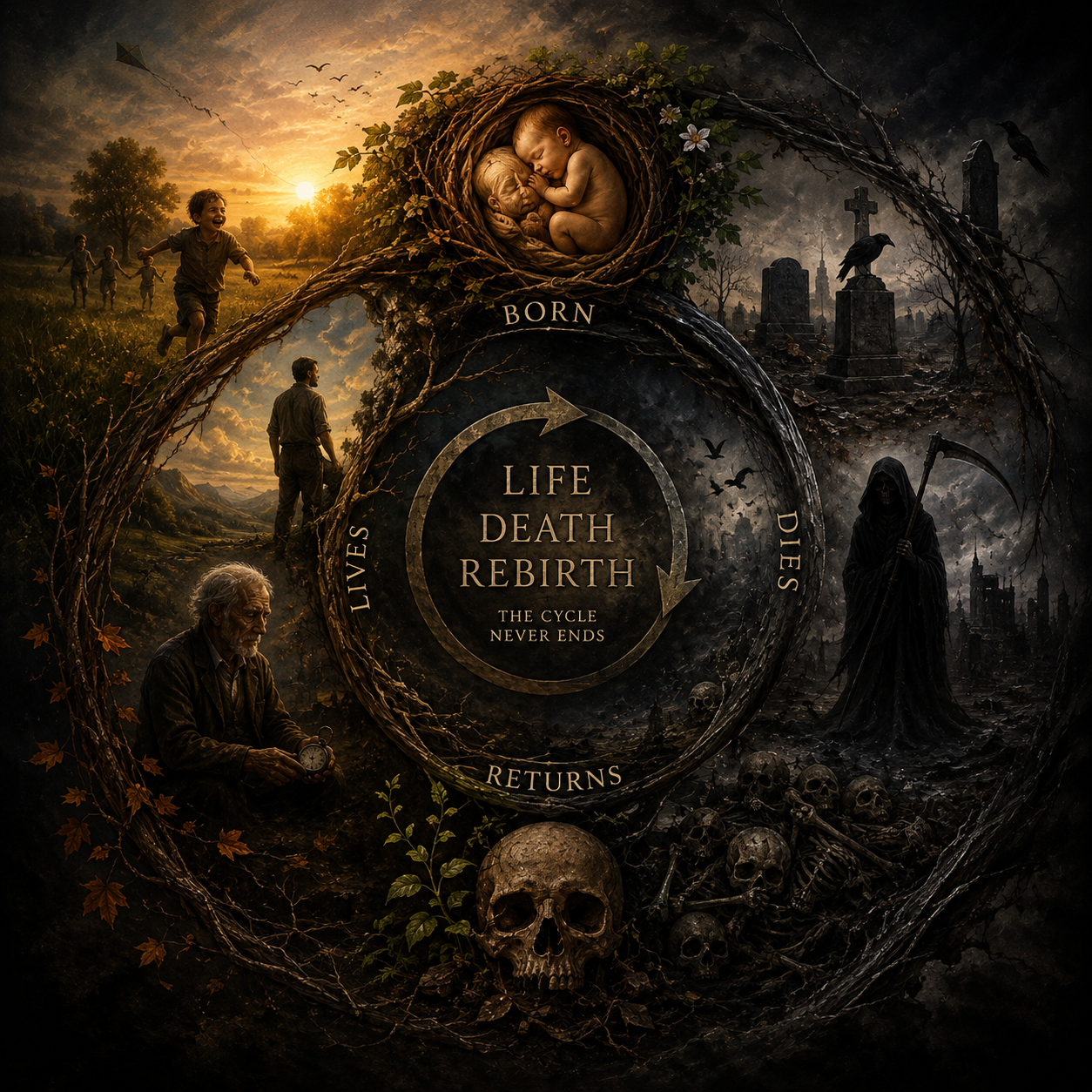
“Where, O death, is your victory? Where, O death, is your sting?”
–1 Corinthians 15:55 (Holy Bible)
Death: A Cultural, Religious, and Historical Summary
Death is the permanent end of the biological functions that sustain a living organism and is one of the few universal experiences shared by all forms of life. Throughout history, death has profoundly shaped human civilization, influencing religion, philosophy, law, medicine, art, literature, and culture. Every society has developed customs and beliefs to understand death, honor the deceased, comfort the living, and address questions about what, if anything, lies beyond mortal life. Although scientific understanding explains death as a biological process, cultural and religious traditions have given it deep spiritual, moral, and symbolic significance for thousands of years.
Historical Perspectives
Human societies have reflected upon death since prehistoric times.
Archaeological discoveries show that early humans intentionally buried their dead tens of thousands of years ago. Many of these ancient burials included tools, ornaments, flowers, food, or ceremonial objects, suggesting beliefs that death held meaning beyond the physical end of life.
As civilizations developed, elaborate funeral customs emerged throughout the world.
The Ancient Egyptians practiced mummification, believing that preserving the body prepared the individual for the afterlife. Monumental tombs, including the pyramids, were constructed as eternal resting places for rulers and nobles.
The Greeks viewed death as a journey to the underworld, where souls were judged and entered different realms according to their earthly lives. Funeral rites were considered essential to ensuring a proper passage into the next world.
The Romans honored ancestors through memorial ceremonies and maintained both burial and cremation traditions during different periods of their history.
Throughout the Middle Ages, death profoundly influenced daily life because of disease, famine, and war. Art and literature frequently explored mortality through themes such as the “Dance of Death” (Danse Macabre), reminding people that death comes to all regardless of wealth or social status.
Modern medicine, public health, and advances in sanitation have greatly extended life expectancy in many parts of the world, but death remains an inevitable part of the human experience.
Religious Perspectives
Nearly every major religion offers teachings concerning death, the soul, and what follows earthly life.
Christianity
Christianity teaches that death entered the world through humanity’s fall into sin but that eternal life is offered through Jesus Christ. Most Christian traditions believe the soul continues after physical death and emphasize resurrection, final judgment, and eternal life in the presence of God. Funeral services commonly focus on hope, remembrance, and the promise of resurrection.
Judaism
Judaism views life as a sacred gift from God. While Jewish traditions differ regarding the afterlife, many believe in the immortality of the soul and a future resurrection. Funeral customs emphasize honoring the deceased, comforting mourners, and respecting the body through prompt burial and periods of communal mourning such as shivah.
Islam
Islam teaches that death marks the transition from earthly life to the eternal life of the Hereafter. Muslims believe every soul returns to God and will ultimately face divine judgment. Funeral rites emphasize simplicity, dignity, prayer, and burial, reflecting the belief that life is temporary while the soul’s relationship with God continues.
Hinduism
Hinduism teaches that death is one stage within the continuous cycle of birth, death, and rebirth (samsara). A person’s actions (karma) influence future rebirths. The ultimate goal is moksha, liberation from this cycle and union with the ultimate reality. Cremation is traditionally practiced as part of releasing the soul from its earthly body.
Buddhism
Buddhism teaches that death is a natural transition within the cycle of rebirth. Rather than viewing death as an absolute ending, it represents one phase in an ongoing process influenced by karma. The ultimate objective is attaining nirvana, liberation from suffering and the cycle of rebirth.
Cultural Significance
Every culture has developed rituals that help families and communities respond to death.
These traditions often include:
- Funeral ceremonies.
- Memorial services.
- Burial or cremation.
- Periods of mourning.
- Prayers or religious observances.
- Visiting graves.
- Annual remembrance days.
- Honoring ancestors.
Many cultures celebrate the lives of the deceased while acknowledging grief and loss.
For example, Mexico’s Día de los Muertos (Day of the Dead) honors deceased loved ones through family gatherings, decorated altars, music, flowers, and traditional foods. Rather than fearing death, the celebration emphasizes remembrance and the enduring bond between generations.
In East Asia, ancestral remembrance ceremonies remain central to many family traditions, reflecting deep respect for previous generations and cultural continuity.
Funeral Customs
Funeral practices vary widely according to religious beliefs, cultural traditions, geography, and personal preference.
Common methods include:
- Burial.
- Cremation.
- Entombment.
- Sea burial.
- Natural or “green” burial.
- Ash scattering.
- Memorial gardens.
- Columbariums.
Modern funeral practices increasingly incorporate personalized ceremonies reflecting the individual’s beliefs, accomplishments, personality, and legacy.
Death in Art and Literature
Death has inspired some of history’s greatest artistic and literary works.
Artists have depicted death through symbols such as:
- Skulls.
- Hourglasses.
- Candles.
- Ravens.
- Autumn leaves.
- Empty chairs.
- Wilted flowers.
These images often remind viewers of life’s temporary nature.
Writers including William Shakespeare, Dante Alighieri, John Milton, Emily Dickinson, Leo Tolstoy, and Edgar Allan Poe explored themes of mortality, grief, remembrance, and the search for meaning beyond death.
Music, poetry, painting, sculpture, and film continue examining death as both a personal experience and a universal mystery.
Social Importance
Death shapes families, communities, and societies in profound ways.
It influences:
- Family traditions.
- Inheritance and legal systems.
- Healthcare decisions.
- Ethical discussions.
- Religious practices.
- Community support.
- Historical memory.
Grieving rituals provide emotional support, preserve memories, strengthen family bonds, and help communities honor those who have died.
Healthcare professionals, clergy, counselors, and hospice organizations often assist individuals and families in navigating end-of-life care and bereavement.
Philosophical Perspectives
Philosophers have debated the meaning of death for thousands of years.
Some view death as the natural completion of life, while others see it as a transition to another form of existence. Existential philosophers have argued that awareness of mortality gives life urgency and encourages people to seek purpose, authenticity, and meaningful relationships.
Questions surrounding consciousness, the soul, morality, and the possibility of an afterlife remain among humanity’s oldest and most enduring philosophical discussions.
Symbolic Meaning
Across cultures and literature, death symbolizes far more than physical mortality. It often represents endings, transformation, sacrifice, change, renewal, and the completion of one stage before another begins.
Many traditions use death symbolically to describe the end of harmful habits, outdated beliefs, relationships, or life chapters, emphasizing that endings frequently create opportunities for growth and renewal.
These symbolic meanings should be understood as cultural, philosophical, and literary interpretations rather than statements about biological death itself.
Conclusion
Across history, religion, and culture, death has remained one of humanity’s most significant and deeply contemplated experiences. It has inspired rituals of remembrance, religious teachings, artistic masterpieces, and philosophical reflection while shaping societies across every continent and era. Although beliefs about what follows death differ greatly among cultures and faiths, nearly all traditions emphasize honoring the deceased, supporting the living, and recognizing the preciousness and finite nature of human life. In this way, death serves not only as life’s inevitable conclusion but also as a powerful reminder of memory, legacy, compassion, and the enduring search for meaning.

Sigmund Freud on Experiencing Death Within Dreams

Sigmund Freud did not regard experiencing death in a dream as a literal prediction of physical death. He treated dream images as psychological constructions whose meanings must be discovered through the dreamer’s personal associations, recent experiences, childhood memories, unconscious wishes, fears, and emotional conflicts.
A dream in which the dreamer dies, is murdered, attends their own funeral, becomes a ghost, or observes their dead body cannot be interpreted through one fixed definition. The same scene may express fear in one person, guilt in another, and a disguised wish for escape or change in someone else.
Freud would ask:
- How did the death occur?
- Who caused it?
- What happened immediately before it?
- What emotion accompanied it?
- What changed because the dreamer died?
- Did the dreamer truly disappear, or remain present as an observer?
- Who attended the funeral?
- Who benefited from the death?
- What waking-life conflict resembles the dream’s emotional atmosphere?
The answers would lead from the visible dream of death to the concealed thoughts that produced it.
Manifest and Latent Content
Freud distinguished between the manifest content and latent content of a dream.
The manifest content is the dream as remembered: being shot, drowning, falling from a building, receiving a fatal diagnosis, lying inside a coffin, or watching one’s own funeral.
The latent content consists of the hidden wishes, memories, emotions, and conflicts represented by those events.
The dream may appear to concern physical death while its actual psychological subject is:
- Escape from responsibility.
- The ending of a relationship.
- Fear of losing one’s social position.
- Guilt over a forbidden wish.
- Anxiety about aging or illness.
- A desire to abandon an old identity.
- Fear of punishment.
- Grief following the death of another person.
- The wish to be noticed, mourned, or appreciated.
- A traumatic experience being repeated during sleep.
Freud held that dreams are meaningful mental structures, but their meaning is commonly disguised through condensation, displacement, reversal, symbolism, and other operations of dream-work.
The Difficulty of Imagining One’s Own Death
Freud argued that people cannot fully imagine their own nonexistence. Whenever a person attempts to imagine being dead, some part of that person remains present as an observer of the scene.
This problem appears clearly in dreams. The dreamer may die but continue watching events. They may observe their own body, listen to people discussing their death, attend their funeral, or travel through an afterlife.
Freud wrote that when people attempt to imagine their own death, they discover that they continue to exist as spectators. He connected this with his view that, at an unconscious level, people behave as though they are immortal.
A dreamer may therefore experience:
- Being dead while still thinking.
- Watching others discover the body.
- Hearing what people say at the funeral.
- Feeling trapped inside a corpse.
- Becoming an invisible spirit.
- Returning after everyone believes they are dead.
- Observing life continue without them.
The continued presence of the observing dreamer shows that the dream has represented the event of death without successfully representing complete nonexistence.
Death as Disappearance or Absence
For Freud, the concept of death in childhood is often closer to disappearance than to a mature understanding of biological finality. A young child may understand being dead as being gone, absent, or no longer interfering with those who remain.
That early meaning can remain active in adult dreams. Experiencing death may therefore express a wish to disappear from a difficult situation rather than a literal wish for physical death.
The dreamer may unconsciously wish to become absent from:
- An exhausting occupation.
- A troubled marriage.
- Financial obligations.
- Family conflict.
- Public embarrassment.
- Legal difficulties.
- Social expectations.
- A demanding role.
- A painful memory.
- A responsibility that feels impossible to fulfill.
Example
A person overwhelmed by work dreams of dying suddenly at their desk. After the death, everyone stops demanding things from them.
The death may represent escape from pressure. The essential feature is not the loss of life but the end of the demands. The dream accomplishes through death what the dreamer feels unable to accomplish consciously through resignation, rest, refusal, or boundary-setting.
Death as Disguised Wish Fulfillment
Freud maintained that dreams commonly fulfill wishes, although the wish may be disguised, distorted, or accompanied by anxiety.
A dream of one’s own death may fulfill a wish when death produces a desired result.
The dream may allow the dreamer to:
- Escape an obligation.
- End a conflict without making a decision.
- Punish people by making them feel guilty.
- Discover who truly cares.
- Receive attention and sympathy.
- Avoid an anticipated failure.
- Leave an unhappy situation.
- Return in a stronger or transformed form.
- Force estranged relatives to reunite.
- Make another person regret their behavior.
The apparent horror of the death does not exclude the possibility of hidden satisfaction. The analyst would ask what advantage the dreamer receives from dying within the dream.
Example
A dreamer attends their own funeral and watches an emotionally distant partner cry uncontrollably.
The dream may fulfill a wish to see proof of the partner’s love. The dreamer’s death creates a situation in which affection, regret, and grief can no longer be withheld.
The latent wish may be: “I want this person to recognize my importance.”
Example
A student dreams of dying the night before an examination.
The dream may express fear of failure, but it may also create an escape from the examination. Death becomes an extreme excuse that releases the student from being tested.
Death as an End to an Identity
Experiencing death may represent the ending of a particular role or identity rather than the destruction of the entire person.
The dreamer may be leaving behind:
- Childhood dependence.
- A former occupation.
- A marriage.
- A public reputation.
- A family role.
- A period of illness.
- An earlier ambition.
- A submissive identity.
- An idealized image of oneself.
- A way of life that is no longer sustainable.
Freud would not automatically interpret death as spiritual transformation. He would examine what concrete person, role, relationship, or wish has become attached to the dying dream-self.
Example
A recently promoted employee dreams that their former self dies and is buried beneath the old workplace.
The death may represent separation from an earlier professional identity. It could also express guilt about surpassing coworkers or fear that success requires abandoning a familiar version of the self.
Death and Unconscious Guilt
Some death dreams may operate as punishment dreams. Freud explained that a punishment dream can satisfy the dreamer’s unconscious sense of guilt by imposing a penalty for a forbidden wish or impulse.
A dreamer may unconsciously believe they deserve punishment because of:
- Hostility toward a loved person.
- Sexual desire considered unacceptable.
- Dishonesty.
- Betrayal.
- Envy.
- Failure to fulfill a duty.
- Relief after another person’s death.
- A wish to escape family obligations.
- Anger toward a parent or child.
- Success achieved at someone else’s expense.
The dreamer may then be arrested, condemned, killed, buried, or sent into a frightening afterlife.
Example
A person conceals an affair and dreams of being sentenced to death in a public courtroom.
The execution may represent unconscious guilt and fear of exposure. The courtroom gives external form to the dreamer’s internal moral judgment.
The identity of the judge may be important. If the judge resembles a parent, spouse, religious authority, or employer, that person may represent the source of the dreamer’s internalized judgment.
Being Murdered
A dream in which another person kills the dreamer may represent a conflict with that person, fear of their influence, or the feeling that the relationship is destroying some part of the dreamer’s life.
The killing may express:
- Fear of domination.
- Emotional betrayal.
- Loss of independence.
- Anger that has been reversed and directed against the dreamer.
- Guilt over hostility toward the attacker.
- Fear of punishment.
- A wish to end the relationship without accepting responsibility.
- The belief that another person is changing the dreamer’s identity.
Freud’s method would require careful attention to who performs the killing.
Killed by a Parent
Being killed by a parent may involve fear of authority, unresolved childhood conflict, guilt over hostility toward the parent, or anxiety about disappointing them.
It could also represent the feeling that parental expectations are preventing the dreamer from living independently.
Killed by a Partner
Being killed by a spouse or romantic partner may reflect fear of emotional betrayal, loss of independence, sexual conflict, resentment, or the belief that the relationship is psychologically consuming the dreamer.
Killed by a Stranger
An unknown killer may represent a disguised person, an unrecognized part of the dreamer’s own emotional life, or a threat whose actual source has not yet been consciously identified.
Free association might reveal that the stranger’s clothing, voice, weapon, or behavior resembles someone known to the dreamer.
Killing and Reversal
Dream-work may reverse the positions of aggressor and victim. A person who unconsciously wishes to attack someone may instead dream that the other person attacks and kills them.
This reversal protects the dreamer from recognizing their own hostility. The dream presents the person as an innocent victim rather than as the source of aggression.
Example
A dreamer who secretly resents a supervisor dreams that the supervisor shoots them.
At the manifest level, the dream expresses fear of the supervisor. At the latent level, the shooting may contain the dreamer’s own aggressive wish, reversed so that the supervisor performs the act.
The interpretation would depend upon the dreamer’s associations and cannot be assumed from the scene alone.
Death by Accident
An accidental death may represent anxiety about losing control or a wish to escape responsibility for a major life change.
Because the death is accidental, no person appears consciously responsible. The accident may therefore permit an unwanted situation to end without requiring the dreamer to choose its ending.
Possible accident dreams include:
- A vehicle collision.
- An airplane crash.
- A building collapse.
- Electrocution.
- A workplace accident.
- Being struck by a falling object.
- A bridge giving way.
- Machinery malfunctioning.
Example
A person uncertain about marriage dreams of dying in a car accident while traveling to the wedding.
The dream may express fear of commitment. It may also fulfill a wish to prevent the wedding through an event for which the dreamer cannot be blamed.
The meaning would be strengthened if the dreamer feels relief rather than terror after the crash.
Falling to One’s Death
A dream of falling may be influenced by bodily sensations during sleep, anxiety, loss of support, failure, or the fear of surrendering control.
When the fall ends in death, the dream may intensify a waking fear involving:
- Professional failure.
- Loss of social status.
- Financial collapse.
- Sexual surrender.
- Abandonment.
- Humiliation.
- The consequences of taking a risk.
- Being “brought down” by another person.
The location from which the dreamer falls is important.
Falling from a workplace may concern career status. Falling from a childhood home may concern family security. Falling after being pushed directs attention toward the person who pushed the dreamer.
Waking Before Impact
The dreamer may awaken before reaching the ground because the dream’s anxiety has become strong enough to interrupt sleep.
The unfinished fall may also reflect uncertainty: the dreamer anticipates catastrophe but has not yet experienced the feared waking-life outcome.
Drowning
Drowning may represent overwhelming emotion, helplessness, bodily sensations, birth-related imagery, or the feeling of being consumed by demands.
The water’s location provides context:
- An ocean may suggest a vast and uncontrollable situation.
- A bathtub may direct attention toward privacy, sexuality, illness, or the body.
- A flooded house may concern family life.
- A sinking car may concern the dreamer’s direction or independence.
- A childhood swimming pool may revive early memories.
Drowning may also fulfill a wish for escape through surrender. The dreamer stops struggling and becomes free from the conflict that preceded the drowning.
However, Freud would not assign this meaning without the dreamer’s personal associations.
Suffocation
Dreams of dying from suffocation may incorporate actual bodily sensations such as obstructed breathing, pressure from bedding, illness, or an uncomfortable sleeping position.
Psychologically, suffocation may also represent:
- Feeling controlled.
- Being unable to speak.
- Emotional confinement.
- Excessive responsibility.
- A relationship that feels restrictive.
- Panic about losing independence.
- Fear that one’s needs cannot be expressed.
Example
A dreamer dies because an unseen force closes their throat.
The dream may concern words that the person feels unable to say. Free association could reveal an argument, secret, complaint, or confession that the dreamer has repeatedly suppressed.
The death gives extreme visual form to the feeling that silence has become unbearable.
Death From Illness
Dreaming of receiving a fatal diagnosis may reflect ordinary health anxiety, recent medical information, fear of aging, or concern about an actual bodily sensation.
It may also represent the belief that a particular emotional situation is gradually destroying the dreamer.
The specific illness may carry personal associations. A disease connected with a deceased relative may revive grief or fear of sharing that person’s fate.
Example
A dreamer is told that they have the same fatal illness that killed a parent.
The dream may express identification with the parent, fear of inherited vulnerability, unresolved grief, or the wish to remain connected with the deceased person through a shared fate.
Execution
Execution dreams often emphasize judgment, guilt, authority, helplessness, and public exposure.
Important details include:
- Who orders the execution?
- What crime is alleged?
- Does the dreamer believe they are guilty?
- Is the execution public?
- Does anyone attempt to save the dreamer?
- Is the dreamer frightened, calm, or relieved?
- Is the execution completed?
An unjust execution may reflect the feeling of being unfairly judged. A deserved execution may express guilt. A last-minute pardon may fulfill a wish for forgiveness.
Example
A dreamer is sentenced to death for a crime they cannot remember committing.
The forgotten crime may represent a repressed wish or source of guilt that the dreamer feels but cannot consciously identify. The punishment is present, while the supposed offense remains concealed.
Attending One’s Own Funeral
A dreamer who attends their own funeral has not completely disappeared. They remain present to observe the reactions of survivors.
Such a dream may fulfill wishes involving:
- Discovering who truly cares.
- Receiving praise.
- Making others regret mistreatment.
- Bringing separated relatives together.
- Escaping obligations while remaining able to watch.
- Hearing truths that people would not say while the dreamer was alive.
- Becoming the center of attention.
Example
No one attends the dreamer’s funeral.
This may express fear of abandonment or insignificance. It could also represent resentment toward others or a wish to withdraw completely from social life.
Example
Hundreds of people attend and praise the dreamer.
The funeral may fulfill wishes for recognition, admiration, and proof that the dreamer’s life matters.
Being Buried Alive
Being buried alive may represent repression, helplessness, confinement, silencing, or fear of being treated as though one no longer matters.
The dreamer may feel:
- Trapped within a relationship.
- Ignored by family members.
- Unable to defend themselves.
- Burdened by secrecy.
- Restricted by social expectations.
- Forgotten by others.
- Unable to escape a former identity.
Attempting to shout from inside the coffin may represent an urgent wish to be heard.
The person responsible for the burial may identify whom the dreamer experiences as silencing or confining them.
Observing One’s Dead Body
Seeing one’s body while remaining conscious illustrates Freud’s observation that the dreamer survives as a spectator of their own death.
The body may represent a version of the self from which the dreamer feels psychologically separated.
The dreamer may be observing:
- Their former identity.
- Their public image.
- A body associated with illness or shame.
- A younger version of themselves.
- A role they no longer wish to perform.
- A part of life regarded as emotionally dead.
Example
A dreamer sees their body wearing an old work uniform.
The dead body may represent an occupational identity that has ended or that the dreamer wishes to leave behind.
Becoming a Ghost
Becoming a ghost allows the dreamer to be absent and present simultaneously.
The ghost can observe others without being seen, return to places from which the dreamer feels excluded, or discover what happens after their disappearance.
A ghost dream may express:
- Feeling invisible.
- Emotional separation.
- The wish to observe secretly.
- Fear of being forgotten.
- Continued attachment to a former home or relationship.
- The desire to influence others without direct confrontation.
- Difficulty accepting that a period of life has ended.
Example
A ghost tries to speak to family members, but no one can hear.
The dream may represent the waking feeling that the dreamer’s needs, warnings, or emotions are being ignored.
Dying and Returning to Life
A dream in which the person dies and returns may fulfill a wish for a second chance.
The dreamer may wish to:
- Correct a mistake.
- Repair a relationship.
- Escape punishment.
- Begin life under different conditions.
- Discover who remained loyal.
- Abandon an old identity.
- Prove personal strength.
- Recover from humiliation or failure.
The return may also express the ego’s inability to imagine permanent nonexistence. Death occurs, but the observing self continues and eventually reenters life.
Feeling Peaceful While Dying
Calmness during dream death changes the meaning of the scene. The dream may express relief from tension, acceptance of an ending, surrender of responsibility, or a wish for rest.
The dreamer should ask what burden disappears at the moment of death.
Peace does not necessarily signify a waking wish to die. The desired element may be silence, rest, freedom from demands, forgiveness, or the end of a conflict.
Example
A person under extreme financial pressure dreams of lying down peacefully and disappearing while all bills blow away.
The latent wish may concern freedom from debt rather than physical death.
Terror During Dream Death
Intense fear may indicate anxiety about losing control, identity, relationships, status, health, or bodily safety.
Freud did not regard anxiety as proof that a dream lacks wish fulfillment. Anxiety may appear when an unconscious wish threatens the conscious personality or when the dream’s disguise begins to fail.
The dreamer may simultaneously desire and fear the ending represented by death.
For example, leaving a destructive relationship may be consciously frightening while also unconsciously desired. The dream may represent that conflict as death.
Death Dreams Following Bereavement
Freud acknowledged that The Interpretation of Dreams was deeply influenced by the death of his own father, which he described as one of the most significant losses in a person’s life.
After bereavement, experiencing one’s own death in a dream may reflect:
- Identification with the deceased.
- A wish to reunite with the person.
- Fear of sharing the same fate.
- Guilt about surviving.
- The recognition of one’s own mortality.
- Reenactment of memories surrounding the death.
- The wish to reverse or master the loss.
A dreamer may die in the same manner as the deceased person because the mind is attempting to understand, repeat, or identify with that experience.
Traumatic Death Dreams and Repetition
Freud later recognized that some traumatic dreams repeatedly return the dreamer to a frightening experience rather than simply disguising a pleasurable wish.
In Beyond the Pleasure Principle, he discussed traumatic dreams as attempts by the mind to revisit and gain control over an overwhelming event. He associated such dreams with repetition compulsion—the tendency to repeat distressing material that has not yet been psychologically mastered.
A person who survived an accident, assault, disaster, or medical emergency may repeatedly dream of dying during a similar event.
The dream may reproduce:
- The same place.
- The same sounds.
- The moment immediately before the danger.
- A different ending in which the dreamer dies.
- An ending in which the dreamer escapes.
- An attempt to rescue someone who was lost.
- A scene in which the dreamer finally gains control.
These dreams should not automatically be treated as disguised wishes for death. Freud’s later work specifically recognized that traumatic repetition can serve a different psychological function.
Death Instincts and Death Dreams
In his later theory, Freud proposed the existence of death instincts as part of a broader account of repetition, aggression, destruction, and the tendency of living processes to return to an earlier state.
However, it would be inaccurate to conclude that every dream of death directly expresses a death instinct.
A death dream may instead involve:
- Wish fulfillment.
- Fear.
- Guilt.
- Punishment.
- Trauma.
- Grief.
- Escape.
- Aggression.
- Bodily stimulation.
- A recent reminder of mortality.
Freud’s death-instinct theory is a broad theory of instinctual life, not a simple dictionary definition for death imagery in dreams.
Expanded Examples
The following examples are hypothetical applications of Freud’s method rather than dreams personally interpreted by Freud.
Example One: Dying at Work
A dreamer collapses and dies during a demanding shift. Afterward, supervisors express regret for having overworked them.
The dream may fulfill wishes for release, recognition, revenge, and proof that the dreamer was mistreated.
Example Two: Murdered by a Family Member
A relative kills the dreamer during an argument.
The dream may express fear of the relative, hostility toward them that has been reversed, or the feeling that family conflict is destroying the dreamer’s independence.
Example Three: Watching One’s Funeral
The dreamer watches former friends cry and apologize.
The dream may fulfill the wish that these people recognize the harm they caused and understand the dreamer’s value.
Example Four: Death Before a Public Speech
The dreamer dies immediately before walking onto a stage.
The death may represent escape from exposure, judgment, embarrassment, or possible failure.
Example Five: Buried but Still Conscious
The dreamer hears family members talking above the coffin but cannot respond.
The dream may represent feeling ignored, excluded, or unable to correct what others believe about them.
Example Six: Drowning While Others Watch
The dreamer calls for help, but companions remain on shore.
The dream may dramatize the belief that others do not recognize the dreamer’s emotional distress. It may also fulfill a hostile wish by making the observers responsible for guilt afterward.
Example Seven: Peaceful Death in a Childhood Home
The dreamer lies down in their childhood bedroom and quietly dies.
The scene may express a wish to return to childhood safety, escape adult obligations, or reunite emotionally with a parent associated with the home.
Example Eight: Returning After Death
The dreamer returns and discovers that another person has taken their job or romantic partner.
The dream may reveal fear of being replaced, forgotten, or losing one’s position during an absence.
Example Nine: Death Saves Another Person
The dreamer sacrifices their life to rescue a child or partner.
The dream may fulfill wishes to be heroic, indispensable, morally admirable, or permanently loved. It may also express guilt or excessive responsibility for another person’s wellbeing.
Example Ten: The Killer Has the Dreamer’s Face
The dreamer is murdered by an identical version of themselves.
The double may represent self-criticism, guilt, conflict between opposing wishes, or the desire to destroy an unwanted part of one’s identity.
Questions for Freudian Analysis
A Freudian examination of a death dream would ask:
- What happened during the day before the dream?
- How did the dreamer die?
- Who caused the death?
- Was the death accidental or intentional?
- What person or situation does the killer resemble?
- What responsibility ended because of the death?
- Who benefited from it?
- Who mourned?
- Who appeared indifferent?
- Did the dreamer remain as an observer?
- Was the dreamer frightened, peaceful, relieved, or curious?
- What relationship or role currently feels as though it is ending?
- Does the dreamer feel guilty about any wish or action?
- Has the dreamer recently experienced bereavement?
- Does the manner of death repeat a real traumatic event?
- What childhood memory is associated with the location?
- What secret wish is satisfied by the outcome?
- What feared punishment is carried out?
- What does “being dead” personally mean to the dreamer: disappearance, silence, rest, punishment, freedom, or transformation?
The meaning would emerge through the dreamer’s associations rather than from the death image alone.
Conclusion
Within Freudian dream theory, experiencing death in a dream does not possess one universal meaning and should not be treated as a prediction of literal death.
Because the unconscious has difficulty representing the dreamer’s complete nonexistence, the dreamer commonly survives as a spectator—watching their body, funeral, burial, or the reactions of others.
Death may represent disappearance, escape, punishment, guilt, the ending of a relationship or identity, fear of losing control, or a disguised wish to be appreciated and mourned. Being murdered may portray conflict, reversed aggression, or fear of domination. Execution may express judgment and guilt. Burial may represent repression or silencing. Becoming a ghost may reflect invisibility or continued attachment. Returning to life may fulfill a wish for a second chance.
When death dreams repeat a real accident, assault, disaster, or medical emergency, they may belong to the traumatic repetition Freud later described rather than to straightforward wish fulfillment.
The essential question is not simply why death appeared, but what the death accomplished. What ended? Who reacted? What burden disappeared? What guilt was punished? What relationship was revealed? What part of the dreamer continued to observe?
For Freud, those details provide the path from the manifest experience of death to the latent psychological conflict beneath it.
Bibliography
Freud, Sigmund. The Interpretation of Dreams. Translated by A. A. Brill. New York: Macmillan, 1913. Originally published as Die Traumdeutung in 1900. This work contains Freud’s theories of wish fulfillment, manifest and latent content, dream-work, childhood wishes, punishment, anxiety, and dreams involving death.
Freud, Sigmund. On Dreams. Translated by M. D. Eder. New York: Rebman Company, 1914. Originally published in 1901. This shorter work summarizes Freud’s theories of latent dream thoughts, condensation, displacement, dramatization, and wish fulfillment.
Freud, Sigmund. Reflections on War and Death. Translated by A. A. Brill and Alfred B. Kuttner. New York: Moffat, Yard and Company, 1918. The essay examines conscious and unconscious attitudes toward mortality, including Freud’s claim that people cannot completely imagine their own nonexistence.
Freud, Sigmund. Beyond the Pleasure Principle. Translated by C. J. M. Hubback. London: International Psycho-Analytical Press, 1922. Originally published in 1920. This work discusses traumatic dreams, repetition compulsion, punishment dreams, and Freud’s developing theory of the death instincts.
Freud, Sigmund. A General Introduction to Psychoanalysis. Translated by G. Stanley Hall. New York: Boni and Liveright, 1920. This collection of lectures explains Freud’s theories of dreams, unconscious associations, symbolism, repression, anxiety, and dream interpretation.
Carl Jung on Experiencing Death Within Dreams

Carl Jung did not regard experiencing death within a dream as an automatic prediction that the dreamer will physically die. He opposed interpreting dream images through rigid symbolic dictionaries. Instead, he instructed the interpreter to “take up the context” by examining every important image through the dreamer’s own associations, circumstances, relationships, emotions, and stage of life.
A dream in which someone dies, is murdered, enters a grave, watches their own funeral, becomes a ghost, or returns from death may therefore carry several possible meanings. It may represent the ending of an identity, the collapse of an outdated conscious attitude, confrontation with mortality, separation from a relationship, psychological transformation, or the emergence of a previously unconscious part of the personality.
For Jung, the central question would not simply be:
“What does death symbolize?”
The more useful questions would be:
- What exactly dies?
- Who or what causes the death?
- What survives?
- What happens afterward?
- How does the dreamer feel?
- What condition in waking life has reached an ending?
- What new possibility appears after the death?
The death scene must be interpreted as part of the complete psychological drama of the dream.
Death as a Psychological Image
Jung regarded dreams as spontaneous expressions of the unconscious. A dream may oppose, correct, or enlarge the dreamer’s conscious viewpoint because the unconscious possesses a degree of autonomy and does not simply repeat what the conscious mind already believes.
Death imagery may therefore appear when the dreamer’s conscious personality cannot recognize that something has ended or must change.
The dream may concern the death of:
- A former identity.
- An outdated belief.
- A social role.
- A relationship.
- A destructive habit.
- A childhood dependency.
- An unrealistic ambition.
- A public image.
- A period of life.
- A psychological defense.
- A one-sided attitude.
- A way of relating to other people.
The person may consciously insist that everything should remain unchanged. The unconscious may then present death as an unavoidable image of transition.
The dream does not necessarily say that the physical person must die. It may show that the dreamer cannot continue living psychologically in exactly the same manner.
Death and the Ego
In Jung’s psychology, the ego is the center of conscious identity, but it is not the entirety of the personality. The complete psyche also includes personal unconscious material, archetypal patterns, neglected qualities, emotional complexes, and the organizing totality Jung called the Self.
A dream of one’s own death may indicate that the ego’s familiar position has become too narrow, rigid, inflated, or disconnected from the rest of the psyche.
The dream may symbolically challenge statements such as:
- “I must always be in control.”
- “I can never appear weak.”
- “My career is my entire identity.”
- “I must satisfy everyone.”
- “My beliefs can never change.”
- “I do not need anyone.”
- “My public reputation is more important than my inner life.”
- “I already know everything about myself.”
The death of the dream-self can represent the collapse of this limited identity. What dies may not be the whole personality but the ego’s mistaken belief that it is the whole personality.
Example
A powerful executive dreams that they die alone in an empty office. Afterward, a child enters the office and opens all the windows.
The death may represent the end of an identity based entirely upon authority, achievement, and professional control. The child may symbolize a neglected possibility involving spontaneity, vulnerability, creativity, or future psychological development.
The dream’s meaning lies not only in the executive’s death but in what appears after it.
Death and Individuation
Jung used the term individuation for the natural process through which a person develops toward greater psychological wholeness. This process involves recognizing and integrating aspects of the personality that the conscious ego has neglected, denied, or projected onto others.
Jung described natural transformation as a spontaneous maturation of personality that can become visible through dreams containing rebirth symbolism and through dialogue between consciousness and an inner counterpart.
Death imagery may appear during this process because psychological growth often requires the ending of an earlier identity. The person cannot become more complete while remaining permanently attached to every former attitude, relationship, defense, or social mask.
Within such a dream, death may indicate:
- Separation from an immature identity.
- Surrender of excessive ego control.
- Recognition of the shadow.
- Withdrawal from an artificial persona.
- Acceptance of previously rejected emotions.
- Movement toward a more authentic life.
- The end of psychological stagnation.
- Preparation for a new stage of development.
Death and rebirth imagery often belong to the same symbolic process. The death removes an obsolete structure; the rebirth introduces a new possibility.
However, Jung did not claim that every dream of death automatically indicates positive transformation. Some death dreams may show fear, depression, emotional collapse, loss of vitality, or resistance to necessary change. The complete dream and the waking context determine the direction.
Death and Rebirth
Jung examined rebirth as an archetypal pattern appearing in religion, initiation, mythology, visionary experience, and psychological development. He distinguished several forms of rebirth, including renewal occurring within a person’s present lifetime and profound transformation of the individual’s nature.
In a dream, death may constitute the first part of this pattern.
The dreamer may:
- Die and awaken in a different place.
- Be buried and emerge from the earth.
- Drown and rise from the water.
- Enter a tomb and discover a child.
- Lose an old body and receive a new one.
- Be dismembered and reassembled.
- Burn and emerge unharmed.
- Become an animal, spirit, or unfamiliar person.
- Descend underground and later return to daylight.
Such imagery may represent a reorganization of personality. The dreamer’s previous conscious identity is symbolically dissolved so that another arrangement can emerge.
The meaning depends upon whether the dream ends with regeneration or remains trapped in destruction.
Example
A dreamer is placed inside a coffin. The coffin descends into the earth, but instead of being buried permanently, it opens into an underground garden.
The coffin may represent an ending, while the garden suggests life developing in a place the conscious ego previously regarded only as dark or frightening. The dream may be showing that withdrawal, grief, or temporary loss contains an undeveloped possibility.
Death as Compensation
Jung believed dreams often have a compensatory function. They can correct or balance an excessively one-sided conscious attitude.
A person who behaves as though they are invulnerable may dream of dying helplessly. Someone obsessed with death may dream of surviving a fatal event. A person who refuses to let go of the past may dream of a funeral. Someone who feels that life has ended may dream of resurrection.
The dream does not always confirm the dreamer’s conscious viewpoint. It may present the opposite perspective that consciousness needs.
Example: The Invulnerable Personality
A person who constantly takes risks and dismisses concern from others dreams that they die because they refuse to enter a shelter.
The dream may compensate for conscious recklessness by confronting the person with vulnerability and consequence.
Example: The Fearful Personality
A person consumed by fear of death dreams that they die, enter a dark tunnel, and discover a peaceful landscape.
The dream may compensate for conscious terror by presenting death as transition rather than annihilation. This does not establish a factual description of an afterlife. Psychologically, it may provide an image through which the person can relate to mortality with less panic.
Death and the Persona
Jung called the persona the social face or role through which a person adapts to the expectations of society. The persona may include professional identity, reputation, status, appearance, manners, or the image one presents to family and community.
A dream of death may concern the collapse of the persona rather than the entire personality.
Possible examples include:
- A uniformed version of the dreamer dies.
- The dreamer’s public photograph is placed in a coffin.
- A famous version of the dreamer is buried.
- The dreamer dies on a stage before an audience.
- The dreamer removes a mask and the masked figure dies.
- A business title appears on a gravestone.
Such dreams may indicate that the social identity no longer represents the dreamer’s inner reality.
Example
A respected community leader dreams of dying during a public ceremony. After the crowd leaves, the dreamer rises and walks into a forest wearing ordinary clothes.
The ceremonial death may represent the end of excessive identification with public approval. The journey into the forest may indicate movement toward a less familiar but more personal inner life.
Death and the Shadow
The shadow contains traits, impulses, emotions, and possibilities that the conscious personality has rejected or failed to develop. It may include aggression, fear, envy, selfishness, sexuality, vulnerability, creativity, courage, or independence.
A death dream can portray conflict between the ego and shadow.
The dreamer may be:
- Murdered by a dark stranger.
- Pursued by an unknown figure.
- Killed by an identical double.
- Dragged underground by an animal.
- Attacked by someone whose qualities the dreamer condemns.
- Sacrificed by a hidden group.
The attacker may personify qualities the dreamer refuses to acknowledge.
Being killed by the shadow does not necessarily mean that the rejected qualities should control the personality. It may mean that the conscious identity can no longer survive while completely excluding them.
Example
A person who prides themselves on always being agreeable dreams that an enraged double kills them.
The double may embody anger that the conscious personality has denied. The dream may show that permanent politeness has become psychologically lifeless and that the dreamer must learn to recognize anger, establish boundaries, and respond honestly.
Being Murdered
Being murdered in a dream may symbolize the feeling that another person, relationship, institution, or unconscious force is destroying an important part of the dreamer’s identity.
The murderer’s identity is central.
Murdered by a Parent
This may involve unresolved dependence, fear of parental authority, or the belief that family expectations prevent the dreamer from developing independently.
Murdered by a Partner
This may concern emotional domination, betrayal, loss of independence, or the ending of the personality the dreamer possessed before the relationship.
Murdered by an Employer
This may indicate that professional demands are consuming the dreamer’s vitality, values, creativity, or private identity.
Murdered by a Stranger
The stranger may represent a force not yet recognized by consciousness. The dreamer should examine the stranger’s clothing, age, behavior, voice, weapon, and emotional atmosphere.
Murdered by One’s Double
The double can portray conflict between two parts of the personality. One identity may be attempting to replace another.
Killing One’s Former Self
A dreamer may not merely experience death but actively kill another version of themselves.
This may indicate a deliberate rejection of:
- A former weakness.
- An embarrassing past.
- Childhood dependency.
- An addiction.
- A social identity.
- A previous relationship.
- An unwanted emotional quality.
- A period associated with failure.
The dream requires careful handling. The killed figure may represent something genuinely outgrown, but it may also represent an important part of the personality that the ego is trying to eliminate rather than integrate.
Example
A dreamer kills a frightened younger version of themselves because the child refuses to continue walking.
The dream may initially seem to portray strength. Yet it may reveal that the conscious personality treats vulnerability with cruelty. Psychological development may require protecting and understanding the frightened child rather than destroying it.
Falling to One’s Death
A fatal fall may portray loss of position, control, certainty, or psychological support.
The height from which the dreamer falls can identify what is endangered:
- A corporate building may concern professional status.
- A church may concern spiritual beliefs.
- A family home may concern domestic security.
- A mountain may concern ambition or achievement.
- A bridge may concern transition.
- A stage may concern public identity.
The dreamer’s response matters. Terror suggests resistance or fear. Relief may indicate that the elevated position has become burdensome.
Example
A person praised for success dreams of falling from a tower. During the fall, they feel increasingly peaceful.
The tower may represent isolation, status, or an inflated identity. The fall may signify a descent from an unsustainable position toward ordinary human life.
Drowning and Death in Water
Water frequently appears as an image of the unconscious in Jung’s work. A dream of drowning may therefore represent being overwhelmed by emotions, complexes, memories, or unconscious material.
The water’s form provides additional context:
- A calm ocean may suggest surrender to something vast.
- A violent flood may indicate emotional overwhelm.
- A dark lake may concern hidden personal material.
- A well may suggest descent into psychological depth.
- A bathtub may concern intimate or bodily experience.
- A river may represent an irreversible process of change.
Drowning can symbolize dangerous loss of ego stability, but it can also form part of a death-and-rebirth sequence when the dreamer later emerges from the water transformed.
Example
A dreamer is pulled beneath dark water and cannot breathe. At the bottom, they discover that they can breathe normally.
The first part may portray fear of the unconscious. The discovery at the bottom suggests that the feared inner world possesses conditions the conscious ego did not expect.
Burial and the Grave
Burial may represent the ending, concealment, preservation, or return of something to the unconscious.
Being buried alive may indicate:
- Feeling silenced.
- Psychological confinement.
- Suppressed individuality.
- Fear of being forgotten.
- Emotional withdrawal.
- Identification with a role that no longer allows growth.
Voluntarily entering a grave may indicate a willingness to descend into grief, memory, solitude, or unconscious experience.
Finding something alive inside a grave may show that what consciousness declared dead still possesses psychological energy.
Example
A dreamer visits their own grave and hears music coming from beneath the earth.
The grave may represent an identity believed to be finished. The music suggests that creative or emotional life continues beneath the conscious surface.
Attending One’s Own Funeral
A dreamer who watches their own funeral remains present as an observing consciousness. The dream may create distance between the ego and the identity being mourned.
Important details include:
- Who attends?
- Who does not attend?
- What do people say?
- Is the coffin open or closed?
- What name appears on the gravestone?
- Does the dreamer feel grief, anger, relief, or amusement?
- Does the dreamer attempt to communicate?
Example
The dreamer attends their funeral, but the coffin contains a business suit rather than a body.
The funeral may concern the death of a professional persona. The living dreamer remains outside the coffin, suggesting that the person is more than the social role being buried.
Example
The dreamer’s funeral is attended entirely by strangers.
The dream may indicate alienation from the people or values surrounding the dreamer’s current identity. It could also suggest that the part being buried never truly belonged to the dreamer.
Observing One’s Dead Body
Seeing one’s own dead body can symbolize separation between the observing consciousness and a former identity.
The condition of the body matters:
- A younger body may represent childhood.
- An older body may represent fear of aging.
- A body in uniform may represent occupation.
- A wounded body may represent psychological injury.
- A body without a face may represent loss of identity.
- A body resembling a parent may indicate identification with that parent.
- Several bodies may portray multiple former identities.
The dreamer should ask, “What version of me is this body?”
Becoming a Ghost
A ghost exists between presence and absence. Becoming a ghost in a dream may symbolize feeling invisible, detached, forgotten, or unable to participate fully in life.
The ghost may:
- Observe family members who cannot see it.
- Return to a former home.
- Follow a partner.
- Attempt to deliver a message.
- Wander without knowing it is dead.
- Refuse to leave a familiar place.
Such a dream may reflect attachment to a relationship, role, memory, or stage of life that has already ended outwardly.
Example
A person who recently retired dreams of becoming a ghost inside their former workplace.
The dream may show that the person’s psychological energy remains attached to the professional identity even though their official role has ended.
Death Followed by Rebirth
When death is followed by rebirth, the second image often reveals the direction of the psychological process.
The dreamer may return as:
- A child.
- An animal.
- A different adult.
- A bird.
- A plant.
- A figure of light.
- A person of another gender.
- A younger or older self.
The new form should not be assigned an automatic meaning. Its characteristics show what the psyche is attempting to develop.
Example
A controlling person dies and returns as a small bird.
The bird may represent lightness, freedom, vulnerability, perspective, or movement. The dream may compensate for a life dominated by heaviness and control.
Example
A timid dreamer dies and returns as a lion.
The lion may represent instinctive confidence, courage, authority, or aggression that has not yet been integrated.
Dismemberment
Dreams of being cut apart, dismembered, or divided may belong to an archetypal transformation pattern. Mythic and religious stories frequently portray a figure who is destroyed and then restored in another form.
Jung’s writings examine death-and-rebirth imagery as part of the struggle through which an earlier psychic organization gives way to a more complete one. His discussions of hero symbolism connect death and rebirth with the conflict between consciousness and the unconscious.
Psychologically, dismemberment may represent:
- The breakdown of a rigid identity.
- Conflict among different parts of the personality.
- Loss of psychological coherence.
- The need to examine the components of one’s life separately.
- A painful transition before reorganization.
- Feeling pulled apart by incompatible responsibilities.
A dream in which the pieces remain scattered may portray fragmentation. A dream in which they are reassembled may suggest transformation and renewed integration.
Fire and Death
Being burned to death may symbolize destruction, purification, overwhelming passion, anger, shame, or radical transformation.
The result determines much of the meaning.
- Complete destruction may indicate the collapse of an identity.
- Survival may represent resilience.
- Emergence in a new form may indicate transformation.
- Burning clothing may concern the persona.
- A burning house may concern the structure of the personality or family life.
- A fire started by the dreamer may indicate participation in the change.
Example
The dreamer burns inside a house but emerges without the title and uniform worn before entering.
The fire may destroy the social identity while leaving the deeper personality alive.
Peaceful Death
A peaceful death dream may reflect acceptance of an ending, readiness to release an identity, or a more conscious relationship with mortality.
The dreamer may be prepared to let go of:
- A relationship that has completed its course.
- A former ambition.
- A parental role.
- A period of conflict.
- A life organized around achievement.
- An identity based upon youth.
- The demand to control every outcome.
Peace does not automatically mean that the dreamer desires physical death. The dream may show that the psychological process of ending no longer requires terror.
Fearful Death
A terrifying death may show that the ego feels threatened by change, unconscious material, loss of control, or actual mortality.
The fear may arise because:
- The dreamer is resisting an unavoidable transition.
- The conscious personality feels fragile.
- An emotional complex has become overwhelming.
- The dreamer fears losing status or identity.
- A traumatic experience has been reactivated.
- The person is confronting illness, aging, or bereavement.
- The unconscious transformation is occurring too rapidly.
Jung did not advise surrendering conscious judgment to dreams. He emphasized that consciousness must continue performing its tasks and should not treat the unconscious as an infallible decision-maker.
A frightening death dream should therefore be examined thoughtfully rather than obeyed literally.
Dreams Near the End of Life
Jung believed that powerful or “big” dreams can arise during critical stages of life, including when a person is approaching death. These dreams may contain collective or archetypal imagery because they address fundamental human experiences rather than only ordinary personal conflicts.
Such dreams may include:
- Journeys to unknown countries.
- Ships preparing to depart.
- Houses being completed.
- Deceased relatives waiting.
- Gates, bridges, or doorways.
- Weddings or reunions.
- Movement toward light.
- Changes of clothing.
- Relocation to a larger home.
- Climbing a mountain.
- Entering a vast landscape.
These images should not be reduced automatically to predictions of death. Their meaning depends upon the dreamer’s age, health, emotional condition, beliefs, and associations.
For an older or seriously ill person, they may help the psyche represent mortality and continuity. For a younger person, the same imagery may concern psychological transition, travel, marriage, career change, or the ending of a former identity.
Death as the Goal of Life
In “The Soul and Death,” Jung argued that death should not be viewed only as an abrupt and meaningless termination. He treated life as a developmental curve: it rises during youth, reaches a height around midlife, and then descends toward its natural conclusion. He believed that the second half of life requires a psychological orientation toward mortality rather than a permanent attempt to preserve the attitudes of youth.
A dream of death during middle or later life may therefore concern the dreamer’s relationship with aging, purpose, completion, and the limits of earthly identity.
The dream may ask whether the person is:
- Refusing to age.
- Clinging to a youthful social identity.
- Avoiding reflection upon mortality.
- Neglecting inner development.
- Measuring life only through achievement.
- Unable to accept limitations.
- Prepared to pass experience or wisdom to others.
- Seeking meaning beyond status and possession.
Jung regarded religious images of continuation after death as psychologically significant products of the unconscious, while also acknowledging that a final metaphysical explanation of death exceeds what empirical psychology can prove.
Encounters With Deceased People
A dream in which a deceased person announces the dreamer’s death does not necessarily provide a literal prophecy.
The dead figure may represent:
- The dreamer’s continuing relationship with the deceased.
- An inherited family attitude.
- Wisdom associated with the person.
- Unresolved grief.
- Fear of sharing the person’s fate.
- A transition connected with the deceased person’s life.
- An archetypal guide appearing in a familiar form.
The dreamer should consider how the deceased person behaved while alive and what qualities they now represent.
Example
A deceased grandparent tells the dreamer, “You cannot bring that name with you.”
The message may concern the end of a family role, inherited identity, reputation, or obligation rather than physical death.
Recurring Death Dreams
Recurring death dreams may indicate that the underlying psychological process remains unresolved.
The dreamer should compare the dreams carefully:
- Does the manner of death change?
- Does the dreamer become less frightened?
- Does someone begin offering help?
- Does rebirth eventually occur?
- Does the body become younger or older?
- Does the location remain the same?
- Does the dreamer learn what must be surrendered?
- Does the dream end at a later point each time?
A developing series may show movement in the dreamer’s relationship with the underlying conflict.
For example, the dreamer may first be murdered helplessly, later confront the attacker, and eventually discover that the attacker is a neglected part of themselves. The sequence may portray increasing conscious recognition of a shadow conflict.
Expanded Examples
The following examples are cautious applications of Jung’s method. They are not fixed interpretations or dreams that Jung personally analyzed.
Example One: Death at a Wedding
The dreamer dies immediately after getting married.
The dream may indicate fear that marriage will end personal independence or a previous identity. It may also show that a solitary phase of life must end for partnership to develop.
Example Two: Death at Work
The dreamer dies at their desk while coworkers continue working.
This may portray emotional exhaustion, loss of individuality, or excessive identification with occupation. The indifference of coworkers may reflect the dreamer’s fear that the institution values the role more than the person.
Example Three: Killed by a Child
A child attacks and kills the adult dreamer.
The child may represent an undeveloped possibility, neglected vulnerability, or future-oriented part of the psyche. The established adult identity may be unable to continue without recognizing this younger element.
Example Four: Death Inside a Church
The dreamer dies before an altar.
The dream may concern the collapse of an inherited religious identity, transformation of spiritual beliefs, sacrifice of ego pride, or confrontation with something experienced as sacred.
Example Five: Death in a Childhood Home
The dreamer dies in their childhood bedroom.
The dream may involve the ending of childhood dependence, release from an old family role, or fear that personal development requires separation from the family’s expectations.
Example Six: Death Without a Body
Everyone declares the dreamer dead, but no body can be found.
This may indicate that an identity has socially ended while the deeper personality remains alive. It may also reflect uncertainty about who the dreamer is becoming.
Example Seven: Death Followed by a New Name
After dying, the dreamer receives a different name.
The new name may symbolize a changed identity or psychological orientation. Its sound, meaning, and personal associations are essential.
Example Eight: Refusing Resurrection
The dreamer is offered a return to life but refuses.
This could indicate exhaustion or resistance to returning to an old situation. It may also represent acceptance that a former identity should remain finished.
Example Nine: Death of the Shadow
The dreamer kills a threatening dark figure and then becomes emotionally numb.
The dream may warn that destroying the shadow also destroys energy, feeling, assertiveness, or creativity. Integration may be required instead of elimination.
Example Ten: Funeral Followed by Sunrise
The dreamer attends their own funeral, after which the sun rises and the mourners remove their black clothing.
The dream may portray an ending that releases new energy. The final sunrise is important because the dream resolves death through renewed consciousness.
Questions for Jungian Examination
A Jungian examination of a death dream would ask:
- What part of me died?
- What qualities did the dead figure possess?
- What was ending in waking life?
- Who caused the death?
- What qualities does the killer represent?
- What survived?
- What appeared after the death?
- Was there rebirth, light, a child, an animal, or a journey?
- Did I feel terror, relief, peace, grief, or curiosity?
- Does my conscious attitude resist change?
- Am I excessively identified with a profession, relationship, belief, or reputation?
- What rejected quality might the attacker represent?
- What social mask may have become lifeless?
- What stage of life am I entering or leaving?
- Is the dream personal or does it possess an unusually powerful archetypal atmosphere?
- What does death mean in my family, religion, or culture?
- Has bereavement, illness, aging, or trauma recently made mortality more immediate?
- Does the dream show only destruction, or does it also show transformation?
- What conscious action might honor the dream without interpreting it literally?
Conclusion
Within Carl Jung’s analytical psychology, experiencing death in a dream is not governed by one universal definition. The meaning depends upon the dreamer’s personal context, emotional response, relationships, developmental stage, and the events that follow the death.
Death may represent the ending of a persona, belief, relationship, role, habit, or outdated ego identity. It may confront the dreamer with neglected shadow material, compensate for an unbalanced conscious attitude, or mark a stage within the individuation process.
Being murdered may portray domination, conflict, or an encounter with a rejected part of the personality. Falling may indicate loss of position or control. Drowning may represent immersion in unconscious emotion. Burial may symbolize concealment, confinement, or descent into psychological depth. Becoming a ghost may portray detachment from life or attachment to something that has already ended. Death followed by rebirth may show the emergence of a new psychological form.
The most important detail is often not that death occurs, but what the death changes. A funeral may bury only a social mask. A grave may contain new life. A dead body may represent an abandoned role. A frightening descent may lead to renewal.
For Jung, death also possesses genuine importance as part of the complete course of life. The psyche may respond to aging and mortality through symbolic images of journeys, departures, transformations, reunions, and rebirth. Psychology can examine the meaning of these images without claiming certainty about metaphysical life after death.
The death dream should therefore be approached as a serious communication from the psyche—not as a fixed omen, but as an image asking what has ended, what must be released, and what is attempting to emerge.
Bibliography
Jung, C. G. “On the Nature of Dreams.” In The Structure and Dynamics of the Psyche, Collected Works of C. G. Jung, vol. 8. Translated by R. F. C. Hull. Princeton University Press. This essay presents Jung’s method of taking up the dream’s context, the autonomy of the unconscious, meaningful dreams, and the dramatic structure of dreams.
Jung, C. G. “The Soul and Death.” In The Structure and Dynamics of the Psyche, Collected Works of C. G. Jung, vol. 8, paragraphs 796–815. Translated by R. F. C. Hull. Princeton University Press. Jung examines death as part of life’s psychological development and discusses the orientation required during the second half of life.
Jung, C. G. “Concerning Rebirth.” In The Archetypes and the Collective Unconscious, Collected Works of C. G. Jung, vol. 9, part 1. Translated by R. F. C. Hull. Princeton University Press. Jung examines forms of rebirth, transformation of personality, natural maturation, and individuation.
Jung, C. G. Dreams. Translated by R. F. C. Hull. Princeton University Press, 1974. This collection draws together Jung’s major essays on dreams from volumes 4, 8, 12, and 16 of the Collected Works.
Jung, C. G. Jung on Death and Immortality. Selected and edited by Jenny Yates. Princeton University Press, 1999. The volume includes “The Soul and Death,” “Concerning Rebirth,” writings on resurrection, commentary on The Tibetan Book of the Dead, letters, and reflections upon life after death.
Jung, C. G. The Archetypes and the Collective Unconscious. Collected Works of C. G. Jung, vol. 9, part 1. Translated by R. F. C. Hull. Princeton University Press, 1969.
Jung, C. G. Symbols of Transformation. Collected Works of C. G. Jung, vol. 5. Translated by R. F. C. Hull. Princeton University Press. The work examines hero symbolism, descent, sacrifice, death, rebirth, and the struggle between conscious and unconscious forces.
Jung, C. G., and Aniela Jaffé. Memories, Dreams, Reflections. Translated by Richard and Clara Winston. New York: Pantheon Books, 1963.
Ibn Sirin on Experiencing Death Within Dreams

Within the traditional dream interpretations attributed to Ibn Sirin, experiencing death in a dream does not carry one fixed meaning. It does not automatically predict that the dreamer will physically die. Depending upon the dreamer’s health, faith, occupation, marital status, financial condition, relationships, and the details surrounding the death, it may signify longevity, travel, marriage, separation, repentance, poverty, prosperity, release from hardship, spiritual neglect, or a major change in circumstances.
The manner of death is especially important. Dying without illness is interpreted differently from dying after severe suffering. Being killed by a known person differs from being murdered by an unidentified attacker. Dying and being buried differs from dying without burial. Returning to life changes the meaning again.
The interpreter would therefore consider:
- Whether the dreamer was healthy or sick.
- Whether the body was washed or shrouded.
- Whether burial occurred.
- Whether people mourned or criticized the dreamer.
- Whether the dreamer returned to life.
- Whether another person caused the death.
- Whether the dreamer felt fear, peace, sorrow, or relief.
- What happened immediately after the death.
These circumstances determine whether the image carries a favorable warning, an unfavorable warning, or an indication of spiritual and practical change.
An Important Historical Qualification
Muhammad ibn Sirin was remembered in Islamic tradition as an early authority on dreams. However, the large dream dictionaries now circulated under his name were compiled and expanded long after his death. The work commonly called the Great Book of Interpretation of Dreams is attributed to Ibn Sirin but appears to have taken its surviving form centuries later. It is therefore historically careful to describe its contents as interpretations traditionally attributed to Ibn Sirin.
This qualification does not erase the importance of the tradition. It clarifies that the material represents a body of Islamic dream interpretation transmitted under Ibn Sirin’s authority rather than a text that can always be proven to have been written personally by him.
Not Every Disturbing Dream Requires Interpretation
In the broader Islamic framework, dreams are traditionally divided into different categories. Some may be meaningful or truthful, some may arise from a person’s waking thoughts and emotional condition, and others may be frightening experiences intended only to cause distress.
A terrifying dream of decapitation, death, entrapment, or helplessness may therefore be treated as a disturbing dream rather than as a prophecy. Islamic guidance warns against acting upon dreams that contradict religious teaching or assuming that every frightening scene contains a message about the future.
Consequently, a dream of death should not automatically create panic. Its circumstances, the dreamer’s condition, and the nature of the dream must all be considered.
Death Without Illness
The attributed tradition states that if a person dreams of dying without any apparent illness, cause, or recognizable features of a dead body, the dream may signify longevity rather than literal death.
This follows a recurring interpretive method in which an image can indicate its opposite. The absence of illness, burial, shrouding, and other signs of actual death changes the meaning.
Example
A healthy person dreams that they suddenly announce, “I am dead,” but continues standing, speaking, and moving normally.
Because the dream contains no physical signs of death, it may indicate a long life or the ending of a temporary condition rather than bodily death.
Example
The dreamer sees their name written among the dead but remains alive and healthy throughout the dream.
The image may serve as a reminder of mortality, accountability, or the passing of time while still signifying continued life.
The attributed text specifically distinguishes death without cause or the normal appearance of death from scenes involving washing, shrouding, burial, or serious illness.
Death as Spiritual Weakness
Death can also represent weakness in religious commitment or the “death” of the heart. If the dreamer dies, is washed, and is completely wrapped for burial, the scene may indicate excessive concern with worldly affairs accompanied by neglect of spiritual responsibilities.
The dream may warn of:
- Neglected prayer.
- Failure to fulfill religious duties.
- Serious wrongdoing.
- A hardened or inattentive heart.
- Pursuit of material success at the expense of faith.
- Delayed repentance.
- Moral compromise.
The image of bodily death can therefore function as a warning that the dreamer’s spiritual condition has become lifeless or dangerously weak.
Example
A wealthy person dreams of being fully washed and shrouded while people praise their financial success.
The dream may warn that worldly advancement is occurring alongside spiritual neglect. The praise concerns the dreamer’s external position, while the shroud exposes the inner danger.
Death and Accountability
Experiencing death may symbolize being called to account for a major wrong, crime, broken trust, or serious sin.
The death scene may represent the moment at which the dreamer can no longer avoid responsibility. Death pangs, judgment, questioning, or being confronted by mourners can intensify this theme.
The attributed dictionary states that suffering the pains of death may signify that the dreamer has acted unjustly toward themselves or another person.
Example
A person who has withheld another individual’s property dreams of suffering prolonged death pains while the owner watches.
The dream may warn that the unresolved injustice is spiritually and morally serious. The pain represents the burden of the wrongful act.
Example
The dreamer dies while carrying documents belonging to someone else.
The scene may concern a trust, obligation, debt, or responsibility that must be returned to its rightful owner.
Death as Marriage
One of the more surprising interpretations in the attributed tradition is the connection between death and marriage.
The deceased person is traditionally washed, perfumed, dressed, and prepared for burial. A bride or groom is likewise washed, perfumed, dressed, and prepared for the wedding. Because of this resemblance, dying and being prepared for burial can signify marriage for an unmarried person.
Dying and being buried may therefore represent:
- Entering marriage.
- Moving into a new household.
- Accepting new obligations.
- Leaving a former way of life.
- Becoming joined to another person or family.
Example
An unmarried person dreams of dying, being washed with fragrant water, and being placed in beautiful clothing rather than an ordinary shroud.
The preparations may signify an approaching marriage or significant union.
Example
A woman dreams of witnessing her own funeral procession while she is unmarried.
In the attributed funeral tradition, a woman seeing her own funeral may signify marriage. If she is already married, the same image may instead concern debts or another household obligation.
Death and Separation
For a married person, dying and being buried may indicate separation rather than marriage.
The separation could involve:
- Divorce.
- The ending of a business partnership.
- Estrangement from relatives.
- Separation from friends.
- Departure from one’s homeland.
- Leaving an occupation or community.
- A major break in an existing agreement.
The death represents the ending of the bond or arrangement in its present form.
Example
A married merchant dreams of dying and being buried beside the building where a business partner works.
The dream may concern the ending of the business partnership, particularly if there is no spouse or family imagery surrounding the burial.
Example
A person experiencing serious marital conflict dreams that their spouse seals the grave and walks away.
The scene may indicate separation, emotional abandonment, or the closing of the marital relationship.
Death as Travel
Death can signify a journey, especially when burial follows it. The deceased leaves the ordinary world, just as a traveler leaves their familiar place.
Being buried after death is sometimes associated with a long journey during which the dreamer may experience financial difficulty. Death and burial can also signify emigration, relocation, or returning to one’s homeland if the person is already living abroad.
Example
A dreamer dies, is placed in a coffin, and awakens inside a distant country.
The dream may indicate relocation, migration, or a journey that will dramatically change the dreamer’s circumstances.
Example
A person living far from home dreams of dying and being buried in their childhood town.
The dream may signify a return to the homeland or the restoration of a connection with family and origin.
Death as Freedom and Relief
For someone who is frightened, ill, sorrowful, imprisoned, oppressed, or burdened, death imagery can carry a favorable meaning.
It may signify:
- Release from fear.
- Relief from sadness.
- Recovery from hardship.
- Freedom from imprisonment.
- The conclusion of an oppressive situation.
- The end of an enemy’s power.
- Deliverance from a debt or burden.
- Escape from a dangerous opponent.
The attributed text explicitly describes death as potentially favorable for a person suffering from fear, sadness, or illness.
The favorable meaning does not necessarily suggest literal death. Death represents the ending of the painful condition.
Example
A prisoner dreams that they die and walk freely through the prison walls.
The death may signify release, the termination of confinement, or the end of the conditions that have restricted them.
Example
A severely distressed person dreams of dying peacefully as chains fall from their hands.
The falling chains identify the true meaning: freedom from whatever has caused the distress.
Sudden Death
Discovering that one has died suddenly may signify unexpected joy or a rapid reversal of circumstances.
The surprise of sudden death corresponds with the sudden arrival of news, relief, or an event the dreamer did not anticipate.
Example
A person burdened by financial concerns suddenly dies in a dream and immediately hears people announcing that all debts have been paid.
The death may signify an abrupt ending to hardship and the arrival of relief.
This interpretation depends upon the absence of severe fear, illness, mourning, or destructive imagery. A sudden death occurring within a terrifying or violent scene may require a different reading.
Death Pangs
Experiencing the pains and struggles associated with dying may represent injustice.
The injustice may be directed toward:
- Oneself.
- A family member.
- A business partner.
- An employee.
- A creditor.
- A vulnerable person.
- Someone whose rights have been withheld.
The greater the suffering, the more serious the moral warning may be.
Example
A person dreams of struggling to breathe during death while hearing the voice of someone they have wronged.
The dream may be calling attention to unresolved injustice and the need to restore the other person’s rights.
Dying Naked
Seeing oneself dead and naked is traditionally associated with poverty, exposure, vulnerability, or loss of material protection.
Nakedness removes clothing, property, rank, and social distinction. The dreamer appears with nothing.
Example
A prosperous person dreams of dying naked in an empty street while possessions disappear.
The dream may warn of financial loss, exposure, or a condition in which wealth can no longer provide security.
Nakedness may also suggest that secrets or weaknesses will be exposed, although the financial interpretation is particularly emphasized in the attributed death entry.
The Surface on Which the Dead Dreamer Lies
The object supporting the dreamer’s dead body can change the interpretation.
Seeing oneself dead upon a mat or carpet may indicate prosperity and worldly success. Lying dead upon a raised litter may signify advancement in status or rank. Lying dead upon a bed may indicate benefits received from one’s family.
Example: Dead on a Carpet
A person dreams of lying dead upon an expensive carpet inside a large home.
The carpet may transform the death image into one of material success, comfort, or increased prosperity.
Example: Dead on a Raised Platform
The dreamer’s body is lifted above a crowd, and people look upward with respect.
The elevated position may signify advancement, authority, or public rank rather than physical death.
Example: Dead on a Family Bed
A dreamer lies dead on a bed surrounded by relatives who provide gifts.
The bed and family presence may signify support, inheritance, assistance, or benefits received from the household.
Being Carried but Not Buried
If the dreamer dies and is carried upon people’s shoulders but is not buried, the dream may signify victory over an enemy. For a person qualified to exercise authority, it may also indicate leadership or an elevated position.
The failure to complete the burial prevents the death from representing a final ending. Instead, the public lifting of the dreamer resembles elevation and recognition.
Example
A leader dreams of dying and being carried above a crowd while everyone follows willingly, but no grave is prepared.
The dream may signify increased authority or victory over opposition.
The Funeral Procession
Seeing one’s funeral can represent social position, leadership, reputation, marriage, debt, travel, or the final condition of one’s worldly conduct.
If people mourn, pray, and speak well of the dreamer, the scene may indicate a commendable conclusion, honor, or respect. If people criticize the dreamer and show no sorrow, it may warn of disgrace or a poor reputation.
Being placed in a coffin that no one carries may signify imprisonment. If people lift and carry the coffin, the dream may indicate service to a powerful authority or appointment to leadership.
Example
The dreamer watches a large funeral crowd crying and speaking well of them.
The dream may signify honor, a good reputation, or a favorable conclusion to an important undertaking.
Example
The dreamer’s coffin remains abandoned while people criticize them.
The scene may warn of isolation, damaged reputation, or conduct that will not be remembered favorably.
Example
The dreamer sits alive on top of their own coffin.
In the attributed tradition, sitting upon a coffin may signify an increase in wealth. The dreamer’s living position above the coffin changes it from an image of final death into one of worldly elevation.
Burial After Death
Burial introduces meanings that are not necessarily present in death alone.
It can signify:
- A long journey.
- Marriage.
- Separation.
- Repayment or return of a trust.
- The need for repentance.
- Spiritual confinement.
- A major commitment.
- Relocation.
If the dreamer is buried and then comes out of the grave alive, the image may signify repentance before death or escape from a difficult condition.
Example
The dreamer is buried but immediately digs upward and returns to daylight.
The return may indicate repentance, restoration, or the opportunity to correct a serious mistake.
Example
The dreamer is buried with an object entrusted to them.
The burial may warn that the trust must be returned before the matter becomes a source of accountability.
Being Buried Alive
Being buried alive carries a more severe range of meanings. It may represent imprisonment, oppression, humiliation, spiritual weakness, betrayal, debt, or punishment.
If the dreamer recognizes the person performing the burial, the attributed tradition interprets that person as potentially causing injustice, oppression, imprisonment, or serious harm.
If the dreamer survives and escapes the grave, the dream may signify deliverance from the oppressive condition.
Example
An employer buries the dreamer alive beneath a workplace.
The dream may represent oppression, unjust control, confinement, or the feeling that the employment situation is destroying the dreamer’s freedom.
Example
A creditor places the dreamer in a grave and covers it with dirt.
The image may concern unpaid debt, financial pressure, collateral, or confinement caused by financial obligations.
Example
The dreamer escapes the grave and removes the dirt from their clothing.
The escape may signify freedom from injustice, imprisonment, fear, or a condition that had appeared impossible to overcome.
The Coffin
A coffin can represent confinement, authority, movement, wealth, or a change of residence, depending upon how it appears.
Being placed in a coffin by another person may signify moving to a new home. Remaining in a coffin that no one carries may represent imprisonment. Being lifted in a coffin may indicate leadership or support given to a person in authority.
Example
The dreamer enters a coffin, but it becomes a furnished room.
The coffin may represent relocation rather than death. The transformation into a room emphasizes the meaning of a new residence.
Example
The coffin is locked and abandoned.
The scene may represent confinement, isolation, or inability to move forward.
The Shroud
A shroud may represent concealment, secrecy, moral failure, imprisonment, marriage to an unsuitable person, or preparation for death.
Being completely wrapped like a deceased person carries a more serious warning. If the head and feet remain uncovered, the attributed tradition connects the incomplete wrapping with religious failure or corruption.
The size and completeness of the shroud may also indicate the dreamer’s nearness to or distance from repentance.
Example
The dreamer is wrapped in a large shroud but struggles to uncover the face.
The scene may indicate concealment, spiritual danger, or a desire to escape a condition of wrongdoing before it becomes complete.
Example
The dreamer sees a shroud but refuses to wear it.
The refusal may indicate resistance to temptation, wrongdoing, or a dangerous relationship.
Washing the Dead Body
Seeing oneself placed upon the table where bodies are washed can carry a favorable meaning. The attributed tradition connects it with purification from sins and the payment of debts.
Washing removes physical impurity from the deceased body. Symbolically, it may represent moral cleansing, fulfilled obligations, and release from burdens.
Example
The dreamer dies owing several people money. During the washing, written debts disappear from the body.
The image may signify repayment, settlement, forgiveness, or the need to resolve financial obligations.
Example
Dirty water becomes clean as the dreamer’s body is washed.
The change may represent repentance or the correction of past conduct.
Dying and Returning to Life
Returning to life after death is generally more hopeful than remaining dead.
It may signify:
- Repentance after sin.
- Wealth after poverty.
- Relief after hardship.
- The safe return of a traveler.
- Recovery of something believed lost.
- Revival of an abandoned opportunity.
- Reconciliation after separation.
- Renewal of faith.
The attributed text states that returning to life can mean becoming financially secure after poverty, repenting, or witnessing the safe return of someone who has been away. It can also represent the recovery of a matter that had been regarded as dead or hopeless.
Example
A poor person dies and returns wearing prosperous clothing.
The dream may indicate improved financial circumstances.
Example
A person guilty of wrongdoing dies, returns, and immediately begins praying.
The return may signify sincere repentance and a second opportunity to correct one’s conduct.
Example
A long-abandoned business appears as a dead body that suddenly rises.
The dream may signify the revival of the business or another matter the dreamer had considered permanently lost.
Being Murdered
Being killed in a dream is not interpreted only as defeat.
The attributed tradition states that being killed can signify longevity and that the dreamer may receive wealth or benefit from the killer. If the killer is recognized, the dream may indicate victory over an enemy. If the killer is unknown, it may warn that the dreamer is neglecting religious duties.
Murdered by a Known Person
The dream may signify:
- Triumph over that person.
- Receiving a benefit from them.
- Wealth obtained through them.
- Resolution of a conflict.
- The reversal of an existing power imbalance.
Murdered by an Unknown Person
This may indicate:
- Neglect of prayer or religious duty.
- Lack of awareness about the source of a problem.
- Spiritual vulnerability.
- Failure to recognize one’s responsibilities.
Example
A rival kills the dreamer, but the dreamer later receives the rival’s property.
The dream may indicate eventual victory or material benefit arising from the conflict.
Example
A faceless person kills the dreamer during a neglected prayer time.
The combination may warn of religious inattention or failure to fulfill an obligation.
Slaughter and Injustice
Slaughter is treated more severely than ordinary killing. It may represent injustice committed by the person performing the slaughter.
Example
A person in authority slaughters the dreamer in front of others.
The image may represent oppression, abuse of power, humiliation, or public injustice.
Blood flowing from the victim can also be associated with slander or serious damage to the victim’s reputation.
Suicide Within the Dream
The attributed material contains different interpretations depending upon the intention and circumstances.
Killing oneself out of fear over the consequences of one’s sins may signify sincere repentance. In another context, deliberate suicide may represent rebellion, disobedience, or serious wrongdoing.
These variations demonstrate why the complete dream must be considered rather than applying one definition automatically.
Example
The dreamer regrets a serious act and dies while asking God for forgiveness.
The scene may represent repentance and the desire to end the sinful conduct.
Example
The dreamer kills themselves defiantly while rejecting every warning.
The image may represent rebellion, refusal of guidance, or persistence in wrongdoing.
A disturbing dream involving suicide should not be treated as a command or prediction. If it reflects waking thoughts of self-harm, immediate real-world support is more important than symbolic interpretation.
Death as a Martyr
Dying as a martyr may signify profit, fulfillment of a promise, business success, honor, or the acceptance of testimony.
The dream emphasizes sacrifice, truthfulness, endurance, or receiving a reward after hardship.
Example
The dreamer dies while protecting innocent people and is afterward honored.
The dream may signify respected service, fulfillment of a commitment, or success obtained through personal sacrifice.
The Death of Family Members
Although the dreamer may not personally die, the deaths of relatives can indirectly describe the dreamer’s condition.
In the attributed tradition:
- The death of a son may signify escape from an enemy.
- The death of a daughter may signify despair concerning relief.
- The death of brothers may represent the defeat of enemies or preservation of wealth.
- The death of a wife may signify bankruptcy or loss of livelihood.
- The death of a mother may signify loss of worldly comfort or neglect of important duties.
- The death of a relative may signify reduced ability or weakening support.
These interpretations are contextual symbols, not reliable predictions that the relatives will literally die.
Example
A merchant dreams that their wife dies at the entrance of the business.
Because the wife’s death is associated in the tradition with loss of livelihood, the location strengthens a possible warning about business or income.
Example
The dreamer’s son dies while an enemy flees.
The combined scene may indicate deliverance from opposition or danger.
A Deceased Person Dying Again
If a person who is already dead dies again in the dream, the behavior of the mourners changes the interpretation.
If there is sorrow but no excessive screaming, the scene may signify marriage among the deceased person’s descendants or relatives. If the dream contains intense screaming, destructive mourning, or severe distress, it may warn of hardship affecting the family.
Example
A deceased grandfather dies again while family members quietly gather and later prepare a wedding meal.
The dream may concern an approaching marriage or joyful family gathering.
Experiencing Death and Hearing the Reactions of Others
The words and behavior of people after the death reveal the dreamer’s reputation and relationships.
Praise may signify honor or a commendable conclusion. Criticism may warn of damaged reputation. Indifference may reveal isolation or neglected obligations.
Example
The dreamer dies, but coworkers continue as though nothing happened.
The dream may indicate that the dreamer’s occupational role is insecure, unappreciated, or replaceable.
Example
People whom the dreamer helped gather to pray and speak kindly.
The scene may signify a good reputation, respected service, or a favorable conclusion to an undertaking.
Expanded Examples
The following examples apply principles found in the traditional material. They are hypothetical illustrations rather than recorded interpretations personally delivered by Ibn Sirin.
Example One: Death Without Burial
A healthy person dreams of dying while remaining unwashed and unburied.
The absence of ordinary death rites may indicate longevity, victory, or a change that does not become final.
Example Two: Death Followed by Marriage Preparations
An unmarried dreamer dies, is washed with perfume, and awakens at a wedding.
The shared preparation of the deceased and the bride or groom may indicate marriage.
Example Three: Death and Return From Poverty
A poor dreamer dies in torn clothing and returns wearing clean garments while carrying money.
The return may signify improved financial circumstances after hardship.
Example Four: Buried by an Employer
The dreamer’s supervisor buries them alive beneath heavy work equipment.
The dream may indicate oppression, injustice, imprisonment by obligation, or severe pressure connected with employment.
Example Five: Escaping the Grave
The dreamer is buried for wrongdoing but pushes away the soil and comes out alive.
The escape may signify repentance, correction, or deliverance before the consequences become final.
Example Six: Funeral With Praise
The dreamer sees a large procession in which people pray and speak respectfully.
The dream may indicate honor, leadership, or a commendable reputation.
Example Seven: Funeral With Criticism
The mourners refuse to pray and describe the dreamer’s wrongdoing.
The scene may warn that current conduct will lead to disgrace unless it is corrected.
Example Eight: Murdered by a Rival
A rival kills the dreamer, but afterward the dreamer inherits the rival’s position.
The death may indicate victory, benefit, or wealth obtained through the person who appeared as the killer.
Example Nine: Death Pangs Before Returning Property
The dreamer suffers intense death pains until returning an entrusted object.
The dream may concern injustice, broken trust, or an obligation that must be fulfilled.
Example Ten: Dead on a Carpet
The dreamer lies dead on a beautiful carpet inside a prosperous house.
The carpet may indicate worldly success, comfort, or increasing wealth.
Example Eleven: Dead and Naked
The dreamer dies without clothing while possessions are taken away.
The scene may warn of poverty, exposure, or loss of material security.
Example Twelve: Death in a Foreign Country
A traveler dies abroad, is buried, and then rises in their homeland.
The dream may signify the completion of a journey and a safe return home.
Example Thirteen: Washed and Released From Debt
The dreamer is washed after death while creditors erase their name from written accounts.
The washing may signify payment of debts and purification from burdens.
Example Fourteen: The Dead Dreamer Is Carried Above a Crowd
The dreamer is lifted upon people’s shoulders but never buried.
The scene may signify leadership, victory, elevated status, or public recognition.
Example Fifteen: Returning After Spiritual Neglect
The dreamer dies after abandoning prayer, returns to life, and enters a mosque.
The return may signify repentance and restoration of religious commitment.
Questions for Interpretation
A careful examination of a death dream would ask:
- Was the dreamer healthy or sick?
- Did death occur suddenly or through illness?
- Were there visible signs of a dead body?
- Was the dreamer naked, clothed, or shrouded?
- Was the body washed?
- Was the dreamer placed on a bed, carpet, litter, or bare ground?
- Was there a coffin?
- Did burial occur?
- Did the dreamer escape from the grave?
- Who caused the death or burial?
- Was the killer known?
- Did the dreamer return to life?
- Did people mourn, pray, praise, criticize, or ignore the dreamer?
- Was the dreamer married or unmarried?
- Was the dreamer poor, wealthy, afraid, imprisoned, sick, or traveling?
- Did the death end a burden or create a benefit?
- Was there an unpaid debt, broken trust, injustice, or neglected duty?
- Did the dream produce fear, peace, shame, relief, or joy?
- Did recent waking thoughts, grief, illness, or fear influence the dream?
The interpretation depends upon the complete pattern rather than the presence of death alone.
Conclusion
Within the traditional interpretations attributed to Ibn Sirin, experiencing death in a dream is a complex image whose meaning depends upon its details.
Death without illness or the normal features of a dead body may signify longevity. Death accompanied by complete washing and shrouding may warn of spiritual weakness or excessive worldly involvement. Death and burial may signify marriage, travel, separation, freedom, repayment of a trust, or the need for repentance.
Being buried alive may indicate oppression, imprisonment, debt, betrayal, or religious decline. Escaping the grave can signify deliverance or repentance. Dying naked may warn of poverty, while lying dead upon a carpet may signify prosperity. Being carried without burial may indicate victory or leadership.
Being murdered by a known person may signify eventual triumph or benefit received through that person. An unknown killer may warn of neglected religious duties. Death pangs may point toward injustice. Washing the dead body may represent purification and the payment of debts.
Returning to life is among the more favorable images. It may signify repentance, wealth after poverty, relief after adversity, the return of a traveler, or the revival of something believed permanently lost.
The essential question is not simply, “Did the dreamer die?” The interpreter must determine what accompanied the death, what ended because of it, what happened afterward, and whether the dream concluded in burial, confinement, relief, repentance, honor, or renewed life.
Bibliography
Al-Akili, Muhammad M. Ibn Seerin’s Dictionary of Dreams According to Islamic Inner Traditions. Philadelphia: Pearl Publishing House, 1992. This modern English compilation contains the extensive entries on death, killing, burial, funerals, shrouds, graves, and encounters with deceased people.
Ibn Sirin, Muhammad. The Interpretation of Dreams. London: Dar al-Taqwa, 1994. This English-language edition is published under Ibn Sirin’s name and contains traditional Islamic interpretations involving death, burial, relatives, religion, repentance, livelihood, and the dead.
Mavroudi, Maria. A Byzantine Book on Dream Interpretation: The Oneirocriticon of Achmet and Its Arabic Sources. Leiden and Boston: Brill, 2002. This scholarly study examines the development and transmission of medieval Arabic dreambooks and provides important historical context for works attributed to Ibn Sirin.
The Great Book of Interpretation of Dreams. Traditional Arabic dream manual attributed to Ibn Sirin. Its chapter structure includes death, the dead, tombs, resurrection, judgment, paradise, hell, diseases, burial, travel, marriage, and other subjects used to interpret death-related dreams. The surviving compilation appears to have taken shape centuries after Ibn Sirin’s lifetime.
Artemidorus of Daldis on Experiencing Death Within Dreams

Artemidorus of Daldis did not teach that experiencing death in a dream always predicts physical death. In the Oneirocritica, death can foretell marriage, separation, travel, freedom, imprisonment, relief from suffering, athletic victory, financial loss, public advancement, or an actual death. The correct interpretation depends upon the dreamer’s age, occupation, health, marital status, social position, location, and the exact manner in which death occurs.
Artemidorus classified significant dreams as signs of future events. Some dreams portray their outcomes directly, while others communicate through analogy, wordplay, resemblance, social custom, or reversal. He therefore considered small details essential and warned that the same dream could have different consequences for people living under different conditions.
Artemidorus of Daldis did not teach that experiencing death in a dream always predicts physical death. In the Oneirocritica, death can foretell marriage, separation, travel, freedom, imprisonment, relief from suffering, athletic victory, financial loss, public advancement, or an actual death. The correct interpretation depends upon the dreamer’s age, occupation, health, marital status, social position, location, and the exact manner in which death occurs.
Artemidorus classified significant dreams as signs of future events. Some dreams portray their outcomes directly, while others communicate through analogy, wordplay, resemblance, social custom, or reversal. He therefore considered small details essential and warned that the same dream could have different consequences for people living under different conditions.
The principal questions in a death dream are:
- Who is the dreamer?
- Is the dreamer free or enslaved?
- Is the dreamer married or unmarried?
- Is the dreamer healthy, sick, grieving, or afraid?
- Is the dreamer at home or living abroad?
- How does the death occur?
- Is the body carried away or buried?
- Does the dreamer return to life?
- Does someone else cause the death?
- What practical resemblance connects the manner of death with the dreamer’s life?
The image of death is only the beginning of the interpretation.
Death as the Completion of a Condition
Artemidorus frequently interprets death as the completion or termination of a present condition. Death ends ordinary duties, relationships, labor, movement, and legal obligations. Consequently, a dream of dying may predict that something in the dreamer’s current life will also come to an end.
What ends might be:
- Enslavement
- Marriage
- Separation from one’s homeland
- Illness
- Fear
- Grief
- A legal dispute
- A period of poverty
- A professional role
- A personal partnership
The outcome can be favorable or unfavorable. Death may release someone from suffering, but it may also remove a person from a valued relationship, position, or source of income.
Death for an Enslaved Person
For an enslaved person who does not hold a trusted position in the household, dreaming of dying, being carried out, or being buried can signify freedom. Artemidorus reasons that the dead have no master and no longer perform compulsory labor. The cessation of service in death resembles liberation from servitude.
Example
An enslaved laborer dreams that he dies and is carried beyond the gates of his master’s property.
Within Artemidorus’s system, the dream may predict freedom because the dead person has left both the master’s household and the duties previously imposed upon him.
The Trusted Servant
The same dream is unfavorable for an enslaved person who occupies a trusted or privileged position. Death may represent the loss of that trust, responsibility, or favored status.
The dream’s meaning changes because the trusted servant possesses something valuable that can “die”: access, authority, responsibility, or the confidence of the master.
Example
A household administrator dreams that he dies and others take possession of his keys.
The death may signify removal from the trusted position rather than freedom. The transferred keys make the loss of authority especially clear.
Artemidorus also records an example in which a slave dreamed that his master murdered him and was later freed. The master caused the death in the dream and likewise became the person through whom the slave’s previous condition ended.
Death for an Unmarried Person
For an unmarried person, dreaming of dying can signify marriage. Artemidorus bases this interpretation upon parallels between wedding and funeral customs. Both events mark the conclusion of one condition and entry into another. Both may involve processions, ceremonial clothing, perfumes, wreaths, attendants, and formal arrangements concerning property and family.
Death therefore represents the end of unmarried life.
Example
An unmarried man dreams that he dies, is washed, perfumed, crowned, and accompanied by a large procession.
The ceremonial details strengthen the marriage interpretation. The rites preparing him for burial resemble those preparing a bridegroom for marriage.
Example
An unmarried woman dreams that her family mourns her death but then carries her into a decorated house filled with music.
The death may indicate that her former household position is ending and that she will enter another home through marriage.
The interpretation does not arise because marriage is considered a literal death. It arises because both events permanently alter the person’s household, legal condition, relationships, and former manner of life.
Death for a Married Person
For a married dreamer, death commonly signifies separation from the spouse. The dreamer has already undergone the transition that death would signify for an unmarried person, so the image now points toward the ending of the existing union.
Artemidorus extends this principle beyond marriage. Death may also foretell separation between:
- Business partners
- Close friends
- Brothers
- Traveling companions
- People joined by an agreement
Death divides people who previously shared a common life or purpose.
Example
A married man dreams that he dies in his marital bed while his wife leaves the room carrying her belongings.
The dream may predict separation because the death occurs within the place associated with the marriage, and the wife’s departure shows the practical form the separation could take.
Example
Two business partners dream that one of them dies and that the company sign is divided in half.
The death may foretell dissolution of the partnership or a major division of their shared interests.
Death as Travel or Relocation
For a person living at home, death may signify departure for a foreign place. For someone already living abroad, death may signify a return home.
Artemidorus reasons that the dead are placed in the earth, the common homeland of humanity. The journey toward burial can therefore represent movement from one residence or country to another.
Example: Leaving Home
A person who has never traveled dreams of dying and being carried beyond the city walls.
The dream may foretell a journey, relocation, or prolonged absence from home.
Example: Returning Home
A traveler living abroad dreams that he dies and is buried in the soil of his native town.
The dream may predict his return to his homeland.
The direction of movement is essential. A person at home is removed from it, while a person already removed from home is returned to the earth associated with origin and belonging.
Death for an Athlete
For an athlete preparing to compete in sacred games, dreaming of death can signify victory. Artemidorus connects the dead and the victorious athlete through the idea of reaching completion or arriving at the final point of a contest.
The Slaughtered Young Wrestler
Artemidorus records a dream concerning the father of a young wrestler. The father dreamed that his son was slaughtered and buried in the stadium at Olympia. The dream was considered favorable because death and athletic victory both represented reaching the end or completion of the course.
The location of the burial is critical. Had the boy been buried elsewhere, the interpretation might have been different. Burial inside the Olympic stadium connected death specifically with completion in athletic competition.
Leonas the Wrestler
A Syrian wrestler named Leonas dreamed that he died, was carried for burial, and was restored to life by his trainer. He performed well in the competition but did not receive the crown because his trainer had been bribed. The dream portrayed both his apparent completion and the trainer’s decisive intervention in reversing it.
This example illustrates why Artemidorus considered every action and every person in the dream important. Revival was not simply favorable; the identity of the person producing it revealed how the outcome would be altered.
Death for Writers and Parents
Death can be favorable for writers, teachers, and people whose work will survive them. It can also be favorable for parents. Children and written works serve as memorials that continue a person’s name or influence after death.
The dream may therefore indicate:
- Producing an important written work
- Completing a book
- Gaining students or followers
- Having children
- Establishing a lasting reputation
- Creating something that outlives the creator
Artemidorus treats literary works and children as forms of continuation through which the person remains remembered.
Example
A writer dreams of dying while finished books are carried out of the house behind the funeral procession.
The dream may predict the completion or circulation of writings through which the author’s name will continue.
Example
A childless man dreams that he dies, but a young boy replaces his name upon the household records.
The death may signify fatherhood or the establishment of a descendant who will preserve the family name.
Death for the Grieving or Fearful
For someone already burdened by grief or fear, death can be favorable because the dead are no longer troubled by anxiety, uncertainty, or sorrow.
The dream may announce:
- The end of mourning
- Freedom from fear
- Resolution of a dangerous situation
- Release from emotional distress
- The disappearance of a threatening condition
- Relief after prolonged uncertainty
The death image represents the termination of suffering rather than the termination of life.
Example
A person awaiting a frightening judgment dreams of dying peacefully and awakening in a quiet field.
The dream may signify release from the fear that has dominated the person’s life.
Example
A grieving person dreams that sorrowful clothing is buried while the dreamer continues walking.
The burial may represent the ending of grief rather than bodily death.
Death for the Sick or Those in Pain
For a person suffering from illness or physical pain, dreaming of death may signify relief from the condition. Death ends bodily suffering, so the image can represent recovery or cessation of pain.
However, Artemidorus’s system remains highly contextual. In some dreams, especially when other signs reinforce the outcome, death imagery may foretell actual death. The dreamer’s health, the directness of the scene, and the surrounding symbols must therefore be considered together.
Example: Relief
A sick person dreams of dying and immediately rises free from pain.
The dream’s conclusion emphasizes recovery. The “death” belongs to the illness or painful condition.
Example: A More Serious Omen
A severely ill person dreams of being completely consumed, permanently shut inside a tomb, or prevented from returning from the underworld.
Such details make the interpretation more severe because the dream provides no restoration, release, or return.
Artemidorus records cases in which seemingly favorable or ambiguous words concealed death for sick dreamers. In one account, a sick man was told that a medical intervention would “cure” him, and he died—becoming permanently free from pain. This reflects Artemidorus’s attention to double meanings and literal fulfillment through an unexpected result.
Death in Property and Legal Disputes
Death can be favorable for someone disputing ownership of land or seeking to purchase land. The dead become permanently associated with the earth, so burial strengthens the dreamer’s claim to land.
For most other lawsuits, death is unfavorable because the dead cannot act and remain under the control of the living. The image can therefore signify defeat, loss of legal power, or inability to continue the case.
Example: Land Dispute
A person contesting ownership of a field dreams of dying and being buried in that exact field.
The dream may indicate success because the body’s permanent placement in the land mirrors secure possession.
Example: Other Litigation
A person involved in a financial lawsuit dreams of dying while the opposing party carries away all documents.
The dream may predict defeat or loss of control over the proceedings.
The object of the legal dispute determines whether the association with death is advantageous or harmful.
Self-Caused Death
When the dreamer causes their own death, Artemidorus interprets the outcome as something that will occur through the dreamer’s own actions.
The image does not necessarily concern literal self-destruction. It may show that the dreamer will personally create the ending, transition, gain, loss, marriage, separation, or release represented by death.
Example
An unmarried person dreams of deliberately entering a tomb and closing the door.
If the death signifies marriage, the self-caused action may indicate that the dreamer will initiate the relationship or voluntarily accept the union.
Example
A business owner dreams of causing their own ceremonial death and then sees the company divided.
The dream may indicate that the owner will personally end, restructure, or sell the business.
The manner in which the dreamer acts can reveal whether the predicted change is voluntary, impulsive, honorable, concealed, or public.
Being Killed by Another Person
When another person kills the dreamer, the predicted outcome comes through that person or through someone represented by them.
The killer may become the agent of:
- Freedom
- Separation
- Financial loss
- Marriage
- Dismissal
- Advancement
- Relocation
- Public exposure
- Release from a former condition
The act is interpreted relationally. Artemidorus asks not only what death means but who has the power to bring about the corresponding change.
Example
A supervisor kills the dreamer in the workplace.
The supervisor may become the agent through whom the dreamer’s employment ends, changes, or advances.
Example
A romantic partner kills an unmarried dreamer during a wedding procession.
The partner may become the person through whom unmarried life ends.
Example
A master kills an enslaved person.
The master may become the person who grants freedom, as in the case recorded by Artemidorus.
Death Following a Judicial Sentence
Death imposed through a formal sentence strengthens the dream’s outcome. Artemidorus treats judicial condemnation as an authoritative confirmation of whatever the particular form of death signifies.
If the underlying omen is favorable, the sentence can make the favorable outcome more certain or publicly recognized. If it is unfavorable, the sentence intensifies the danger, loss, punishment, or compulsion.
The form of execution then supplies an additional layer of meaning.
Being Hanged
Hanging represents pressure, constraint, suspension, elevation, and removal from the ground.
Artemidorus connects it with:
- Oppression or pressure
- Confinement
- Departure from one’s present residence
- Loss of connection with land
- Elevation that may be favorable or unfavorable
- A condition in which the dreamer cannot act freely
Because the hanged person no longer touches the earth, the dream may predict that the dreamer will not remain in the current home or country.
Example
A person dreams of being hanged above the road leading out of town.
The dream may signify compulsory departure, relocation, or inability to remain in the present place.
Example
A person under severe authority dreams of hanging while heavy weights pull downward.
The dream may portray pressure, restriction, or oppression imposed by that authority.
The dreamer’s social position and the location of the hanging determine whether elevation brings honor or danger.
Slaughter and Sacrifice
Dreaming of being slaughtered generally carries the same foundational meanings as dying, but Artemidorus says that the predicted result may occur more quickly.
The place of slaughter is especially important. Being sacrificed at an altar, marketplace, public assembly, or other prominent location can be favorable, particularly for an enslaved person. Public sacrifice creates visibility, ceremony, and honor. For the enslaved, it can signify a conspicuous or honorable liberation.
Example
An enslaved person dreams of being ceremonially sacrificed before an assembled city.
The dream may predict public manumission or another visible elevation in status.
Example
An athlete dreams of being slaughtered inside the stadium.
The location associates the death with completion and victory in the contest.
Example
A private person is secretly slaughtered in a locked room.
The secluded setting may indicate an outcome occurring privately, through concealment, or without public honor.
Being Burned Alive
Artemidorus treats death by burning as resembling a lightning strike. For a sick person, it can indicate release from illness through a linguistic association between salvation and release. For a young person, burning may represent powerful irrational impulses, especially consuming erotic desire or passion.
Example: Illness
A sick dreamer is burned, but the fire removes diseased flesh and leaves the person standing.
The fire may signify relief from illness.
Example: Passion
A young person dreams that romantic desire causes flames to consume the body.
The fire may represent an overpowering passion that controls judgment and behavior.
Fire can therefore represent both destruction and intense desire. The dreamer’s health, age, and circumstances determine which resemblance is most relevant.
Crucifixion
Artemidorus gives crucifixion an unusually wide range of meanings because the image contains several visible features: wood, nails, binding, elevation, nakedness, public display, immobility, and separation from the ground.
Crucifixion for Sailors
Crucifixion is favorable for sailors. Artemidorus compares the wood and nails of the cross with a ship, while the upright structure resembles a mast. The dream may therefore predict successful sailing, secure connection with a ship, or professional benefit at sea.
Crucifixion for the Poor
It can be favorable for a poor person because the crucified figure is elevated and becomes capable of feeding many birds. The image transforms deprivation into elevation and the ability to provide nourishment.
Crucifixion for the Wealthy
For a wealthy person, crucifixion is unfavorable. The crucified person is stripped naked and loses flesh. The dream can therefore signify loss of property, wealth, bodily strength, or social protection.
Exposure of Secrets
Because a crucified person is publicly visible, the dream may indicate that secrets will be exposed. Private conduct, concealed relationships, financial matters, or wrongdoing may become known.
Marriage and Partnership
For an unmarried person, crucifixion can signify marriage because the body is bound. The union may not be especially advantageous, however, because the binding is painful and restrictive. The same reasoning may apply to friendship and business partnership.
Freedom for an Enslaved Person
Crucifixion may free an enslaved dreamer because the crucified are elevated beyond ordinary subordination. The change of physical position reflects a change in social position.
Departure From Home
Because the crucified person’s feet do not touch the land, the dream may drive someone away from home or property. It can signify exile, travel, eviction, or loss of connection with land.
Public Office
Being crucified prominently within a city can signify public office or authority appropriate to the location. Elevation and visibility become images of public rank. Artemidorus’s method permits an apparently humiliating image to become favorable when its physical features resemble the position the dreamer seeks.
Example
A politician dreams of being elevated on a cross in the central civic square while citizens gather below.
The dream may signify public office or a highly visible civic position.
Example
A wealthy merchant dreams of being stripped and crucified outside the marketplace.
The dream may warn of financial loss and public exposure.
Example
A sailor dreams of being fixed to a cross that transforms into a ship’s mast.
The dream may be favorable for travel or maritime employment.
Death by Wild Beasts
Being condemned to or killed by wild animals also changes according to the dreamer’s condition.
For a poor person, it can be favorable because the dreamer’s body feeds many creatures. The image may indicate that the person will acquire enough resources to support many dependents.
For a wealthy person, the dream may signify attacks, injustices, or losses caused by people whose behavior resembles the animals involved.
It may also signify illness because the body is torn and consumed. For an enslaved person who dies in the attack, the death may still represent freedom.
Example
A wealthy official dreams that wolves surround and consume him.
The wolves may represent aggressive people who will take portions of his property, authority, or reputation.
Example
A poor man dreams that many birds and animals feed from his body.
The disturbing image may nevertheless signify that he will gain resources sufficient to support a large household or group.
Example
An enslaved person is killed by a lion and leaves the master’s estate.
The death can indicate freedom, while the lion may identify the powerful person or force through which liberation occurs.
Decapitation
Dreaming that one’s head is removed receives one of Artemidorus’s most detailed interpretations. The head can represent parents, children, a spouse, a close friend, a household manager, a home, authority, capital, or the leading person in a hierarchy.
The meaning depends upon what functions as the “head” of the dreamer’s life.
Parents
The head can represent parents because they are the source of the dreamer’s life. Decapitation may therefore foretell the death, loss, departure, or separation of a parent.
Children
Children may also be represented because they resemble the parent in face and form. The loss of the head can consequently signify loss or separation involving offspring.
Spouse, Friend, or Household Manager
A spouse, close friend, or competent household manager may serve as the organizing “head” of the dreamer’s affairs. Decapitation can predict losing the person upon whom the household or daily life depends.
The House
Because the head contains the principal senses, it may correspond to the house that contains and protects the person. Decapitation may therefore indicate losing or leaving one’s home.
Capital and Money
For bankers, moneylenders, collectors, shipowners, and merchants, the head can represent financial capital through verbal association. Decapitation may signify loss of principal, invested money, business resources, or commercial authority.
For someone deeply burdened by debt, the same loss may be favorable because the financial “capital” or debt burden is removed.
Travel and Return
For someone living abroad, decapitation can signify returning home. The severed head falls to the ground and remains there, connecting the dreamer again with native land.
Land Litigation
It can be favorable in a dispute over land because the head falls to the earth, symbolically securing possession.
Enslaved People
For a trusted servant, decapitation can signify loss of trust because the person is separated from the master represented by the head. For other enslaved people, it may signify freedom because the connection between head and body resembles the relationship between master and servant.
Danger That Has Already Occurred
Artemidorus sometimes reasons that a person facing a possible death sentence may benefit from dreaming that the execution has already occurred. The same event cannot happen twice in exactly the same manner, so the dream can signify escape from the threatened punishment.
Example: The Banker
A banker dreams that a judge orders his head removed and that coins spill from the neck.
The dream may predict loss of capital or collapse of financial resources.
Example: The Debtor
A heavily indebted person dreams of losing a head made entirely of written loan agreements.
The dream may signify release from debt because the oppressive “capital” is removed.
Example: The Expatriate
A traveler living abroad dreams that the severed head rolls all the way to the doorstep of the childhood home.
The dream may predict return to the homeland.
Example: The Household
A dreamer whose family depends upon a capable spouse sees that person’s face upon the severed head.
The dream may concern separation from or loss of the spouse who organizes the household.
Artemidorus records a case in which a Greek dreamed of being beheaded four times and subsequently obtained Roman citizenship, losing his former name and civic status. The decapitations represented repeated removal of his previous identity rather than physical death.
Burial
Artemidorus generally states that simply dying, being carried out, and being buried do not always require separate interpretations. They often express the same completion of a condition.
The details surrounding burial nevertheless remain significant:
- Where is the body buried?
- Who carries it?
- Is the burial public or secret?
- Is the dreamer dead or still alive?
- Does the dreamer escape?
- Does the burial take place at home, abroad, in a stadium, or upon disputed land?
The location connects the death to the area of life in which the outcome will occur.
Being Buried Alive
Being buried alive is distinctly unfavorable. Artemidorus associates it with imprisonment, bondage, confinement, and conditions in which a person is unable to move or act freely.
Example
A person awaiting trial dreams of being buried alive beneath a locked courthouse.
The dream may predict imprisonment or severe legal restriction.
Example
A worker dreams that an employer covers them with earth beneath the workplace.
The image may represent binding obligations, oppressive control, or inability to leave the employment.
Example
A traveler is buried alive at a border.
The dream may signify detention or prevention from completing the journey.
Unlike ordinary death, which may end servitude or pain, live burial preserves consciousness while removing freedom. That distinction explains its association with confinement.
Descending to Hades
A dream of entering Hades or the underworld takes its meaning from the dreamer’s condition and whether return is possible.
For someone prosperous and living according to personal wishes, descent can signify inactivity, loss, or a decline in circumstances. The inhabitants of the underworld are cold, motionless, and unable to conduct ordinary affairs.
For someone already anxious or grieving, the underworld can signify release from sorrow because the dead no longer experience worldly cares.
Travel and Distance
Going to Hades can signify travel to a remote place. Ancient expressions associated distant departure with going to the realm of the dead.
If the dreamer returns from Hades, the dream may predict returning home from abroad. If the dreamer remains there, it may signify prolonged residence away from home.
Detention
If the dreamer wants to return but is forcibly prevented, the image may predict detention, imprisonment, prolonged illness, or, in a serious case, death.
Escape From Hades
For a sick person, escaping from Hades is favorable. It may signify survival of great danger or recovery from severe illness.
Example
A traveler descends underground, finds a road back to daylight, and emerges in the hometown.
The dream may foretell return from abroad.
Example
A sick person is dragged toward Hades but escapes through an open gate.
The dream may signify recovery from a dangerous illness.
Example
A prosperous merchant enters Hades and discovers that no one trades or moves.
The dream may warn of interruption to business, loss of activity, or declining prosperity.
Dying and Returning to Life
Revival changes the final meaning of a death dream. Death may represent an anticipated conclusion, while return to life shows that the result will be reversed, interrupted, or followed by restoration.
The identity of the person who revives the dreamer is especially important. That person may become the agent who prevents an expected outcome or restores the dreamer’s position.
The dream of Leonas illustrates this principle: his trainer revived him in the dream and later became responsible for preventing his complete athletic victory.
Example
A dismissed worker dreams of dying at the workplace and being revived by a former supervisor.
The supervisor may become the person through whom employment or professional standing is restored.
Example
An athlete dies at the finish line and is revived before receiving a crown.
The dream may indicate near-victory followed by intervention that prevents full completion.
Example
A traveler dies abroad and returns to life upon touching native soil.
The dream may predict a difficult journey ending in safe return.
Revival does not automatically cancel the death meaning. It modifies it by showing reversal, interruption, or restoration.
Watching One’s Own Funeral
Artemidorus focuses more directly upon dying, being carried out, and burial than upon the modern idea of watching one’s funeral as an invisible observer. Nevertheless, the procession, bearers, location, ceremonial treatment, and final burial would all carry interpretive weight.
A funeral procession may signify:
- Marriage for an unmarried person
- Separation for a married person
- Freedom for an enslaved person
- Travel or relocation
- Public elevation
- Athletic completion
- The ending of illness or fear
The meaning does not arise from mourning alone. It arises from the social and ceremonial features that resemble the predicted change.
Example
An unmarried dreamer walks beside their own funeral procession and recognizes wedding attendants among the mourners.
The combination strongly points toward marriage.
Example
A public official sees their body carried above a cheering crowd but not buried.
The elevation and public visibility may signify office, authority, or honor rather than death.
A Death Dream Referring to Another Person
Artemidorus recognizes that a dream apparently concerning the dreamer can sometimes be fulfilled through another closely connected person.
He records examples in which:
- A person dreamed of dying, but the father died.
- A person dreamed of being beheaded, and the father died.
- A father’s fiery destruction appeared through the dreamer’s death.
- A lover’s death in the dream was fulfilled through the dreamer because separation from the beloved was experienced as equivalent to death.
These examples follow Artemidorus’s theory of dreams with double or transferred reference. Parents, children, lovers, and other closely connected people may function as extensions or counterparts of the dreamer.
Example
A dreamer sees their own head removed while the father’s name is written upon it.
The dream may concern the father because the parent is the source and symbolic “head” of the dreamer’s life.
Example
A person dreams that they die immediately after a beloved partner leaves.
The death may be fulfilled as separation, or it may refer to the partner whose absence makes life feel ended.
This possibility makes family and relational context essential.
Encounters With Dead People
Artemidorus also examines dreams in which deceased people appear. Their behavior, their former relationship with the dreamer, and what they give or take determine the omen.
If the dead remain inactive, their meaning may follow the nature of the relationship they had with the dreamer. A beloved or beneficial person may announce something pleasant, while a hostile or harmful person may announce difficulty.
A Dead Person Taking Objects
A deceased person taking away objects commonly buried with the dead is unfavorable. Clothing, food, money, or other personal necessities carried away by the deceased can signify severe loss, illness, or death affecting the dreamer or someone connected with the object.
Example
A dead relative takes the dreamer’s clothing and refuses to return it.
Because clothing belongs intimately to the person, the dream may indicate serious danger, loss of status, illness, or death.
Example
A deceased person removes food from the family table.
The dream may concern loss of livelihood, illness within the household, or deprivation affecting the family.
A Dead Person Giving Objects
What the dead give must also be interpreted carefully. The nature of the item, the deceased person’s former relationship with the dreamer, and the usefulness or harmfulness of the gift all matter.
Artemidorus does not permit a simple rule that every gift from the dead is favorable or unfavorable. A useful object may announce benefit, while an object associated with burial, sickness, or loss may carry a darker meaning.
He records a dream in which a deceased wife arranged beds. The dream was followed by illness among members of the household because beds are required by the sick.
Expanded Examples
The following are illustrative applications of Artemidorus’s documented principles rather than dreams personally recorded by him.
Example One: An Unmarried Dreamer Dies
An unmarried person dies, is perfumed, crowned, and taken in procession to another household.
Possible meaning: Marriage and departure from unmarried life.
Example Two: A Married Dreamer Dies
A married person dies while the spouse removes the shared household possessions.
Possible meaning: Separation or dissolution of the marriage.
Example Three: An Enslaved Laborer Dies
The dreamer dies, is carried beyond the master’s estate, and is never returned.
Possible meaning: Freedom from servitude.
Example Four: A Trusted Servant Dies
The dreamer dies while another person receives the household keys.
Possible meaning: Loss of trust, authority, or privileged responsibility.
Example Five: A Sick Person Dies and Rises Healthy
The dreamer dies from illness and immediately returns without pain.
Possible meaning: Recovery or the ending of physical suffering.
Example Six: A Grieving Person Is Buried
The dreamer’s mourning clothes are placed in a grave, after which the dreamer walks away peacefully.
Possible meaning: Relief from grief.
Example Seven: An Athlete Dies in a Stadium
The dreamer is slaughtered and buried at the finish line.
Possible meaning: Victory or completion in competition.
Example Eight: A Person Is Buried Alive
The dreamer remains conscious but cannot move beneath the soil.
Possible meaning: Imprisonment, bondage, or severe restriction.
Example Nine: A Banker Is Beheaded
The dreamer’s severed head becomes a bag of money that others carry away.
Possible meaning: Loss of capital.
Example Ten: A Debtor Is Beheaded
The dreamer’s head is composed of debt records that disappear after the execution.
Possible meaning: Release from debt.
Example Eleven: A Sailor Is Crucified
The cross transforms into the mast of a ship.
Possible meaning: Favorable maritime travel or professional success at sea.
Example Twelve: A Wealthy Person Is Crucified
The dreamer is publicly stripped while possessions are distributed.
Possible meaning: Financial loss and exposure.
Example Thirteen: A Civic Candidate Is Elevated
The dreamer is crucified in the central public square while officials gather below.
Possible meaning: Public office or highly visible authority.
Example Fourteen: A Foreigner Descends to Hades
The dreamer enters the underworld but finds a road leading back to the homeland.
Possible meaning: Return from abroad.
Example Fifteen: A Sick Person Escapes Hades
The gate of the underworld closes immediately after the dreamer escapes.
Possible meaning: Survival of a serious illness or danger.
Example Sixteen: A Dead Relative Takes Clothing
A deceased family member removes the dreamer’s coat and disappears.
Possible meaning: A serious warning involving health, status, or life.
Example Seventeen: The Dreamer Is Killed by an Employer
The employer causes the dreamer’s death and then places someone else in the position.
Possible meaning: The employer becomes the agent through whom the dreamer’s employment or professional status ends.
Example Eighteen: The Dreamer Returns to Life
The dreamer dies, but a particular friend revives them.
Possible meaning: The friend may become the person through whom a loss, separation, dismissal, or failure is reversed.
Questions Required for Interpretation
An Artemidoran interpretation of experiencing death would require answers to questions such as:
- Was the dreamer enslaved, free, trusted, or subordinate?
- Was the dreamer married or unmarried?
- Was the dreamer at home or abroad?
- Was the dreamer healthy, sick, grieving, or afraid?
- What occupation did the dreamer hold?
- Was the dreamer preparing for competition?
- Was there a lawsuit, and what was being disputed?
- Did the dreamer die naturally or through execution?
- Who caused the death?
- Was the death self-inflicted within the dream?
- Was there a formal sentence?
- Was the dreamer hanged, burned, slaughtered, crucified, beheaded, or killed by animals?
- Was the body carried or buried?
- Where did the burial occur?
- Was the dreamer buried alive?
- Did the dreamer descend to the underworld?
- Did the dreamer return?
- Who restored the dreamer to life?
- Was a close relative represented through the dreamer’s body?
- Did a deceased person give or take anything?
- What practical resemblance links the dream image to the dreamer’s present circumstances?
Without these details, the statement “I dreamed that I died” would be too incomplete for a reliable interpretation under Artemidorus’s method.
Conclusion
Within Artemidorus of Daldis’s Oneirocritica, experiencing death in a dream is not governed by one universal meaning. Death represents the ending, completion, or radical change of a condition, and the dreamer’s actual circumstances determine what that condition is.
For an ordinary enslaved person, death may signify freedom; for a trusted servant, loss of position. For an unmarried person, it may signify marriage; for a married person, separation. For someone at home, it may signify foreign travel; for someone abroad, return home. For an athlete, death may signify victory. For a writer or parent, it may indicate the creation of a lasting memorial. For the grieving, fearful, sick, or suffering, death may represent release.
Being buried alive points toward imprisonment and bondage. Self-caused death indicates an outcome produced through the dreamer’s own actions, while being killed by another person indicates that the result will come through that individual. Judicial execution strengthens the predicted result.
Each form of execution adds its own meaning. Hanging suggests pressure, restriction, elevation, and departure from the land. Slaughter can hasten the outcome and, when publicly ceremonial, may signify honor or liberation. Burning can represent recovery from sickness or consuming passion. Crucifixion can benefit sailors, poor people, enslaved people, or those seeking public office, but it may harm the wealthy through loss and exposure. Decapitation may concern parents, children, spouses, household leaders, homes, financial capital, travel, debt, or changes of legal identity.
Descent to Hades can represent distant travel, inactivity, sorrow, imprisonment, illness, or death. Returning from it may indicate homecoming or recovery. Revival after death shows reversal or restoration, often through the person who performs the revival.
The most important question is not simply whether the dreamer died. The interpreter must determine what social condition, relationship, duty, illness, location, occupation, or legal position is being brought to an end—and what the exact manner of death resembles in the dreamer’s waking life.
Bibliography
Artemidorus. The Interpretation of Dreams. Translated by Martin Hammond. Introduction and notes by Peter Thonemann. Oxford World’s Classics. Oxford University Press, 2020.
Artemidorus. Artemidorus’ Oneirocritica: Text, Translation, and Commentary. Edited and translated by Daniel E. Harris-McCoy. Oxford University Press, 2012. This critical edition presents the Greek text, English translation, and detailed historical commentary on Artemidorus’s interpretive system.
Artemidorus. The Interpretation of Dreams: Oneirocritica. Translated by Robert J. White. Noyes Classical Studies. Park Ridge, New Jersey: Noyes Press, 1975.
Pack, Roger A., ed. Artemidori Daldiani Onirocriticon Libri V. Leipzig: B. G. Teubner, 1963.
Thonemann, Peter. An Ancient Dream Manual: Artemidorus’ The Interpretation of Dreams. Oxford University Press, 2020. The work provides historical context for Artemidorus’s life, profession, social world, and techniques of interpreting dreams according to the dreamer’s circumstances.
Ann Faraday on Experiencing Death Within Dreams

Ann Faraday approached dreams as practical communications that could help people recognize concerns, emotions, physical sensations, relationship patterns, and unresolved problems affecting their waking lives. Her books Dream Power and The Dream Game were designed as do-it-yourself guides through which dreamers could record, investigate, and learn from their own dreams.
Faraday did not encourage dreamers to impose a predetermined meaning upon an image. The dreamer’s own memories and associations remained essential because a dream is a unique production arising from that individual’s experiences.
Therefore, experiencing death within a dream should not automatically be interpreted as a prediction of physical death. The death may represent an ending, fear, escape, emotional exhaustion, loss of identity, grief, change, or concern about an actual health or safety issue. Its meaning depends upon what happened, how the dreamer felt, who was involved, and what was occurring in waking life.
The most useful question is not simply:
“What does death mean?”
Faraday’s method would lead the dreamer to ask:
- What ended when I died?
- What burden disappeared?
- Who caused the death?
- Who witnessed or mourned it?
- Did I feel terrified, peaceful, relieved, or curious?
- What happened during the previous day or two?
- What present situation feels as though it is ending?
- What practical action does the dream suggest?
Death Dreams and Recent Waking Concerns
Faraday emphasized that many dreams reflect matters that occupied the dreamer’s mind during the preceding day or two. A death dream may therefore arise after an experience that made loss, danger, illness, change, or mortality emotionally important.
Recent influences may include:
- Hearing that someone died.
- Attending a funeral.
- Watching a film involving death.
- Reading about an accident or disaster.
- Receiving medical information.
- Worrying about personal health.
- Experiencing the ending of a relationship.
- Losing employment.
- Moving from a familiar home.
- Reaching an important birthday.
- Thinking about an aging parent.
- Feeling that a period of life is coming to an end.
- Believing that responsibilities have become unbearable.
The waking event may provide the obvious subject, but the dream can also reveal the dreamer’s emotional response to it.
For example, a person who recently learned that a coworker died may dream of their own death. The dream may reflect shock, identification with the coworker, fear of personal mortality, or anxiety that the dreamer is wasting time in an unsatisfying occupation.
The dream should first be connected to recent experience before a distant or highly symbolic explanation is accepted.
Death as the Ending of a Situation
In Faraday’s practical approach, dream images often portray waking situations through ordinary metaphors. Death may represent the ending of something rather than the death of the physical body.
The dream may concern the end of:
- A relationship.
- Employment.
- A friendship.
- A family role.
- A period of dependence.
- An ambition.
- A habit.
- A former identity.
- An unhealthy pattern.
- A stage of grief.
- A legal or financial conflict.
- A period of emotional suffering.
A person may say, “That part of my life is dead,” “My career is dying,” or “The relationship is over.” The dream may transform such language into a literal scene of death.
Example
A person who plans to leave a longtime occupation dreams of dying at the workplace.
The death may represent the ending of the professional identity rather than physical danger. The dreamer should examine whether the death feels frightening because the job has been central to their identity, or relieving because they want freedom from it.
Example
A newly married dreamer sees their unmarried self lying in a coffin.
The dead figure may represent the conclusion of the dreamer’s former lifestyle. The dream does not necessarily condemn the marriage; it may simply acknowledge that an earlier identity cannot continue unchanged.
Death as Escape
A dream of death may reveal a wish to escape a situation the dreamer feels unable to end through ordinary action.
Death within the dream may remove:
- Work demands.
- Financial obligations.
- Family pressure.
- A difficult relationship.
- Public embarrassment.
- An approaching examination.
- A legal proceeding.
- A feared confrontation.
- Responsibility for another person.
- The need to make a painful decision.
The dreamer should ask what becomes easier after the death.
Example
A person overwhelmed by work dreams of dying at a desk. Afterward, supervisors apologize and cancel every unfinished assignment.
The important feature may be the removal of the assignments. The dream could be exposing a desperate need for rest, assistance, or firmer boundaries.
The practical message would not be that the person should die. It may be that the current workload feels impossible and requires immediate change.
Example
A student dreams of dying the night before an examination.
The dream may express fear of failure, but it may also provide an extreme excuse for avoiding the test. The waking question becomes whether the student feels unprepared and what preparation can still be completed.
Emotional Reactions to Dream Death
The emotion experienced during the death is one of the strongest guides to its meaning.
Terror
Terror may indicate:
- Fear of losing control.
- Anxiety about illness.
- Fear of an approaching ending.
- Resistance to change.
- Concern about losing status.
- Fear of abandonment.
- Recognition that a real situation has become dangerous.
Relief
Relief may indicate:
- A desire to escape pressure.
- The ending of an exhausting role.
- Freedom from conflict.
- Readiness to let go.
- A need for rest.
- Satisfaction that another person finally recognizes the dreamer’s suffering.
Peace
Peaceful death may represent:
- Acceptance of an ending.
- Emotional release.
- Completion.
- Desire for silence or rest.
- Confidence that a difficult period is passing.
- Reconciliation with an unavoidable change.
Curiosity
Curiosity may indicate:
- Interest in what others really think.
- Questions about mortality.
- A desire to observe life from a distance.
- Uncertainty about what will happen after a major change.
- Interest in discovering who would care or respond.
Anger
Anger during death may suggest:
- Feeling forced out of a role.
- Believing another person is taking away the dreamer’s choices.
- Resentment about being ignored.
- Fear of being replaced.
- Resistance to an ending imposed by someone else.
Two people can dream of the same form of death and receive completely different practical meanings because their emotional responses differ.
Being Murdered
A dream of being murdered may represent the feeling that a person, relationship, responsibility, or institution is destroying something important within the dreamer’s life.
The murderer’s identity provides an important clue.
Murdered by a Partner
This may reflect:
- Feeling controlled.
- Fear of betrayal.
- Loss of independence.
- The belief that the relationship is suppressing individuality.
- Anger that cannot be expressed openly.
- Concern that conflict is becoming emotionally harmful.
Murdered by a Parent
This may concern:
- Parental expectations.
- Fear of disapproval.
- Dependence.
- Unresolved childhood conflict.
- The feeling that the parent does not accept the dreamer’s adult identity.
Murdered by an Employer
This may express:
- Occupational exhaustion.
- Fear of dismissal.
- Loss of personal time.
- Belief that work is damaging health or relationships.
- Feeling powerless under authority.
Murdered by a Stranger
An unknown attacker may represent:
- A danger whose source has not been identified.
- Anxiety without a clear explanation.
- An unfamiliar part of the dreamer’s personality.
- A new problem entering the dreamer’s life.
- A person concealed through disguise.
The stranger’s clothing, voice, age, behavior, and weapon may connect the figure to a recognizable waking concern.
Example
A dreamer is killed by a masked person wearing the same uniform as the dreamer’s supervisor.
Even though the face is hidden, the clothing may connect the attacker with employment pressure. The mask may indicate that the dreamer has not openly admitted how threatening the work environment feels.
The Dreamer as Both Killer and Victim
A dreamer may be killed by an identical double or discover that they caused their own death.
This can represent conflict between two parts of the dreamer’s life:
- The responsible self and the exhausted self.
- The public self and the private self.
- The obedient self and the rebellious self.
- The former identity and the emerging identity.
- The part that wants change and the part that fears it.
Example
A dreamer is murdered by an older version of themselves.
The older figure may represent fear of aging, anxiety about the future, or the belief that present choices are destroying future possibilities.
Example
A younger version of the dreamer kills the adult dreamer.
The younger figure may represent an unresolved childhood need, abandoned ambition, or part of the dreamer’s personality that feels neglected by adult responsibilities.
The practical task is to identify what qualities each version possesses and where the same conflict appears in waking life.
Death by Accident
Accidental death may represent fear that events are moving beyond the dreamer’s control. It may also allow a situation to end without requiring the dreamer to accept responsibility for ending it.
Common scenes include:
- Vehicle collisions.
- Airplane crashes.
- Falling buildings.
- Workplace accidents.
- Bridge collapses.
- Electrocution.
- Machinery failure.
- Being struck by an object.
Example
A dreamer uncertain about marriage dies in a car crash while traveling to the wedding.
The accident may express fear that the planned commitment will end the dreamer’s independence. It might also provide a blameless way for the wedding not to occur.
The dreamer should examine whether the strongest waking feeling is love, hesitation, pressure, or fear of disappointing others.
Example
A worker dies when faulty machinery collapses.
The dream may be metaphorical, but it could also reflect a literal safety concern noticed at work. Faraday’s practical method would not dismiss an objective danger merely because it appeared in a dream.
The dreamer should consider whether equipment, fatigue, unsafe procedures, or poor training require real attention.
Falling to One’s Death
A fatal fall may portray loss of support, status, security, confidence, or control.
The place from which the dreamer falls helps identify the waking concern:
- Falling from an office may concern employment.
- Falling from a family home may concern domestic security.
- Falling from a school may concern performance.
- Falling from a stage may concern reputation.
- Falling from a bridge may concern a difficult transition.
- Falling from a mountain may concern ambition.
Being Pushed
Being pushed may indicate that the dreamer believes another person is contributing to their failure, insecurity, or loss of control.
The person who pushes the dreamer may represent an actual conflict. An unseen push may represent pressure whose source has not been consciously identified.
Waking Before Impact
Waking before hitting the ground may show that the feared waking event has not yet occurred. The dreamer anticipates disaster but does not know the outcome.
It may also result from the body’s abrupt arousal during the falling sensation.
The practical question is: What present situation feels as though it is heading toward a damaging conclusion?
Drowning
Drowning may portray emotions, duties, information, or problems that feel overwhelming.
The water’s location helps define the issue:
- Drowning in an ocean may concern an enormous or uncontrollable situation.
- Drowning in a family home may concern domestic pressure.
- Drowning inside a vehicle may concern independence or direction.
- Drowning in a workplace may concern excessive responsibilities.
- Drowning in a bathtub may concern privacy, vulnerability, or the body.
- Drowning in childhood water may revive an early memory.
Example
A parent dreams of drowning while carrying several children.
The dream may reflect the feeling of being overwhelmed by responsibility for others. The children need not be blamed; they may represent the weight of the parent’s obligations and fear of failing to protect everyone.
Example
The dreamer stops struggling and feels peaceful beneath the water.
The dream may reveal exhaustion and a desire to stop fighting a situation. The practical message could be the need for support, rest, or a different approach rather than continued solitary struggle.
Suffocation
Dreams of dying from suffocation may have either a physical or metaphorical source.
Possible literal influences include:
- Nasal congestion.
- Breathing difficulty.
- Bedding covering the face.
- An uncomfortable sleeping position.
- A room that feels overheated or poorly ventilated.
- A recent choking experience.
Possible metaphorical meanings include:
- Feeling unable to speak.
- Living under excessive control.
- Being emotionally smothered.
- Carrying too many responsibilities.
- Lacking personal space.
- Remaining silent about an important issue.
- Feeling that another person’s demands leave no room to breathe.
Example
A dreamer dies because a hand closes around the throat, but no person is visible.
The dream may concern words the dreamer feels unable to say. The unseen hand may represent fear, social pressure, or an internal rule that prevents honest expression.
The practical question becomes: What am I afraid to say, and to whom?
Death From Illness
Dreaming of a fatal illness may reflect recent health concerns, medical appointments, symptoms, news stories, or the death of someone with a similar condition.
It may also use illness as a metaphor for a situation that is gradually damaging the dreamer’s life.
Example
A dreamer is told that stress has become a terminal disease.
The dream may be dramatically expressing the belief that stress has become intolerable. It may encourage the person to take the effects of overwork, conflict, or exhaustion seriously.
Example
The dreamer develops the same illness that killed a parent.
The dream may reflect grief, fear of heredity, identification with the parent, or anxiety about reaching the age at which the parent became ill.
A death dream cannot diagnose disease. Persistent or concerning symptoms require ordinary medical evaluation rather than dream interpretation alone.
Execution
Dreams of execution may involve judgment, guilt, punishment, exposure, or the feeling that another person has been given complete power over the dreamer’s future.
Important details include:
- Who gives the sentence?
- What offense is named?
- Does the dreamer believe the sentence is fair?
- Is the execution public?
- Does anyone defend the dreamer?
- Is there a pardon?
- Does the dreamer feel guilty or falsely accused?
Example
A dreamer is sentenced to death for “not doing enough.”
The dream may reveal extreme self-criticism. The judge may represent the dreamer’s own unrealistic standards or a person whose approval appears impossible to obtain.
Example
The dreamer is condemned for a crime committed by someone else.
This may reflect the waking feeling of being blamed for another person’s conduct or carrying responsibilities that do not belong to the dreamer.
A Last-Minute Pardon
A pardon may express hope that:
- A mistake can be corrected.
- Forgiveness is possible.
- A deadline can still be met.
- A relationship can be repaired.
- The dreamer has judged themselves too severely.
- Help will arrive before the feared consequence occurs.
Attending One’s Own Funeral
A dreamer may be dead but continue watching the funeral. This scene allows the dreamer to observe how other people react to their absence.
The dream may concern:
- The desire to know who truly cares.
- Fear of being forgotten.
- A wish to receive praise.
- Resentment toward people who fail to appreciate the dreamer.
- Curiosity about what others say privately.
- Fear of being replaced.
- A desire to make others regret their behavior.
Example
An emotionally distant partner cries uncontrollably at the dreamer’s funeral.
The dream may express the wish to receive unmistakable proof of the partner’s love. The practical issue is whether the dreamer currently feels unappreciated or emotionally neglected.
Example
No one attends the funeral.
This may represent loneliness, fear of insignificance, social withdrawal, or resentment toward people the dreamer believes would not care.
It could also reveal that the dreamer has become disconnected from available relationships and needs to rebuild contact.
Example
The funeral is filled with strangers who praise the dreamer.
The dream may express a desire for public recognition or the belief that outsiders understand the dreamer better than family and friends.
Observing One’s Dead Body
Seeing one’s own body from a separate viewpoint may represent emotional distance from a former role, appearance, or identity.
The clothing and condition of the body are especially important.
A Body in a Work Uniform
This may represent an occupational identity the dreamer is leaving or feels consumed by.
A Childhood Body
This may concern childhood memories, dependency, grief over lost innocence, or the ending of an old family role.
An Older Body
This may reflect anxiety about aging, time, illness, or future regret.
A Faceless Body
This may indicate uncertainty about identity or the feeling that others recognize only the dreamer’s role and not the person.
Example
A dreamer sees their dead body wearing clothing from a former marriage.
The body may represent the version of the dreamer that existed within that relationship. The dream could acknowledge that this identity has ended even if emotional adjustment remains incomplete.
Being Buried Alive
Burial while still conscious can represent entrapment, silencing, neglect, or the feeling that others have prematurely dismissed the dreamer’s needs and abilities.
Possible waking connections include:
- Feeling trapped in employment.
- Being confined by debt.
- Remaining in a controlling relationship.
- Being ignored by family.
- Having no opportunity to explain oneself.
- Hiding an important part of one’s identity.
- Feeling forgotten after retirement or illness.
- Believing that others have made decisions without consultation.
Example
The dreamer shouts from inside a coffin, but family members continue covering it with soil.
The dream may represent the feeling that the family is not listening to the dreamer’s objections or needs.
Example
The dreamer escapes by breaking through the coffin.
The escape may show developing confidence, assertiveness, or readiness to confront the waking condition.
Becoming a Ghost
A ghost can be present while remaining unseen and unable to participate normally. Becoming a ghost may therefore represent:
- Feeling invisible.
- Emotional detachment.
- Fear of being forgotten.
- Continued attachment to a former relationship.
- Difficulty leaving an old home or occupation.
- The wish to observe others secretly.
- Being physically present but emotionally excluded.
- The belief that one’s voice has no effect.
Example
A retired worker becomes a ghost inside the former workplace.
The dream may reveal that the person’s identity remains attached to the old position. The practical task may be to develop new routines, relationships, or sources of purpose.
Example
A ghost attempts to warn family members, but no one can hear.
The dream may reflect frustration that the dreamer’s advice is ignored. It may also suggest that the dreamer communicates indirectly and needs to express the concern more clearly while awake.
Entering an Afterlife
A dream of heaven, hell, judgment, light, darkness, or another world should be interpreted through the dreamer’s personal religious and cultural beliefs.
It may reflect:
- Fear of punishment.
- Hope of reunion.
- Concern about morality.
- Grief.
- Curiosity about death.
- A need for forgiveness.
- Desire for peace.
- A recent sermon, conversation, or religious text.
- Anxiety about whether one has lived properly.
Faraday’s method would begin with the dreamer’s own beliefs rather than imposing a universal theological conclusion.
Example
The dreamer enters a peaceful afterlife but feels guilty for leaving family behind.
The dream may combine a desire for rest with anxiety about abandoning responsibilities.
Example
The dreamer expects punishment but is welcomed.
The dream may suggest that the dreamer judges themselves more harshly than necessary or longs for forgiveness.
Dying and Returning to Life
Returning to life can represent renewal, a second opportunity, recovery, or the restoration of something believed lost.
It may concern:
- Repairing a relationship.
- Recovering from illness.
- Returning to work.
- Regaining confidence.
- Correcting a mistake.
- Reviving an abandoned project.
- Establishing a new identity.
- Being recognized after neglect.
Example
A dreamer dies during an argument and returns able to speak calmly.
The dream may show that the old manner of responding must end so that a more constructive form of communication can emerge.
Example
The dreamer returns to discover that everyone has changed.
This may express fear that life will move forward without the dreamer during illness, unemployment, separation, or withdrawal.
Example
A person returns from death with a new name.
The new name may represent a new role, identity, goal, or way of understanding oneself. Its personal meaning should be explored.
Peaceful Death Dreams
A peaceful dream death may reflect readiness to release a burden or accept a transition.
The dreamer should identify what disappears at the moment of death:
- Noise.
- Debt.
- Conflict.
- Pain.
- Responsibility.
- A demanding identity.
- Fear.
- Loneliness.
- The need to satisfy others.
Example
The dreamer dies quietly as stacks of unpaid bills dissolve.
The dream may express a wish to escape financial pressure. Its practical value lies in revealing how overwhelming the debt feels and encouraging the dreamer to seek realistic assistance or a repayment plan.
Peaceful death does not automatically represent a desire for physical death. The desired experience may be rest, resolution, silence, freedom, or relief.
Frightening Death Dreams
A terrifying death may indicate that an ending feels forced, unsafe, premature, or beyond the dreamer’s control.
It can relate to:
- Sudden job loss.
- A breakup.
- Illness.
- Aging.
- Fear of failure.
- Loss of reputation.
- Family instability.
- A major move.
- Financial collapse.
- Unresolved trauma.
The dream may dramatize the emotional seriousness of the situation so that the dreamer will stop minimizing it.
Dreams Following Bereavement
After someone dies, dreams of one’s own death may reflect identification, grief, fear, longing, guilt, or a desire for reunion.
The dreamer may:
- Die in the same manner as the deceased.
- Join the deceased person.
- Exchange places with them.
- Attend a shared funeral.
- Receive instructions from them.
- Return to a location associated with the death.
- Discover that the deceased is still alive.
Example
A parent dreams of dying in place of a deceased child.
The dream may express the wish that the parent could have protected or replaced the child. It may also reflect survivor guilt and the painful belief that the death should have happened differently.
Example
A dreamer joins a deceased spouse but later returns home alone.
The dream may allow a temporary reunion while also acknowledging the continuing necessity of life among the living.
The dreamer’s personal grief and relationship with the deceased are more important than any standardized meaning.
Recurring Death Dreams
A recurring death dream may indicate that the waking issue remains unresolved or that the dreamer has not yet recognized its practical message.
The dreamer should compare each version:
- Does the manner of death change?
- Does the dreamer become less afraid?
- Does the killer become identifiable?
- Does help eventually arrive?
- Does the dreamer begin escaping?
- Does resurrection appear?
- Does the location remain the same?
- Does the dreamer finally speak or act?
A changing dream series may show changing attitudes.
Example
In the first dream, a person is helplessly buried. In the second, they shout. In the third, they break through the coffin.
This progression may reflect increasing awareness and assertiveness regarding a waking situation in which the person previously felt powerless.
Death Dreams as Practical Warnings
Faraday allowed that some dreams can function as warnings, although a warning need not be supernatural. The dream may organize details the dreamer has already noticed unconsciously.
A death dream could draw attention to:
- Dangerous fatigue while driving.
- Unsafe equipment.
- Ignored medical symptoms.
- A violent relationship.
- Substance misuse.
- Excessive stress.
- Reckless behavior.
- An unsafe travel plan.
- A deteriorating emotional condition.
The dream should be tested against reality.
For example, dreaming repeatedly of falling asleep and dying while driving could reflect actual exhaustion. The useful response would be to avoid driving while fatigued and correct the sleep problem—not to assume that the dream has predicted an unavoidable accident.
Literal, Metaphorical, and Pun-Based Meanings
Faraday’s approach recognizes that dreams can communicate through literal pictures of ordinary expressions and verbal puns. The Dream Game includes substantial attention to puns, proper names, reversals, and colloquial phrases transformed into dream imagery.
A death dream may picture expressions such as:
- “Dead tired.”
- “Bored to death.”
- “Scared to death.”
- “Dead end.”
- “Dead serious.”
- “Drop dead.”
- “A dying relationship.”
- “My career is dead.”
- “Dead to the world.”
- “Working myself to death.”
- “I would rather die than do that.”
- “That nearly killed me.”
- “The end of an era.”
- “Dying of embarrassment.”
- “A part of me died.”
Example
A person working extremely long hours dreams of collapsing dead beneath a clock.
The dream may be literalizing the phrase “working myself to death.”
Example
A dreamer reaches a road marked “Dead End” and immediately dies.
The dream may concern a relationship, job, or plan that the dreamer believes can no longer progress.
The dreamer should review recent conversations and private thoughts for language that the dream may have transformed into pictures.
Expanded Examples
The following examples illustrate possible applications of Faraday’s practical method. They are hypothetical and should not be treated as interpretations she personally recorded.
Example One: Death at Work
The dreamer dies at a desk while unfinished files continue piling up.
Possible waking meaning: Occupational overload, exhaustion, fear of failure, or the feeling that work has consumed personal life.
Example Two: Murdered by a Partner
A partner kills the dreamer and then continues living as though nothing happened.
Possible waking meaning: Fear of emotional neglect, loss of identity within the relationship, resentment, or concern that the partner does not appreciate the dreamer’s sacrifices.
Example Three: Death Before a Speech
The dreamer dies immediately before speaking to a crowd.
Possible waking meaning: Fear of public humiliation, judgment, exposure, or failure.
Example Four: Watching One’s Funeral
Former friends attend the funeral and apologize.
Possible waking meaning: Desire for acknowledgment, reconciliation, proof of personal importance, or regret from people who caused harm.
Example Five: Buried Alive by Family
Relatives bury the dreamer while insisting it is “for the best.”
Possible waking meaning: Feeling controlled by family decisions, silenced, underestimated, or denied personal choice.
Example Six: Drowning in Paperwork
Forms and documents become water and drown the dreamer.
Possible waking meaning: Administrative, financial, legal, or occupational demands feel overwhelming.
Example Seven: Death in a Childhood Home
The adult dreamer dies in a childhood bedroom.
Possible waking meaning: The ending of an old family role, unresolved childhood fear, dependence, or desire to return to a period of safety.
Example Eight: Becoming a Ghost
The dreamer watches family members but cannot speak to them.
Possible waking meaning: Feeling emotionally invisible, unheard, excluded, or disconnected from family life.
Example Nine: Death Followed by Rebirth
The dreamer dies as an exhausted adult and returns as an energetic child.
Possible waking meaning: Desire for rest, play, renewal, creativity, or freedom from adult pressure.
Example Ten: A Funeral With No Body
Everyone attends the dreamer’s funeral, but the coffin is empty.
Possible waking meaning: A public identity or role is ending, but the deeper person remains alive and undefined.
Example Eleven: Peaceful Death After Conflict
The dreamer dies after finally telling another person the truth.
Possible waking meaning: Honest communication ends an old pattern of silence or submission.
Example Twelve: Repeated Execution
The dreamer is repeatedly sentenced to death for minor mistakes.
Possible waking meaning: Excessive self-criticism, fear of authority, perfectionism, or belief that every mistake will have catastrophic consequences.
Example Thirteen: Death Saves Another Person
The dreamer sacrifices themselves to rescue a relative.
Possible waking meaning: Feeling responsible for everyone, neglecting personal needs, or wanting recognition as indispensable and heroic.
Example Fourteen: Refusing to Return to Life
The dreamer is offered resurrection but chooses to remain in a peaceful garden.
Possible waking meaning: Extreme exhaustion, resistance to returning to a stressful situation, or desire to leave an identity that no longer feels livable.
Example Fifteen: The Dreamer Cannot Die
The dreamer repeatedly experiences fatal accidents but continues living.
Possible waking meaning: Resilience, frustration that a difficult situation will not end, or recognition that feared events have not destroyed the dreamer.
Questions for Examining a Death Dream
A Faraday-style examination would ask:
- What happened during the previous day or two?
- Have I recently discussed death, illness, danger, aging, or loss?
- How did I die?
- Where did the death occur?
- Who was present?
- Who caused it?
- What person or situation does the killer resemble?
- What ended because of the death?
- What burden disappeared?
- Who benefited?
- Who mourned?
- Who ignored the death?
- Did I remain present as a ghost or observer?
- Was I frightened, relieved, peaceful, angry, or curious?
- What role or relationship currently feels finished?
- What situation makes me feel trapped, smothered, overwhelmed, or invisible?
- Does the dream illustrate a phrase such as “dead tired” or “working myself to death”?
- Could a physical sensation during sleep have influenced the dream?
- Is there a real health or safety issue that deserves attention?
- Does the dream suggest a practical change?
- What small action can I take while awake?
The best interpretation is not necessarily the most dramatic. It is the one that produces honest recognition and helps the dreamer respond constructively to waking life.
Conclusion
Within Ann Faraday’s practical approach, experiencing death in a dream does not possess one universal meaning and should not automatically be interpreted as a prediction of physical death.
Death may represent the ending of a relationship, job, identity, responsibility, conflict, or period of life. It can portray fear of change, desire for escape, emotional exhaustion, concern about health, grief, or a need for renewal.
Being murdered may show that the dreamer feels controlled or psychologically harmed by another person or situation. Accidental death may reflect loss of control or the wish for an unwanted situation to end without personal responsibility. Falling may represent failing support or status. Drowning may portray emotional overwhelm. Suffocation may indicate suppressed speech or excessive control. Execution may concern guilt, judgment, or harsh self-criticism.
Attending one’s funeral may reveal a desire to know who cares, receive appreciation, or observe the effect of one’s absence. Being buried alive may express entrapment or silencing. Becoming a ghost may portray invisibility or attachment to a life that has already changed. Dying and returning may symbolize renewal, recovery, or a second opportunity.
The dreamer’s emotional response remains decisive. Terror, relief, peace, anger, and curiosity each change the meaning. Recent events, literal safety concerns, physical sensations, personal memories, everyday metaphors, and verbal puns must also be considered.
The most useful interpretation asks not merely why death appeared, but what the death accomplished. What ended? What burden vanished? What person gained power? What truth became visible? What practical change would prevent the dreamer from continuing to feel overwhelmed, confined, ignored, or emotionally lifeless?
Bibliography
Faraday, Ann. Dream Power. New York: Coward, McCann & Geoghegan, 1972. The book presents Faraday’s practical, do-it-yourself approach to remembering dreams, examining personal associations, and using dream material for insight and problem-solving.
Faraday, Ann. The Dream Game. London: Maurice Temple Smith, 1975. American editions were published by Harper & Row. The book offers a step-by-step method for recording, understanding, and using dreams and includes discussion of verbal puns, visual puns, reversals, proper names, metaphors, and personal associations.
Faraday, Ann. Dr. Ann Faraday’s Dream Power. New York: Berkley Books, later edition. This edition describes the work as a practical guide to realistic dream interpretation, dream recall, REM sleep, and creative use of dream material.
Faraday, Ann. Factors Affecting the Experimental Recall of Dreams. Doctoral thesis, University College London, 1969. This work reflects Faraday’s academic interest in dream recall before the publication of her popular dream-interpretation books.
Related themes:
- Dreaming of Funerals (burials)
- Dreaming of Crows
- Dreaming of the Dead
- Dreaming of Caskets (coffins)
- Dreaming of Darkness

“Sharing is Caring”

Leave a Reply
You must be logged in to post a comment.