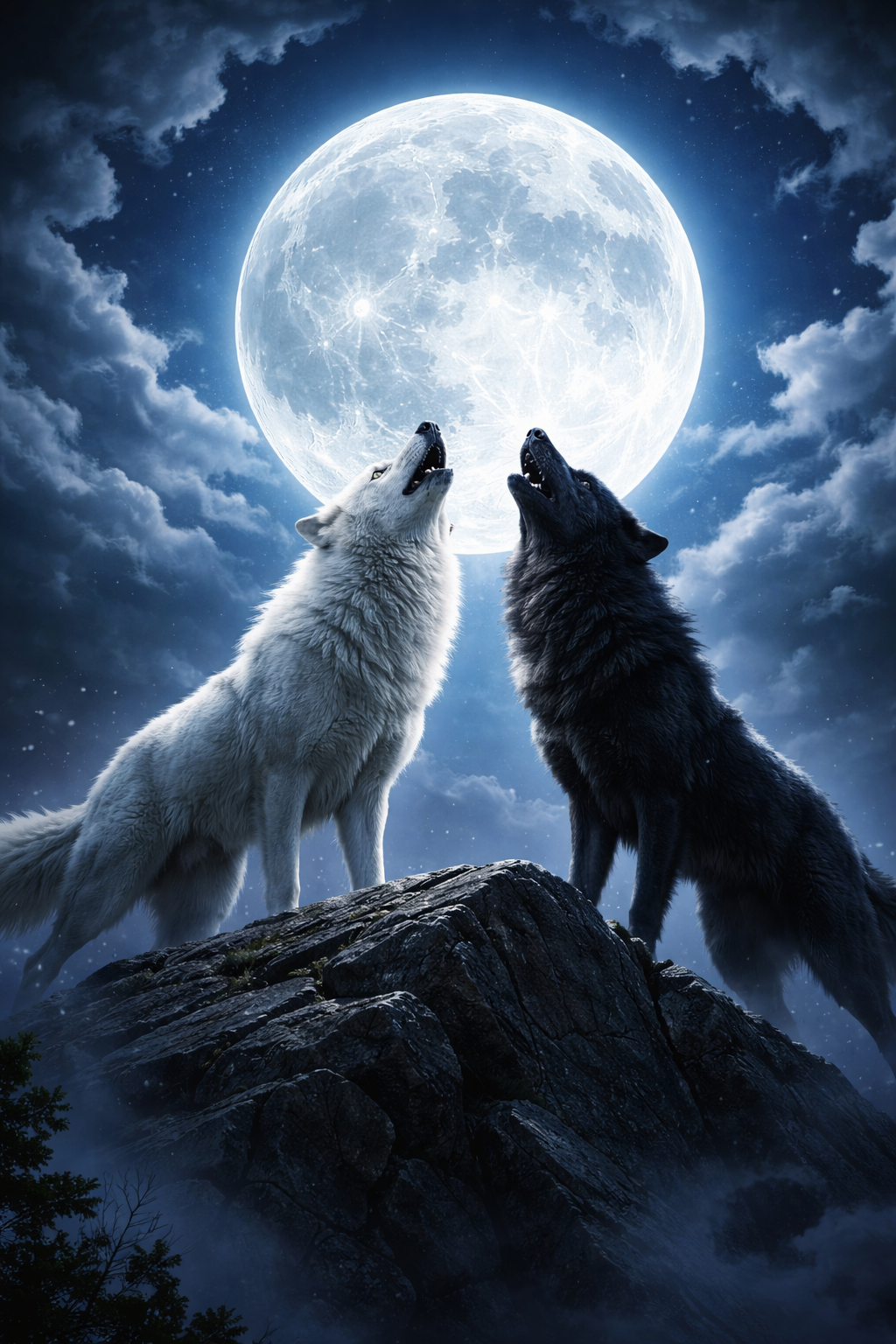
“THE HOWL OF THE MIGHTY WOLF IS THE OPERA OF THE WILD”
-J. DReAMZZZ
Wolves: Cultural, Environmental, and Mythological Summary
Wolves are highly intelligent social predators belonging to the canine family and are among the most influential animals in human history, mythology, and environmental science. The gray wolf (Canis lupus) once occupied much of North America, Europe, and Asia and remains the most widespread wild wolf species. For thousands of years, wolves have inspired admiration, fear, spiritual reverence, and folklore. Environmentally, they are important predators capable of influencing entire ecosystems, while culturally they have represented everything from danger and destruction to loyalty, courage, freedom, and family unity.
Environmental Importance
Wolves are apex predators, meaning that healthy adult wolves generally have few natural predators other than humans. Their presence can strongly influence the number, distribution, and behavior of prey animals.
Common wolf prey includes:
- Deer
- Elk
- Moose
- Caribou
- Wild boar
- Bison
- Smaller mammals when larger prey is unavailable
By hunting large herbivores, wolves can help prevent excessive grazing and browsing. This can indirectly benefit forests, grasslands, riverbanks, and other habitats.
Wolves frequently target prey that is young, old, injured, weakened, or otherwise easier to capture, although healthy animals may also be hunted.
Wolves and Ecosystem Balance
One of the most important ecological concepts associated with wolves is the trophic cascade.
A trophic cascade occurs when predators influence animals lower in the food chain, producing effects that spread through an ecosystem. When wolves affect the population or behavior of herbivores such as deer and elk, vegetation can sometimes recover in areas where heavy browsing previously occurred.
Greater vegetation may provide habitat and food for:
- Birds
- Beavers
- Insects
- Small mammals
- Fish
- Other wildlife
Wolves therefore can influence ecosystems far beyond the animals they directly kill.
Their carcasses and leftover prey also provide food for scavengers such as ravens, eagles, bears, foxes, and numerous insects and microorganisms.
Social Structure
Wolves are extremely social animals.
They normally live in family groups called packs. A typical pack consists largely of a breeding pair and their offspring from different years rather than unrelated wolves organized around constant battles for dominance.
Pack members cooperate in:
- Hunting
- Raising pups
- Defending territory
- Finding food
- Protecting injured members
- Communicating danger
This cooperation has contributed to the wolf’s enduring cultural association with family, loyalty, teamwork, and protection.
Communication
Wolves communicate through an elaborate combination of sound, scent, posture, and facial expression.
Their famous howl serves several purposes. Wolves may howl to locate separated pack members, announce territorial presence, gather the pack, or communicate over long distances.
Other forms of communication include:
- Growling
- Whining
- Barking
- Tail positioning
- Ear movements
- Facial expressions
- Scent marking
A wolf’s howl can travel considerable distances under favorable environmental conditions, making it particularly effective across forests, mountains, and open landscapes.
Historical Relationship With Humans
Humans and wolves have shared landscapes for tens of thousands of years.
Their relationship has been complicated. Humans admired wolves as skilled hunters while simultaneously viewing them as competitors for game and threats to livestock.
The domestication of ancient wolf populations eventually contributed to the emergence of the domestic dog, although modern dogs did not simply descend from today’s living gray wolves. Wolves and dogs instead share ancestry through ancient wolf populations.
As agriculture and livestock farming expanded, conflicts between people and wolves increased. Wolves were systematically hunted, trapped, poisoned, and eliminated from large portions of their historical range.
During the modern conservation era, attitudes began changing as scientists gained a better understanding of the ecological importance of large predators.
Cultural Significance
Few animals have received such contradictory cultural interpretations as the wolf.
Wolves have represented:
- Courage
- Freedom
- Strength
- Loyalty
- Family
- Protection
- Intelligence
- Wilderness
- Danger
- Destruction
- Isolation
- Instinct
The expression “lone wolf” describes someone acting independently, although solitary wolves in nature are often young animals temporarily leaving their original pack in search of territory or a mate.
The contrast between the social pack wolf and the solitary wandering wolf has made the animal particularly powerful in literature and symbolism.
Wolves in Indigenous Cultures
Wolves hold important spiritual and cultural roles within many Indigenous traditions, although beliefs differ greatly among individual peoples and should not be treated as a single tradition.
In some Native North American cultures, wolves are associated with:
- Hunting skill
- Loyalty
- Courage
- Family
- Spiritual guidance
- Protection
Some traditions regarded wolves as teachers because both humans and wolves historically survived through cooperation, family organization, territorial knowledge, and coordinated hunting.
Wolf imagery continues to appear in Indigenous stories, artwork, ceremonies, and clan traditions.
Greek and Roman Mythology
Wolves appear prominently in classical mythology.
According to Roman tradition, the abandoned twins Romulus and Remus were rescued and suckled by a she-wolf. Romulus later became the legendary founder of Rome.
The image of the Capitoline Wolf nursing the twins became one of the most recognizable symbols of Roman civilization.
In Greek tradition, wolves were sometimes associated with Apollo, particularly through the epithet Lykeios. Wolves also appeared in stories concerning wilderness, transformation, punishment, and supernatural power.
Norse Mythology
Wolves occupy a dramatic position within Norse mythology.
The enormous wolf Fenrir, a child of Loki, was feared by the gods because prophecy foretold that he would play a major role during Ragnarök, the catastrophic final conflict of the gods.
Two other wolves, Sköll and Hati, pursue the Sun and Moon through the heavens. According to mythological tradition, they eventually catch their celestial prey during Ragnarök.
Wolves therefore became connected with fate, chaos, cosmic destruction, and uncontrollable natural power.
However, wolves were not exclusively negative within Norse tradition. The god Odin was accompanied by two wolves, Geri and Freki, demonstrating another association between wolves, warriors, power, and divine companionship.
European Folklore
During medieval and early modern European history, wolves increasingly became symbols of danger.
Folktales commonly portrayed wolves as threatening creatures lurking beyond the boundaries of human settlements.
Stories such as Little Red Riding Hood and The Three Little Pigs reinforced the image of the wolf as cunning, predatory, and dangerous.
The legendary werewolf also became deeply embedded in European folklore. Werewolf stories described humans who transformed into wolves or wolf-like creatures, often during the night or under supernatural influence.
These legends contributed significantly to the wolf’s association with transformation, uncontrollable instinct, and humanity’s darker nature.
The Wolf and the Moon
Popular culture frequently depicts wolves howling at the full Moon.
Wolves do howl at night, but they are not specifically howling at the Moon. Their upward head position helps project sound over greater distances. Because wolves are active around twilight and nighttime and the Moon is highly visible during those periods, the two became strongly connected in mythology and art.
Today, the image of a wolf howling beneath a full Moon is one of the most recognizable symbols of wilderness, mystery, and independence.
Wolves in Literature and Popular Culture
Wolves appear throughout literature, film, heraldry, sports, and modern entertainment.
They may be portrayed as:
- Dangerous predators
- Loyal companions
- Guardians
- Warriors
- Supernatural creatures
- Symbols of wilderness
- Spiritual guides
Writers have also used wolves to explore the tension between civilization and nature.
Jack London’s The Call of the Wild and White Fang, for example, helped establish the wolf and wolf-dog as powerful literary symbols of instinct, survival, wilderness, and the relationship between humans and nature.
Conservation
Wolves have historically suffered significant population declines because of hunting, habitat loss, poisoning, and conflict with livestock owners.
Conservation programs have restored wolf populations in some regions, while conflicts continue where wolves and livestock share the same landscapes.
Modern wildlife management attempts to balance:
- Wolf conservation
- Livestock protection
- Hunting interests
- Rural communities
- Ecosystem health
- Public safety
Their recovery in some areas has become one of the most studied examples of large-predator conservation.
Symbolic Meaning
Across cultures, wolves possess unusually complex symbolism.
A wolf pack commonly represents family, cooperation, loyalty, unity, and mutual protection.
A lone wolf may represent independence, isolation, self-reliance, or separation from one’s community.
An aggressive wolf frequently symbolizes danger, predatory power, fear, or uncontrolled instinct.
A protective wolf may symbolize guardianship, courage, loyalty, and strength.
The wolf’s ability to function both as an intensely social animal and as an independent survivor gives it a unique symbolic duality.
Conclusion
Wolves are far more than the dangerous predators portrayed in traditional folklore. Scientifically, they are sophisticated social animals and important components of many ecosystems. Environmentally, their influence can extend from prey populations to vegetation and scavenger communities. Culturally, they have represented family, loyalty, independence, wilderness, fear, and strength. Mythologically, wolves have appeared as guardians, companions of gods, destroyers of worlds, founders of civilizations, and supernatural creatures.
This combination of intelligence, social cooperation, predatory power, and mystery has made the wolf one of the most enduring animal symbols in human civilization.

Sigmund Freud on the Representation of Wolves Within Dreams

Sigmund Freud did not teach that every wolf appearing in a dream has one universal meaning. His method required the dreamer to examine personal memories, childhood experiences, fears, wishes, family relationships, stories, and recent events connected with the image.
Nevertheless, wolves occupy a particularly important place in Freud’s writings because one of his most famous cases, Sergei Pankejeff—the “Wolf Man”, centered upon a childhood nightmare involving several white wolves sitting silently in a tree and staring at him. Freud first discussed material from this dream in 1913 and later analyzed it extensively in From the History of an Infantile Neurosis, published in 1918.
For Freud, the wolves in that particular dream became connected with:
- Fear of the father.
- Childhood anxiety.
- Fear of being attacked or “eaten.”
- Fairy tales involving wolves.
- Repressed childhood wishes.
- Castration anxiety.
- The relationship between activity and passivity.
- Looking and being looked at.
- Childhood sexual curiosity.
- Memories and fantasies condensed together through dream-work.
These meanings belong to Freud’s analysis of one particular patient and should not be turned into a rule that every wolf dream automatically represents the father, sexuality, or castration.
The Famous Wolf Man Dream
Pankejeff recalled a childhood dream in which he was lying in bed at night when the window suddenly opened. Outside, several white wolves were sitting motionless in a walnut tree. Their attention was fixed upon him, and he became terrified that they would eat him. He screamed and awakened. Freud regarded this as the earliest anxiety dream his patient clearly remembered.
The dream later became central to Freud’s reconstruction of Pankejeff’s childhood neurosis.
What interested Freud was not merely that wolves appeared. He examined virtually every detail:
- Why were the wolves white?
- Why were there six or seven?
- Why were they in a tree?
- Why were their tails large?
- Why were their ears upright?
- Why were they completely still?
- Why were they staring at the dreamer?
- Why was the dreamer afraid of being eaten?
This is an important lesson in Freud’s approach.
A wolf does not possess meaning independently of the rest of the dream.
The Wolf as an Anxiety Animal
Freud described the wolf in Pankejeff’s case as the central anxiety animal of a childhood animal phobia. The unusual feature was that the child had not learned to fear wolves through encounters with actual wolves. His fear had largely been shaped by stories and illustrations.
The wolf may therefore become a suitable dream image for fear because it already carries frightening associations in the dreamer’s mind.
A dream wolf could potentially represent:
- A frightening person.
- A threatening authority.
- Someone feared during childhood.
- A situation associated with helplessness.
- Fear of being attacked.
- Fear of punishment.
- Fear of losing control.
- A childhood story that remains emotionally powerful.
Hypothetical example
A child is repeatedly frightened by a story involving a wolf and later dreams that a wolf waits outside the bedroom.
A Freudian investigation would begin with the child’s memories of the story and the people who introduced it.
The wolf might eventually connect with someone in the family, but that conclusion would need to emerge from the child’s associations.
The Wolf and the Father
In the Wolf Man case, Freud eventually stated that the feared wolf represented the patient’s father under particular conditions.
This conclusion did not come simply from the fact that the animal was a wolf.
Pankejeff’s associations linked the wolves with memories involving:
- His father.
- Sheep his father had shown him.
- His father’s playful threats to “gobble” him.
- Childhood fear.
- Fairy tales.
- The particular posture of the wolf.
- Other childhood memories involving the father.
Freud therefore gradually connected the threatening wolf with paternal fear and the child’s complicated emotional relationship with his father.
Hypothetical example
A dreamer sees an enormous wolf sitting in the father’s chair.
If the dreamer already describes the father as intimidating, controlling, or unpredictable, the wolf may become a disguised representation of paternal authority.
But the interpretation would be much weaker if the dreamer associated wolves with something entirely different.
Fear of Being Eaten
Pankejeff awakened in terror because he feared the wolves would eat him. After the dream, fear of being devoured by a wolf became an important part of his childhood anxiety.
In Freud’s reconstruction, this fear belonged to a much larger set of infantile wishes and anxieties.
More generally, being eaten by a wolf could be examined through associations involving:
- Helplessness.
- Being overwhelmed by someone stronger.
- Fear of punishment.
- Dependence upon a powerful person.
- Childhood fantasies.
- Stories involving devouring animals.
- Fear that another person’s demands will consume the dreamer.
Hypothetical example
An adult dreams that a wolf swallows them whole after a supervisor gives an impossible assignment.
The wolf might represent the supervisor if the dreamer associates that person with aggression or domination.
The devouring scene may express the feeling:
“This person or responsibility is consuming me.”
The dream would still need to be interpreted through personal associations rather than through the wolf alone.
Wolves and Fairy Tales
One of the most important features of Freud’s analysis was the influence of fairy tales.
Pankejeff associated the dream with Little Red Riding Hood and The Wolf and the Seven Little Goats. The number of wolves, their appearance, the idea of being eaten, and other details drew upon material from these stories.
Freud’s 1913 essay The Occurrence in Dreams of Material from Fairy Tales specifically addressed the way childhood stories can supply imagery later used in dreams.
A wolf dream may therefore arise from:
- Childhood bedtime stories.
- Illustrations.
- Movies.
- Folklore.
- Religious stories.
- Cartoons.
- Stories told by parents or grandparents.
The dream may use familiar wolf imagery to represent a completely different underlying issue.
Example
A dreamer repeatedly dreams of a wolf dressed as an elderly woman.
The dreamer might immediately remember the wolf disguised as a grandmother in a childhood story.
Freud’s method would then investigate what the grandmother figure, disguise, deception, and fear of being eaten mean personally.
The Grandfather’s Wolf Story
Pankejeff also remembered a story told by his grandfather.
In that tale, a tailor pulled off a wolf’s tail. Later, a pack of wolves attempted to reach the tailor after he climbed a tree. Freud believed this story contributed important material to the later dream.
The story helped explain why:
- Wolves appeared in a group.
- A tree appeared.
- Tails were emphasized.
- The wolves were threatening.
- The dream contained reversals of the story.
This illustrates Freud’s theory of dream-work.
Dreams may take several memories and combine them into a single scene.
Wolves as Condensed Dream Images
For Freud, one dream object can represent several different thoughts simultaneously.
The Wolf Man’s wolves were connected with:
- His father.
- Fairy-tale wolves.
- Sheep.
- Dogs.
- Foxes.
- Childhood threats.
- The grandfather’s story.
- Fear of being eaten.
- The dreamer’s sexual anxieties.
The wolves therefore provide a striking example of condensation.
One image carries several psychological associations at once.
Hypothetical example
A dreamer sees a wolf that has:
- The voice of the dreamer’s father.
- The uniform of the dreamer’s employer.
- The eyes of a childhood bully.
A Freudian interpretation would not necessarily choose one of these people.
The wolf may condense all three because they share a common emotional quality—perhaps authority, intimidation, or fear.
White Wolves
The wolves in Pankejeff’s dream were unusually white.
Freud did not assign “white wolf” a universal symbolic definition. Pankejeff’s own associations linked the whiteness to sheep, including sheep associated with his father. The story of the Seven Little Goats also contributed a white-paw motif.
Thus even an unusual color was explained through personal associations.
Hypothetical example
A dreamer sees a completely black wolf.
Freud’s method would not automatically interpret black as evil.
The dreamer would instead be asked:
- What does a black wolf remind you of?
- Have you recently seen one in a film or picture?
- Does black remind you of mourning?
- A particular dog?
- A person’s clothing?
- Night?
- Fear?
The same principle applies to white, gray, red, or golden wolves.
The Wolf’s Eyes and Being Watched
One of the most disturbing features of the Wolf Man dream was the wolves’ fixed gaze. They sat silently and concentrated their attention upon the child.
Freud considered themes of looking and being looked at especially significant in the dream. His reconstruction contained several reversals involving who was observing whom.
In another wolf dream, the gaze might concern:
- Fear of being watched.
- Fear of judgment.
- Curiosity.
- Voyeurism.
- Shame.
- Being inspected by authority.
- Fear that a secret has been discovered.
Hypothetical example
A wolf watches the dreamer through an office window while the dreamer hides paperwork.
The wolf may represent a supervisor or another person whose scrutiny the dreamer fears.
The key element may be being watched, not being physically attacked.
Motionless Wolves
Interestingly, the wolves in the famous dream did not attack.
They remained perfectly still.
Freud treated this stillness as meaningful and connected it with the dream-work’s tendency to reverse or distort latent material. In his reconstruction, the stillness of the wolves belonged to a broader pattern of reversals within the dream.
A motionless predator may therefore be psychologically different from an attacking predator.
Hypothetical example
A pack of wolves surrounds the dreamer but never moves.
The dream may express anticipation rather than actual attack.
The dreamer may fear that something terrible is about to happen, even though the feared event has not occurred.
This could correspond with:
- Waiting for disciplinary action.
- Fear of legal consequences.
- Anticipating confrontation.
- Waiting for medical results.
- Fear that hidden conflict will erupt.
Being Chased by Wolves
Freud did not establish a universal interpretation for being chased by wolves. A Freudian analysis would focus on the identity of the pursuer and the wish or fear from which the dreamer is trying to escape.
Questions would include:
- Who does the wolf resemble?
- What happens if it catches you?
- What person currently makes you feel pursued?
- What responsibility are you avoiding?
- What childhood fear does the wolf recall?
- Does the wolf represent someone you love as well as fear?
Hypothetical example
A dreamer is chased by a wolf with the father’s voice.
The image could indicate fear of paternal authority, unresolved guilt, or anxiety about disappointing the father.
Hypothetical example
The dreamer is chased by a wolf that wears the dreamer’s own clothing.
The animal may represent an impulse, anger, desire, or behavior the dreamer is trying to deny.
Freud would still seek the dreamer’s associations before reaching that conclusion.
Being Attacked by a Wolf
An attacking wolf may represent feared aggression.
The aggression might belong to:
- A parent.
- A rival.
- A spouse.
- An employer.
- Another authority figure.
- The dreamer’s own hostile wishes.
Freud believed dreams can disguise unacceptable impulses by attributing them to someone or something else.
Example
A dreamer feels intense anger toward a coworker during the day but suppresses it. That night a wolf attacks the coworker.
The wolf may carry the dreamer’s own aggression.
The dream does not necessarily reveal that the dreamer consciously wants to cause harm. It may give symbolic expression to hostility that waking consciousness does not comfortably acknowledge.
Killing a Wolf
Killing a wolf could represent a wish to overcome whatever the wolf represents.
If the wolf corresponds with:
- A threatening father, killing it may involve rebellion against paternal authority.
- A rival, it may represent competitive triumph.
- Fear itself, it may dramatize the wish to become fearless.
- The dreamer’s aggression, killing it may represent an attempt to suppress that impulse.
Example
A dreamer kills a frightening wolf and immediately begins crying.
The contradictory reaction suggests ambivalence.
Perhaps the wolf represents someone the dreamer both fears and loves.
Destroying the threat also means psychologically attacking someone emotionally important.
Becoming a Wolf
A dream in which the dreamer becomes a wolf could potentially express identification with qualities the dreamer associates with wolves.
These may include:
- Aggression.
- Sexuality.
- Independence.
- Predatory behavior.
- Anger.
- Strength.
- Fearlessness.
- Social exclusion.
But these are not fixed Freudian wolf meanings.
Hypothetical example
A passive person who never expresses anger dreams of turning into a wolf and frightening everyone.
The transformation may allow an aggressive wish to appear that the dreamer suppresses while awake.
Hypothetical example
The dreamer becomes a wolf but is horrified by the transformation.
The dream may reveal fear of losing control over impulses the person considers unacceptable.
A Friendly Wolf
A friendly wolf changes the emotional structure entirely.
It could represent:
- A feared person becoming safe.
- Growing acceptance of aggression.
- A formerly frightening childhood image losing its power.
- A protective person associated with wolves.
- An instinct or desire that no longer feels dangerous.
Example
A dreamer who previously dreamed of being chased by wolves later dreams of walking beside one.
A Freudian examination might ask whether the underlying fear has changed.
Perhaps a threatening relationship has improved, or the dreamer has become less frightened of their own assertiveness.
A Pack of Wolves
A group of wolves may represent several people or one problem multiplied.
In the Wolf Man dream, the number of wolves was partly derived from fairy-tale material. Freud insisted that even numerical details required explanation.
A pack might therefore correspond with:
- Several family members.
- Coworkers.
- Rivals.
- Authorities.
- A social group.
- Repeated versions of the same fear.
Hypothetical example
Seven wolves surround a dreamer who is in conflict with seven members of a committee.
The numerical correspondence would deserve attention.
Another example
Twenty wolves appear even though the dreamer knows no group of twenty people.
The exaggeration might intensify a feeling of being outnumbered or overwhelmed.
Wolf Pups
Wolf pups may introduce childhood, vulnerability, family, or development.
The dreamer might associate them with:
- Children.
- Dependents.
- Younger siblings.
- One’s own childhood.
- Aggression that is still developing.
- Something feared that initially appears harmless.
Example
A dreamer adopts a wolf pup that gradually becomes dangerous.
The dream may portray a problem, desire, or relationship that began harmlessly but has become increasingly difficult to manage.
The Wolf Inside the House
A wolf entering the home may bring a feared external force into the dreamer’s private or family environment.
Example
A wolf enters through the front door and sits in the father’s chair.
The personal setting may strengthen a family interpretation.
Example
A wolf hides beneath the marital bed.
The dream may concern conflict, sexuality, jealousy, aggression, or fear affecting the relationship.
Again, the dreamer’s associations determine which interpretation is most plausible.
Wolves and Childhood Memories
Freud’s Wolf Man case demonstrates how strongly childhood material can survive within later dreams.
Pankejeff’s dream drew upon:
- Fairy-tale illustrations.
- Stories told by his grandfather.
- Experiences involving his father.
- Childhood fears.
- Earlier family situations.
A wolf appearing in an adult dream may therefore reactivate a childhood memory that appears unrelated to the person’s current problem.
Example
An adult dreams of a wolf while facing an intimidating employer.
During free association, the wolf reminds the dreamer of a frightening childhood book read by a strict parent.
The employer and parent may then become linked through their shared emotional quality.
The wolf serves as the bridge between present and childhood experience.
Wolves and Castration Anxiety in the Wolf Man Case
Freud connected the Wolf Man’s dream with what he called castration anxiety. The case material repeatedly contained images involving tails, wounds, cutting, sexual difference, and fears of bodily loss. Freud interpreted the dream within his theory of childhood sexual development and the patient’s relationship with his father.
This point should be stated carefully.
Freud did not establish:
Every wolf dream means castration anxiety.
Rather, castration anxiety became important because numerous associations in this specific analysis converged upon it.
Without similar associations, imposing the same interpretation on another dreamer would contradict Freud’s own method of following the dreamer’s material.
The Wolf and Repressed Wishes
Freud regarded anxiety dreams as particularly important because frightening dream content can conceal wishes that consciousness finds unacceptable.
In the Wolf Man case, Freud concluded that the nightmare involved a conflict between infantile wishes and intense fear. The dream was not merely a picture of external danger; it represented a complicated internal conflict that the dreamer could not consciously tolerate.
Thus, a terrifying wolf might represent both:
- Something feared.
- Something psychologically desired but unacceptable.
Hypothetical example
A dreamer is terrified by a powerful wolf but simultaneously wants to follow it into the forest.
The contradiction may reveal ambivalence.
The wolf might represent a person, desire, or form of independence that both attracts and frightens the dreamer.
Questions for a Freudian Interpretation of Wolves
A Freudian examination of a wolf dream would ask:
- What is my earliest memory of wolves?
- Did I encounter wolves in fairy tales, films, books, or family stories?
- Who does the wolf remind me of?
- Does its face, voice, posture, or behavior resemble someone?
- Was the wolf watching, chasing, attacking, protecting, or ignoring me?
- Was I afraid of being eaten?
- Did I become the wolf?
- Was there one wolf or a pack?
- Why was that particular number present?
- What color was the wolf?
- What does that color remind me of?
- Where did the wolf appear?
- Was it inside my home or outside?
- Did it resemble a dog, fox, or another familiar animal?
- What happened during the day before the dream?
- What childhood fear does the dream reactivate?
- What authority figure currently frightens me?
- What aggressive feeling am I refusing to acknowledge?
- What wish might be concealed beneath the fear?
- Does the dream involve looking, being watched, punishment, dependence, or helplessness?
The answers are more important than the animal alone.
Conclusion
Within Sigmund Freud’s dream theory, wolves do not possess one universal symbolic meaning. Their interpretation must be discovered through the dreamer’s associations, childhood experiences, fears, wishes, family relationships, and the surrounding structure of the dream.
Freud’s most important wolf interpretation comes from Sergei Pankejeff, the famous Wolf Man. His childhood nightmare of several white wolves sitting motionless in a tree became one of the most detailed dream analyses Freud ever published.
In that case, the wolves became connected with the father, childhood fear, fairy tales, fear of being eaten, looking and being looked at, infantile wishes, sexual curiosity, and castration anxiety. Their whiteness came partly from associations with sheep and fairy-tale material; their number came from The Wolf and the Seven Little Goats; the tree connected with both Christmas and a story told by the patient’s grandfather; and their threatening stillness became part of Freud’s reconstruction of the dream-work.
The case demonstrates Freud’s central principle particularly well: the wolf itself is not enough to interpret the dream.
A frightening wolf may represent an intimidating person. A chasing wolf may embody feared pursuit or punishment. An attacking wolf may carry aggression. A friendly wolf may show that something previously feared is becoming less threatening. Becoming a wolf may allow an aggressive or instinctive wish to appear. A pack may represent several people or magnify the sense of being overwhelmed.
But each of these possibilities must be tested against the dreamer’s own associations.
The central Freudian question is therefore not merely:
“What does a wolf symbolize?”
It is:
“Who or what in my personal history has supplied this wolf with its fear, aggression, gaze, voice, color, and power—and what unconscious wish or conflict has the dream disguised through that animal?”
Bibliography
Freud, Sigmund. From the History of an Infantile Neurosis. Written primarily in 1914 and first published in 1918. Later included in The Standard Edition of the Complete Psychological Works of Sigmund Freud, vol. 17, edited and translated by James Strachey. This is Freud’s full case history of Sergei Pankejeff and contains the detailed analysis of the famous wolf dream.
Freud, Sigmund. “The Occurrence in Dreams of Material from Fairy Tales.” 1913. Later included in The Standard Edition, vol. 12. Freud discusses the use of fairy-tale material within dreams and introduces important elements later developed in the Wolf Man case.
Freud Museum London. “The Wolf Man’s Dream.” Educational resource presenting Pankejeff’s dream, his associations, Freud’s method of interpretation, and the connection of the dream with childhood anxiety and fairy-tale imagery.
Freud, Sigmund. The Interpretation of Dreams. Originally published as Die Traumdeutung in 1899/1900. This work establishes Freud’s broader method of interpreting dreams through free association, manifest and latent content, wish fulfillment, condensation, displacement, and dream-work.
Carl Jung on the Representation of Wolves Within Dreams

Carl Jung did not establish a fixed rule declaring that every wolf appearing in a dream has one universal meaning. His method required the interpreter to examine the entire dream, the dreamer’s personal associations, emotional reaction, present circumstances, and the role the image plays within the dream. Jung called this process “taking up the context,” emphasizing that the meaning of each important dream element must be determined partly through the dreamer’s own associations.
Within Jung’s analytical psychology, however, a wolf can be an especially powerful image because animals frequently provide the unconscious with ways of portraying instinctual aspects of human personality. Jung explicitly interpreted an ape in one patient’s dreams as representing the dreamer’s neglected instinctual personality, and in his dream seminars he explained that instincts which are not integrated into personality can become objectified as autonomous figures confronting the dreamer.
A wolf dream can therefore cautiously involve themes such as instinct, aggression, independence, fear, protection, appetite, territoriality, social belonging, suppressed anger, or qualities the conscious personality has rejected. The wolf may also take on an archetypal quality when the dream is unusually powerful, strange, mythic, or emotionally overwhelming. Jung regarded archetypal dream images as expressions arising from deeper layers of the unconscious rather than merely from recent personal experience.
The central Jungian question is therefore not simply “What does a wolf mean?” It is:
“What instinctual or unconscious force has appeared in the form of this wolf, and what relationship does the conscious personality have with it?”
The Wolf as an Image of Instinct
Animals are especially suited to representing instinct because they behave without the elaborate conscious rationalization characteristic of human beings.
Jung distinguished instinct from conscious decision and considered instinct deeply connected with the unconscious. His writings repeatedly connect archetypal patterns with instinctual foundations, and his clinical examples show animals portraying aspects of personality that conscious attitudes have neglected.
A wolf may therefore appear when the dreamer has become separated from natural reactions such as:
- anger,
- self-protection,
- appetite,
- sexuality,
- competition,
- territorial defense,
- independence,
- group loyalty,
- or the ability to recognize danger.
This does not automatically make the wolf negative.
The problem may actually be that the dreamer has too little access to the quality represented by the wolf.
Hypothetical example
A person who constantly allows others to mistreat them dreams that a large wolf begins following them.
At first the dreamer is frightened, but the wolf eventually stands between the dreamer and an attacker.
A Jungian interpretation might consider whether the wolf represents an instinct for self-defense that consciousness has neglected.
The threatening animal becomes protective once the dreamer stops fleeing from it.
The Wolf and the Shadow
One of the strongest possible Jungian interpretations of a frightening wolf concerns the shadow.
Jung described the shadow as containing aspects of personality that consciousness does not readily acknowledge. In Aion, he explained that the shadow includes hidden and repressed personality material and that its deeper ramifications reach back toward humanity’s animal ancestry.
A wolf may therefore become a suitable shadow image when the dreamer rejects qualities such as:
- aggression,
- ambition,
- competitiveness,
- sexuality,
- selfishness,
- anger,
- dominance,
- independence,
- or the desire to resist authority.
The important point is that shadow qualities are not necessarily evil.
A person may repress qualities that are needed.
Someone who identifies strongly with being gentle may reject healthy aggression. Someone determined always to cooperate may suppress independence. Someone who tries to remain agreeable may deny justified anger.
The wolf may then carry these qualities for the dreamer.
Hypothetical example
A quiet employee dreams that a black wolf breaks into the workplace and growls at an abusive manager.
The dreamer may consciously view the wolf as dangerous, yet the animal performs an action the dreamer is unable to perform while awake.
The wolf could represent denied assertiveness or anger.
The psychological task would not necessarily be to “kill the wolf.” It might be to discover how the energy represented by the wolf can be expressed consciously and responsibly.
The Dangerous Wolf
A violent or threatening wolf may indicate instinctual energy that has become hostile because it has been ignored, repressed, or poorly integrated.
Jung observed that instinctual forces can appear as autonomous figures when consciousness is at odds with them. Instead of functioning naturally within the personality, the instinct appears psychologically as something separate that confronts the ego.
Hypothetical example
A dreamer is chased every night by an increasingly aggressive wolf.
During waking life, the person refuses to acknowledge intense resentment toward family members.
The repeated pursuit may suggest that the rejected emotion is demanding recognition.
The important question is not necessarily:
“How do I escape the wolf?”
It may instead be:
“What happens if I stop running and discover what this animal wants?”
Being Chased by Wolves
A wolf chasing the dreamer can represent an instinct, emotion, conflict, or unconscious issue that consciousness is attempting to avoid.
The dreamer should examine what happens immediately before the chase.
Does the wolf appear after the dreamer:
- lies to someone,
- abandons a responsibility,
- enters the forest,
- leaves the family home,
- refuses a confrontation,
- becomes romantically involved,
- or takes something that does not belong to them?
The preceding action may reveal why the wolf gives chase.
Hypothetical example
A person continually avoids confronting an exploitative business partner and dreams of running from a wolf through an endless city.
The wolf may represent the confrontation the dreamer knows is necessary.
Running prolongs the nightmare because waking avoidance prolongs the psychological conflict.
Being Attacked by a Wolf
An attacking wolf may represent an instinctual force that consciousness experiences as dangerous.
Possible meanings include overwhelming anger, fear of losing control, aggression directed toward the dreamer, or a rejected part of the dreamer that has become increasingly autonomous.
Hypothetical example
A wolf repeatedly bites the dreamer’s hands whenever the dreamer attempts to complete a particular project.
The dream might ask whether the project conflicts with an instinctive objection the dreamer has ignored.
Perhaps the person consciously insists:
“This is what I should do.”
But another part of the personality is saying:
“I do not want this.”
The attack becomes a conflict between conscious intention and unconscious resistance.
Fighting a Wolf
Fighting a wolf may portray a struggle between the conscious personality and an instinctive or shadow quality.
Victory is not automatically psychologically desirable.
If the wolf represents destructive aggression, defeating it might show increasing control.
But if the wolf carries healthy independence or self-protection, destroying it could mean that consciousness is suppressing something necessary.
Hypothetical example
A man dreams of killing a wolf and immediately discovers that he is defenseless against attackers.
The dream might suggest that in eliminating aggression entirely, he has also eliminated his capacity for self-defense.
The wolf possessed a dangerous quality, but also a necessary one.
Killing the Wolf
The emotional aftermath is crucial.
If killing the wolf produces relief, the dream may concern gaining control over a destructive instinct or threatening psychological condition.
If killing it produces grief, emptiness, or weakness, the dream may indicate that the dreamer is destroying an important part of themselves.
Hypothetical example
A dreamer kills a wolf that has been terrorizing a village. Everyone celebrates.
The image may portray successful confrontation with a destructive pattern.
Hypothetical example
A dreamer kills a wolf and immediately loses the ability to speak.
The sequence suggests that the wolf may have carried something connected with expression, courage, or an authentic voice.
Destroying it removes that power as well.
Befriending a Wolf
A friendly wolf can represent a more cooperative relationship with instinctual life.
This may occur when the dreamer begins to accept qualities previously considered dangerous.
Hypothetical example
A person who has repeatedly dreamed of being chased by a wolf eventually dreams of sitting beside the same animal.
The changed relationship may indicate psychological development.
The unconscious force has not disappeared.
The dreamer’s relationship with it has changed.
The wolf has moved from enemy to companion.
Feeding a Wolf
Feeding a wolf may indicate consciously giving attention or energy to an instinctual aspect of the personality.
Whether this is healthy depends upon the consequences.
Hypothetical example
A starving wolf approaches the dreamer cautiously. The dreamer feeds it, and the animal becomes calm.
The image may suggest that an instinct has become dangerous because it has been neglected.
Giving it an appropriate place reduces its hostility.
Another example
The dreamer continually feeds a wolf until it becomes enormous and destroys the house.
The dream may instead warn that a particular impulse is being indulged without sufficient limits.
Integration is not the same as surrender.
Becoming a Wolf
Dreams of transforming into a wolf can be especially significant because the dreamer is no longer merely observing instinctual material—the ego temporarily identifies with it.
The transformation may involve:
- discovering strength,
- accessing aggression,
- rejecting social restrictions,
- gaining independence,
- accepting sexuality,
- becoming more instinctive,
- or becoming overwhelmed by impulses.
Hypothetical example
A person who feels powerless transforms into a wolf and confidently walks through a dangerous forest.
The transformation may compensate for an excessively weak conscious attitude.
Another example
The dreamer becomes a wolf and attacks everyone they love.
Here the transformation may warn that uncontrolled anger or instinct threatens relationships.
The meaning depends upon what the wolf-self actually does.
The Wolf and Compensation
Compensation is fundamental to Jung’s theory of dreams. Dreams can counterbalance an overly narrow conscious attitude by presenting material that consciousness has neglected. Jung’s later writings describe dreams as communications from the unconscious that can bring neglected or unrealized aspects of personality into awareness.
A wolf may therefore compensate for conscious behavior.
A person who is too passive may dream of a powerful wolf.
A person who is too aggressive may dream of being terrified by wolves.
A person excessively dependent upon social approval may dream of a lone wolf.
A person excessively isolated may dream of being surrounded by a cooperative pack.
The dream can show what the conscious personality lacks.
The Lone Wolf
A solitary wolf may emphasize independence, separation, exile, or a psychologically necessary withdrawal from collective expectations.
The interpretation depends upon whether the dreamer experiences solitude as freedom or suffering.
Hypothetical example
A person considering leaving an oppressive group dreams of a wolf walking alone toward the mountains.
The animal may portray the possibility of independent development.
Another example
A lonely dreamer watches a wolf desperately calling to a distant pack.
The dream may expose a need for belonging that consciousness has minimized.
The same solitary animal can therefore signify either necessary independence or painful isolation.
A Pack of Wolves
A wolf pack introduces the problem of the individual’s relationship with the group.
The pack may represent:
- family,
- coworkers,
- friends,
- society,
- collective expectations,
- group loyalty,
- conformity,
- or collective aggression.
Hypothetical example
A dreamer joins a wolf pack and feels safer than ever before.
The image may indicate a healthy need for community or belonging.
Another example
The wolves force the dreamer to hunt something they do not want to kill.
The pack may represent pressure to behave according to collective values that conflict with the dreamer’s individuality.
This can become particularly significant within individuation, where the developing individual must establish a relationship with society without simply becoming identical with the group.
Wolves Surrounding the Dreamer
Being surrounded by wolves may represent being overwhelmed by instinctual, emotional, or collective forces.
The dreamer should ask whether waking life currently includes a situation where they feel:
outnumbered, watched, socially pressured, attacked, or unable to escape other people’s demands.
Hypothetical example
A manager who is losing control of a hostile workplace dreams of being surrounded by twenty wolves.
The pack may portray the emotional reality of feeling threatened by the group.
However, the dream could also ask whether the manager has become unnecessarily afraid of instinctive group opposition that should instead be understood.
The Wolf as a Guide
An animal that leads rather than attacks can serve a different psychological function.
A guiding wolf may represent instinct knowing something consciousness does not.
Hypothetical example
The dreamer becomes lost in a snowstorm. A wolf appears, looks back repeatedly, and leads the dreamer home.
A Jungian interpretation might suggest that conscious reasoning has become inadequate and that instinctive judgment now provides orientation.
The wolf does not necessarily represent mystical prophecy. Psychologically, it can personify a form of unconscious guidance.
Following a Wolf Into the Forest
The forest frequently creates a dream setting in which ordinary conscious orientation weakens.
Following a wolf into such a place may represent willingness to encounter unfamiliar unconscious material.
Hypothetical example
The dreamer follows a wolf into a dark forest and discovers an abandoned childhood home.
The wolf has guided consciousness toward material connected with the past.
The dream’s meaning would depend upon what happens inside the house.
The Wolf at the Door
A wolf waiting outside a house can create an image of something instinctual remaining outside the conscious personality.
The house may represent the organized world of the dreamer’s ordinary personality, while the animal remains excluded.
Hypothetical example
A wolf scratches at the door every night, but the dreamer refuses to let it inside.
The recurring dream may suggest that an excluded psychological quality continually requests recognition.
If the wolf eventually breaks through the door, the dream may show the cost of refusing dialogue with that material.
The Wolf Inside the House
Once the wolf enters the home, instinct has entered the organized sphere of daily personality.
Its behavior determines the meaning.
A wolf peacefully sleeping beside the fireplace differs radically from one destroying furniture.
Hypothetical example
The dreamer discovers a wolf sleeping calmly beneath the dining table.
The image may suggest that instinctual life has found an acceptable place within family or conscious life.
Another example
A wolf destroys every room except one.
The surviving room may identify the area of personality capable of withstanding or containing the instinctual crisis.
Black Wolves
Jung did not establish a universal dictionary rule that black wolf = shadow.
Nevertheless, blackness combined with a threatening animal can strengthen a shadow interpretation when the dreamer experiences the animal as unknown, frightening, or morally disturbing.
The shadow, in Jung’s formulation, contains aspects of the personality that the ego does not readily recognize as its own.
Hypothetical example
A black wolf follows the dreamer but disappears whenever they turn around.
The animal may represent a quality that operates psychologically but remains difficult to confront directly.
Another example
The dreamer finally turns toward the black wolf and discovers that it is injured.
What seemed threatening may contain pain, vulnerability, or neglected needs.
The encounter changes once consciousness looks directly at the shadow image.
White Wolves
A white wolf should not automatically be interpreted as pure, spiritual, or benevolent.
Jung’s method requires personal associations and the complete context before color is interpreted.
A white wolf might personally evoke:
- snow,
- winter,
- purity,
- death,
- rarity,
- spirituality,
- a childhood story,
- a particular animal,
- or something supernatural.
Hypothetical example
A white wolf appears during a dream filled with darkness and guides the dreamer toward daylight.
The contrast may make the animal an orienting or helpful unconscious figure.
Another example
A beautiful white wolf attacks without warning.
The dream may warn that something the dreamer considers pure, admirable, or trustworthy contains an unrecognized dangerous aspect.
An Injured Wolf
An injured wolf may indicate damaged instinct.
The dreamer may have lost confidence in:
- self-protection,
- assertiveness,
- sexuality,
- independence,
- emotional expression,
- or the ability to recognize danger.
Hypothetical example
A wolf with a wounded leg cannot hunt.
The dreamer has recently become unable to defend personal boundaries.
The animal’s injury may portray weakened assertiveness.
Helping the wolf could symbolize restoring that ability.
A Starving Wolf
Hunger is particularly important because the dream gives the instinct a need.
What has the dreamer been depriving?
Possibilities include emotional intimacy, creativity, rest, sexual expression, independence, achievement, physical activity, or meaningful social connection.
Hypothetical example
A starving wolf enters a wealthy home containing enormous amounts of food, but nobody feeds it.
The dream may portray a personality that possesses adequate resources yet refuses to satisfy a fundamental psychological need.
The wolf becomes dangerous because hunger has been ignored.
Wolf Pups
Wolf pups introduce themes of developing instinct, vulnerability, beginnings, or qualities that have not yet reached maturity.
Hypothetical example
A dreamer discovers abandoned wolf pups and begins caring for them.
The image may indicate that new instinctive capacities—perhaps assertiveness, independence, or emotional confidence—need conscious development.
Another example
The dreamer fears the pups because they might become dangerous adults.
The dream may reveal anxiety about allowing a new psychological quality to develop.
The Mother Wolf
A female wolf caring for young may emphasize protective instinct, fierce attachment, maternity, or defense of vulnerable aspects of life.
Hypothetical example
A mother dreams of becoming a wolf when strangers approach her child.
The dream may portray protective aggression that the conscious personality normally suppresses.
The wolf demonstrates that nurturing and aggression can coexist when protection is required.
The Wolf and Fear
A frightening animal dream should not automatically be interpreted as evidence that the animal represents something evil.
Jung repeatedly emphasized the autonomy and power of unconscious material. Archetypal images can produce intense emotional reactions because the ego encounters something larger and less familiar than ordinary conscious experience.
Fear may therefore mean:
“This psychological content is powerful and unfamiliar.”
It does not necessarily mean:
“This psychological content must be destroyed.”
The Wolf and the Archetypal Level
Most wolf dreams can first be explored through personal circumstances.
But some dreams possess an unusually mythic character.
A gigantic wolf swallowing the moon, a wolf guarding an underground temple, or a wolf speaking with supernatural authority may require what Jung called amplification—examining mythological, religious, folkloric, and cultural parallels when personal associations alone are insufficient.
Jung distinguished personally acquired unconscious material from the deeper archetypal patterns of the collective unconscious and treated mythic dream imagery as potentially expressing this deeper level.
The interpreter should still avoid declaring that every mythic wolf represents one archetype.
The larger cultural image expands the dream; it does not replace the dreamer.
The Wolf and Individuation
In Jung’s psychology, individuation involves development toward a more complete relationship between conscious and unconscious aspects of personality. Jung described dream images arising during individuation as capable of expressing processes that reorganize personality around a broader psychic center.
A recurring wolf may participate in this process if the dreamer gradually develops a different relationship with it.
For example:
First dream: The wolf attacks.
Later dream: The wolf follows.
Later dream: The dreamer feeds the wolf.
Later dream: The wolf walks beside the dreamer.
Such a sequence could suggest increasing integration of a previously frightening instinctual quality.
The wolf has not disappeared.
It has become related to consciousness.
A Wolf Speaking to the Dreamer
A speaking animal makes instinct articulate.
The exact words matter more than any generalized interpretation.
Hypothetical example
A wolf tells the dreamer, “You have forgotten how to say no.”
The statement could personify an unconscious realization concerning boundaries and assertiveness.
Another example
A wolf says, “Come with me,” and leads the dreamer away from a crowd.
The image may concern the need to separate temporarily from collective expectations.
The dreamer should examine whether waking life currently requires more independence.
A Wolf Howling
Howling may emphasize communication, loneliness, calling, warning, or the need to be heard.
Hypothetical example
A wolf howls repeatedly while the dreamer cannot produce a voice.
The wolf may express something the conscious personality cannot say.
Another example
One wolf howls and an entire pack answers from the distance.
The image may concern recognition that the dreamer is not as isolated as consciously believed.
The Wolf and the Persona
Jung used persona for the social face or role through which a person relates to the outer world.
A dramatic contrast between civilized appearance and wolf imagery can therefore become psychologically significant.
Hypothetical example
A respected public figure removes formal clothing and discovers wolf fur underneath.
The dream might reveal a contrast between the socially controlled persona and instinctual qualities concealed beneath it.
The dream need not condemn either side.
The problem may be the excessive distance between them.
The Wolf and Projection
A dreamer may experience another person as “wolf-like” because qualities belonging partly to the dreamer’s own unconscious have been projected outward.
Hypothetical example
A dreamer repeatedly sees a hated coworker transform into a wolf.
The dream should not automatically be interpreted as proof that the coworker is dangerous.
A Jungian examination would also ask:
What wolf-like characteristics does the dreamer attribute to this person, and do any of those qualities exist unrecognized within the dreamer?
The dream could reveal both an objective conflict and a projection.
The Protective Wolf
Not all wolf dreams concern aggression toward the dreamer.
A wolf may defend the dreamer.
Hypothetical example
Several attackers approach, but a wolf emerges and drives them away.
The animal may represent a protective instinct becoming available during a period when conscious confidence is inadequate.
Another example
A wolf guards a sleeping child.
The image may symbolize fierce protection of something young, vulnerable, creative, or developing within the personality.
The Caged Wolf
A caged wolf can produce a particularly clear image of controlled instinct.
The important question is whether the cage is necessary.
Hypothetical example
A violent wolf must remain behind strong bars.
The dream may indicate that destructive aggression requires conscious limits.
Another example
A peaceful wolf slowly dies inside an unnecessary cage.
The dream may criticize excessive self-control.
The person may have suppressed spontaneity, sexuality, anger, or independence to such an extent that instinctual vitality is disappearing.
Releasing the Wolf
Opening the cage can represent allowing an instinctive quality greater freedom.
Whether this is psychologically constructive depends on what follows.
If the released wolf peacefully enters the forest, liberation may be appropriate.
If it attacks everyone nearby, the dream may warn that release without conscious responsibility is dangerous.
Jungian integration requires relationship with instinct rather than either total repression or uncontrolled surrender.
Questions for a Jungian Interpretation of Wolves
A careful Jungian examination would consider the dreamer’s personal associations with wolves; whether the wolf frightened, protected, pursued, watched, guided, or ignored the dreamer; whether it was alone or part of a pack; whether the dreamer fought, fed, followed, killed, rescued, or became the wolf; what emotion accompanied the encounter; what qualities the dreamer consciously rejects in themselves; whether the wolf behaves like someone known in waking life; whether the dreamer is currently too passive, too aggressive, too dependent, or too isolated; whether the wolf seems personal or strangely mythic; and how the relationship with the animal changes across recurring dreams.
The fundamental question is:
What psychological quality is the wolf carrying that my conscious personality has not yet learned to recognize or relate to?
Conclusion
Within Carl Jung’s analytical psychology, the wolf can be understood most fruitfully as a potential image of instinctual and unconscious life, but it should never be reduced to one automatic definition.
Jung’s documented method requires the interpreter to establish the dreamer’s personal context and associations before assigning meaning. He also repeatedly connected animal imagery with instinctual personality and explained that instincts which are poorly integrated can confront consciousness in personified or autonomous forms.
A frightening wolf can therefore represent aggression, anger, self-protection, independence, sexuality, fear, or another instinctive quality that consciousness experiences as threatening. When that material belongs to aspects of personality the ego refuses to acknowledge, the wolf can take on a shadow-like function. Jung described the shadow as containing hidden or repressed personality material whose deeper roots extend toward humanity’s animal ancestry.
Yet the wolf may also be protective. It may guide the dreamer, defend a vulnerable child, lead the dreamer through darkness, or become a companion. Such dreams can suggest that instinct is not merely something dangerous to suppress but something with which consciousness must establish a workable relationship.
A lone wolf may concern independence or isolation. A pack may raise questions about belonging and collective pressure. A starving wolf may portray neglected needs. A caged wolf may represent restrained instinct. Becoming a wolf may indicate either access to needed power or dangerous identification with uncontrolled impulses. A recurring progression from being chased by a wolf to walking beside it may suggest increasing integration.
When a wolf appears in a strongly mythic or numinous dream, the image may also carry an archetypal dimension. Jung regarded dreams as one of the primary places where archetypal material can appear, especially when the imagery exceeds what personal associations alone can adequately explain.
The central Jungian interpretation is therefore not:
“A wolf means danger.”
Nor is it simply:
“A wolf means instinct.”
The deeper question is:
“What wild, instinctive, feared, protective, independent, or rejected part of the psyche has taken the form of this wolf—and does the dreamer need to escape it, restrain it, confront it, feed it, follow it, or finally learn to walk beside it?”
Bibliography
Jung, C. G. Dreams. From Volumes 4, 8, 12, and 16 of the Collected Works of C. G. Jung. Princeton University Press. This collection contains Jung’s major essays on dream interpretation, context, compensation, archetypal imagery, and individuation.
Jung, C. G. “On the Nature of Dreams.” First published in 1945; collected in Jung’s writings on dreams. Jung outlines his method of “taking up the context” by determining the associations surrounding important dream elements.
Jung, C. G. Aion: Researches into the Phenomenology of the Self. Collected Works, Vol. 9, Part II. Princeton University Press. Contains Jung’s important formulation of the shadow and its connection with deeper layers of human psychic and animal inheritance.
Jung, C. G. Psychology and Religion: West and East. Collected Works, Vol. 11. Princeton University Press. Jung discusses a patient’s dream of an ape as representing a neglected instinctual personality, providing an important documented basis for understanding animal figures as carriers of instinctual material.
Jung, C. G. The Structure and Dynamics of the Psyche. Collected Works, Vol. 8. Princeton University Press. Includes Jung’s theoretical treatment of instinct and its relationship to the unconscious.
Jung, C. G. Dream Analysis: Notes of the Seminar Given in 1928–1930. Princeton University Press. These seminars contain Jung’s discussions of dreams, the shadow, autonomous figures, and the tendency of unintegrated instincts to become psychologically objectified.
Jung, C. G. The Archetypes and the Collective Unconscious. Collected Works, Vol. 9, Part I. Princeton University Press. Jung develops his theory of archetypes and the collective unconscious, providing the framework for interpreting unusually mythic or numinous animal imagery.
Ibn Sirin on the Interpretation of Wolves Within Dreams

Within the traditional dream literature attributed to Muhammad ibn Sirin, the wolf is primarily a warning symbol associated with deception, theft, unjust hostility, false accusation, fear, and treacherous behavior. The attributed Muntakhab al-Kalām fī Tafsīr al-Aḥlām describes the wolf as an unjust and lying enemy, a thief, and a deceptive or treacherous companion.
The wolf, however, does not have exactly the same meaning in every dream. The action of the animal matters greatly. A wolf entering the house, a wolf becoming domesticated, raising a wolf pup, drinking wolf’s milk, or simply seeing a wolf can produce different interpretations within the traditional material. The introductory principles of the attributed dreambook also emphasize examining the kind, nature, and characteristics of the dream image, together with the dreamer’s circumstances.
A historical caution is necessary. Ibn Sirin was an important early Muslim scholar and later became especially famous for dream interpretation, but major reference works note that several dreambooks circulating under his name were compiled or attributed to him after his lifetime. The interpretations discussed here are therefore best described as belonging to the traditional Ibn Sirin attribution rather than being guaranteed verbatim statements personally written by Ibn Sirin.
The Wolf as a Deceptive Enemy
The clearest traditional interpretation describes the wolf as a person characterized by injustice, lying, theft, treachery, cunning, and deception.
A wolf may therefore represent someone who:
- Conceals hostile intentions.
- Lies convincingly.
- Takes property that does not belong to them.
- Pretends to be trustworthy.
- Betrays a friendship.
- Manipulates other people.
- Makes false accusations.
- Approaches the dreamer for selfish reasons.
The danger associated with the wolf is therefore not merely physical aggression. Deception itself is central to the image.
Example
A dreamer sees a wolf approaching while appearing friendly, but the animal suddenly attempts to enter the dreamer’s home.
Within this traditional framework, the dream could warn about someone whose friendly appearance conceals dishonest intentions.
The person represented by the wolf might be someone attempting to obtain:
- Money.
- Property.
- Confidential information.
- Access to the household.
- Trust that they do not deserve.
The dream should encourage reasonable caution rather than an automatic accusation against any particular person.
The Wolf as a Thief
The association between wolves and theft is particularly strong.
The attributed text explicitly states that if a wolf enters the dreamer’s house, a thief may enter the house.
This is one of the most direct wolf interpretations in the traditional material.
Example
A wolf enters through an unlocked back door and begins searching the rooms.
The dream may traditionally warn about:
- Theft.
- Someone gaining unauthorized access.
- Property being insufficiently protected.
- An untrustworthy person entering the household.
A reasonable waking response would be practical: secure valuable possessions, check locks, and exercise ordinary caution.
The dream should not be treated as proof that a particular person is a thief.
A Wolf Inside the House
The house makes the wolf interpretation more specific because the threat has moved from outside the dreamer’s life into the private household.
A wolf inside the home may traditionally raise concerns involving:
- Property.
- Household security.
- A deceptive visitor.
- Someone abusing the family’s trust.
- A person who has gained access to private affairs.
Example
The dreamer discovers a wolf hiding underneath the dining table.
The animal’s concealed presence may suggest that an untrustworthy person or hidden problem has entered the family environment.
Example
The wolf enters the house but immediately leaves without taking anything.
The warning may concern attempted intrusion rather than completed loss.
The ending of the dream should therefore be considered before assuming the worst outcome.
The Wolf as a Treacherous Companion
The attributed dreambook does not restrict the wolf to an unknown criminal. It also describes the wolf in terms of a treacherous companion—someone already within the dreamer’s circle who behaves deceitfully.
This can make wolf dreams especially significant when the dream concerns:
- Friends.
- Business partners.
- Coworkers.
- Relatives.
- Advisers.
- Associates.
Example
A trusted friend suddenly turns into a wolf.
The dream may express concern that this person is not as trustworthy as the dreamer believed.
However, dream symbolism alone should not be used to declare that someone is actually betraying the dreamer. The image is better treated as a warning to examine the relationship carefully.
The Wolf and False Accusation
One of the most distinctive wolf interpretations in the attributed tradition is that seeing a wolf can indicate accusing an innocent person of something they did not do. The text explicitly connects this interpretation with the Qur’anic story of Prophet Yusuf.
In Surah Yusuf, Ya‘qub expresses fear that a wolf might devour Yusuf. Later, Yusuf’s brothers falsely claim that a wolf killed him after they had actually placed him in a well. The wolf therefore becomes part of a false explanation used to conceal human wrongdoing.
This gives the wolf an important secondary meaning:
The apparent culprit may not be the true culprit.
Example
A dreamer sees a wolf standing beside something that has been destroyed, and everyone immediately blames the animal.
The dream could caution the dreamer against reaching conclusions without evidence.
Example
The dreamer personally accuses a wolf of stealing something but later discovers the missing object elsewhere.
The traditional Yusuf association makes this especially appropriate as a warning against false accusation.
The dream could encourage the dreamer to verify facts before blaming another person.
The Wolf and the Story of Yusuf
The Qur’anic background is essential for understanding why the wolf became associated with false accusation in this tradition.
Ya‘qub tells his sons that he fears a wolf might eat Yusuf while they are distracted. After the brothers abandon Yusuf in the well, they return crying and falsely claim that a wolf attacked him.
Thus the wolf becomes connected with several ideas:
- Fear.
- Loss.
- Deception.
- False testimony.
- Concealing the real offender.
- Blaming an innocent party.
- Family betrayal.
The attributed dreambook specifically invokes this story when explaining why a wolf may indicate accusing an innocent person.
Wolves and Family Betrayal
Because of the Yusuf narrative, a wolf dream can cautiously raise questions about betrayal or deception within a close group, particularly when the rest of the dream clearly involves relatives.
This should not be turned into a rule that wolves always symbolize siblings.
Example
A dreamer sees several wolves surrounding a younger family member while relatives watch from a distance.
The image may suggest concern that the vulnerable person is being treated unfairly or that family members are concealing their true intentions.
Example
The dreamer protects a relative from wolves but later discovers that the wolves were deliberately released by other relatives.
The strongest theme would be deception within the family rather than the animals themselves.
The Wolf as Fear
The attributed Muntakhab also explicitly associates the wolf with fear and the loss or failure of an affair.
A wolf may therefore appear when the dream concerns fear that:
- A plan will fail.
- Property will be lost.
- Someone cannot be trusted.
- An important matter will escape the dreamer’s control.
- An enemy will interfere.
- Something valuable will disappear.
Example
A merchant sees a wolf carrying away business documents.
The image may express fear of financial or commercial loss.
Example
A traveler sees a wolf blocking the only road.
The animal may represent fear that some hostile or deceptive person will interfere with the journey or undertaking.
The complete circumstances determine whether the wolf represents an actual person or simply the danger surrounding the undertaking.
Being Chased by a Wolf
The surviving attributed entry does not provide a separate universal rule specifically declaring what being chased by a wolf means.
A cautious application of the documented symbolism would interpret the chase according to the basic nature assigned to the wolf: an unjust enemy, liar, thief, treacherous companion, or source of fear.
Example
A wolf chases the dreamer while carrying stolen money.
The financial detail strengthens the interpretation involving theft.
Example
The wolf has the voice of someone the dreamer knows.
The known person may be connected with whatever deception or hostility the dreamer fears.
Example
The dreamer successfully reaches safety and the wolf cannot follow.
The ending may indicate protection or escape from the danger represented by the animal rather than inevitable harm.
Being Attacked by a Wolf
An attacking wolf can similarly be understood as a hostile person becoming more active.
Possible concerns might include:
- Theft.
- Betrayal.
- False accusation.
- Financial harm.
- An enemy becoming openly hostile.
This is a contextual application of the attributed wolf symbolism rather than a separately documented Ibn Sirin rule for every wolf attack.
Example
A wolf attacks only when the dreamer opens a money box.
The relationship between the attack and money strongly suggests concern about property.
Example
A wolf attacks after a trusted friend leaves the gate open.
The friend’s role may be just as important as the animal, suggesting that betrayal or misplaced trust has enabled the danger.
Escaping From a Wolf
Because the wolf traditionally represents danger, escaping it can cautiously be read as avoiding whatever danger the wolf embodies.
Example
A thief-like wolf enters the house, but the dreamer forces it back outside.
The dream could suggest successful protection from a dishonest person or preservation of property.
Example
The dreamer realizes the wolf is following them and changes direction before it can approach.
The image may emphasize recognizing deception before suffering harm.
These are applications of the basic symbolism rather than fixed textual entries.
A Wolf Becoming Domesticated
The attributed dreambook gives a very interesting transformation:
If the wolf changes from its wild form into a domesticated animal, it can represent a thief who repents.
This is one of the more positive wolf transformations.
The dangerous nature does not simply disappear without meaning. The transformation signifies a change in the person represented by the wolf.
Example
A vicious wolf becomes a peaceful sheep.
The dream may signify that someone previously dishonest or dangerous changes behavior and becomes trustworthy.
Example
A wolf enters the household aggressively but later becomes a harmless domestic animal.
The dream could suggest that a threatening person reforms or abandons harmful conduct.
The transformation is essential. A naturally tame wolf is not necessarily identical to a wolf visibly changing from wild to domestic.
Raising a Wolf Pup
The attributed text contains another highly specific interpretation involving a wolf pup.
It says that a person who raises a wolf pup may be raising a foundling descended from a thief, and that the child may eventually become a cause of damage to the household or loss of property.
This interpretation reflects the social assumptions of the historical dreambook and should be presented as a traditional omen rather than a judgment about real adopted, fostered, or unrelated children.
Example
A dreamer unknowingly raises a wolf pup that later destroys household possessions.
Within the old symbolic system, the dream warns that something being nurtured inside the household may eventually become destructive.
A modern reader should not use this traditional image to stigmatize a real child.
A Wolf Pup That Becomes Gentle
If a wolf pup grows into a peaceful animal rather than becoming destructive, the dream has departed from the exact negative pattern described in the traditional text.
The favorable transformation could then become important, especially because the attributed tradition also allows a wild wolf becoming domesticated to symbolize repentance.
The ending matters.
A threatening beginning does not always require a threatening conclusion.
Drinking Wolf’s Milk
Wolf’s milk appears separately in the attributed dream literature.
The Muntakhab groups wolf’s milk with imagery indicating intense fear, and the same passage says it may sometimes relate to obtaining money from an unjust person.
Thus drinking wolf’s milk may concern:
- Fear.
- Anxiety.
- A threatening authority.
- Money connected with an oppressive person.
- Benefit obtained from a morally difficult source.
Example
A worker is forced to drink wolf’s milk given by an oppressive employer.
The image could combine fear of authority with money received from that person.
Example
The dreamer willingly drinks the milk and immediately becomes frightened.
The direct emotional result reinforces the traditional association with fear.
Multiple Wolves
The core attributed wolf entry does not provide a fixed rule stating that a certain number of wolves represents a certain number of enemies.
Therefore, a pack should be interpreted cautiously.
Several wolves may intensify themes such as:
- Multiple deceptive people.
- A threatening social group.
- Family conflict.
- Fear coming from several directions.
But the number should not automatically be assigned a meaning unless another element of the dream establishes it.
Example
Five wolves appear, and the dreamer is currently dealing with five people involved in the same dispute.
The numerical correspondence may be meaningful.
Example
Hundreds of wolves surround the dreamer.
The exaggerated number may simply emphasize the feeling of being overwhelmed.
A Wolf That Does Not Attack
The mere presence of a wolf can still be meaningful because the attributed text explicitly gives an interpretation simply for “seeing a wolf.”
A silent or distant wolf might therefore function as a warning rather than an active attack.
Example
A wolf watches the dreamer’s house from a hill but never approaches.
The danger may exist outside the household but has not yet entered it.
Example
The dreamer notices the wolf before anyone else does.
The dream may emphasize awareness of deception or danger that others have overlooked.
A Friendly Wolf
A friendly wolf requires careful interpretation.
If the dream clearly shows a formerly dangerous wolf changing into a tame or domestic state, the attributed tradition provides a favorable interpretation involving repentance.
But if the wolf merely behaves pleasantly from the beginning, the dream should not automatically be declared positive. Since deception is one of the wolf’s central qualities, apparent friendliness might itself deserve scrutiny.
Example
A wolf behaves affectionately but secretly steals food from the house.
The friendliness disguises the traditional thief symbolism.
Example
A known dangerous wolf visibly changes, loses its aggression, and becomes domesticated.
The transformation supports the repentance interpretation much more strongly.
A Wolf Disguised as Something Harmless
Because cunning and deception are central to the attributed interpretation, disguise is particularly consistent with wolf imagery.
Example
A wolf wears the skin of a harmless animal and attempts to enter the house.
The dream may warn about someone whose external appearance does not correspond with their intentions.
Example
The dreamer initially believes the wolf is a family pet but later recognizes it.
The dream may concern discovering that someone previously trusted is unreliable.
These are contextual applications rather than separately recorded fixed entries.
Killing or Defeating a Wolf
The core Muntakhab passage does not establish a simple rule saying that killing a wolf always equals victory over an enemy.
It would therefore be safer to interpret the outcome through the underlying symbol.
If the wolf represents:
- A thief, defeating it may correspond with protecting property.
- A liar, exposing it may correspond with discovering deception.
- An unjust enemy, overcoming it may correspond with escaping hostility.
- Fear, subduing it may represent the threatening matter being resolved.
The details of the dream should determine the result rather than imposing a universal formula.
A Wolf Accusing Someone Else
This is particularly significant because of the traditional association with false accusation.
Example
A wolf points toward an innocent person and convinces everyone that the person committed a crime.
The dream dramatically combines the wolf’s attributes of deception with the Yusuf-related theme of false blame.
Such a dream could caution the dreamer against believing accusations merely because they are confidently presented.
Wolves, Truth, and Evidence
The wolf symbolism in this attributed tradition carries an unusually important lesson:
Appearances and accusations may be false.
In the story of Yusuf, a wolf is blamed for an act committed by human beings.
Thus, when a wolf appears in a dream involving accusations, missing property, betrayal, or conflicting stories, the dream may encourage the dreamer to distinguish:
- What is alleged.
- What actually happened.
- Who benefits from the accusation.
- Whether someone innocent is being blamed.
- Whether the obvious explanation is deliberately misleading.
This is one of the richest applications of the traditional wolf symbolism.
Questions for Interpreting a Wolf Dream
A careful interpretation within the traditional Ibn Sirin framework would ask:
- Did the wolf enter the house?
- Was anything stolen?
- Did the wolf act openly or deceptively?
- Was it connected with a friend or companion?
- Was someone falsely accused?
- Did the dream involve family members?
- Did the wolf represent fear surrounding an important undertaking?
- Was the wolf wild or domesticated?
- Did it visibly transform from wild to tame?
- Was there a wolf pup?
- Was the dreamer raising or protecting it?
- Did the dreamer drink wolf’s milk?
- Was money connected with an oppressive person?
- Did the dreamer escape the wolf?
- Did the wolf merely watch rather than attack?
- Was the dreamer blaming the wolf for something it did not actually do?
- Is there a present waking situation involving theft, dishonesty, betrayal, or accusations?
These details provide a much stronger interpretation than simply stating:
“A wolf means an enemy.”
Conclusion
Within the traditional dream interpretations attributed to Ibn Sirin, the wolf is predominantly a symbol of deception, dishonest hostility, theft, treachery, fear, and false accusation.
The attributed Muntakhab al-Kalām describes the wolf as an unjust, lying, thieving, treacherous, cunning, and deceptive person. If a wolf enters the dreamer’s home, the traditional interpretation warns of a thief entering the household.
The wolf is also uniquely connected with false accusation because of the story of Prophet Yusuf. Yusuf’s brothers blamed a wolf for his disappearance even though they themselves had abandoned him in the well. The attributed dreambook explicitly invokes that story when saying that seeing a wolf can indicate accusing an innocent person.
Not every wolf omen is permanent. If a wolf visibly changes into a domesticated animal, the traditional interpretation can signify a thief who repents. This makes transformation within the dream particularly important.
Raising a wolf pup receives a much more severe traditional warning involving future household damage and loss of property, while wolf’s milk is associated with intense fear and, in some cases, money obtained from an unjust person.
The central interpretive question is therefore:
“Does this wolf represent an openly threatening enemy—or something more deceptive: a thief, a treacherous companion, a false accusation, a hidden danger, or a person whose true intentions have not yet been recognized?”
Artemidorus of Daldis on the Interpretation of Wolves Within Dreams

In Artemidorus of Daldis’s Oneirocritica, the wolf has two unusually specific meanings. In Book 2.12, Artemidorus states that a wolf can signify a year and can also signify an enemy who is violent, predatory, malicious, and openly aggressive toward the dreamer.
These two meanings may initially appear unrelated, but they demonstrate Artemidorus’s characteristic method. He interpreted dream images by considering their name, behavior, natural characteristics, and resemblance to future circumstances. His treatment of animals forms part of a larger section of Book 2 devoted to the natural world.
The wolf can therefore represent:
- An openly hostile enemy.
- A predatory or exploitative person.
- Someone whose aggression is deliberate rather than hidden.
- A person threatening the dreamer’s property, livelihood, position, or safety.
- A hostile situation developing over a particular period of time.
- A year or annual cycle.
- The completion of successive stages, based upon Artemidorus’s explanation of wolves moving one after another.
The exact behavior of the wolf within the dream remains crucial.
Artemidorus’s Direct Interpretation of the Wolf
Artemidorus’s principal wolf interpretation appears in Oneirocritica 2.12.11.
He connects the Greek word for wolf, lykos, with the poetic word lykabas, which could mean a year or a period of time. Artemidorus explains the connection by describing wolves crossing a river one behind another in orderly succession. He compares this sequence with the succession of the seasons that completes the annual cycle.
He then gives the wolf a second meaning: a hostile enemy characterized by violence, predation, malice, and open aggression.
These are the strongest documented Artemidoran meanings of a wolf dream.
The Wolf as an Enemy
The clearest practical interpretation is that the wolf represents an enemy.
But Artemidorus gives this enemy particular characteristics.
The wolf-like enemy is:
- Violent.
- Predatory.
- Malicious.
- Aggressive.
- Openly hostile.
The emphasis upon open aggression is particularly important.
The dream may therefore concern someone whose hostility has become visible.
Example
A dreamer sees a large wolf standing directly outside the entrance to the home, growling whenever the dreamer approaches.
Within Artemidorus’s framework, the wolf may represent a hostile person who is openly threatening the dreamer’s household, property, or security.
The dream does not require the enemy to be physically violent. The “attack” might concern:
- Business.
- Money.
- Property.
- Reputation.
- Public office.
- Legal conflict.
- Competition.
The waking circumstances determine the most likely application.
A Wolf Attacking the Dreamer
An attacking wolf strengthens Artemidorus’s documented enemy interpretation.
If the wolf itself signifies an openly aggressive enemy, an actual attack may indicate that the hostility is moving from threat into action.
Hypothetical example
A merchant dreams that a wolf attacks while carrying away merchandise.
The combination would naturally point toward a hostile person threatening the merchant’s business or possessions.
Hypothetical example
A wolf attacks the dreamer immediately after the dreamer enters a public building.
The location may connect the enemy with public affairs, government, business, or another matter conducted outside the household.
These are applications of Artemidorus’s documented wolf-as-enemy rule rather than separately recorded fixed interpretations.
Being Chased by a Wolf
Artemidorus does not leave a separate surviving rule saying that every wolf chase has one exact outcome.
However, if the wolf represents an aggressive enemy, being chased by one can reasonably be interpreted as being pursued by hostility.
This might correspond with:
- An opponent repeatedly confronting the dreamer.
- A creditor pursuing payment.
- A legal adversary.
- A political rival.
- A business competitor.
- Someone seeking revenge.
- A hostile person who refuses to leave the dreamer alone.
Example
A dreamer repeatedly escapes from a wolf but finds it waiting at every new location.
Within Artemidorus’s system, the image might indicate an enemy or dispute that continues to follow the dreamer despite attempts to avoid it.
The ending would matter greatly.
If the wolf finally disappears, the hostility may cease.
If it catches the dreamer, the enemy may gain an advantage.
Escaping From a Wolf
Successfully escaping a wolf could cautiously suggest escaping the hostile circumstances represented by it.
Example
A wolf pursues the dreamer toward a city gate, but the dreamer enters and closes the gate before the wolf arrives.
The dream may indicate protection from an enemy.
The gate, city, and whatever assistance the dreamer receives would also contribute to the interpretation.
Example
The wolf falls into a ditch while chasing the dreamer.
The enemy may encounter an obstacle of their own making.
Again, this is an extension of Artemidorus’s documented enemy symbolism rather than a separate textual rule.
Killing a Wolf
Artemidorus’s surviving wolf passage does not establish the simplified formula:
“Killing a wolf always means defeating an enemy.”
Nevertheless, because he directly says the wolf may signify a violent enemy, killing or overcoming that wolf could logically indicate overcoming the hostile person represented by it when the rest of the dream supports that conclusion.
Example
A wolf attacks a farmer’s animals, and the farmer kills it before anything is taken.
The dream may indicate successful defense of possessions or livelihood against a hostile person.
Example
The dreamer wounds the wolf but it escapes.
The image may suggest that the conflict is weakened but not completely resolved.
Artemidorus repeatedly placed importance upon the final outcome of a dream action rather than treating the appearance of an object by itself as sufficient interpretation. His method was based on observing dream outcomes and relating the dream action to corresponding waking events.
The Wolf as a Predator
The word predatory in Artemidorus’s description is especially useful.
A predator survives by taking something from another creature.
A wolf dream can therefore be applied cautiously to someone who seeks to take something from the dreamer.
The threatened object might be:
- Money.
- Property.
- Customers.
- Employment.
- Political position.
- Reputation.
- Territory.
- Authority.
- Resources.
Example
A wolf enters a field and begins killing livestock.
For a person whose livelihood depends upon property, animals, or agriculture, the dream could signify an enemy threatening economic resources.
Example
A wolf enters a shop and eats everything intended for customers.
For a merchant, the image might concern someone damaging business or profits.
The person represented by the wolf is dangerous because they take for their own benefit at the dreamer’s expense.
The Wolf and Open Hostility
Artemidorus does not merely call the wolf an enemy. His description emphasizes someone who is openly aggressive.
This suggests a conflict that is recognizable.
The dreamer may already know:
- Who opposes them.
- Why the conflict exists.
- What the opponent wants.
- What area of life is threatened.
Example
A known rival approaches openly riding beside a wolf.
The wolf may emphasize the aggressive qualities of the rivalry.
Example
A wolf stands directly across a road and refuses to move.
The enemy may openly obstruct something the dreamer intends to accomplish.
The obstacle is visible rather than concealed.
A Wolf Watching the Dreamer
A wolf does not have to attack immediately.
A wolf observing from a distance may represent an enemy who is present but has not yet acted.
Example
A wolf watches a shepherd from the edge of the field.
The image may indicate that a hostile person is waiting for an opportunity to interfere with something the dreamer is responsible for protecting.
Example
A wolf follows a traveler without attacking.
The enemy or danger may be accompanying the undertaking but has not yet produced harm.
The dream’s continuation becomes essential.
If the wolf later attacks, the threat becomes active.
If it leaves, the danger may pass.
A Wolf Outside the House
A wolf outside a home can cautiously suggest hostility that remains outside the household or family sphere.
Example
The wolf circles the house but cannot enter.
The dream may indicate that the enemy threatens the household but remains unable to cause direct harm.
Example
Someone inside deliberately opens the door for the wolf.
Now another element becomes important: the person admitting the wolf may be connected with how the hostility gains access.
Artemidorus’s interpretations frequently depend upon relationships among several dream elements rather than upon interpreting one symbol in isolation.
A Wolf Inside the House
A wolf inside the home may indicate that the enemy or hostile matter has entered the dreamer’s private affairs.
Possible waking parallels might involve:
- Family disputes.
- Property conflict.
- Household finances.
- An unwelcome person gaining influence.
- Hostility involving relatives.
Example
A wolf sits peacefully inside until the dreamer opens a money chest, at which point it attacks.
The association between the wolf and property would make financial hostility especially significant.
A Pack of Wolves
Artemidorus’s surviving wolf interpretation does not specify that each wolf must equal one enemy.
Therefore it would be inaccurate to state automatically:
Five wolves = five enemies.
A pack may nevertheless intensify the basic meaning of hostility.
It could represent:
- Several opponents.
- Collective aggression.
- A group working against the dreamer.
- A hostile public.
- One dangerous conflict appearing magnified.
Example
A politician dreams of being surrounded by wolves while addressing a hostile crowd.
The pack may represent organized opposition.
Example
A merchant sees wolves surrounding a caravan from every direction.
The image may indicate multiple threats to a commercial undertaking.
The actual number becomes significant only when the dreamer’s waking circumstances provide a convincing correspondence.
The Leader of a Wolf Pack
A single dominant wolf among many can cautiously represent the person directing a hostile group.
Example
Ten wolves remain passive until one larger wolf signals them to attack.
The largest wolf may represent the principal opponent while the others represent supporters, associates, or consequences of that person’s hostility.
This follows Artemidorus’s analogy-based method but is not a separately recorded wolf rule.
A Lone Wolf
A single wolf brings the interpretation toward one concentrated source of hostility.
Example
One enormous wolf repeatedly appears wherever the dreamer goes.
The animal may represent one persistent enemy whose influence seems larger than that of several ordinary opponents.
If the dreamer recognizes a particular person through clothing, voice, location, or circumstances, those details would strengthen the identification.
A Friendly Wolf
A friendly wolf is more complicated.
Artemidorus describes the wolf itself as an aggressive enemy, so friendliness contradicts the animal’s expected nature.
That contradiction should be interpreted rather than ignored.
Possible readings include:
- An enemy temporarily behaving peacefully.
- Reconciliation.
- Hostility that has lost its power.
- A threatening person now cooperating with the dreamer.
Hypothetical example
A wolf that previously attacked the dreamer approaches and lies peacefully at the dreamer’s feet.
The transformation may indicate that an opponent has been subdued or that a hostile relationship is becoming peaceful.
Hypothetical example
The wolf appears friendly but suddenly attacks.
The return to its predatory nature reinforces the hostile meaning.
Because Artemidorus often paid close attention to whether dream behavior was consistent or contrary to nature, the transformation itself would require interpretation.
Feeding a Wolf
Feeding a wolf could cautiously indicate supplying resources to someone who is hostile or predatory.
Example
The dreamer feeds a hungry wolf, but the wolf immediately demands more.
The image could warn that satisfying a hostile person once will not necessarily end their demands.
Example
The dreamer feeds the wolf and it leaves peacefully.
The dream may indicate settling a dispute through payment or concession.
The result determines whether feeding the wolf was beneficial.
A Wolf Taking Food
A wolf stealing food may strengthen the predatory aspect of Artemidorus’s enemy interpretation.
Example
A wolf enters a household and carries away stored grain.
For an ancient household, grain represented survival and economic security.
The dream could therefore indicate an enemy causing financial or material loss.
Example
The wolf takes only food belonging to one particular person.
The hostility might primarily concern that individual.
Wolves and Livestock
A wolf attacking livestock creates an especially natural image of predation.
The animals being attacked may represent possessions, livelihood, dependents, or another area of vulnerability according to Artemidorus’s broader treatment of animal dreams.
Example
A shepherd sees a wolf enter the flock.
The dream may indicate an enemy threatening the shepherd’s resources.
Example
The sheep surround and drive away the wolf.
The expected relationship has been reversed.
Such a reversal may indicate that people considered weak successfully overcome the aggressor.
The Wolf as a Year
The second major documented meaning is very different.
Artemidorus states that a wolf can signify a year.
His explanation depends upon language and animal behavior.
The Greek word for wolf is lykos. Artemidorus associates it with the poetic word lykabas, used for a year or period of time. He then explains the term through the behavior of wolves crossing rivers one behind another in orderly succession, comparing their sequence to the seasons completing the annual cycle.
Modern scholarship notes that Artemidorus’s proposed etymology is probably historically incorrect, but it is important because Artemidorus himself used it as an interpretive principle.
Thus a wolf dream can sometimes concern time rather than an enemy.
Wolf Dreams and a One-Year Period
If the surrounding dream clearly concerns duration, succession, waiting, travel, seasons, or completion, Artemidorus’s year interpretation may become more appropriate.
Example
A dreamer asks when an undertaking will be completed and then dreams of one wolf crossing a river.
Within Artemidorus’s own linguistic reasoning, the wolf could indicate a year.
Example
A person waiting for someone’s return sees a wolf complete a long circular journey and arrive back at the same location.
The annual-cycle interpretation might be stronger than the enemy interpretation.
The surrounding circumstances determine which meaning better fits the dream.
Wolves Crossing a River
This image comes particularly close to Artemidorus’s own explanation.
He claims wolves cross rivers one behind another in an orderly line, and uses their succession as an analogy for the orderly succession of the seasons completing a year.
A dream of wolves crossing water may therefore emphasize:
- Succession.
- Stages.
- Completion.
- Passage through time.
- An annual cycle.
Example
Four wolves cross a river one after another while the landscape changes from spring to summer, autumn, and winter.
Although this specific dream is hypothetical, its imagery would strongly reinforce Artemidorus’s documented annual interpretation because both the wolves and seasonal progression point toward the completion of a year.
A Wolf Returning After a Year
Suppose a dreamer sees a wolf leave and hears that it will return when the seasons have completed their cycle.
The temporal interpretation would become unusually strong.
The wolf might indicate:
- A one-year deadline.
- A recurring annual event.
- Something expected to return after a year.
- Completion of an undertaking during that period.
Artemidorus’s method permits such a reading because his wolf entry explicitly contains the annual meaning.
One Wolf Versus Several Years
It would be tempting to assume that several wolves automatically signify several years.
However, Artemidorus’s surviving passage does not clearly establish such a numerical formula.
Therefore:
One wolf can signify a year, but five wolves should not automatically be declared five years without supporting details.
If the dream itself provides additional numerical evidence—five seasonal cycles, five inscriptions, or five clearly separated stages—the number may become more meaningful.
This caution keeps the interpretation close to the surviving text.
The Wolf as Both Enemy and Time
A single dream may potentially use both documented meanings simultaneously.
For instance:
Example
A wolf pursues the dreamer through all four seasons before finally disappearing.
The wolf could indicate an enemy whose hostility lasts approximately a year.
Example
A wolf blocks a road, and a voice tells the dreamer that the road will remain closed until the wolf leaves after the next winter.
The image combines enemy and duration.
Artemidorus’s symbolic system often permits one image to acquire meaning through more than one characteristic when the dream supports it.
A Wolf That Appears Every Season
A recurring wolf could have a particularly strong temporal meaning.
Example
The dreamer sees the same wolf during spring, summer, autumn, and winter.
The completed sequence could point toward an entire year.
If the wolf is threatening throughout the dream, it could also suggest a hostile matter continuing during that period.
A Wolf at the Beginning of a Journey
Artemidorus placed considerable importance on the dreamer’s actual circumstances, including journeys, occupations, legal matters, health, and social position. His Oneirocritica was intended as a practical interpretive manual based on collected dream reports and their outcomes rather than merely abstract symbolism.
A traveler seeing a wolf may therefore ask:
- Does an actual hostile person threaten the journey?
- Is robbery a concern?
- Does the wolf indicate a delay lasting a significant period?
- Does the dream show successful escape?
Example
A traveler sees a wolf blocking the road but eventually drives it away.
The journey may encounter hostile interference that can ultimately be overcome.
A Wolf at Work
The dreamer’s occupation could determine who or what the wolf represents.
Merchant
The wolf may represent a predatory competitor or someone threatening profits.
Farmer
It may indicate a person threatening land, crops, animals, or resources.
Public official
The wolf may represent an openly hostile political opponent.
Athlete
It may represent a dangerous competitor.
Litigant
It may correspond with an aggressive legal opponent.
These are contextual applications of Artemidorus’s direct statement that the wolf signifies an openly hostile enemy.
A Wolf Speaking
Artemidorus does not provide a separate surviving universal interpretation for a speaking wolf.
If a wolf speaks, its words should be considered alongside its documented character.
Example
A wolf tells the dreamer, “I will take your land.”
The message strengthens the interpretation of a hostile opponent threatening property.
Example
The wolf announces, “I will return when the year is complete.”
The statement directly combines Artemidorus’s two documented wolf meanings: enemy and year.
The words spoken in a predictive dream could therefore clarify which meaning is intended.
Wolf Color
Artemidorus’s surviving wolf entry does not provide separate fixed interpretations for:
- Black wolves.
- White wolves.
- Gray wolves.
- Red wolves.
It would therefore be inaccurate to assign universal Artemidoran meanings to those colors without additional evidence.
The safest method is to interpret the wolf first through Artemidorus’s documented meanings and then ask whether the color modifies the image through some other established feature of the dream.
Example
A black wolf attacks at night.
The wolf’s aggression remains more securely grounded in the text than an invented universal meaning for “black wolf.”
Example
A white wolf crosses a river without threatening anyone.
The annual or temporal interpretation may be stronger because the animal’s behavior—not its color—is the most documented feature.
A Huge Wolf
Size may intensify the importance of the represented enemy.
Hypothetical example
A wolf larger than a house blocks the dreamer’s path.
The exaggerated size may indicate that the opponent or conflict appears extremely powerful.
The underlying meaning still comes from Artemidorus’s direct characterization of the wolf as an aggressive enemy.
A Wounded Wolf
A wounded wolf may indicate a weakened opponent.
Example
The wolf initially attacks fiercely but is already bleeding and eventually collapses.
The hostility may be substantial but declining.
Example
The dreamer discovers that someone else has wounded the wolf.
An ally may have weakened the opponent before the dreamer confronts them.
These are analogical applications, not separate recorded rules.
A Dead Wolf
A dead wolf may cautiously indicate the end of the hostility represented by it.
If the wolf also represents a year, however, death or disappearance at the completion of a sequence might represent the end of a particular period.
Example
A wolf dies precisely when winter ends.
The image might indicate both the end of hostility and the completion of an annual cycle.
A Wolf Protecting the Dreamer
A protective wolf contradicts Artemidorus’s standard description of the animal as a hostile enemy.
The contradiction itself is therefore significant.
Example
The dreamer’s known enemy appears as a wolf but unexpectedly protects the dreamer from another danger.
The dream may indicate temporary cooperation with someone normally hostile.
Example
A wolf begins as an attacker but later becomes a guardian.
The changed behavior may suggest reconciliation or transformation of the relationship.
One should not simply discard Artemidorus’s enemy interpretation; rather, the altered behavior modifies it.
The Importance of the Dream’s Ending
Artemidorus claimed that his interpretations were based upon collected experience of dreams and subsequent outcomes. He criticized interpreters who relied only upon plausible speculation without attending to actual experience.
For a wolf dream, therefore, the ending is especially important.
Consider the differences:
Wolf appears → dreamer escapes: danger avoided.
Wolf appears → attacks: hostility becomes active.
Wolf appears → steals possessions: enemy causes loss.
Wolf appears → is defeated: enemy may be overcome.
Wolf appears → crosses river peacefully: temporal interpretation may become stronger.
Wolf appears → follows through four seasons: hostility or circumstance may endure through a yearly cycle.
The wolf’s mere presence does not tell the entire story.
Expanded Dream Examples
The following examples are applications of Artemidorus’s documented principles. They should not be mistaken for individual dreams recorded verbatim in the Oneirocritica.
Example One: The Hostile Wolf
A wolf stands before the dreamer and openly growls.
Possible interpretation: An openly aggressive enemy.
Example Two: The Attacking Wolf
The wolf attacks the dreamer’s property.
Possible interpretation: A hostile person threatening material interests.
Example Three: The Pursuing Wolf
The dreamer is chased for a long distance.
Possible interpretation: Persistent hostility or an opponent who continues to pursue a dispute.
Example Four: Escaping the Wolf
The dreamer reaches safety and closes the gate.
Possible interpretation: Avoiding or overcoming hostile interference.
Example Five: The Wolf Crossing Water
A wolf crosses a river in orderly movement.
Possible interpretation: A year or passage through an annual cycle, directly reflecting Artemidorus’s explanation of the wolf symbol.
Example Six: Wolves and the Seasons
Wolves appear successively through spring, summer, autumn, and winter.
Possible interpretation: Completion of a yearly cycle.
Example Seven: Wolf and Rival
A known rival transforms into a wolf and approaches aggressively.
Possible interpretation: The rival is being represented as the violent and predatory enemy described in Oneirocritica 2.12.11.
Example Eight: Wolf Taking Money
A wolf carries away the dreamer’s purse.
Possible interpretation: A hostile or predatory person causing financial loss.
Example Nine: Wolf Outside the House
A wolf circles the property but cannot enter.
Possible interpretation: An external threat that has not successfully penetrated the household.
Example Ten: Wolf Inside the House
A wolf enters and damages possessions.
Possible interpretation: Hostility affecting private or domestic affairs.
Example Eleven: Pack of Wolves
Several wolves surround a traveler.
Possible interpretation: Multiple hostile pressures or intensified opposition; the number should not automatically be equated with a particular number of enemies.
Example Twelve: Wolf Defeated
The dreamer drives away the wolf without suffering injury.
Possible interpretation: Successful resistance to an aggressive opponent.
Example Thirteen: Wounded Wolf
An attacking wolf is unable to continue because it is injured.
Possible interpretation: A hostile person whose ability to cause harm has weakened.
Example Fourteen: Wolf Lasts Through a Year
A wolf pursues the dreamer through all four seasons and disappears at the next spring.
Possible interpretation: Hostility or difficulty lasting approximately one annual cycle.
Example Fifteen: Peaceful River Crossing
A wolf ignores the dreamer and simply crosses a river in a line with others.
Possible interpretation: The temporal meaning may be more appropriate than the enemy meaning because the behavior directly resembles Artemidorus’s own explanation of the annual cycle.
Questions for an Artemidoran Interpretation of Wolves
A careful interpretation would ask:
- Was the wolf hostile or peaceful?
- Did it attack?
- Did it pursue the dreamer?
- Did it steal or destroy something?
- Was it threatening property, family, occupation, or public position?
- Was there one wolf or several?
- Was a recognizable enemy present?
- Did the wolf resemble or transform from a particular person?
- Did the dreamer escape?
- Was the wolf defeated?
- Did the wolf cross a river?
- Did several wolves move in succession?
- Did the dream include seasons or references to a year?
- Was the dreamer waiting for something to happen?
- Did the wolf appear repeatedly over time?
- Was the hostility openly visible in waking life?
- What area of the dreamer’s life presently contains an aggressive opponent?
- Does the dream make more sense as a prediction involving an enemy, a period of one year, or both?
These questions remain much closer to Artemidorus’s surviving text than assigning a broad modern psychological meaning to the wolf.
Conclusion
Artemidorus of Daldis gives the wolf two principal documented meanings in Oneirocritica 2.12.11.
First, the wolf may signify a year. Artemidorus connects the Greek word lykos (“wolf”) with the poetic term lykabas, meaning a year or period of time. He explains the connection through the supposed behavior of wolves crossing rivers one after another in orderly sequence, which he compares with the seasons succeeding one another until a year is complete.
Second, the wolf signifies an enemy characterized by violence, predation, malice, and open aggression.
This second meaning makes an attacking or pursuing wolf particularly significant when the dreamer is experiencing an obvious conflict. A wolf threatening property may represent an enemy threatening wealth or livelihood. A wolf blocking a path may indicate hostile obstruction. Escaping or defeating the animal can cautiously suggest successfully resisting the opponent, although Artemidorus did not provide a separate fixed rule for every possible wolf action.
The temporal meaning should not be overlooked. A wolf crossing water, appearing in an orderly succession, or accompanying imagery of seasons and completion may concern the passage of a year rather than personal hostility. A dream combining aggressive wolf imagery with the completion of four seasons could potentially unite the two meanings and suggest an enemy or conflict continuing over an annual period.
Most importantly, Artemidorus did not describe the wolf primarily as a hidden psychological instinct or as an abstract symbol of wilderness. His surviving interpretation is much more concrete and predictive.
The central Artemidoran question is:
“Does this wolf announce an openly hostile and predatory enemy, the passage or completion of a year, or a situation in which both hostility and time are working together?”
Bibliography
Artemidorus. The Interpretation of Dreams (Oneirocritica). Translated by Robert J. White. Noyes Press, 1975; revised edition, Original Books, 1990. White’s English translation remains an important complete English edition of Artemidorus’s five-book work.
Artemidorus. The Interpretation of Dreams. Translated by Martin Hammond, with introduction and notes by Peter Thonemann. Oxford World’s Classics. Oxford University Press, 2020.
Thonemann, Peter. An Ancient Dream Manual: Artemidorus’ The Interpretation of Dreams. Oxford University Press, 2020. Thonemann discusses Artemidorus’s animal symbolism and specifically examines the wolf passage in Oneirocritica 2.12.11, including its connection with lykabas, the annual cycle, and the openly aggressive enemy.
Harris-McCoy, Daniel E. Artemidorus’ Oneirocritica: Text, Translation, and Commentary. Oxford University Press, 2012. A modern critical edition, translation, and commentary on the Greek text.
Pack, Roger A., ed. Artemidori Daldiani Onirocriticon Libri V. Leipzig: B. G. Teubner, 1963. Critical Greek edition of the Oneirocritica.
Ann Faraday on the Interpretation of Wolves Within Dreams

Ann Faraday did not establish a fixed dream-dictionary rule stating that a wolf always represents danger, aggression, instinct, an enemy, or any other single idea. Her books Dream Power and The Dream Game were designed as practical guides that encouraged people to examine their own dreams, recent waking concerns, emotions, personal associations, literal possibilities, metaphors, and wordplay. The Dream Game was specifically presented as a step-by-step manual for understanding and using dreams.
Therefore, when applying Faraday’s method to a wolf dream, the most important question is not simply:
“What does a wolf symbolize?”
It is:
“Why has my mind chosen a wolf to portray something that concerns me now?”
Depending upon the dreamer, a wolf might represent fear, danger, independence, loneliness, hunger, aggression, protection, a threatening person, a social group, a family concern, or simply an actual wolf recently encountered in a film, book, conversation, photograph, or news story. None of these meanings should be imposed automatically.
Begin With the Previous Day or Two
One of Faraday’s strongest practical principles was that dreams commonly reflect matters that have occupied the dreamer’s mind during the previous day or two. She therefore encouraged dreamers to relate the dream to recent events and concerns before searching for complicated symbolism.
A wolf dream might follow:
- Watching a documentary about wolves.
- Seeing a wolf in a movie.
- Reading a fairy tale.
- Hearing about a wolf attack.
- Discussing dangerous animals.
- Seeing a large dog that resembles a wolf.
- Feeling threatened by someone.
- Arguing with a group of people.
- Feeling socially isolated.
- Worrying about money.
- Feeling extremely hungry.
- Hearing expressions involving wolves.
Example
A person watches a wildlife documentary about wolves immediately before bed and dreams of being surrounded by wolves.
Faraday’s method would first recognize the obvious source.
The dream may simply be incorporating recent visual material.
Only if the dream contains unusual emotional or personal significance would the dreamer need to search further.
Personal Associations Come First
Faraday strongly emphasized the dreamer’s own network of memories and associations rather than treating symbols as having universal meanings. Her work repeatedly presents dream interpretation as something the individual can learn to do by examining how dream images connect with personal life.
The dreamer should therefore complete the sentence:
“A wolf reminds me of…”
Possible answers might include:
- Fear.
- Wilderness.
- Strength.
- Danger.
- Freedom.
- Loneliness.
- Family.
- Hunting.
- Hunger.
- Dogs.
- Childhood stories.
- A particular movie.
- A particular person.
- A sports team.
- A neighborhood nickname.
- A former partner.
- A tattoo.
- A pet.
The answer could completely change the dream’s meaning.
Example
One dreamer loves wolves and considers them beautiful, intelligent animals.
Being approached by a wolf may feel comforting.
Another dreamer was frightened by wolf stories as a child.
The same approaching wolf may produce intense fear.
Under Faraday’s method, these dreams should not receive identical interpretations.
The Frightening Wolf
When a wolf is frightening, the dreamer should determine what waking situation produces a similar emotional reaction.
The wolf might represent:
- A threatening person.
- Financial pressure.
- An intimidating employer.
- Fear of confrontation.
- A dangerous situation.
- Fear of losing something.
- An aggressive group.
- A problem the dreamer has postponed.
The emotional resemblance is important.
Example
A dreamer has been avoiding an aggressive supervisor and dreams that a wolf waits outside the workplace every morning.
The wolf may provide a dramatic picture of how the dreamer emotionally experiences the supervisor.
The dream is not necessarily saying:
“My supervisor is a wolf.”
It may instead be saying:
“Going to work currently feels like approaching something dangerous.”
That recognition may help the dreamer decide what practical action is necessary.
Being Chased by a Wolf
Being chased is especially useful in Faraday’s practical method because the dreamer can ask:
“What am I running away from?”
Possible waking parallels include:
- An overdue responsibility.
- A confrontation.
- Financial debt.
- A demanding person.
- An uncomfortable truth.
- A decision.
- Fear of failure.
- An unresolved relationship.
Example
A dreamer ignores several unpaid bills and dreams of a wolf chasing them through the streets.
The wolf may dramatize a financial problem that feels increasingly threatening.
The practical message may be less about wolves and more about addressing the bills before the situation worsens.
Example
A dreamer is avoiding an argument with a family member and repeatedly dreams of running from a wolf.
If the wolf reminds the dreamer of that person, the chase may represent continued avoidance of the confrontation.
Being Attacked by a Wolf
A wolf attack may depict a waking problem that feels as though it is actively harming the dreamer.
Possible waking equivalents could include:
- Verbal attacks.
- Workplace hostility.
- Bullying.
- Financial pressure.
- An aggressive relationship.
- Social criticism.
- Fear of actual physical danger.
The specific part of the body attacked may also matter.
Example
A wolf repeatedly bites the dreamer’s hands.
The dreamer has recently felt unable to perform work because another person continually interferes.
The hands may connect the attack specifically with the dreamer’s ability to work, create, or handle responsibilities.
Example
A wolf attacks whenever the dreamer speaks.
The dream may involve fear of expressing an opinion.
The useful question becomes:
“Who or what makes me feel unsafe when I speak openly?”
Escaping From a Wolf
Successfully escaping can indicate that the dreamer feels capable of avoiding or solving whatever waking problem the wolf represents.
Example
The dreamer is chased by a wolf but eventually reaches a locked house and becomes safe.
The dream may suggest that the dreamer believes protection or a solution is available.
The house itself should then be examined:
- Whose house is it?
- What does that place represent?
- Who allows the dreamer inside?
The solution contained within the dream may be more important than the wolf.
The Friendly Wolf
A friendly wolf should not automatically be treated as dangerous simply because wolves are predators.
Faraday’s approach gives considerable importance to what actually happens in the dream.
A friendly wolf may represent something the dreamer personally associates with:
- Protection.
- Loyalty.
- Strength.
- Freedom.
- Companionship.
- Independence.
- Nature.
- A person who initially seemed intimidating but proved trustworthy.
Example
A wolf follows the dreamer home and sleeps peacefully beside the door.
If the dreamer experiences the animal as protective, it may represent security or someone the dreamer trusts to protect them.
Example
A frightened dreamer eventually pets a wolf that has been appearing in nightmares.
The changing relationship may indicate that something previously feared is becoming easier to confront.
The practical question would be:
“What has recently become less frightening in my waking life?”
A Wolf Protecting the Dreamer
Protection radically changes the emotional meaning.
Example
A wolf stands between the dreamer and several attackers.
The dreamer should ask what quality the wolf possesses that is currently needed.
It might be:
- Courage.
- Assertiveness.
- Alertness.
- Strength.
- Loyalty.
The dream may be emphasizing a resource rather than a threat.
Becoming a Wolf
Dreaming of becoming a wolf requires the dreamer to ask what qualities they personally associate with wolves.
Example
A timid person transforms into a powerful wolf when confronted by someone who mistreats them.
The transformation may express a need to become more assertive.
Example
A normally calm person transforms into a wolf and attacks everyone around them.
The dream may express concern that anger has become difficult to control.
The same transformation can therefore mean something constructive or troubling depending upon what the wolf does.
The Lone Wolf
Faraday’s attention to everyday language makes the expression “lone wolf” particularly relevant.
Dreams can turn ordinary verbal expressions and metaphors into concrete pictures. Research specifically examining the dream puns described in The Dream Game found that these dream constructions often convert abstract ideas into visual scenes.
A solitary wolf may therefore literally picture the expression:
“lone wolf.”
Example
A dreamer leaves a group and immediately transforms into a wolf wandering alone.
The dream may concern:
- Independence.
- Social isolation.
- Feeling different.
- Refusing group expectations.
- Choosing to work alone.
The emotional reaction determines whether the solitude is desirable.
If the wolf feels free, independence may be the point.
If the wolf continually searches for others, loneliness may be more important.
A Pack of Wolves
A wolf pack may be related to a waking group.
Possible associations include:
- Family.
- Friends.
- Coworkers.
- A social group.
- A sports team.
- A hostile crowd.
- People working together.
Example
The dreamer joins a pack and feels completely accepted.
The dream may concern belonging.
Example
The pack turns against the dreamer.
The image may reflect anxiety about being rejected by a group.
Example
The dreamer is surrounded by wolves resembling coworkers.
The dream might picture the workplace as competitive or hostile.
The dreamer should ask:
“What group currently makes me feel surrounded or outnumbered?”
“Thrown to the Wolves”
A particularly useful Faraday-style interpretation involves the familiar expression:
“Thrown to the wolves.”
Example
A manager literally throws the dreamer into a pit filled with wolves.
The dreamer has recently been assigned an impossible task without support.
The dream may be visually dramatizing the feeling:
“My manager threw me to the wolves.”
This type of concrete visual wordplay fits especially well with Faraday’s documented interest in dream puns and metaphors.
“Wolf in Sheep’s Clothing”
Another expression that may appear literally in dreams is:
“A wolf in sheep’s clothing.”
Example
The dreamer sees a sheep remove its wool and reveal a wolf underneath.
The dream may concern suspicion that someone’s outward friendliness hides different intentions.
Before concluding that another person is actually deceptive, however, the dreamer should examine what occurred recently to create that suspicion.
The dream reveals the dreamer’s concern; it does not prove another person’s motives.
“Cry Wolf”
A dream involving repeatedly shouting warnings about wolves may relate to the expression:
“cry wolf.”
Example
The dreamer warns everyone about an approaching wolf, but nobody listens.
This may reflect the feeling that the dreamer’s concerns are not being taken seriously.
Alternatively, if the dreamer repeatedly gives false alarms within the dream, it may raise the practical question of whether the dreamer has exaggerated problems so often that others have stopped responding.
The context decides which meaning fits.
“Keep the Wolf From the Door”
This expression is especially relevant to financial dreams.
“To keep the wolf from the door” traditionally means maintaining enough resources to avoid severe poverty or hunger.
Example
A family continually pushes a wolf away from the front door by feeding coins into a machine.
The imagery may concern financial survival.
The dreamer should ask:
- Are bills becoming difficult to pay?
- Is employment uncertain?
- Is there anxiety about housing?
- Is the household struggling to maintain basic expenses?
The wolf may be a literal visualization of economic insecurity.
Hunger and the Wolf
Wolves may also be associated with hunger simply because the dreamer thinks of them that way.
Expressions such as:
“hungry as a wolf”
can also become dream imagery.
Example
The dreamer becomes a starving wolf while walking through a supermarket.
The first interpretation may be literal: perhaps the dreamer went to bed hungry.
Faraday’s approach encourages checking straightforward bodily or environmental explanations before constructing elaborate symbolic meanings.
If literal hunger does not fit, the dreamer can ask:
“What am I hungry for in waking life?”
Possibilities may include:
- Money.
- Affection.
- Recognition.
- Success.
- Attention.
- Adventure.
But these meanings must come from the dreamer’s circumstances.
The Wolf at the Door
A wolf standing outside a house may be especially likely to connect with the phrase “wolf at the door.”
Example
The dreamer continually locks the doors while a wolf waits outside.
If the dreamer has recently been worried about eviction, debt, unemployment, or financial survival, the metaphor may be quite direct.
If money is not a concern, however, the dreamer should not force a financial interpretation.
The wolf may instead represent another threatening problem waiting to enter private life.
Wolves Inside the House
When wolves enter the home, the dreamer should examine what the house represents personally.
It may concern:
- Family.
- Marriage.
- Privacy.
- Security.
- Property.
- Personal boundaries.
Example
Several wolves calmly enter the family dining room and eat everyone’s food.
The dream may concern resources being consumed by family obligations.
Example
One wolf hides underneath the dreamer’s bed.
The dream may concern a private fear, relationship issue, or anxiety that feels especially close.
The location identifies where the problem belongs.
The Black Wolf
Faraday did not establish a fixed rule that a black wolf means evil, death, fear, or anything else.
The dreamer should separately examine:
Wolf associations + black associations.
Black might remind the person of:
- Night.
- Mourning.
- Clothing.
- A pet.
- Darkness.
- A particular person.
- A particular vehicle.
Example
A black wolf resembles a dog the dreamer owned during childhood.
The personal memory may be far more important than the color’s conventional associations.
The White Wolf
A white wolf similarly has no automatic Faraday meaning.
White might evoke:
- Snow.
- Winter.
- Purity.
- Coldness.
- A particular film.
- A childhood story.
- A rare animal.
- Someone dressed in white.
Example
A white wolf appears after the dreamer spends the evening watching photographs of Arctic wildlife.
The recent experience may explain the image entirely.
Example
A white wolf appears repeatedly whenever the dreamer thinks about a deceased relative who loved wolves.
The wolf may have become personally associated with that individual.
Wolf Pups
Wolf pups may bring associations with:
- Children.
- Pets.
- Vulnerability.
- Responsibility.
- Something potentially dangerous that is currently small.
Example
The dreamer adopts several wolf pups but becomes worried about how large they will eventually become.
The dream may concern a responsibility that presently seems manageable but is expected to grow.
Possible waking equivalents might include:
- Debt.
- A business.
- Children.
- A new project.
- A commitment.
The important question is:
“What am I currently nurturing that may become much larger?”
Feeding a Wolf
Feeding may indicate giving time, money, attention, or emotional energy to whatever the wolf represents.
Example
The dreamer feeds a wolf and it becomes calm.
The waking message might be that an ignored need requires attention.
Example
The dreamer continually feeds a wolf but it becomes larger and more demanding.
The dream may warn that feeding a problem is making it stronger.
The difference lies in the outcome.
A Caged Wolf
A cage introduces the issue of control.
Example
The dreamer keeps an angry wolf behind bars.
The dream may concern controlling something feared.
Example
The wolf is harmless but remains imprisoned and becomes sick.
The dream may instead suggest unnecessary restriction.
The dreamer should ask what part of waking life feels:
- Trapped.
- Overcontrolled.
- Suppressed.
- Confined.
Again, these are possible applications, not fixed wolf definitions attributed to Faraday.
Killing a Wolf
Killing a wolf does not automatically mean victory.
The dreamer should first identify what the wolf represents.
Example
The dreamer kills an attacking wolf and feels relieved.
The image may represent solving a threatening problem.
Example
The dreamer kills a friendly wolf and immediately regrets it.
The dream may indicate that the dreamer has rejected something valuable—perhaps independence, assertiveness, companionship, or another personally associated quality.
The emotional aftermath is essential.
Recurring Wolf Dreams
Faraday placed practical importance on recording dreams and examining recurring themes. The Dream Game specifically teaches dream journaling as part of understanding patterns across dreams rather than relying only on isolated images.
A recurring wolf should therefore be tracked carefully.
Record:
- Where it appears.
- Whether it attacks.
- Who is present.
- Whether its behavior changes.
- What happened during the preceding day.
- Whether the dreamer becomes more or less afraid.
Example
Dream 1: The wolf chases the dreamer.
Dream 2: The wolf follows without attacking.
Dream 3: The dreamer feeds the wolf.
Dream 4: The wolf walks beside the dreamer.
Rather than interpreting each dream independently, Faraday’s practical approach would encourage examining the changing pattern alongside changes in waking life.
Perhaps a feared situation is becoming manageable.
Wolf Dreams and Literal Warnings
Faraday allowed that dreams can sometimes bring practical waking information to attention, but her emphasis was on clues the mind has already picked up rather than simply treating every disturbing dream as supernatural prophecy. Her approach encourages investigating reasonable waking concerns when a dream seems to function as a warning.
For example, if a dreamer plans to camp in an area where wildlife safety is genuinely relevant and dreams repeatedly of wolves entering the campsite, checking local wildlife information would be reasonable.
The dream should not be treated as proof that an attack will occur.
The Wolf as a Person
Sometimes the dreamer immediately knows that the wolf reminds them of someone.
That resemblance may arise through:
- Voice.
- Eyes.
- Clothing.
- Behavior.
- Location.
- Name.
- Occupation.
- Personality.
Example
The dreamer’s employer has the face of a wolf.
The useful question is:
“What quality makes my mind portray this person as a wolf?”
The answer might be:
- Aggression.
- Competitiveness.
- Intimidation.
- Independence.
- Hunger for success.
The dreamer’s own description supplies the interpretation.
A Person Turning Into a Wolf
Transformation makes the connection even more explicit.
Example
A friendly acquaintance suddenly turns into a wolf.
The dream may reveal a change in how the dreamer currently feels about this person.
Perhaps something occurred recently that produced:
- Distrust.
- Fear.
- Attraction.
- Admiration.
- Concern about aggression.
The dream does not establish the person’s true character. It shows how the dreamer is currently experiencing them.
The Wolf as the Dreamer
Faraday’s Gestalt-influenced practical exercises also encouraged dreamers to explore dream figures from the inside rather than treating them solely as external objects. Her work made extensive use of experiential approaches to dream characters and dream situations.
A useful exercise might therefore be:
“Imagine that you are the wolf. What do you want?”
The answer might be:
- “I want to be left alone.”
- “I am hungry.”
- “I want to protect my family.”
- “I want you to stop running.”
- “I am angry.”
- “I need somewhere to belong.”
The spontaneous answer may reveal an aspect of the waking problem that the dreamer had not considered.
Practical Faraday-Style Questions for a Wolf Dream
A useful examination would ask:
- What happened during the previous day or two?
- Did I recently see, read about, or discuss wolves?
- What is my earliest memory of wolves?
- Do wolves frighten or fascinate me?
- Does the wolf resemble someone I know?
- Was it attacking, following, protecting, hiding, or guiding me?
- Was I alone or surrounded by a pack?
- Did I become the wolf?
- Was the wolf hungry?
- Was it inside or outside my home?
- Was it black, white, gray, or another unusual color?
- Did the dream contain an expression such as “lone wolf,” “cry wolf,” “wolf at the door,” or “thrown to the wolves”?
- What waking situation produces the same emotion?
- Is there a literal problem I should investigate?
- What changed after the wolf appeared?
- What practical action does the dream suggest?
Conclusion
Within Ann Faraday’s approach, wolves do not have one predetermined dream meaning. The dreamer must connect the animal with recent waking events, personal associations, emotional reactions, literal circumstances, and the broader dream story. Faraday’s books were explicitly designed to help individuals interpret their own dreams through this kind of practical examination.
A threatening wolf might represent a person or situation that feels dangerous. Being chased may depict something the dreamer is avoiding. An attacking wolf may show how a waking conflict feels emotionally. A friendly or protective wolf may instead represent strength, safety, loyalty, or another personally valued quality.
A lone wolf may concern independence or loneliness. A pack may correspond with family, coworkers, friends, or another social group. Wolf pups may represent something small that the dreamer expects to grow. Feeding a wolf may show that attention is either calming a problem or making it stronger. Becoming a wolf may allow the dreamer to experience qualities that are difficult to express normally.
Faraday’s attention to wordplay and metaphor makes wolf dreams especially rich. A dream may literally picture expressions such as “lone wolf,” “wolf in sheep’s clothing,” “cry wolf,” “throw me to the wolves,” or “keep the wolf from the door.” Research specifically examining Faraday’s examples from The Dream Game found that dream puns can turn abstract verbal ideas into concrete dream scenes.
For Faraday, therefore, the central question is not:
“What does a wolf universally symbolize?”
It is:
“What person, fear, need, relationship, problem, or waking-life situation feels wolf-like to me—and what is the dream showing me that I can actually do about it?”
Related Themes:
- Animals
- Dreaming of Canines
- Dreaming of Darkness
- Dreaming of the Moon
- Dreaming of the Wilderness

“Sharing is Caring”

Leave a Reply
You must be logged in to post a comment.