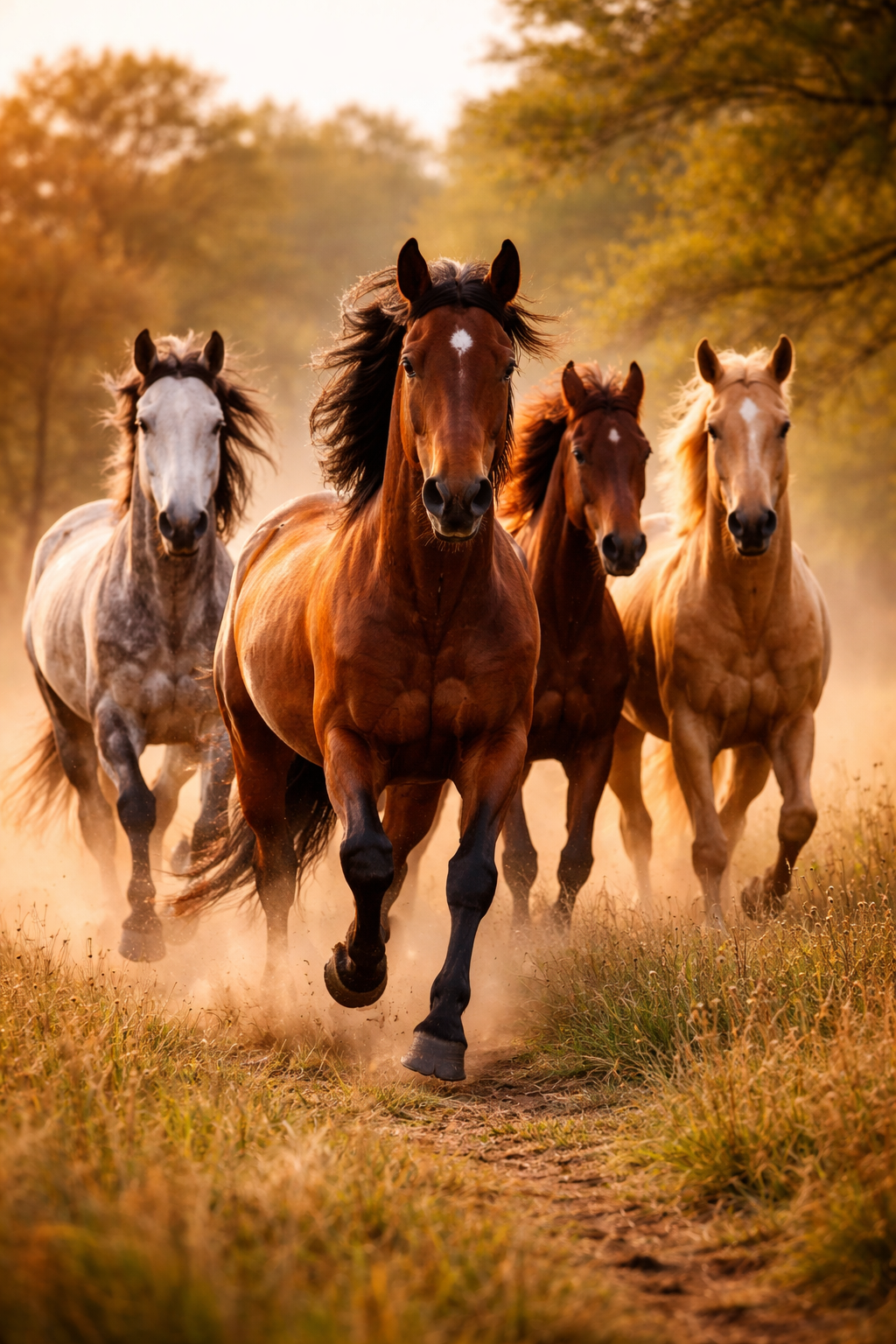
“HORSES LEND US THE WINGS WE LACK”
–Pam Brown
Horses: A Historical, Cultural, and Religious Summary
The horse has been one of the most influential animals in human civilization, shaping transportation, agriculture, warfare, trade, communication, sport, religion, and art for thousands of years. Domesticated horses transformed how people traveled, fought wars, moved goods, and connected distant societies. Across cultures, horses have also become powerful symbols of freedom, strength, nobility, endurance, wealth, and spiritual power.
Historical Importance
Horses were domesticated thousands of years ago on the Eurasian steppes, although the exact process occurred gradually and involved different populations over time. Early humans initially hunted wild horses for food before eventually using them for transportation, labor, and breeding.
Once horses became integrated into human societies, they changed civilization dramatically.
Horses made it possible to:
- Travel farther and faster.
- Transport goods over long distances.
- Expand trade routes.
- Herd livestock.
- Plow agricultural land.
- Carry messages.
- Conduct warfare more effectively.
- Explore and settle new territories.
Mounted travel helped connect distant cultures and contributed to the expansion of empires across Europe, Asia, Africa, and the Americas.
Horses in Warfare
For centuries, horses were central to military power.
Ancient armies used horses to pull chariots before cavalry became widespread. Mounted soldiers could move faster than infantry and attack from greater distances.
Famous horse-centered military traditions included:
- Scythian horse archers.
- Persian cavalry.
- Greek and Macedonian mounted forces.
- Roman cavalry units.
- Mongol horse armies.
- Medieval European knights.
- Ottoman cavalry.
- Indigenous horse cultures of the North American Plains.
The Mongol Empire became especially famous for its highly mobile cavalry. Mongol warriors often traveled with multiple horses, allowing them to cover enormous distances with remarkable speed.
The development of firearms, railroads, armored vehicles, and mechanized warfare gradually reduced the horse’s military role during the nineteenth and twentieth centuries.
Agriculture and Transportation
Before tractors and automobiles, horses were essential sources of power.
They pulled:
- Plows.
- Wagons.
- Carriages.
- Farm equipment.
- Fire engines.
- Delivery vehicles.
- Stagecoaches.
Horse-powered transportation influenced the growth of cities and international commerce for centuries.
Stagecoach routes and mounted postal systems helped connect communities long before modern telecommunications.
Cultural Significance
Across cultures, horses have represented status, prestige, and power.
Historically, owning horses could indicate wealth because maintaining them required land, food, and resources. Kings, warriors, nobles, and political leaders were often depicted on horseback to symbolize authority and military strength.
Horses frequently symbolize:
- Freedom.
- Strength.
- Courage.
- Speed.
- Independence.
- Loyalty.
- Nobility.
- Endurance.
- Adventure.
The image of a horse running freely across an open landscape remains one of the most recognizable cultural symbols of freedom.
Indigenous Cultures of North America
The reintroduction of horses to the Americas by Europeans dramatically changed many Indigenous societies.
Horses became especially important among Plains peoples, where they improved:
- Hunting.
- Transportation.
- Warfare.
- Trade.
- Migration.
They also became closely connected with social identity, wealth, and ceremonial traditions.
Different Indigenous nations developed their own specialized horse cultures, breeding practices, riding traditions, and spiritual meanings surrounding horses.
Greek Mythology
Horses appear prominently in Greek mythology.
Pegasus, the famous winged horse, became a symbol of inspiration, divine power, and freedom.
The god Poseidon was strongly associated with horses and was sometimes credited with creating them.
Greek mythology also contains the centaurs, creatures with the upper body of a human and lower body of a horse, often symbolizing the tension between reason and instinct.
The legendary Trojan Horse became one of history’s most famous symbols of deception and military strategy.
Norse Mythology
Horses played important roles in Norse religion and mythology.
The god Odin rode Sleipnir, an extraordinary eight-legged horse capable of traveling between different worlds.
Sleipnir symbolized supernatural speed, spiritual travel, and the ability to cross boundaries between realms.
Horses were also associated with status, warfare, fertility, and religious ceremony in ancient Scandinavian societies.
Christianity
Horses appear frequently in the Bible.
One of the most famous examples is found in the Book of Revelation, which describes the Four Horsemen of the Apocalypse.
The riders and their horses symbolize forces such as conquest, war, famine, and death.
Biblical horses may also symbolize:
- Military strength.
- Human power.
- Victory.
- Judgment.
- Warfare.
Christian teachings often contrast reliance upon military horses with reliance upon God, emphasizing that earthly power is ultimately limited.
Judaism
The Hebrew Bible frequently mentions horses in connection with kings, armies, chariots, and warfare.
Ancient Israelite writings sometimes warn against placing excessive confidence in horses and military power rather than in God.
Horses therefore became associated both with strength and with the limitations of human power.
Islam
Horses hold an honored place in Islamic history and culture.
They were important in transportation, warfare, trade, and the expansion of early Muslim societies.
Islamic tradition encourages humane treatment of animals, and horses have often been admired for their beauty, courage, and endurance.
The Arabian horse became one of the world’s most famous breeds and played an important role in the development of many later horse breeds.
Hinduism
Horses have strong symbolic and religious importance in Hindu traditions.
The Sun god Surya is often depicted riding a chariot drawn by seven horses, symbolizing light, time, energy, and the movement of the Sun across the heavens.
Ancient Vedic traditions also included the Ashvamedha, or horse sacrifice, a royal ritual associated with sovereignty and political authority.
The horse therefore became connected with kingship, power, cosmic energy, and divine movement.
Buddhism
In Buddhist tradition, horses can symbolize spiritual progress, energy, and disciplined effort.
The historical Buddha, Siddhartha Gautama, is traditionally said to have left his palace riding his horse Kanthaka when beginning his search for enlightenment.
Kanthaka therefore became associated with renunciation, devotion, and the beginning of a spiritual journey.
Horses in Art and Literature
Horses have been depicted in art since prehistoric times.
Some of the world’s earliest known cave paintings feature horses, demonstrating their importance to ancient human societies.
Later artists portrayed horses in:
- Battle scenes.
- Royal portraits.
- Hunting scenes.
- Religious art.
- Landscapes.
- Sporting events.
Equestrian statues became especially important symbols of political and military leadership. Rulers portrayed on horseback projected authority, courage, and command.
Horses also appear prominently in literature, including stories of war, exploration, the American West, racing, and friendship between humans and animals.
Sport and Recreation
Horses remain important in modern sports and recreation.
Popular equestrian activities include:
- Horse racing.
- Show jumping.
- Dressage.
- Rodeo.
- Polo.
- Endurance riding.
- Trail riding.
- Harness racing.
Horse racing has developed into a major international sport with famous events such as the Kentucky Derby, Grand National, Melbourne Cup, and Prix de l’Arc de Triomphe.
Social and Economic Importance
Although machines replaced horses in many traditional jobs, horses continue to support significant industries.
These include:
- Racing.
- Breeding.
- Veterinary medicine.
- Agriculture.
- Tourism.
- Recreation.
- Therapy programs.
- Competitive sports.
In some rural communities around the world, horses remain important for transportation and agricultural work.
Horses and Human Relationships
Humans often develop strong emotional bonds with horses.
Because horses respond to body language, movement, and tone, working with them requires trust and communication.
Horses are also used in certain therapeutic and educational settings, where structured interaction may support confidence, coordination, emotional regulation, and social engagement.
Symbolic Meaning
Across cultures, horses commonly symbolize freedom, power, movement, endurance, and personal strength.
A running horse may represent independence and liberation.
A warhorse may symbolize courage, conflict, or authority.
A white horse often represents purity, victory, or spiritual power in various traditions, while a dark horse may symbolize mystery, unpredictability, or an unexpected challenger.
Because horses carry people from one place to another, they are also frequently associated with journeys, transitions, exploration, and transformation.
Conclusion
Few animals have shaped human civilization as profoundly as the horse. Horses transformed transportation, agriculture, warfare, communication, trade, and exploration while becoming deeply embedded in religion, mythology, art, and cultural identity. From Pegasus and Sleipnir to the biblical horsemen and the sacred horses of Hindu tradition, the horse has repeatedly represented extraordinary strength, freedom, movement, and spiritual power.
Although technology has replaced many of the horse’s traditional roles, its cultural importance remains strong. Today, horses continue to represent the enduring relationship between humanity and nature, combining physical power with intelligence, sensitivity, and remarkable social connection.

Sigmund Freud on the Representation of Horses Within Dreams

Sigmund Freud did not establish a single universal rule stating that a horse always means the father, sexuality, strength, freedom, or any other fixed concept within dreams. His method required the dreamer to examine personal associations to the horse—its color, behavior, rider, location, emotional effect, and connections with recent experiences and childhood memories.
Sigmund Freud did not establish a single universal rule stating that a horse always means the father, sexuality, strength, freedom, or any other fixed concept within dreams. His method required the dreamer to examine personal associations to the horse—its color, behavior, rider, location, emotional effect, and connections with recent experiences and childhood memories.
The Freud Museum emphasizes this central point in Freud’s method: dream images should not simply be interpreted through a fixed dictionary. Their private meanings emerge through the dreamer’s associations.
Horses nevertheless occupy an important place within Freud’s writings. He interpreted an actual horse in one of his own dreams, discussed wild horses among animal images capable of representing passionate impulses, and devoted extensive attention to horses in his famous 1909 case study “Analysis of a Phobia in a Five-Year-Old Boy,” commonly known as the case of Little Hans.
Within Freud’s framework, a horse dream may therefore potentially involve:
- A particular person represented through displacement.
- A father or authority figure when personal associations support it.
- Passionate or instinctual impulses.
- Fear of aggression or punishment.
- Sexual curiosity or anxiety.
- Power and physical energy.
- Being controlled by another person.
- Attempting to control a powerful situation.
- Competition or rivalry.
- Childhood fears.
- Pregnancy or childbirth in a very specific associative context.
- A bodily sensation incorporated into the dream.
- Verbal expressions and puns involving horses or riding.
The exact dream remains more important than the animal by itself.
Freud’s Own Dream of Riding a Gray Horse
One of Freud’s most useful documented examples appears in The Interpretation of Dreams.
Freud dreamed that he was riding a gray horse. At first he rode timidly and awkwardly. Later he became increasingly comfortable and felt completely at home in the saddle.
This dream was influenced partly by a real physical condition. Freud was suffering from a painful boil in an area of the body that would have made horseback riding extremely uncomfortable. Yet the dream represented him doing precisely what his physical pain should have prevented him from doing.
Freud interpreted this as part of the dream’s attempt to preserve sleep.
The painful sensation threatened to awaken him.
The dream effectively responded:
You cannot be suffering from that pain because you are comfortably riding a horse.
The horse dream therefore helped deny the bodily disturbance and allowed sleep to continue.
This example shows that dreaming about a horse may sometimes begin with something very literal:
- Pressure on the body.
- Pain.
- Sleeping position.
- Physical discomfort.
- Recent horseback riding.
- Seeing horses during the day.
A Freudian interpretation should therefore not begin by assuming that the horse must represent an elaborate psychological symbol.
The Horse as a Representation of a Woman
Freud’s gray-horse dream also developed a second level of meaning.
During his analysis, Freud explicitly concluded that the intelligent horse became a symbolic representation of a female patient whom he had previously treated. He recalled that the patient had effectively led him wherever she wished, much as a rider might believe they control a horse while actually being carried in the direction the horse chooses.
This is one of the clearest documented examples demonstrating why Freud resisted simple dream dictionaries.
In this particular dream:
horse → female patient
But this was not because Freud believed every horse universally represents a woman.
The meaning developed because of:
- His relationship with the patient.
- His colleague replacing him in her treatment.
- Expressions involving riding.
- His memories of that household.
- The physical sensations experienced during sleep.
A different dreamer could have entirely different associations.
Riding a Horse and the Question of Control
Because Freud’s own dream involved riding, the relationship between rider and horse can become particularly important.
The dreamer may appear to control the horse.
Or the horse may actually control the dreamer.
This distinction can reflect a waking relationship or situation.
Hypothetical example
A dreamer rides a horse that ignores every command and takes them wherever it wants.
A Freudian examination might ask:
Who in my life currently leads me wherever they want despite my belief that I am in control?
The horse could potentially represent:
- A romantic partner.
- A client.
- An employer.
- A family member.
- A strong desire.
- An overwhelming situation.
The answer would come through free association.
Riding Successfully
A dreamer confidently controlling a horse might express a wish for mastery.
The dream could involve:
- Control over circumstances.
- Professional confidence.
- Sexual confidence.
- Authority.
- Physical ability.
- Overcoming fear.
- Competition.
Example
A person who feels powerless at work dreams of riding an enormous horse perfectly through difficult terrain.
The dream may fulfill a wish for control and competence.
But further associations remain necessary.
Perhaps horseback riding reminds the person of a parent, childhood experience, movie, former relationship, or particular social class.
Those associations could substantially alter the interpretation.
Losing Control of a Horse
An uncontrolled horse can portray something that feels psychologically difficult to manage.
Possible associations might include:
- Anger.
- Sexual desire.
- Ambition.
- Anxiety.
- Another person.
- A relationship.
- An increasingly difficult responsibility.
Freud wrote that wild beasts in dreams can represent passionate impulses, including impulses belonging to the dreamer or to another person whom the dreamer fears. He specifically included wild horses among animal images capable of representing the feared father or powerful instinctual energy.
Example
A normally restrained person dreams that a horse suddenly bolts while they desperately pull the reins.
Within Freud’s framework, the dream could raise the question:
What powerful impulse am I currently trying to restrain?
The answer might concern anger, desire, ambition, jealousy, or another emotion—but only the dreamer’s associations can establish which.
Wild Horses and Passionate Impulses
Freud made one of his broader statements about animal symbolism in The Interpretation of Dreams when discussing wild beasts.
He wrote that such animals may symbolize passionate impulses and that dangerous animals—including wild horses—can sometimes represent a dreaded father figure. He also connected wild beasts with libido experienced as something threatening to the ego and opposed by repression.
This gives wild-horse dreams a particularly interesting Freudian possibility.
A wild horse might represent:
- Powerful desire.
- Aggression.
- Sexual excitement.
- Anger.
- A feared person’s passion.
- A powerful parent.
- An impulse the dreamer feels unable to control.
But even here Freud’s broader method requires caution.
A dreamer who owns horses professionally may dream of a wild horse for entirely ordinary reasons.
The Horse and the Father
The strongest documented connection between horses and a father figure occurs in Freud’s analysis of Little Hans.
Hans developed an intense fear of horses at approximately five years old. He feared going outside because a horse might bite him. The Freud Museum describes this horse phobia as one of Freud’s most famous childhood cases.
Freud eventually interpreted particular feared horses as substitutes for Hans’s father.
This interpretation was based partly upon specific details.
Hans was especially disturbed by:
- The black area around horses’ mouths.
- Things horses wore in front of their eyes.
Freud connected these features with the father’s moustache and eyeglasses and told Hans that his fear of horses was connected with his fear of his father.
This is an example of displacement.
Emotion originally connected with one person becomes attached to another object—in this case, the horse.
Important limitation
This does not establish:
Horse = father in every dream.
It establishes that a horse can represent the father when the dreamer’s own associations and details support that interpretation.
A Horse With Human Features
A dream horse may contain characteristics belonging to a known person.
For example:
- The father’s eyes.
- The mother’s voice.
- A supervisor’s clothing.
- A partner’s mannerisms.
- A familiar facial expression.
Freud would consider such details extremely important.
Example
A dreamer sees a horse with the exact moustache of their father.
The association is relatively direct.
The horse may be functioning as a displaced representation of the father, particularly if the dream contains fear, authority, competition, or punishment.
Fear of Being Bitten by a Horse
Little Hans specifically feared that a horse would bite him.
Within Freud’s interpretation, this fear became connected with the child’s anxiety toward his father and the possibility of paternal retaliation within Freud’s theory of the Oedipal conflict.
For another dreamer, a biting horse might represent something entirely different.
Possible associations could include:
- Fear of attack.
- Punishment.
- A hostile parent.
- A threatening authority.
- An aggressive relationship.
- Fear surrounding one’s own wishes.
Example
A dreamer reaches toward a horse and expects affection, but the horse bites the hand.
The dream may depict a relationship in which the dreamer seeks closeness but expects punishment or rejection.
The identity of the horse would need to be discovered through association.
Being Chased by a Horse
Freud did not provide a universal formula for being chased by horses.
Using his method, the question becomes:
Who or what is pursuing me through the horse?
If the horse represents a feared authority, being chased may express fear of punishment.
If it represents an instinct or desire, the chase may dramatize the dreamer’s attempt to escape that impulse.
Example
A dreamer runs from a powerful stallion but becomes increasingly fascinated by it.
The mixture of fear and attraction may indicate an emotionally conflicted relationship with whatever the horse represents.
Freud placed great importance upon precisely such ambivalence—loving and hostile or desiring and fearing attitudes existing together.
Horses Falling Down
Falling horses became especially important in the Little Hans case.
Hans had witnessed a large horse pulling a vehicle fall down in the street. The event frightened him intensely and became incorporated into his phobia.
Within Freud’s analysis, the falling horse eventually acquired several meanings.
It became connected with:
- The father falling or dying.
- Hans’s hostile wish toward his father.
- Fear for the father.
- His mother’s childbirth.
- A heavily loaded body expelling its contents.
Freud specifically concluded that the falling horse could represent not only the dying father but also the mother in childbirth.
This again illustrates condensation.
One horse image can represent several different people, wishes, memories, and anxieties simultaneously.
Dreaming of a Horse Falling
For a different dreamer, a falling horse should not automatically receive the Little Hans interpretation.
Instead, Freud’s method would ask:
- Have you ever seen a horse fall?
- Who does the horse remind you of?
- Did you feel horror, relief, guilt, or sadness?
- What powerful person in your life currently appears weakened?
- Did you secretly want the horse to fall?
- What happened immediately before the fall?
Hypothetical example
A dreamer intensely dislikes an authoritarian employer and dreams that the employer rides a horse that collapses.
The dream might contain a disguised wish for the employer’s power to fail.
If the dreamer immediately rushes to save the horse, however, guilt or affection may coexist with the hostile wish.
The Horse and Wish Fulfillment
Freud regarded dreams fundamentally as expressions connected with wishes, although censorship, displacement, condensation, and secondary revision can disguise those wishes.
A horse dream may therefore fulfill a straightforward wish.
Someone who always wanted a horse may simply dream of owning one.
A child prohibited from riding may dream of riding freely.
Someone physically incapable of riding may dream of riding perfectly—much as Freud himself dreamed of horseback riding while experiencing pain that should have made riding impossible.
Example
A person confined by responsibilities dreams of galloping freely across an open field.
One possibility is straightforward wish fulfillment:
I want to escape these restrictions.
But the dreamer’s personal meaning of horseback riding must still be established.
Horses and Sexuality
Because Freud interpreted dreams through psychosexual conflicts and sometimes treated wild animals as representations of passionate impulses, horses may acquire sexual significance when the dreamer’s associations support it.
However, it would be inaccurate to claim:
“Freud believed every horse is a sexual symbol.”
Horse imagery might become sexual because of:
- Riding.
- Physical power.
- Fear of uncontrolled passion.
- Genital associations.
- A specific childhood memory.
- Attraction to a person represented by the horse.
Little Hans himself showed considerable curiosity about the bodies and genital anatomy of large animals, including horses, and Freud integrated that material into his analysis of the child’s conflicts.
A Powerful Stallion
Freud did not establish “stallion = male sexuality” as an automatic dream rule.
Nevertheless, if a dreamer associates a stallion with masculinity, sexuality, dominance, or physical power, those associations become legitimate material for analysis.
Example
A dreamer is fascinated but frightened by an uncontrollable stallion.
The horse might represent a powerful desire that is simultaneously attractive and threatening.
A Mare
Likewise, a mare does not possess one universal Freudian meaning.
Yet Freud’s own gray horse dream demonstrates that a horse could represent a woman—in his case, a particular female patient.
Therefore, if the dreamer’s associations clearly lead toward:
- Mother.
- Wife.
- Romantic partner.
- Female authority.
- A specific woman.
then the horse may act as that person’s representation.
Horses Pulling Heavy Loads
Heavily loaded horses had special importance in the Little Hans material.
Freud connected heavily loaded carts and horses with Hans’s ideas about:
- Pregnancy.
- Childbirth.
- Bodily contents.
- Defecation.
Freud interpreted loaded carts as symbolic representations connected with pregnancy and the falling of a heavily loaded horse with childbirth.
Again, this interpretation belongs to Hans’s particular associative system.
Hypothetical example
A pregnant dreamer sees a horse struggling to pull an enormous cart.
A Freudian analysis could investigate pregnancy associations, particularly if the dreamer personally connects the load with carrying a child.
But another dreamer might associate the same image with:
- Workload.
- Financial responsibility.
- Family obligations.
- Physical exhaustion.
A Horse Carrying Too Much
Outside the specific Hans context, an overloaded horse may provide an obvious visual metaphor.
The dreamer might identify with the horse.
Example
A worker dreams of a horse collapsing beneath dozens of packages.
The free association might quickly produce:
“That is exactly how I feel at work.”
No more complicated symbolism would necessarily be required.
A Dead Horse
Freud did not establish a fixed dream rule for a dead horse.
Its meaning would depend upon what living horses represent to the dreamer.
If the horse represents:
- Father → death of horse may concern fear or wish involving father.
- Desire → dead horse may represent loss of desire.
- Work → dead horse may suggest exhaustion.
- Freedom → dead horse may represent restriction.
- A relationship → the dream may concern its ending.
Example
A person whose father was an avid horseman dreams of a dead horse after the father becomes ill.
The most immediate association may simply be the father.
The personal connection is stronger than any generalized symbolism.
An Injured Horse
An injured horse similarly invites the question:
What powerful or useful thing in my life now seems damaged?
Possible associations include:
- A parent.
- A relationship.
- Physical health.
- Sexual confidence.
- Professional competence.
- A previously powerful ambition.
The dreamer’s emotional reaction is crucial.
A Friendly Horse
A calm and affectionate horse might represent a relationship with a person or impulse that feels safe.
Example
A dreamer previously frightened of a horse eventually pets it.
This might suggest that something formerly threatening has become psychologically manageable.
But the dream might also simply reflect a real improvement in the dreamer’s comfort around horses.
A Horse Entering the House
Freud did not give a standard interpretation for a horse entering a house.
Free association should therefore determine both elements.
The horse may represent a person, impulse, memory, or wish.
The house may connect with:
- Family.
- Childhood.
- Privacy.
- The body.
- A particular literal home.
Example
A horse resembling the dreamer’s father walks into the childhood bedroom.
The personal associations make the family connection much stronger than the animal alone.
Horseback Riding and Verbal Puns
Freud paid close attention to linguistic connections, jokes, idioms, and double meanings.
His own horse dream involved the expression “ride the high horse.” The dream also connected riding skill with an earlier professional situation and the language of being securely “in the saddle.”
A horse dream may therefore visually represent expressions such as:
- “Get off your high horse.”
- “Back in the saddle.”
- “Hold your horses.”
- “Dark horse.”
- “Bet on the wrong horse.”
- “Beating a dead horse.”
- “Straight from the horse’s mouth.”
- “Horse around.”
- “Change horses.”
- “Put the cart before the horse.”
Example: “High horse”
A dreamer argues arrogantly with everyone while sitting on an extremely tall horse.
The dream may literally picture the accusation:
“You are on your high horse.”
Example: “Back in the saddle”
Someone returning to work after a long absence dreams of mounting a horse.
The dream may use ordinary language rather than obscure symbolism.
Example: “Hold your horses”
A person rushing into an important decision dreams of desperately trying to restrain several horses.
The image may embody the familiar instruction to slow down.
Freud’s attention to verbal associations makes such possibilities particularly relevant.
The Color of the Horse
Freud did not establish a universal chart in which:
- White horse = one meaning.
- Black horse = another.
- Brown horse = another.
His own dream provides an excellent example.
Freud’s horse was gray, and he connected the color with the pepper-and-salt-colored clothing worn by his colleague P.
Thus the horse’s color acted as an associative bridge to a particular person.
A Freudian interpretation of color would therefore ask:
What does this exact color remind me of?
White Horse
A white horse might remind the dreamer of:
- A wedding.
- A childhood story.
- A movie.
- A deceased relative.
- A religious image.
- A particular real horse.
The personal association is primary.
Black Horse
A black horse might connect with:
- A particular animal.
- Clothing.
- Mourning.
- Night.
- A frightening story.
- A specific person.
Blackness does not automatically make the horse evil.
Gray Horse
Freud’s own gray horse demonstrates how precise an association can become.
Gray did not simply represent neutrality or old age.
It pointed toward the clothing of a colleague and helped connect the horse dream with a professional relationship.
Multiple Horses
Several horses may represent several people, several impulses, or one concern multiplied.
The number should be examined rather than automatically decoded.
Example
Three horses resemble three coworkers competing with the dreamer.
The numerical correspondence may be meaningful.
Example
Hundreds of horses stampede toward the dreamer.
The exaggeration may express the overwhelming intensity of the emotion or conflict represented by them.
A Horse Stampede
A stampede combines the horse’s power with loss of individual control.
A Freudian analysis could explore:
- Uncontrolled excitement.
- Aggression.
- Sexual desire.
- Social panic.
- Fear of being overwhelmed.
- Several powerful people acting together.
If the dreamer is terrified of their own emotional impulses, the stampede may represent those impulses magnified into an external threat.
A Horse Protecting the Dreamer
A horse that protects rather than threatens may represent a person or quality experienced as powerful but beneficial.
Example
A horse stands between the dreamer and an attacker.
Free association might reveal that the horse resembles a protective parent or partner.
Alternatively, the dreamer may associate horses with personal strength and wish to possess more of that strength.
Becoming a Horse
A dream in which the dreamer becomes a horse could express identification with whatever qualities the dreamer associates with the animal.
These might include:
- Strength.
- Sexual energy.
- Hard work.
- Being controlled.
- Carrying burdens.
- Freedom.
- Aggression.
Example
A dreamer becomes a workhorse pulling everyone else’s belongings.
The metaphor may be almost literal:
“Everyone treats me like a workhorse.”
Example
The dreamer becomes a wild horse and escapes confinement.
The dream may fulfill a wish to escape a restricting situation.
Horse and Rider as Separate Parts of a Conflict
Sometimes both horse and rider may be psychologically significant.
The rider may represent conscious intention.
The horse may carry a powerful impulse.
Example
The rider wants to go right while the horse insists on going left.
The dream may portray conflict between what the dreamer consciously believes they should do and what another desire pushes them toward.
The interpreter should ask for associations to both figures rather than assuming a predefined body-versus-mind symbolism.
Questions for a Freudian Interpretation of Horses
A careful Freudian analysis would ask:
- What is my first memory of horses?
- Have I ever ridden one?
- Do horses frighten or attract me?
- Who does this horse remind me of?
- Did it have any human characteristics?
- What color was it?
- What does that color remind me of?
- Was I riding the horse or watching it?
- Who controlled whom?
- Was the horse calm, wild, injured, falling, or attacking?
- Was I afraid it would bite me?
- Was there a rider?
- Did the rider resemble someone I know?
- Was the horse carrying a heavy load?
- Did the dream involve physical pain or pressure while I slept?
- Did something involving horses happen during the previous day?
- Does the dream picture an expression such as “high horse,” “back in the saddle,” or “hold your horses”?
- Does the horse remind me of a parent, partner, patient, employer, or authority figure?
- What wish would be fulfilled if I could control this horse?
- What am I afraid would happen if the horse became uncontrollable?
- What emotion am I trying to restrain?
- What childhood memory is connected with this animal?
These associations determine the interpretation far more reliably than simply declaring:
“A horse means power.”
Conclusion
Within Sigmund Freud’s approach, the horse is a highly context-dependent dream image.
Freud provides an unusually valuable documented example in The Interpretation of Dreams. In his own dream, he rode a gray horse while suffering from a painful physical condition that should have made riding impossible. The dream helped preserve sleep by denying the pain. At another level, the horse represented a particular female patient, its gray color connected with a colleague’s clothing, and the riding imagery incorporated verbal expressions involving being “in the saddle” and “riding the high horse.”
Freud also stated more generally that wild beasts can represent passionate impulses and specifically mentioned wild horses among animal images that can represent a dreaded father or libido experienced by the ego as threatening.
His most extensive treatment of horse imagery occurred in the Little Hans case. Hans’s fear of horses was interpreted through displacement: particular features of the frightening horses reminded Freud of the father’s moustache and eyeglasses, and Freud connected the horse with Hans’s fear of paternal retaliation.
The falling horse became even more complicated. Through condensation, it could represent both the feared or wished-for fall of the father and, within Hans’s specific network of associations, his mother in childbirth.
These examples demonstrate precisely why the horse should not be given one fixed Freudian meaning.
A horse may represent a father in one dream and a woman in another. It may represent passion when wild, physical discomfort when being ridden, a burden when heavily loaded, or a verbal expression when the dream dramatizes phrases involving riding.
The central Freudian question is therefore:
“Who or what does this particular horse become when I follow my own associations—and what wish, fear, relationship, bodily sensation, childhood memory, or powerful impulse has the dream displaced onto it?”
Bibliography
Freud, Sigmund. The Interpretation of Dreams. Originally published as Die Traumdeutung in 1899/1900. Freud’s discussion includes his own dream of riding a gray horse, the incorporation of bodily stimulation into dreams, dream-work, free association, symbolism, displacement, condensation, and wish fulfillment.
Freud, Sigmund. “Analysis of a Phobia in a Five-Year-Old Boy.” 1909. The case of Little Hans contains Freud’s extensive analysis of the child’s horse phobia, including the horse as a representation of the father, fear of being bitten, the significance of the father’s moustache and eyeglasses, and the multiple meanings of falling and heavily loaded horses.
Freud Museum London. “The Curious Case of Little Hans.” Educational materials summarizing the historical case, Hans’s intense fear of horses, and Freud’s interpretation of the phobia within his theory of childhood conflict.
Freud Museum London. “Freud’s Method for Interpreting Dreams.” Overview of Freud’s use of free association and his rejection of a simplistic fixed-symbol dream dictionary.
Carl Jung on the Representation of Horses Within Dreams

Carl Jung regarded the horse as one of the important animal images of the unconscious. Unlike a simple fixed-symbol approach, Jung believed the meaning of a horse dream must be determined from the dreamer’s personal circumstances, emotional reaction, associations, and the horse’s behavior within the dream. Nevertheless, Jung wrote directly and extensively about the symbolic significance of the horse.
In The Practice of Psychotherapy, Jung described the horse as an archetypal image widespread throughout mythology and folklore. He associated it with the non-human or animal side of the psyche, instinct, the unconscious, bodily life, dynamic energy, and a power capable of carrying the individual forward. He also linked the horse with the mother archetype in certain mythological contexts.
In Symbols of Transformation, Jung likewise discussed horses as representations of instinctual libido or psychic energy. He emphasized that animal figures in dreams can give visible form to instinctive forces that have not been adequately incorporated into conscious personality.
Within Jung’s framework, a horse in a dream may therefore represent instinctual energy, vitality, movement, unconscious motivation, bodily life, freedom, powerful emotion, or a force carrying the dreamer toward psychological change. Whether this force is helpful or dangerous depends upon the condition of the horse and the dreamer’s relationship with it.
The Horse as an Image of the Unconscious
Jung explicitly described the horse as representing what he called the non-human psyche—the instinctive and animal dimension of human nature that exists beneath ordinary conscious reasoning.
This part of the personality includes bodily impulses, spontaneous reactions, desires, emotional energies, and forms of instinctive knowledge that consciousness may not fully understand.
The horse can therefore become an image of something within the dreamer that possesses tremendous energy but does not operate primarily through rational thought.
A calm horse may show instinct working cooperatively with consciousness.
A frightened horse may indicate instinctive anxiety.
A violent horse may reveal instinctual energy that has become difficult to contain.
A horse carrying the dreamer confidently forward may suggest that unconscious energy is supporting development.
The central question becomes:
What unconscious force is carrying the dreamer, and where is it trying to go?
The Horse as Instinct
Jung repeatedly connected animal imagery with instinct. In Symbols of Transformation, he specifically included the horse among animals through which libido or instinctive psychic energy may appear symbolically.
The horse can therefore represent impulses involving movement, desire, sexuality, aggression, survival, ambition, independence, physical vitality, or simply the body’s own natural rhythms.
Importantly, Jung used libido in a broad sense as psychic energy rather than restricting it to one particular drive.
Dream example: The powerful horse
A dreamer sees a magnificent horse pawing impatiently at the ground.
The dreamer admires the animal but is afraid to approach it.
A Jungian interpretation might ask whether the dreamer possesses a powerful instinct, ambition, creative drive, emotional need, or desire that consciousness has been reluctant to acknowledge.
The horse is full of energy.
The question is whether that energy can be approached and integrated.
Riding a Horse
Riding creates a particularly meaningful relationship between conscious personality and instinct.
The rider attempts to direct the horse, but the horse provides the actual energy and movement.
This can produce a useful image of the relationship between the ego and the unconscious.
The rider may represent conscious intention.
The horse may represent the deeper psychic energy carrying that intention into action.
Riding confidently
A dreamer who rides comfortably and remains in communication with the horse may be experiencing a relatively cooperative relationship with instinct.
The person knows where they are going, while the horse supplies the strength required to get there.
Such imagery may appear during a period of:
personal confidence, creative productivity, emotional integration, independence, or renewed vitality.
Example
A dreamer rides a strong horse over difficult terrain but never needs to force the animal.
The dream might indicate that conscious goals and instinctive motivation are moving in the same direction.
Losing Control of the Horse
An uncontrollable horse presents a very different psychological situation.
Jung described the horse as a dynamic power capable of carrying someone away like a surge of instinct. He also observed that horses can panic because instinctive creatures do not possess the higher consciousness available to human beings.
A runaway horse can therefore represent psychic energy that is carrying the ego somewhere it did not consciously intend to go.
Example
A dreamer rides a horse that suddenly bolts toward a cliff.
The dream may ask whether some emotional or instinctive force is becoming dangerously autonomous.
That force could involve anger, ambition, desire, fear, obsession, or another powerful state.
The point is not that the horse itself is evil. The problem is that communication between rider and animal has broken down.
Falling From a Horse
Falling can indicate that the conscious personality has lost its relationship with the energy represented by the horse.
A person may feel:
overwhelmed by emotion, disconnected from confidence, unable to control an undertaking, or suddenly deprived of vitality.
Example
A successful executive dreams of riding a magnificent horse before suddenly falling while the horse continues without them.
The horse may represent the energy driving the person’s career.
The fall could suggest that the career momentum has become larger than the conscious individual can manage.
The horse continues.
The rider does not.
The dream may therefore question whether the dreamer is still directing their life or merely being carried by its momentum.
The Wild Horse
A wild horse may present instinctive life in a relatively unrestrained form.
It can symbolize:
freedom, vitality, powerful desire, independence, spontaneous emotion, or instinct that has not yet entered a stable relationship with consciousness.
Example
A highly controlled person dreams repeatedly of wild horses running across an open landscape.
The dream may compensate for an excessively restricted conscious life.
The horses possess something the dreamer lacks: spontaneity and freedom.
The dream does not necessarily tell the person to abandon all discipline. Rather, it may indicate that conscious life has become too narrow and requires greater access to instinctive vitality.
The Caged or Confined Horse
A horse locked in a small enclosure can suggest that natural energy has been excessively restricted.
Example
A dreamer discovers a powerful horse chained inside a dark basement.
The horse desperately wants to move but cannot.
A Jungian examination might ask what instinctive or creative energy the dreamer has confined.
Perhaps the person has suppressed anger, ambition, creativity, sexuality, independence, or the desire for a different life.
The basement location could strengthen the connection with unconscious material.
The horse remains alive, but its energy has no acceptable outlet.
Releasing the Horse
Releasing a confined horse may indicate allowing previously restricted energy into life.
But the outcome matters.
If the released horse moves calmly into an open field, the liberation may be constructive.
If it immediately destroys everything around it, the dream may warn that suppressed instinct cannot simply be released without conscious relationship and responsibility.
Jung’s goal was not uncontrolled instinct.
It was integration.
The Horse as Dynamic Psychic Energy
One of Jung’s most direct descriptions of the horse is that it represents dynamic and vehicular power—a force that carries the individual forward.
This makes the direction of movement especially important.
A horse carrying the dreamer upward may indicate one kind of development.
A horse descending underground suggests another.
A horse carrying the dreamer home differs from one carrying the dreamer into unknown territory.
Example
A horse suddenly appears during a period when the dreamer feels completely stuck and carries them across a river.
The animal may represent psychic energy capable of moving the person through a transition that conscious thought alone has been unable to resolve.
The crossing itself becomes just as important as the horse.
Following a Horse
Sometimes the dreamer does not ride the animal but follows it.
This may indicate that instinct is providing direction.
Example
A person lost in a forest sees a horse and follows it until reaching a road.
The horse may represent an instinctive orientation that knows the way when rational consciousness does not.
The image does not have to imply supernatural guidance.
Psychologically, it can portray the unconscious possessing information or orientation that the conscious ego has not yet formulated.
The Horse as a Guide Into the Unconscious
A horse that carries the dreamer into a cave, forest, underground passage, or unfamiliar landscape can symbolize movement into deeper unconscious material.
Example
A white horse carries the dreamer through a dark forest to an abandoned childhood home.
The horse provides the energy and transportation.
The destination suggests that the unconscious is directing attention toward childhood material.
The important question would then become what happens inside the house.
The Horse and the Body
Jung specifically connected the horse with animal life of the body. In his discussion of horse symbolism, he described the animal as representing bodily and instinctual life beneath the level of conscious human personality.
A horse dream may therefore sometimes concern:
physical vitality, exhaustion, sexuality, bodily needs, illness, appetite, or the way the dreamer treats their own body.
Example
A person continually overworks and dreams of forcing an exhausted horse to keep running.
The horse may represent the dreamer’s own body.
Conscious ambition says:
“Keep going.”
The body says:
“I cannot.”
The dream becomes a conflict between conscious will and bodily reality.
The Exhausted Horse
A weak, starving, or exhausted horse may suggest depleted psychic or physical energy.
Example
A dreamer encounters an emaciated horse that can barely stand.
The dreamer has spent months meeting everyone else’s demands while neglecting rest and personal interests.
The horse may personify the condition of the dreamer’s vitality.
The dream asks not how to force the horse to move but how to restore it.
Feeding the Horse
Feeding may indicate nourishing the source of energy represented by the animal.
Example
The dreamer finds a starving horse and feeds it.
Soon the animal regains strength.
The dream may suggest that psychological vitality can return when neglected needs are acknowledged.
What constitutes “food” in waking life could be:
rest, creative expression, relationships, meaningful work, physical activity, or another personally necessary source of energy.
The Injured Horse
An injured horse may represent damaged instinctive functioning.
Example
A horse has an injured leg and cannot move forward.
The dream may portray a part of the dreamer that wants to progress but lacks the psychological strength or confidence to do so.
The location of the injury, how it occurred, and whether the dreamer helps the animal would all matter.
The Dead Horse
A dead horse may indicate that an important source of energy has become unavailable.
This might concern:
motivation, desire, creativity, independence, physical vitality, or an old way of moving through life.
Example
A dreamer discovers that the horse that carried them through earlier dreams has died.
Rather than assuming catastrophe, a Jungian interpretation might ask whether a particular psychological attitude has completed its purpose.
Perhaps the old form of energy must die before another can emerge.
Dream sequences are particularly useful here.
Horse and Rider as Consciousness and Instinct
The horse-and-rider relationship provides one of the most useful ways to apply Jung’s horse symbolism.
If the rider completely dominates the horse, instinct may be excessively controlled.
If the horse completely dominates the rider, instinct may be overwhelming consciousness.
A healthier image may involve cooperation.
Example
A rider pulls violently on the reins while the horse struggles.
The dream may portray excessive conscious control.
Example
The rider has no reins and is carried helplessly wherever the horse chooses.
The opposite problem appears: insufficient conscious direction.
Example
The dreamer rides without force while horse and rider respond naturally to one another.
This can symbolize a more integrated relationship between conscious intention and instinctive energy.
The Horse and the Mother Archetype
Jung explicitly connected the horse, particularly as a beast of burden and carrier, with the mother archetype. He cited mythological examples in which horse-like or carrying figures transport heroes and linked this carrying function with the maternal source of life.
In Symbols of Transformation, horse symbolism also appears within Jung’s larger analysis of the mother image and the struggle for psychological independence.
This does not mean that every horse dream represents the dreamer’s literal mother.
Rather, the connection becomes more plausible when the dream contains themes such as:
being carried, dependence, childhood, birth, protection, nourishment, or difficulty separating from a maternal environment.
Example
An adult dreamer repeatedly rides the same horse back to the childhood home whenever attempting to leave.
The horse may represent an unconscious force repeatedly returning the person toward an earlier condition of dependence.
The psychological question may concern separation and independence.
The Horse Carrying the Dreamer
The horse’s capacity to carry can have both positive and negative meanings.
A horse carrying someone safely may suggest support.
A horse carrying someone helplessly backward may suggest regression.
Example
A dreamer tries to walk toward a new home, but a horse continually carries them back to their parents’ house.
The image might portray an unconscious pull toward dependence or an older psychological condition.
The horse is not merely transportation.
It represents the force maintaining the movement.
Horses and Transformation
In Symbols of Transformation, Jung placed horse imagery within a broad network of myths concerning libido, movement, heroes, mothers, death, rebirth, and psychological development.
A horse may therefore become particularly meaningful when it appears at a threshold:
before crossing water, entering a forest, climbing a mountain, descending underground, leaving home, or approaching an unknown destination.
Example
A horse appears immediately after the dreamer decides to leave an old life behind.
The animal may represent the energy required for transition.
If the dreamer refuses to mount, the dream may expose hesitation.
If they mount willingly, movement begins.
The Black Horse
Jung specifically mentioned black night-horses in connection with darker mythological associations, including sorcery and death imagery.
However, this should not be simplified into:
Black horse = death.
The black horse should first be interpreted in the complete dream.
Blackness may intensify the animal’s connection with:
the unknown, unconscious material, fear, darkness, transformation, or a psychic force the dreamer does not yet understand.
Example
A black horse emerges from darkness but peacefully carries the dreamer to safety.
Although the horse appears frightening, its function is constructive.
The dream may suggest that something arising from the unknown unconscious becomes the means of escape from a conscious problem.
Another example
A black horse repeatedly appears before major endings in a dream sequence.
Here the darker mythological associations may deserve stronger consideration.
The White Horse
Jung did not establish a simple rule that a white horse always represents purity or spirituality.
A white horse can acquire those meanings when the dream and the dreamer’s associations support them, particularly if the animal appears numinous, luminous, guiding, or extraordinary.
Example
A white horse appears at the center of a dark landscape and leads the dreamer toward sunrise.
The contrast may give the animal an orienting or transformative function.
But a white horse that attacks the dreamer would require a very different interpretation.
Color alone does not override behavior.
The Red Horse
A red horse might emphasize vitality, blood, passion, heat, aggression, or another association connected with red.
Jung’s contextual method would require the dreamer’s personal associations before deciding which meaning applies.
Example
A red horse becomes increasingly violent whenever the dreamer suppresses anger.
The color may amplify the horse’s connection with emotional heat and aggression.
The Winged Horse
A flying or winged horse combines animal instinct with elevation.
It can portray instinctive energy transformed into imagination, aspiration, creativity, or spiritual movement.
Example
A horse grows wings immediately after the dreamer stops trying to control it violently.
The dream may indicate that instinct, once related to rather than merely suppressed, can become a source of creative development.
This is a Jungian application rather than a fixed horse rule stated by Jung.
A Herd of Horses
A herd may represent a large quantity of instinctive energy or a collective movement.
Example
Hundreds of horses stampede toward the dreamer.
The image may portray instinctive forces becoming overwhelming.
The dreamer should ask what currently feels impossible to control.
Another example
A herd moves peacefully across an open plain while the dreamer watches with admiration.
The image may depict natural psychic energy functioning without conflict.
The dreamer is witnessing rather than fighting instinctive life.
A Stampede
A stampede is especially useful as an image of collective loss of control.
The dreamer may feel overwhelmed by:
emotion, social pressure, panic, desire, or rapidly developing circumstances.
Jung’s description of the horse as an instinctive creature subject to panic makes this interpretation particularly appropriate when supported by waking circumstances.
Becoming a Horse
Dreaming of becoming a horse can indicate identification with the qualities represented by the animal.
Example
A physically exhausted person transforms into a horse and is immediately loaded with enormous burdens.
The image may reveal how the dreamer experiences themselves: as a creature expected only to work and carry other people’s responsibilities.
Another example
A timid person transforms into a wild horse and runs freely.
The dream may compensate for excessive restriction and reveal a need for greater independence or vitality.
A Horse Speaking
Jung noted that horses in folklore sometimes possess unusual perception and can speak or know things human beings do not. He used this folkloric characteristic to reinforce the horse’s connection with the unconscious.
A speaking horse can therefore be especially important.
Example
The horse says:
“You are going the wrong way.”
The statement may personify an unconscious realization that the dreamer’s conscious plan is misguided.
Example
The rider repeatedly ignores the horse’s warnings until the road collapses.
The dream may dramatize consciousness ignoring instinctive knowledge.
The Horse as Intuition
Jung also discussed a fairy tale in which riding animals participate in images of knowing and intuition. In his analysis, a horse could carry a knowing function that is not identical with ordinary conscious reasoning.
Thus a horse that seems to “know the way” may represent an intuitive function.
Example
The dreamer is completely lost, but the horse insists on one road and eventually reaches safety.
The dream may suggest that intuitive judgment currently sees something conscious reasoning does not.
The Four-Legged Horse and Wholeness
In Jung’s analysis of one fairy tale, the contrast between a three-legged and four-legged horse became significant because fourness frequently represented wholeness in his psychology. The complete four-legged horse proved superior to the incomplete three-legged animal.
This does not mean that every ordinary four-legged horse represents the Self.
But an unusually incomplete or damaged horse in a highly symbolic dream may raise questions about psychological completeness.
Example
A dreamer repeatedly encounters a three-legged horse that later regains its fourth leg.
Within a strongly archetypal dream sequence, the restoration could suggest movement toward greater completeness or integration.
The Horse and the Shadow
A frightening or wild horse can sometimes carry shadow material when it embodies qualities the dreamer refuses to acknowledge.
These may include:
aggression, sexuality, ambition, independence, anger, physical desire, or spontaneity.
Example
A highly restrained individual dreams of a violent horse locked behind a door.
The horse may carry emotional energy that conscious personality considers unacceptable.
The psychological task is not necessarily to destroy the horse.
It is to develop a relationship with the qualities it represents.
Taming the Horse
Taming a wild horse may represent developing a conscious relationship with instinct.
But Jungian integration should not be confused with breaking or destroying the animal.
Example
The dreamer spends several dreams trying unsuccessfully to beat a wild horse into obedience.
Eventually the dreamer approaches peacefully, and the horse voluntarily allows itself to be ridden.
The changing relationship may represent psychological development.
The dreamer has learned to cooperate with instinct rather than attempt to dominate it through force.
Horse Dreams and Compensation
Jung regarded dreams as compensating for one-sided conscious attitudes.
A highly disciplined person may dream of wild horses.
A reckless person may dream of desperately trying to control one.
An exhausted person may dream of a collapsing horse.
A passive person may dream of a powerful stallion.
A person cut off from bodily life may repeatedly encounter horses.
The dream presents what consciousness is neglecting.
Recurring Horse Dreams
Recurring horses deserve to be examined as a sequence.
For example:
First dream: the horse runs away.
Second dream: the dreamer approaches it.
Third dream: the dreamer feeds it.
Fourth dream: the horse accepts a saddle.
Fifth dream: horse and rider travel together.
Such a sequence could suggest increasing integration of instinctive energy.
Conversely, a formerly healthy horse that becomes progressively weaker across dreams might warn that some source of vitality is being neglected.
Mythological Horse Imagery
Jung considered mythological amplification valuable when a dream image becomes unusually archetypal or numinous. He wrote extensively about horses in myth and folklore, including their relationships with mother imagery, transport, fertility, instinct, magic, death, and heroic transformation.
A dream containing a gigantic supernatural horse, a horse emerging from the sea, a talking horse, or a horse carrying the dead may therefore call for wider mythological amplification.
However, personal context still comes first.
The dreamer should not abandon individual associations simply because the image resembles a myth.
Questions for a Jungian Interpretation of Horses
A Jungian examination would consider what horses personally mean to the dreamer; whether the animal is calm, frightened, wild, injured, exhausted, or powerful; whether the dreamer rides it or merely follows it; who controls the movement; where the horse is going; whether the dreamer trusts or fears it; what bodily or instinctive need may be neglected; whether the horse appears as a guide, carrier, burdened animal, or threatening force; whether the dreamer’s conscious life is excessively controlled or excessively impulsive; and whether the horse changes over a sequence of dreams.
The most useful question is:
“What living psychic energy has taken the form of this horse, and what relationship does my conscious personality currently have with that energy?”
Conclusion
Carl Jung gave the horse a particularly rich place within analytical psychology.
He explicitly described the horse as an archetypal image of the non-human psyche, instinctive animal life, the unconscious, bodily impulses, and dynamic power. The horse carries the individual much as a surge of instinct can carry consciousness.
This makes the relationship between horse and rider especially significant. A cooperative horse may indicate that conscious intention and instinctive energy are working together. A runaway horse may portray instinct overwhelming conscious control. An exhausted horse may show depleted vitality. A confined horse may represent suppressed energy. A wild horse may compensate for a life that has become excessively restricted.
Jung also associated the horse with the mother archetype through its carrying function and with the deeper biological life of the body. In Symbols of Transformation, horse symbolism becomes part of his larger examination of libido, maternal symbolism, instinct, and the psychological struggle toward independence.
The horse may also possess an intuitive or guiding quality. Jung noted the ancient folkloric tendency to portray horses as animals that can perceive what human consciousness cannot, and in his analysis of fairy-tale material he connected riding animals with functions of knowing and intuition.
Dark or black horses may acquire ominous associations in mythological contexts, and Jung specifically mentioned black night-horses in relation to sorcery and death imagery. But even this is not a fixed dictionary rule. A black horse that rescues the dreamer performs a very different psychological function from one that carries the dreamer toward destruction.
Ultimately, the horse in Jung’s psychology represents something alive, powerful, instinctive, and capable of movement. It may carry the dreamer forward, throw them off, refuse to move, run wild, collapse from exhaustion, lead them into darkness, or guide them safely home.
The central Jungian question is therefore:
“What instinctive, bodily, emotional, or unconscious power is this horse carrying—and must I control it, release it, nourish it, listen to it, or learn how to ride alongside it without destroying its natural strength?”
Bibliography
Jung, C. G. Symbols of Transformation. Collected Works of C. G. Jung, Vol. 5. Princeton University Press. Jung’s extensive discussion of horse symbolism links the animal with libido, instinct, maternal imagery, bodily life, mythology, and psychological transformation.
Jung, C. G. The Practice of Psychotherapy. Collected Works, Vol. 16. Princeton University Press. Jung explicitly describes the horse as an archetypal image representing the non-human psyche, animal impulses, the unconscious, dynamic power, and a force that carries consciousness like a surge of instinct.
Jung, C. G. Dreams. Princeton University Press. This collection brings together Jung’s major writings on dream analysis, compensation, context, symbolism, and archetypal dream material.
Jung, C. G. The Archetypes and the Collective Unconscious. Collected Works, Vol. 9, Part I. Princeton University Press. Jung’s discussion of animal and fairy-tale symbolism includes the riding animal as an image capable of carrying functions of knowing, intuition, and unconscious psychic activity.
Ibn Sirin on the Representation of Horses Within Dreams

Within the traditional Islamic dream literature attributed to Muhammad ibn Sirin, the horse is predominantly an image of honor, dignity, authority, prosperity, nobility, advancement, and worldly position. A strong and well-trained horse can indicate increasing status and success, while a horse that is uncontrollable, weakened, lost, or damaged can signal a corresponding decline in the dreamer’s circumstances.
Later compilations attributed to Ibn Sirin describe the horse as representing status, rank, honor, dignity, power, and glory, adding that an improvement in the horse’s quality corresponds to an improvement in those qualities for the dreamer.
A historical qualification is important. Ibn Sirin was remembered in the Islamic tradition for skill in dream interpretation, but scholarship shows that large dream manuals later circulated under his name contain material compiled after his lifetime. The interpretations below are therefore most accurately called traditional interpretations attributed to Ibn Sirin, rather than guaranteed statements personally written by him.
The Horse as Honor and High Position
One of the strongest meanings attributed to the horse is social elevation.
The horse may signify:
- Honor.
- Prestige.
- Authority.
- Leadership.
- Wealth.
- Dignity.
- Advancement.
- Noble companionship.
- Victory over an enemy.
The condition of the horse is especially important. A beautiful, powerful, healthy horse strengthens the favorable interpretation, while defects in the animal can correspond with deficiencies in the dreamer’s position or prosperity.
Example
A person dreams of owning an exceptionally beautiful and powerful horse that everyone admires.
Within this traditional framework, the horse may signify increasing honor, reputation, authority, or financial prosperity.
If the dreamer is already responsible for others, the horse may indicate an increase in influence.
Riding a Horse
Riding a horse is generally favorable when the horse is obedient and the dreamer controls it properly.
Traditional material attributed to Ibn Sirin associates riding with:
- Dignity.
- Honor.
- Wealth.
- Authority.
- Achievement.
- Travel.
- Noble companionship.
The horse’s obedience matters greatly.
Riding an obedient horse
If the horse responds naturally to the rider and remains under control, the dream can indicate success, authority, stability, and the ability to manage affairs.
Riding an uncontrollable horse
If the horse refuses commands or carries the rider wherever it wishes, the traditional interpretation becomes much more cautionary.
Compiled Islamic dream material states that riding an animal one cannot control may mean following one’s passions or desires, whereas successfully controlling the horse can indicate deliverance from adversity.
Example
A dreamer rides a powerful horse calmly through a large city.
The controlled horse may indicate that the dreamer will successfully manage a position of authority or an important undertaking.
Example
The horse suddenly bolts and ignores every command.
The dream can warn that desire, impulsiveness, anger, pride, or another uncontrolled matter is beginning to direct the dreamer rather than being directed by them.
The Horse and Self-Control
The relationship between rider and horse is one of the most useful elements in this traditional symbolism.
A controlled horse suggests:
- Mastery.
- Discipline.
- Stability.
- Proper authority.
An uncontrollable horse may suggest:
- Excessive passion.
- Recklessness.
- Disobedience.
- Loss of authority.
- Difficult circumstances.
A later compilation explains that a horse bolting beyond the rider’s control can correspond with the dreamer being carried away by whims or passions, with the severity increasing according to how uncontrollable the animal becomes.
The important question is therefore:
Is the dreamer controlling the horse, or is the horse controlling the dreamer?
Falling From a Horse
Falling from a horse generally weakens the favorable meaning of riding.
If riding represents honor, authority, and position, then falling can signify:
- Declining status.
- Failure.
- Loss of authority.
- Deteriorating circumstances.
- Loss of control.
Later traditional summaries attributed to Ibn Sirin specifically associate falling or descending from the horse with a decrease in the dreamer’s condition or position.
Example
A ruler dreams of riding an impressive horse before suddenly falling in front of a crowd.
The dream could warn of loss of prestige or authority.
Example
A businessman falls from the horse immediately before reaching a destination.
The dream may indicate an obstacle or setback occurring before an important goal is completed.
Getting Off the Horse
Voluntarily dismounting can also have a negative meaning in some attributed material.
One entry states that descending from a horse may indicate an action or wrongdoing that results in resignation from office or dismissal from employment.
This is especially relevant when the dreamer holds:
- Public office.
- Management authority.
- Professional responsibility.
- Leadership.
The interpretation should not be treated as a certain prediction of job loss, but traditionally the downward movement corresponds with loss of position.
Owning Horses
Owning horses is generally favorable.
The attributed tradition associates ownership with:
- Prosperity.
- Victory over an enemy.
- Wealth.
- Authority.
- Beneficial possessions.
Example
A dreamer discovers that a stable filled with healthy horses belongs to them.
The dream may indicate prosperity or an expansion of authority and resources.
The healthier and more impressive the horses, the stronger the favorable implication.
A Herd of Horses
A large group of horses can carry several meanings depending upon what the dreamer is doing with them.
Owning or caring for a herd is associated with presiding over people or managing an enterprise.
Example
A dreamer supervises hundreds of horses and ensures that each is properly fed.
The dream may indicate responsibility over employees, property, business affairs, or a community.
The key element is not merely abundance. It is management.
Horses and Leadership
The traditional connection between horses and authority reflects their historical association with rulers, warriors, travelers, and people of high status.
A dreamer who successfully commands horses may therefore be represented as someone capable of commanding people or affairs.
Example
Several horses wait quietly until the dreamer gives a signal.
The image can indicate authority over others or successful management.
Example
The horses scatter and refuse to obey.
The dream may indicate difficulty controlling those under the dreamer’s authority or disorder within an organization.
Horse and Victory Over Enemies
Owning horses is also explicitly associated with victory over one’s enemies in later compilations attributed to Ibn Sirin.
Example
A person engaged in a serious dispute dreams of mounting a strong horse and riding beyond opponents.
The image may traditionally indicate gaining an advantage over opposition.
The dream should not be interpreted as permission for aggression. The symbolic emphasis is upon overcoming opposition and attaining the desired position.
The Horse as a Noble Companion
Riding a horse may also indicate befriending or meeting a noble or honorable person, including a good companion encountered during travel.
Example
A traveler dreams that an unfamiliar but beautiful horse carries them safely along a difficult road.
The horse may represent beneficial companionship or assistance from a respected person during the journey.
The Horse and Travel
Horses naturally represent movement, and the attributed tradition includes travel among their meanings.
A horse moving smoothly can indicate:
- Successful travel.
- Progress toward a destination.
- Advancement in an undertaking.
Example
The dreamer rides steadily toward a distant city.
The image may represent a journey or progress toward a major goal.
Example
The horse repeatedly stops before the destination.
The dream may indicate delays or obstacles.
Winged or Flying Horses
A horse with wings receives an especially favorable interpretation in later traditional material.
A person riding a flying horse may attain honor and dignity and may also undertake a journey.
Example
The dreamer mounts a horse that grows wings and carries them high into the sky.
The dream may indicate elevation in status, honor, or travel.
Because the horse rises above ordinary limitations, the elevation reinforces the meaning of advancement.
The Mare
A mare has several important meanings in the attributed tradition.
Owning a mare may indicate the birth of a beautiful son, while other horse imagery may concern marriage or one’s spouse.
A mare or riding horse can also represent:
- A wife.
- A husband.
- Marriage.
- Family circumstances.
Example
A married person receives a healthy mare and brings it home.
The dream may concern spouse, family, prosperity, or children depending upon the dreamer’s circumstances.
The Horse and Marriage
Horse imagery can become especially significant when the dream involves saddles, the household, or a mare.
Later material attributed to Ibn Sirin includes marriage among possible horse meanings, particularly where the animal represents a noble spouse.
Example
An unmarried dreamer mounts an elegant horse and rides peacefully home.
The dream could traditionally indicate marriage to a respectable partner.
The horse’s quality may reflect the perceived quality of the union.
The Black Mare
A black mare is specifically interpreted in later Ibn Sirin-attributed compilations as indicating marriage to a wealthy woman.
This is a very specific traditional entry and should not be expanded into the claim that every black horse represents wealth.
Example
An unmarried man dreams of receiving a healthy black mare.
Within the traditional entry, the dream may point toward marriage involving financial prosperity.
The Green Mare
Later attributed material also gives a specific interpretation for a green mare, associating it with marriage to a woman of attractive character and a pleasing voice.
Because this is an unusually specific medieval dreambook entry, it is best treated as part of the historical tradition rather than as a universal meaning of green horses.
A White Mare With Dark Spots
A white mare marked with black spots is traditionally connected in one compiled entry with marriage to an exceptionally beautiful woman.
Again, the key point is the exact animal described.
The old dreambooks often differentiate horses by:
- Sex.
- Breed.
- Color.
- Strength.
- Training.
- Equipment.
The Blond or Fair-Colored Horse
A blond or light-colored horse receives a particularly spiritual interpretation in material explicitly attributed to Ibn Sirin.
It can signify:
- Knowledge.
- Devotion.
- Piety.
- Fear of wrongdoing.
Example
A student of religion sees a calm, beautiful blond horse waiting outside a place of worship.
The dream may indicate increased knowledge, devotion, or religious seriousness.
The animal’s calmness strengthens the favorable interpretation.
The Workhorse
A workhorse is associated with effort, striving, and determination.
Later material attributes to Ibn Sirin the idea that the stronger and healthier the workhorse, the better the dreamer’s drive and capacity for serious effort.
A workhorse may therefore represent:
- Work.
- Labor.
- Persistence.
- Earning a living.
- Long-term effort.
Example
A worker dreams of a strong workhorse pulling a difficult load without tiring.
The image may indicate determination and ability to complete demanding work.
Example
The horse is exhausted and unable to continue.
The dream may warn that the dreamer’s effort, health, resources, or determination is being depleted.
Riding a Workhorse
Riding a workhorse is traditionally associated with a long journey or, in one attributed entry, with obtaining money through the dreamer’s wife.
As with many highly specific dreambook interpretations, the dreamer’s marital and occupational circumstances should be considered before applying it.
The Condition of the Horse Reflects the Dreamer
One of the most useful traditional principles states that the condition of the horse can reflect the condition of the dreamer.
A strong horse may therefore correspond with:
- Strong position.
- Wealth.
- Confidence.
- Good circumstances.
A weak or damaged horse may correspond with:
- Reduced status.
- Difficulty.
- Financial weakness.
- Trouble in the household.
Example
A powerful official dreams that their formerly impressive horse has become thin and weak.
The image may warn of weakening authority, finances, or social position.
Example
A struggling person sees a sick horse recover and become strong.
The improvement may indicate improving circumstances.
An Obedient Horse
An obedient, trained horse is especially favorable.
One source explicitly attributes to Ibn Sirin the idea that an obedient and well-trained horse indicates favorable fortune, while an unruly horse indicates the opposite.
The horse’s obedience signifies that matters proceed in an orderly way.
An Unruly Horse
A rebellious horse reverses much of the favorable meaning.
It can indicate:
- Difficulty.
- Uncontrolled desires.
- Bad decisions.
- Loss of authority.
- Conflict.
Example
A person with an important leadership position dreams that the horse continually refuses instructions.
The dream may indicate difficulty managing affairs or people.
Example
The dreamer deliberately releases the reins and allows the horse to run wildly.
The emphasis may shift toward voluntarily following passions or abandoning self-discipline.
Reins and Control
Reins are important because they make the rider’s control visible.
Later compiled interpretations connect losing the reins with losing guidance, control, or welfare.
Example
The dream begins with the rider confidently controlling the horse, but the reins suddenly disappear.
The change may signify loss of control over a previously manageable situation.
A Saddled Horse
A saddle can strengthen the connection with riding, authority, status, and marriage.
Traditional material also gives saddled horses some highly specific family-related meanings.
A gathering of saddled horses can signify women gathering for either a wedding or a funeral.
Example
Many saddled horses stand outside a home while women gather inside.
The dream may concern a major family gathering such as a wedding or funeral.
The emotional tone and surrounding details determine which is more plausible.
Horses Running Without Riders
A traditional interpretation preserved in later compilations states that horses running between houses without saddles or riders can indicate heavy rain or flooding.
This is a good example of how traditional dream interpretation sometimes works through resemblance: the rapid movement of many horses is likened to the force and spread of rushing water.
Example
A large number of riderless horses race through streets while the sky darkens.
Within the traditional framework, this may indicate heavy rain.
A Horse Entering the House
The horse entering the home can represent the arrival of an honorable or important person.
Later attributed material states that the entrance of certain horses into a house or neighborhood may signify the arrival of an honorable and powerful person, while the horse’s departure can signify such a person’s departure.
Example
A magnificent horse walks calmly into the dreamer’s courtyard.
The dream may announce the arrival of a respected visitor or beneficial person.
The horse should be peaceful and impressive for the favorable meaning to be strongest.
A Horse Leaving the House
If an honorable horse leaving can correspond with the departure of an honorable person, the dream might concern:
- Someone moving away.
- Departure of a leader.
- Loss of influential support.
- End of a beneficial relationship.
The dream should be interpreted according to who in the household fits the image.
The Death of a Horse
A horse dying in the dreamer’s presence receives a serious traditional interpretation.
Later material attributed to Ibn Sirin connects it with loss involving the dreamer’s home or business.
Example
A merchant dreams that a valuable horse dies inside the shop.
The traditional warning may concern the business.
Example
The horse dies immediately after entering the family property.
The dream may concern household circumstances or property.
Such dreams should be understood as traditional omens, not certain predictions of literal loss.
A Horse Attacking the Dreamer
An attacking horse is interpreted differently from a wild animal attack.
One later entry attributed to Ibn Sirin states that a horse attacking the dreamer can signify a noble person or young man demanding just retribution from the dreamer.
Example
The dreamer has wronged someone and dreams that an impressive horse confronts and attacks them.
Within this traditional framework, the horse may represent a legitimate claim being brought against the dreamer.
The emphasis is not merely aggression. It is a demand for justice.
A Horse Biting the Dreamer
A particularly unusual attributed entry states that if one’s horse bites them, the dreamer may lead an army in war.
This is highly specific historical dreambook symbolism and should not be generalized to every horse bite.
Killing a Horse
Later compiled material attributes to Ibn Sirin the interpretation that killing a horse can indicate receiving status, rank, and money.
However, slaughtering a horse for a reason other than food is given a different meaning: damaging or ruining one’s livelihood.
The distinction between the actions is therefore important.
The Horse’s Tail
The horse’s tail is linked in traditional interpretations with descendants, followers, and family continuation.
A long or abundant tail may indicate many followers or descendants, while damage to it can correspond with reduction in those relationships.
Example
A ruler sees the horse’s tail grow exceptionally long.
The image may indicate increasing followers or supporters.
Example
The tail is suddenly cut.
A Hairy Horse
A horse covered with unusually abundant hair is traditionally associated with a large family.
The abundance of hair corresponds with abundance of descendants or household members.
Buying a Horse
Buying a horse generally preserves the favorable associations of prosperity and advancement.
One later attributed entry states that buying a horse and paying its seller can indicate business profits or income obtained through teaching.
Example
A teacher dreams of purchasing a healthy horse.
The dream could traditionally indicate financial benefit arising from knowledge or instruction.
Selling a Horse
Because the horse can represent status and prosperity, selling or losing it may sometimes correspond with letting go of position, influence, or benefit.
When interpreting such a dream, the dreamer should examine:
- Why the horse was sold.
- Whether the sale was voluntary.
- Whether the dreamer received fair value.
- Whether the dreamer regretted the sale.
The result matters as much as the action.
A Horse Drowning
One later Ibn Sirin-attributed entry states that a horse drowning can indicate serious illness or death affecting the dreamer.
Because this is a traditional predictive interpretation, it should be presented with caution and should not be treated as a medical diagnosis or certainty.
If someone is actually ill, appropriate medical evaluation matters far more than symbolic interpretation.
The Horse and the Dreamer’s House
Horse imagery can sometimes symbolize a good house or residence in the attributed tradition.
This is especially relevant when the dream directly combines horses with:
- Buying property.
- Entering a home.
- Building.
- Moving.
- Household prosperity.
Example
A dreamer searching for a home is led by a healthy horse to a beautiful house.
The horse may reinforce a favorable interpretation concerning property or residence.
Horses and Prosperity
Taken as a whole, the horse is among the more favorable animal images in this dream tradition when it appears:
- Healthy.
- Strong.
- Beautiful.
- Obedient.
- Properly saddled.
- Under the dreamer’s control.
Such a horse can indicate:
honor + authority + prosperity + favorable advancement.
The interpretation becomes weaker when the horse is:
- Sick.
- Dying.
- Rebellious.
- Uncontrollable.
- Lost.
- Poorly equipped.
Expanded Dream Examples
Example One: Riding a Beautiful Horse
The dreamer rides a powerful horse confidently.
Possible traditional meaning: Honor, dignity, authority, wealth, and advancement.
Example Two: Horse Refuses Commands
The dreamer cannot control the animal.
Possible traditional meaning: Being carried away by passions, reckless conduct, or difficulty controlling affairs.
Example Three: Falling From the Horse
The dreamer falls publicly.
Possible traditional meaning: Decline in authority, status, or circumstances.
Example Four: Owning Many Horses
The dreamer manages a large stable.
Possible traditional meaning: Prosperity, influence over people, or management of a business.
Example Five: Blond Horse
A calm blond horse approaches.
Possible traditional meaning: Knowledge, devotion, piety, and fear of wrongdoing.
Example Six: Black Mare
An unmarried man receives a black mare.
Possible traditional meaning: Marriage to a wealthy woman according to a specific later entry attributed to Ibn Sirin.
Example Seven: Flying Horse
The dreamer rides a winged horse into the sky.
Possible traditional meaning: Honor, elevated status, and possibly travel.
Example Eight: Horse Enters the Home
A magnificent horse walks peacefully inside.
Possible traditional meaning: Arrival of an honorable or powerful person.
Example Nine: Horse Dies in the Business
A merchant sees a horse die in the workplace.
Possible traditional meaning: Traditional warning involving the business or property.
Example Ten: Horse Attacks
A noble-looking horse confronts the dreamer after a dispute.
Possible traditional meaning: A person of standing may demand legitimate retribution or justice.
Example Eleven: Horse Herd Runs Through Streets
Many riderless horses race between houses.
Possible traditional meaning: Heavy rain or flooding.
Example Twelve: Horse Becomes Stronger
A weak horse gradually becomes healthy and powerful.
Possible traditional meaning: Improving status, prosperity, or personal circumstances.
Questions for Interpreting a Horse Dream
A careful interpretation within the traditional Ibn Sirin framework should ask:
- Was the horse strong or weak?
- Was it beautiful or unhealthy?
- Was I riding it?
- Could I control it?
- Was there a saddle?
- Were the reins secure?
- Did I fall?
- Did I voluntarily dismount?
- Was it a stallion, mare, or workhorse?
- What color was it?
- Did it enter or leave my home?
- Did I own one horse or many?
- Was I caring for a herd?
- Did the horse attack or bite?
- Did it die or drown?
- Was it flying?
- Was it carrying me toward a destination?
- Am I currently seeking authority, marriage, travel, employment, or business success?
- Does the horse’s condition resemble the condition of my own affairs?
These details allow the interpretation to move beyond the vague statement:
“A horse means success.”
Conclusion
Within the traditional dream interpretations attributed to Ibn Sirin, the horse is primarily associated with dignity, honor, rank, authority, prosperity, and advancement. A healthy and impressive horse strengthens these favorable meanings, and the attributed tradition explicitly states that improvement in the horse corresponds with improvement in the dreamer’s status and condition.
Riding an obedient horse can represent authority, wealth, prestige, and the successful management of one’s affairs. Riding a horse that cannot be controlled introduces an important warning: the dreamer may be allowing passion, recklessness, or circumstances to take control.
Owning horses can signify prosperity and victory over opposition. Managing a herd may indicate authority over people or business affairs. A mare may concern marriage, family, or offspring. A workhorse emphasizes striving and labor. A flying horse can signify unusual elevation and honor.
Color can also modify the interpretation. A blond horse is associated in the attributed tradition with knowledge, devotion, piety, and fear of wrongdoing, while later compiled entries give particular marital meanings to certain mares of specific colors.
The unfavorable horse generally contains some form of loss of order: the horse becomes uncontrollable, the rider falls, the reins disappear, the animal weakens, or the horse dies. Since the horse itself represents the dreamer’s status and circumstances, deterioration of the horse can mirror deterioration of those affairs.
The central traditional question is therefore:
“What condition is the horse in, who controls it, where is it carrying the dreamer, and does its strength represent increasing honor and prosperity—or does its rebellion or weakness reveal a loss of control, status, or stability?”
Bibliography
Ibn Sirin, Muhammad. The Interpretation of Dreams. Dar al-Taqwa, 1994. This English-language volume is part of the later dreambook tradition published under Ibn Sirin’s name and contains sections devoted to animals and horses.
Ibn Sirin, Muhammad. Interpretation of Dreams / Tafsīr al-Aḥlām al-Kabīr. Dar al-Kotob al-Ilmiyah, 2014. This later edition contains a chapter specifically devoted to horses, mounts, beasts of burden, and livestock.
Kitāb Tafsīr al-Aḥlām, al-Musammā Muntakhab al-Kalām fī Tafsīr al-Aḥlām. Later printed compilation traditionally attributed to Muhammad ibn Sirin.
TDV İslâm Ansiklopedisi. “İbn Sîrîn.” The scholarly reference discusses Ibn Sirin’s historical reputation for dream interpretation and the later attribution of dream manuals to his authority.
Orfali, Bilal, and Lina Jammal, eds. Al-Bishāra wa-l-Nidhāra fī Taʿbīr al-Ruʾyā. AUB Press. Modern textual scholarship demonstrates that important portions of the later dream-manual tradition long circulated under Ibn Sirin’s name despite having other authorship.
The old traditional material gives this a severe family-related interpretation and treats it as an unfavorable reduction in offspring or lineage. Such imagery is best understood as part of the historical symbolic tradition rather than as a literal prediction.
Artemidorus of Daldis on the Representation of Horses Within Dreams

In Artemidorus of Daldis’s Oneirocritica, the horse is a highly flexible dream image whose meaning depends upon what the horse is doing, who is dreaming, the dreamer’s social position, occupation, health, relationships, and the role the horse performs within the dream. Artemidorus did not reduce the horse to one automatic definition. His broader method required the interpreter to consider the whole dream and the circumstances of the individual dreamer. Modern scholarship emphasizes that his interpretations regularly vary according to status, gender, occupation, and practical situation.
Artemidorus nevertheless gives several concrete meanings to horses. In his system, a horse may represent:
- A wife or female lover.
- A person who supports the dreamer.
- A master or employer.
- A helpful friend.
- A vehicle or means of transportation.
- A ship, by analogy with transportation.
- Athletic competition.
- Social advancement or honor in appropriate contexts.
- Burden, servitude, exhaustion, or illness when the dreamer is treated like a draught animal.
Perhaps most importantly, Artemidorus’s horse is frequently defined by its function. The horse carries, supports, transports, competes, and submits to a rider. Those practical characteristics provide the basis for many of its dream meanings.
The Horse as a Wife or Woman
One of Artemidorus’s clearest documented interpretations is that a horse can signify a woman, wife, or female lover.
In discussing the animal, Artemidorus compares the horse with a woman partly because of beauty and pride in appearance and because the horse carries or supports a rider. Modern analysis of his text notes that the horse-woman analogy depends on these characteristics rather than on a single universal definition.
This allows a horse to represent a romantic or marital partner when the circumstances of the dream make that interpretation appropriate.
Example
A man dreams that he owns a beautiful horse that remains constantly beside him.
Within Artemidorus’s framework, the horse could signify a wife or female partner if the dreamer’s present circumstances concern marriage or romance.
The animal’s condition would become important.
A beautiful and healthy horse would create one impression.
A sick, wounded, missing, or rebellious horse would create another.
The Horse as a Beloved Woman
Artemidorus gives particularly strong evidence for this interpretation in the preface to Book 4.
He explains that a person skilled in dream interpretation who is in love with a woman may not dream directly of the beloved woman. Instead, the dream may substitute another image—including a horse—that conventionally signifies a woman.
This demonstrates an important Artemidoran principle:
The horse can stand in place of a person.
Example
A man in love dreams repeatedly of a particular horse approaching him.
If his circumstances strongly concern the woman he loves, Artemidorus’s own text permits the horse to represent her indirectly.
The interpreter would still have to examine:
- Whether the horse approaches or leaves.
- Whether it accepts or rejects the dreamer.
- Whether it is healthy or injured.
- Whether another person controls it.
- Whether the dreamer can reach it.
The horse’s behavior then becomes a prediction concerning the relationship.
A Horse Entering the Bedchamber
Artemidorus records a particularly interesting horse dream involving a romantic relationship.
A man dreamed that a horse was brought into his bedchamber. According to a scholarly discussion of Oneirocritica 4.46, the dream foretold that the man would lose access to his mistress. The same scholarly discussion notes that the passage ends by reinforcing the idea that a horse can indicate a woman.
This example shows how Artemidorus combines:
horse + location + relationship
The bedroom changes the meaning because it directly connects the horse with sexual or romantic access.
Example
A horse is led into the dreamer’s bedroom but then immediately taken away.
Within the logic of Artemidorus’s recorded case, such a dream could concern separation from a female lover.
The movement of the horse is crucial.
The Horse as a Person Who Supports the Dreamer
Artemidorus does not limit the horse to women.
He also says that a horse can represent:
- A master.
- An employer.
- A supportive friend.
- Anyone upon whom the dreamer depends for assistance.
The reasoning is functional.
A horse supports and carries its rider.
Therefore a person who supports the dreamer can be represented by a horse.
Example
A dreamer struggling financially rides safely across dangerous ground on a strong horse.
The horse could represent a friend, employer, patron, or other person whose support allows the dreamer to move through difficulty.
If the horse suddenly collapses, the dream may predict that this support will weaken or disappear.
The Horse as a Master
For a person in a dependent position, a horse may signify a superior.
Artemidorus’s social world was sharply structured by hierarchy. His interpretations repeatedly distinguish between slaves, free people, employers, officials, wealthy people, poor people, men, and women.
A horse representing someone who carries or sustains the dreamer can therefore correspond with a:
- Master.
- Patron.
- Employer.
- Benefactor.
Example
A worker dreams that their horse refuses to move and abandons them far from home.
If the horse represents an employer or supporter, the dream might indicate loss of employment, assistance, or patronage.
The Horse as a Friend
Artemidorus also includes a friend who looks after the dreamer among possible horse-equivalents.
This is a particularly useful reminder that horse symbolism in Artemidorus is not inherently romantic.
Example
A traveler dreams that a horse appears precisely when the road becomes dangerous and carries them safely away.
The horse may represent a helpful friend or benefactor.
The animal’s function—supporting and transporting—creates the meaning.
The Horse as a Ship
Artemidorus compares the horse with a ship because both perform similar functions.
The horse transports people across land.
The ship transports people across sea.
Modern scholarship specifically notes this horse-ship equivalence in Artemidorus’s discussion.
This means the horse may sometimes concern:
- Travel.
- Transportation.
- A journey.
- The means by which the dreamer reaches a destination.
- A person or institution responsible for carrying the dreamer forward.
Example
A merchant planning an important journey dreams that the horse intended to carry him becomes lame.
The image may warn of difficulty with transportation or the journey itself.
Example
The horse moves swiftly and safely to the destination.
The dream may suggest favorable progress.
The destination remains important.
Riding a Horse
Riding naturally raises questions of:
- Movement.
- Progress.
- Control.
- Transportation.
- Social position.
- Competition.
Artemidorus does not treat riding in isolation from the dreamer’s circumstances.
A horse carrying a traveler has one function.
A horse ridden by an athlete has another.
A horse connected with a lover or wife has another.
A horse used by a slave or employer may have yet another meaning.
Example
A dreamer rides comfortably toward a desired city.
The interpretation could concern successful progress toward some undertaking.
Example
The horse refuses to carry the dreamer.
If the horse represents a supporter, spouse, employer, or means of travel, the refusal may indicate difficulty in that corresponding area.
Who Controls the Horse?
Although Artemidorus does not create a modern psychological theory of control, the practical relationship between rider and horse clearly matters.
The interpreter should ask:
- Does the horse obey?
- Does it resist?
- Does it throw the rider?
- Does it carry the dreamer safely?
- Does another person control it?
- Is the dreamer walking beside it rather than riding?
These actions change the likely future outcome.
Hypothetical example
A dreamer’s horse is taken over by another rider.
If the horse signifies a wife or lover, another rider might suggest interference in the relationship.
If it signifies an employer or supporter, the image could instead concern another person gaining control of that resource.
The dreamer’s actual circumstances decide which meaning is appropriate.
The Condition of the Horse
Artemidorus’s general approach makes the condition of an animal important.
A healthy, useful horse fulfills its natural function.
A lame, injured, exhausted, or dying horse cannot.
A horse representing support will therefore be interpreted partly according to whether it remains capable of supporting.
Healthy horse
May indicate reliable assistance, effective transportation, or favorable functioning of whatever the horse represents.
Injured horse
May indicate weakened support, impaired travel, or difficulty involving the person represented.
Dead horse
May signify complete loss of the function or relationship represented by it.
These are contextual applications of Artemidorus’s method rather than separate universal formulas stated verbatim in the Oneirocritica.
Horse Racing
Horses also appear in Artemidorus’s discussions of athletic competition.
Book 1 contains a treatment of Greek athletic events, including horse races and chariot races. Peter Thonemann notes that equestrian competitions appear in Oneirocritica 1.56.7–9, although Artemidorus gives them a relatively brief treatment compared with some other athletic events.
For an athlete, therefore, a horse may have a very direct connection with:
- Victory.
- Defeat.
- Competition.
- Athletic reputation.
- Public honor.
Example
A professional horse racer dreams of his horse crossing the finish line first.
The dream is closer to the dreamer’s actual profession than a symbolic interpretation involving marriage or friendship.
Artemidorus would pay attention to the dreamer’s occupation.
The Chariot and Athletic Victory
Thonemann notes that dreaming of a four-horse chariot or riding triumphantly into a city can be favorable for an athlete because victorious athletes in major competitions could receive a ceremonial re-entry into their home city.
The chariot therefore becomes an image of:
- Victory.
- Honor.
- Public recognition.
- Athletic achievement.
Example
An athlete dreams of entering the city in a chariot while crowds celebrate.
The dream would be especially favorable because the scene resembles the public honor granted to successful competitors.
The same image for another dreamer could require a different interpretation.
Horse Dreams and Social Status
One of Artemidorus’s most important principles is that the same dream can mean something completely different for different people.
His dream interpretations depend heavily upon:
- Wealth.
- Poverty.
- Freedom or slavery.
- Occupation.
- Gender.
- Health.
- Social position.
A horse dream must therefore be interpreted according to who dreams it.
A horse race seen by an athlete is different from the same dream seen by a merchant.
A horse representing a lover for one dreamer might represent an employer for another.
The Horse and Slavery
One particularly striking horse-related principle appears when the dreamer is not riding the horse but is instead made to function like a draught animal.
Artemidorus says that dreaming of being harnessed to a cart like a four-footed draught animal foretells slavery, exhausting work, and sickness, even for a wealthy or socially prominent person.
This creates an important contrast.
Being carried by a horse is very different from being forced to become the horse.
Example
A wealthy man dreams that he is harnessed beside horses and forced to pull a wagon.
The dream is unfavorable because the person has been reduced from rider to beast of burden.
The image points toward:
- Servitude.
- Hard labor.
- Loss of status.
- Physical exhaustion.
- Illness.
The Burdened Horse
A horse pulling a burden can also be interpreted through its function.
If the horse represents a supportive person, the burden may indicate that the supporter is carrying significant responsibility.
If the horse represents the dreamer indirectly, the image could concern exhausting work.
Example
A horse struggles beneath an overloaded cart while the dreamer watches helplessly.
If the animal represents an employer, spouse, friend, or patron, the dream may indicate that the person is becoming unable to continue providing support.
Becoming a Horse
Artemidorus often interpreted transformations according to the real-world characteristics of the new form.
A person becoming a horse could therefore be examined through the horse’s social and practical function.
If the transformed dreamer becomes a riding animal or draught animal, the dream may involve:
- Service.
- Being used by another.
- Carrying another person’s burden.
- Loss of ordinary human status.
This reading becomes especially plausible when the dream contains harnesses, carts, reins, or compulsory labor.
A Horse Carrying Another Person
The identity of the rider is important.
Example
The dreamer’s horse carries a stranger away.
If the horse represents the dreamer’s spouse, friend, employer, or supporter, another person may become the recipient of that relationship or assistance.
Example
A horse previously belonging to the dreamer is now ridden by a rival.
The dream may suggest loss of something or someone previously available to the dreamer.
The precise interpretation depends upon which horse-equivalence fits the waking circumstances.
A Horse Running Away
A horse that escapes may represent something useful becoming unavailable.
Possible Artemidoran applications include:
- A lover departing.
- A wife separating.
- A supporter withdrawing assistance.
- An employer becoming unavailable.
- A means of transportation being lost.
- A plan becoming difficult to complete.
Example
A horse breaks free just before the dreamer begins a journey.
The strongest interpretation may concern interruption of travel or loss of the means necessary to proceed.
Finding a Horse
Finding a useful horse may correspond with acquiring what the horse represents.
Example
A person without employment finds a healthy horse that allows them to ride.
If the dreamer’s circumstances point toward work and support, the horse could represent a new employer or benefactor.
Example
An unmarried man finds a beautiful horse and brings it home.
If marriage and romance dominate the dreamer’s present life, Artemidorus’s woman-equivalence could become more relevant.
Losing a Horse
The reverse image can indicate loss.
If the horse represents:
wife → relationship difficulty or separation.
supporter → loss of assistance.
employer → occupational trouble.
ship/transport → interrupted travel.
athletic horse → difficulty in competition.
The interpreter must identify which function fits the dreamer.
A Beautiful Horse
Beauty matters particularly because Artemidorus’s comparison between horse and woman involves the horse’s beauty and pride in appearance.
A beautiful horse may therefore strengthen a romantic interpretation when:
- The dreamer is in love.
- Marriage is being considered.
- A female partner is clearly connected with the dream.
But beauty alone does not force this meaning.
For an athlete, the same horse may simply represent an excellent competitive animal.
For a traveler, it may indicate reliable transportation.
An Ugly or Diseased Horse
A damaged or unattractive horse would diminish the favorable qualities normally associated with the animal’s function.
Example
A man concerned about his relationship dreams that a formerly beautiful horse becomes sick.
If the horse corresponds with his partner, the deterioration could signify difficulty affecting the relationship.
Example
A merchant sees his travel horse become lame.
The interpretation may concern business travel rather than romance.
Again, circumstances control meaning.
Horse Color
Artemidorus does not appear to give a simple universal chart in which every horse color has a fixed meaning such as:
- White horse = purity.
- Black horse = death.
- Red horse = passion.
Such formulas should therefore not be attributed to him without textual evidence.
His method would instead require the interpreter to determine whether color has practical relevance within the specific dream.
The more securely documented meanings come from:
- The horse’s function.
- Its relationship with the rider.
- The dreamer’s status.
- The dreamer’s occupation.
- The horse’s condition.
- The surrounding action.
Multiple Horses
Several horses may magnify whichever function is relevant.
Example
A wealthy athlete sees many racehorses competing successfully.
The dream may involve athletic competition and honor.
Example
A man in a complicated romantic situation sees several horses and must choose one.
Because Artemidorus allows a horse to signify a woman, the image could concern romantic choice if the dreamer’s circumstances support that reading.
The number itself should not automatically be given a fixed meaning.
The Horse and Marriage
Because Artemidorus directly connects horses with women and wives, horse dreams can concern marriage.
Useful questions include:
- Does the dreamer mount the horse?
- Does the horse accept the dreamer?
- Does it flee?
- Does someone else possess it?
- Is it beautiful and healthy?
- Is it injured?
- Does it enter the home?
- Does it leave the bedroom?
These actions may indicate different developments in the relationship.
Example
A horse willingly accompanies an unmarried dreamer home.
The dream may favor a relationship or marriage when the dreamer’s present circumstances already point toward such an outcome.
Horse, Wife, and Support
An especially interesting feature of Artemidorus’s system is that several meanings of the horse overlap.
A wife may also be a source of support.
A friend may provide transportation or resources.
An employer may “carry” the dreamer financially.
A ship carries the traveler.
The common element is:
support and conveyance.
This explains why one animal can legitimately signify several different people or things. Modern scholarship emphasizes that Artemidorus selected among these meanings according to the dreamer’s concrete circumstances.
The Horse and Practical Function
Artemidorus’s horse interpretations show his strongly practical style of symbolism.
He does not primarily ask:
“What spiritual essence does the horse possess?”
He asks what the animal does.
A horse:
- Carries.
- Supports.
- Transports.
- Competes.
- Bears a rider.
- Pulls loads.
- Moves people from one place to another.
Those functions determine its predictive possibilities.
A Horse Blocking the Road
A horse that assists travel normally carries the dreamer forward.
A horse blocking movement reverses that function.
Hypothetical example
The dreamer’s horse refuses to move just before an important journey.
The dream may indicate delay in travel or difficulty caused by the person or resource represented by the horse.
A Horse Leading the Dreamer Somewhere
If the horse determines the destination, attention should be paid to where it goes.
Example
A horse carries the dreamer to the home of a particular woman.
If romantic circumstances are relevant, the horse may reinforce the connection with her.
Example
The horse carries the dreamer to the workplace.
The employer-support interpretation may be stronger.
A Horse in a Dream of an Experienced Interpreter
Artemidorus makes an unusual point about people who already understand dream symbolism.
A skilled interpreter may not simply dream directly about whatever occupies the mind. The psyche may instead present an indirect symbolic image.
Thus a man in love may dream not of the woman herself but of a horse or another image signifying a woman.
This indicates that a horse can function as an encoded substitute.
For Artemidorus, interpretation therefore depends partly upon whether the dreamer already understands symbolic language.
Questions for an Artemidoran Interpretation of Horses
A careful interpretation would ask:
- Was the dreamer riding the horse?
- Who owned it?
- Was it carrying or supporting someone?
- Was it healthy or sick?
- Was it beautiful?
- Did it obey?
- Did it run away?
- Did another person ride it?
- Did it enter a bedroom?
- Did it enter or leave a house?
- Was the dreamer in love?
- Was marriage currently important?
- Could the horse represent a wife or female lover?
- Could it represent an employer or patron?
- Could it represent a supportive friend?
- Could it represent transportation or a journey?
- Was the dreamer an athlete?
- Did the dream involve racing or a chariot?
- Was the dreamer reduced to pulling a cart like an animal?
- Did the dream involve exhausting work or sickness?
- What practical function did the horse perform?
- Which waking person or circumstance performs the same function?
These questions reflect Artemidorus’s method much more closely than simply saying:
“A horse means power.”
Conclusion
Within Artemidorus of Daldis’s Oneirocritica, the horse is a multifunctional predictive symbol whose meaning changes according to the dreamer and the horse’s practical role.
One of the clearest documented meanings is woman or wife. Artemidorus compares the horse with a woman through beauty, pride in appearance, and the animal’s role in supporting a rider. He also explicitly states that a man experienced in dream interpretation who is in love may dream of a horse instead of the woman he loves.
A recorded case involving a horse brought into a bedchamber further connects the animal with a mistress and sexual access.
But the horse is not restricted to romance. Artemidorus also allows it to represent a master, employer, supportive friend, or anyone who carries or sustains the dreamer. He compares it with a ship because both perform the basic function of transportation.
Horse and chariot racing also appear in his treatment of athletic dreams. For athletes, equestrian imagery can concern public competition, victory, and honor.
The horse becomes strongly unfavorable when the human being is forced to take the horse’s place. Artemidorus says that dreaming of being harnessed like a four-footed draught animal foretells servitude, exhausting labor, and sickness.
These interpretations reveal Artemidorus’s central principle: the function of the horse determines its meaning.
The horse carries.
The wife or lover may support.
The friend assists.
The employer sustains.
The ship transports.
The racehorse competes.
The draught animal labors.
Consequently, the essential Artemidoran question is not simply:
“What does a horse symbolize?”
It is:
“Whom or what does this horse carry, support, replace, transport, or serve—and which person or circumstance in the dreamer’s waking life performs the same role?”
Bibliography
Artemidorus. The Interpretation of Dreams. Translated by Martin Hammond. Introduction and notes by Peter Thonemann. Oxford World’s Classics. Oxford University Press, 2020. The modern Oxford translation of Artemidorus’s five-book Oneirocritica.
Artemidorus. The Interpretation of Dreams: Oneirocritica. Translated by Robert J. White. Noyes Press, 1975. Portions of White’s English translation are reproduced through Attalus.
Thonemann, Peter. An Ancient Dream Manual: Artemidorus’ The Interpretation of Dreams. Oxford University Press, 2020. Thonemann examines Artemidorus’s practical methods, social assumptions, treatment of animals, and equestrian athletic imagery.
Franco, Cristiana. “Gendering Animals.” I Quaderni del Ramo d’Oro on-line 13 (2021). Franco discusses Artemidorus’s animal symbolism and specifically analyzes the horse as woman, ship, master, employer, friend, and supporter.
Mavroudi, Maria. A Byzantine Book on Dream Interpretation: The Oneirocriticon of Achmet and Its Arabic Sources. Brill, 2002. Includes discussion of Artemidorus’s horse imagery, including the dream of the horse brought into the bedchamber and the horse as a woman.
Ann Faraday on the Representation of Horses Within Dreams

Ann Faraday did not approach the horse as a dream symbol with one predetermined meaning. Her practical method emphasized that dreams should be connected with the dreamer’s current life, recent experiences, personal associations, emotional reactions, literal circumstances, metaphors, and wordplay. The Dream Game was explicitly designed as a step-by-step manual for understanding and using one’s own dreams, while Dream Power encouraged individuals to interpret dreams for practical self-knowledge rather than simply consulting fixed symbol definitions.
Accordingly, a horse might represent very different things for different dreamers. It could evoke freedom, strength, work, travel, responsibility, sexuality, competition, control, independence, wealth, companionship, fear, or exhaustion—but these are possibilities generated by the dreamer’s associations, not fixed meanings assigned by Faraday.
The most useful Faraday-style question is therefore not:
“What does a horse universally symbolize?”
It is:
“What does this particular horse remind me of, what happened in my life recently, and what practical situation does the horse’s behavior resemble?”
Begin With Recent Waking Life
Faraday emphasized relating dreams to events and preoccupations of the previous day or two. Summaries of The Dream Game preserve her instruction that understanding a dream properly requires examining its relationship to recent events and concerns.
A horse dream may therefore follow something as straightforward as:
- Seeing horses on television.
- Driving past a stable.
- Discussing horseback riding.
- Watching a horse race.
- Thinking about a childhood horse.
- Seeing a western movie.
- Discussing a difficult workload.
- Hearing someone described as a “dark horse.”
- Feeling that life is moving too quickly.
- Feeling controlled by someone else.
Example
A person watches a documentary about wild horses and dreams that night of hundreds of horses running across a plain.
Faraday’s method would first recognize the recent visual source before assigning elaborate symbolism.
The dream may simply be incorporating material from the previous day.
If the dream carries unusually strong emotion, however, the dreamer should then investigate why that particular scene became psychologically important.
Consider the Horse Literally First
One of Faraday’s practical rules was to examine a dream literally before moving to metaphorical interpretation. A summarized passage from The Dream Game states that dreams should initially be considered literally for possible reminders, practical information, or warnings; metaphorical interpretation follows when a literal reading does not adequately explain the dream.
Therefore, dreaming about a horse might first concern an actual:
- Horse.
- Riding lesson.
- Stable.
- Race.
- Animal-care problem.
- Trip involving horseback riding.
- Person who owns horses.
- Financial responsibility involving an animal.
Example
A horse owner dreams that the stable gate has been left open.
Before interpreting the open gate psychologically, a Faraday-style response would be practical:
Check the gate.
If there is no literal problem, the dreamer can then ask whether something else in life currently feels insufficiently protected.
Personal Associations With Horses
Faraday’s method places great importance on what the dream image means to the individual dreamer.
The dreamer might complete the sentence:
“When I think of horses, I think of…”
Possible responses include:
- Freedom.
- Childhood.
- My grandfather.
- Racing.
- Wealth.
- Farms.
- Hard work.
- Beauty.
- Fear.
- Power.
- Cowboys.
- Competition.
- A former partner.
- A favorite movie.
- A childhood accident.
Each answer can lead the interpretation in a different direction.
Example
One person grew up on a ranch and remembers horses as loving companions.
A horse approaching them in a dream may bring feelings of safety and familiarity.
Another person was thrown from a horse as a child.
An approaching horse may evoke danger.
The same animal does not require the same interpretation.
Riding a Horse
Riding is particularly useful because it naturally raises questions involving direction and control.
Faraday would likely encourage the dreamer to examine what the experience resembles in waking life.
Ask:
Am I directing the horse, or is the horse directing me?
Riding comfortably
A smooth ride may correspond with a situation that feels manageable.
Example
A dreamer rides confidently toward a destination while beginning a new project.
The horse could represent the project, personal momentum, or simply the feeling:
“Things are moving along well.”
Losing control
If the horse ignores the rider, the dream may picture some waking situation that feels difficult to control.
Example
A business owner dreams of desperately pulling the reins while the horse runs in the opposite direction.
The dreamer might ask:
“What part of my business currently feels as though it is taking me somewhere I did not intend to go?”
A Runaway Horse
A runaway horse can dramatically picture a situation gaining momentum.
Possible waking parallels include:
- Spending.
- Anger.
- A relationship.
- Work responsibilities.
- Ambition.
- Anxiety.
- A project becoming too large.
Example
A dreamer begins riding slowly, but the horse accelerates until it cannot be stopped.
The dream may express:
“This situation is getting away from me.”
The practical value of the dream lies in identifying the situation and acting before it becomes genuinely unmanageable.
Falling From a Horse
Falling may involve losing control, confidence, position, or momentum.
Example
A dreamer preparing for an important competition dreams of falling from a horse immediately before the finish line.
The dream could reflect concern about failing just before completing something important.
But the first question would still be literal:
Has the dreamer recently ridden horses, watched horse racing, or worried about an actual fall?
Being Chased by a Horse
A pursuing horse may represent something the dreamer feels unable or unwilling to confront.
The useful question is:
“What feels as though it is chasing me?”
Possible answers may include:
- Work.
- Debt.
- Responsibility.
- A demanding person.
- A deadline.
- An emotion.
- A decision.
Example
A person keeps postponing an important responsibility and dreams repeatedly of a horse chasing them.
The horse may simply dramatize the pressure that continues to follow the dreamer.
The dream’s practical message may be:
Deal with what you are avoiding.
Being Attacked by a Horse
An attacking horse might represent a situation normally regarded as manageable or even positive that has become threatening.
Example
A dreamer loves horses but dreams that one suddenly bites them.
The surprising behavior becomes important.
Perhaps something the person normally trusts has recently become difficult.
The dreamer should ask:
“What did I expect to be safe that now feels threatening?”
The answer might concern a relationship, workplace, investment, or responsibility.
A Wild Horse
For many people, wild horses evoke:
- Freedom.
- Independence.
- Untamed energy.
- Escape.
- Nature.
- Resistance to control.
But Faraday’s method would require the dreamer to supply those associations personally.
Example
A person who feels trapped in an extremely controlled lifestyle dreams of wild horses running freely.
The dream may dramatize a desire for greater freedom.
Another person might associate wild horses with danger and lack of discipline.
For that individual, the same dream could mean something quite different.
A Horse in a Cage
A confined horse creates an obvious contrast between an animal capable of movement and its restriction.
Example
A dreamer finds a powerful horse locked inside a tiny room.
The image may correspond with feeling:
- Restricted.
- Underused.
- Trapped.
- Unable to move forward.
The practical question becomes:
“Where in my life do I currently have ability or energy but no room to use it?”
Releasing a Horse
Opening the gate may represent removing a restriction.
Example
The dreamer releases a confined horse and watches it run happily away.
This might express relief connected with:
- Leaving a job.
- Ending an obligation.
- Allowing a child greater independence.
- Giving oneself greater freedom.
The dreamer’s feelings determine whether the release is experienced as liberation or loss.
A Workhorse
The word “workhorse” makes horse imagery especially interesting under Faraday’s method because she gave substantial attention to puns, slang, metaphor, and figurative expressions in dreams. A scholarly analysis of dream puns specifically examines examples from The Dream Game and argues that such dreams can convert abstract verbal thought into concrete visual imagery.
Example
A dreamer becomes a horse pulling enormous amounts of office equipment.
The person has recently been doing most of the work for an entire department.
The meaning may be almost literal:
“I feel like the workhorse.”
No complicated symbolic system is necessary.
An Exhausted Horse
An exhausted horse may similarly represent exhaustion if the dreamer identifies with it.
Example
A horse collapses after carrying a huge load.
The dreamer has been working long hours without rest.
The image may say:
“This is what you are doing to yourself.”
The appropriate response may involve rest, delegation, or reducing responsibilities.
An Injured Horse
An injured horse may connect with something the dreamer believes has lost its ability to function.
That might be:
- The dreamer’s own energy.
- A relationship.
- A project.
- Confidence.
- A literal physical concern.
Example
A horse has an injured leg and desperately tries to continue running.
The dreamer may recognize the same pattern:
“I am trying to keep going even though I need to stop.”
A Dead Horse
A dead horse provides one of the clearest opportunities for Faraday-style wordplay because of the familiar expression:
“Beating a dead horse.”
Example
The dreamer keeps striking a dead horse while everyone begs them to stop.
If the dreamer has repeatedly argued about an issue that cannot be changed, the dream may literally picture:
“You are beating a dead horse.”
This type of concrete rendering of figurative speech closely fits Faraday’s documented interest in dream puns and metaphors.
A dead horse could also have a more personal meaning if horses represent something specific to the dreamer.
Related Themes:

“Sharing is Caring”

Leave a Reply
You must be logged in to post a comment.