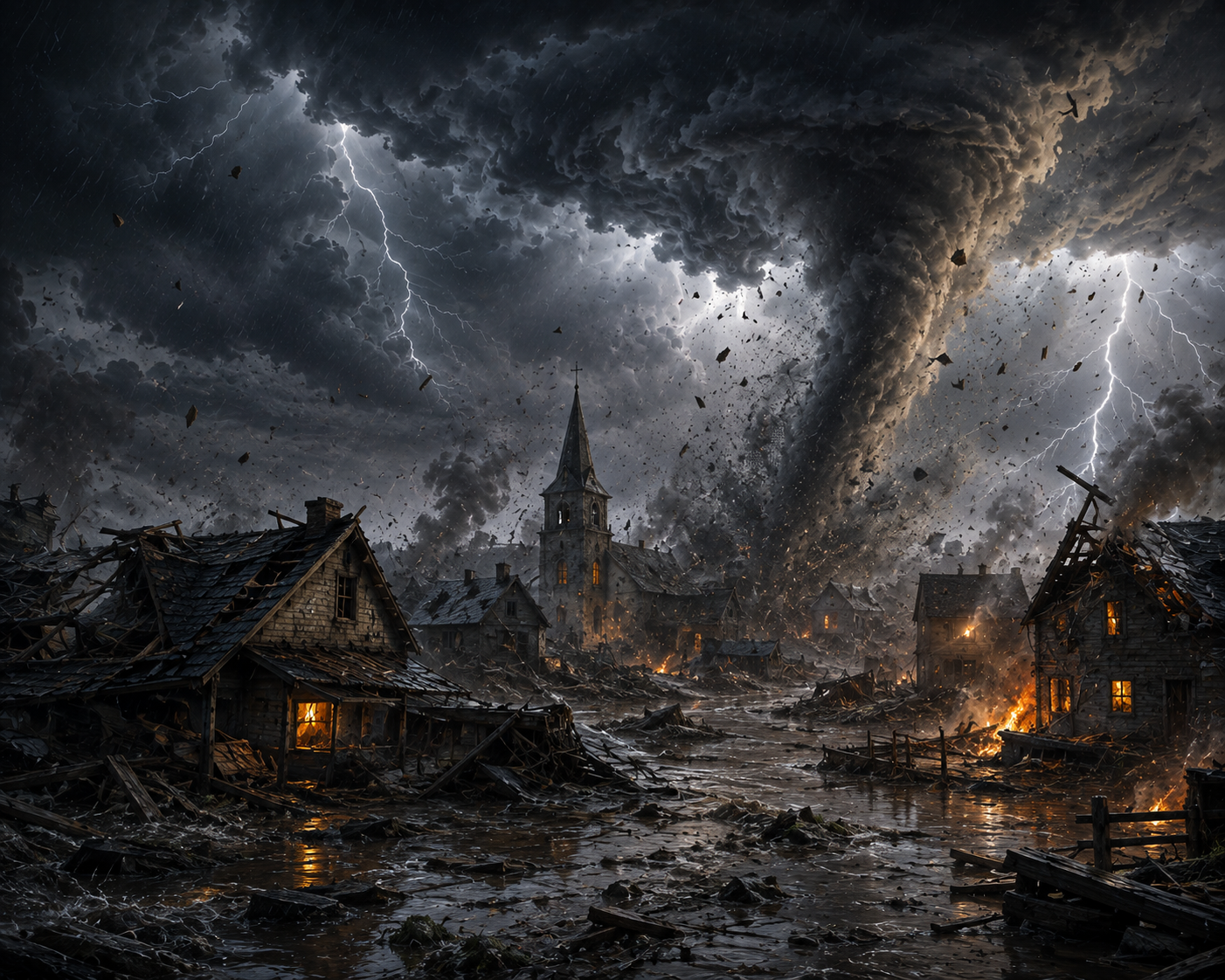
Storms have inspired awe and fear throughout human history. Thunder, lightning, torrential rain, violent winds, and darkened skies remind us of nature’s immense power and unpredictability. It is therefore unsurprising that storms frequently appear in dreams, often leaving the dreamer with lingering emotions long after waking.
Dreaming of a storm can symbolize emotional upheaval, uncertainty, conflict, transformation, fear, or spiritual reflection. Yet, like most dream symbols, a storm does not possess one universal meaning. Its significance depends upon the dreamer’s personal circumstances, emotions during the dream, and the events unfolding within the dream itself.
This article explores the symbolism of storms from the perspectives of Sigmund Freud, Carl Jung, Ibn Sirin, Artemidorus of Daldis, Ann Faraday, and the original interpretive philosophy of Joseph Dream Catcherz.
The Universal Symbolism of Storms
Across cultures, storms have long represented periods of uncertainty and change.
Historically, storms have been associated with:
- Emotional turmoil
- Conflict
- Divine power
- Transformation
- Fear of the unknown
- Destruction followed by renewal
- Chaos preceding stability
Because storms are temporary by nature, they often symbolize challenges that eventually pass, even when they appear overwhelming in the moment.
Sigmund Freud: Storms as Emotional Conflict and Repressed Anxiety
According to Sigmund Freud, dreams express unconscious thoughts, unresolved emotions, and psychological conflicts that may not be fully recognized during waking life.
Within a Freudian framework, a storm may represent intense emotional pressure building beneath conscious awareness. Thunder, lightning, and violent winds can symbolize internal tension created by suppressed fears, guilt, anger, or unresolved conflict.
Freud emphasized that dream symbols do not possess fixed meanings. Instead, the dreamer’s personal associations determine the significance of the imagery. For one individual, a storm may reflect anxiety over an important life decision. For another, it may represent emotional conflict within relationships, work, or family life.
Freud would encourage examining the emotional experience of the storm rather than focusing solely on the weather itself.
Carl Jung: Storms as Transformation Within the Psyche
Carl Gustav Jung viewed dreams as communications from the unconscious that assist the individual in achieving psychological balance.
Within Jungian psychology, storms often symbolize periods of profound internal transformation.
The storm may represent:
- confrontation with the Shadow
- psychological growth
- emotional cleansing
- major life transitions
- unconscious forces seeking recognition
Dark clouds may symbolize emerging unconscious material, while lightning can represent sudden insight or realization.
Although storms may appear frightening, Jung often viewed periods of psychological disruption as necessary stages in personal development.
Once the storm passes, the dreamer frequently discovers greater clarity and emotional balance.
Ibn Sirin: Storms as Trials, Warnings, and Divine Tests
In the tradition attributed to Ibn Sirin, storms often symbolize hardship, trials, powerful events, or periods of uncertainty.
A violent storm may represent:
- approaching difficulties
- social unrest
- personal hardship
- fear of authority
- significant life changes
However, context remains essential.
If the dreamer safely survives the storm, it may indicate perseverance through adversity and eventual relief.
If heavy rain accompanies the storm without destruction, rain has often been understood within Islamic tradition as a sign of mercy, blessing, or provision.
Thus, the dreamer’s circumstances and the outcome of the storm play a central role in interpretation.
Artemidorus of Daldis: Storms and External Circumstances
The ancient Greek dream interpreter Artemidorus of Daldis believed dreams should always be interpreted according to the dreamer’s personal situation.
For Artemidorus, storms often reflected disruptions occurring within one’s external life.
These disruptions could involve:
- travel
- business
- family
- political affairs
- financial concerns
- personal safety
A merchant dreaming of a violent storm might anticipate difficulties affecting commerce.
A traveler could interpret the same dream differently than a soldier or farmer.
Artemidorus emphasized that the dreamer’s occupation, responsibilities, and social position influenced the meaning of every symbol.
Ann Faraday: Storms as Emotional Experiences
Modern dream researcher Ann Faraday encouraged dreamers to understand symbols through their own emotional associations rather than relying solely on universal definitions.
From Faraday’s perspective, storms frequently represent emotional experiences currently unfolding in the dreamer’s life.
The dream may reflect:
- overwhelming stress
- unresolved worries
- family conflict
- workplace pressure
- fear of uncertainty
- emotional overload
Faraday would encourage dreamers to ask questions such as:
- What emotions did I experience during the storm?
- Was I afraid, calm, or fascinated?
- Was I caught in the storm or observing it?
- Did the storm end peacefully?
The answers often reveal more than the storm itself.
Joseph Dream Catcherz: Storms as Growing Problems and Fear of Consequences
According to the original interpretive philosophy of Joseph Dream Catcherz, storms frequently represent small problems that have gradually grown into larger difficulties because they have remained unresolved.
Just as storms begin with subtle atmospheric changes before developing into powerful systems, life’s challenges often begin as seemingly minor concerns that expand over time when ignored.
A storm may therefore symbolize:
- small problems becoming overwhelming
- mounting stress
- unresolved conflict
- growing responsibilities
- accumulating pressure
- fear that circumstances are becoming more difficult to control
Storms may also represent the dreamer’s fear that a recent decision has created consequences they can no longer avoid.
Perhaps a difficult conversation was postponed.
Perhaps an important financial decision was made.
Perhaps trust was broken within a relationship.
The subconscious may portray these worries as an approaching storm whose strength reflects the dreamer’s increasing anxiety.
When the Storm Clears
One of the most encouraging dream scenarios occurs when the storm gradually disappears.
Within the Joseph Dream Catcherz philosophy, a clearing storm represents the subconscious concluding that the situation is not as dangerous or overwhelming as initially believed.
As sunlight returns and the clouds part, the dream suggests that perspective has changed.
The dreamer may be:
- gaining confidence
- recognizing solutions
- accepting uncertainty
- releasing unnecessary worry
- discovering that the feared consequences are less severe than imagined
Rather than predicting future events, the clearing storm reflects the mind’s growing realization that peace is returning.
The emotional atmosphere has shifted just as the weather has.
Common Storm Dream Scenarios
Watching a Storm From Indoors
Observing a storm safely from inside often suggests awareness of problems without being directly overwhelmed by them.
The dreamer may be preparing emotionally for challenges while remaining protected.
Being Trapped in a Storm
Feeling unable to escape a storm may symbolize feeling overwhelmed by responsibilities, stress, or emotional pressure.
The dream often reflects the belief that circumstances are temporarily beyond one’s control.
Walking Calmly Through a Storm
Remaining calm despite severe weather may indicate emotional resilience.
The dream suggests growing confidence in handling life’s difficulties.
Lightning During a Storm
Lightning frequently symbolizes sudden realization, unexpected truth, or rapid emotional insight.
The storm may therefore combine prolonged stress with a moment of important understanding.
A Storm Destroying Buildings
Dreams of destructive storms may symbolize fear that current problems could affect important aspects of life, such as relationships, employment, finances, or long-held plans.
The extent of the destruction often mirrors the dreamer’s perceived seriousness of the situation rather than predicting literal events.
Storm Followed by Sunshine
This is generally one of the most reassuring storm dreams.
The transition from darkness to light often symbolizes:
- emotional recovery
- renewed hope
- resolution of conflict
- improved perspective
- personal healing
Within the Joseph Dream Catcherz philosophy, this image strongly supports the idea that the subconscious has reassessed the problem and no longer views it as the overwhelming threat it once appeared to be.
Storms and the Human Mind
Storm dreams often occur during periods of significant emotional activity.
They may coincide with:
- major life decisions
- relationship challenges
- financial uncertainty
- career changes
- grief
- family responsibilities
- health concerns
- periods of personal transformation
Rather than predicting disaster, these dreams frequently mirror the dreamer’s internal emotional climate.
Conclusion
Storms remain among the most powerful symbols found in dreams because they closely resemble the emotional storms experienced throughout life. Whether viewed through the psychoanalytic lens of Freud, the symbolic psychology of Jung, the spiritual tradition attributed to Ibn Sirin, the contextual method of Artemidorus, the personal reflection encouraged by Ann Faraday, or the original philosophy of Joseph Dream Catcherz, storms consistently represent periods of challenge, uncertainty, or change.
Joseph Dream Catcherz adds a distinctive perspective by suggesting that storms often symbolize small problems that have gradually grown into larger concerns or the fear that a recent decision may lead to unwanted consequences. Yet the appearance of clearing skies offers hope. When the storm breaks and sunlight returns, the dream may reveal that the subconscious has recognized the problem as less threatening than originally believed.
Like every storm in nature, emotional storms eventually pass. Dreams remind us that while difficult seasons are inevitable, clarity, understanding, and calmer skies often follow.
Bibliography
American Academy of Sleep Medicine. (2023). International Classification of Sleep Disorders (3rd ed., Text Revision). Darien, IL: American Academy of Sleep Medicine.
Artemidorus of Daldis. (1990). The Interpretation of Dreams (Oneirocritica) (R. J. White, Trans.). Park Ridge, NJ: Noyes Press. (Original work published 2nd century CE.)
Faraday, A. (1972). The Dream Game. New York, NY: Harper & Row.
Freud, S. (1900/2010). The Interpretation of Dreams (J. Strachey, Trans.). New York, NY: Basic Books.
Hobson, J. A. (2002). Dreaming: An Introduction to the Science of Sleep. Oxford University Press.
Ibn Sirin. (Attributed). The Great Book of Dream Interpretation (Various English editions and translations).
Jung, C. G. (1964). Man and His Symbols. Garden City, NY: Doubleday.
Jung, C. G. (1968). The Structure and Dynamics of the Psyche. Collected Works of C. G. Jung (Vol. 8). Princeton, NJ: Princeton University Press.
Kryger, M. H., Roth, T., & Dement, W. C. (Eds.). (2017). Principles and Practice of Sleep Medicine (6th ed.). Philadelphia, PA: Elsevier.
Nielsen, T. A. (2017). Dreaming. In M. H. Kryger, T. Roth, & W. C. Dement (Eds.), Principles and Practice of Sleep Medicine (6th ed.). Elsevier.
Revonsuo, A. (2000). The reinterpretation of dreams: An evolutionary hypothesis of the function of dreaming. Behavioral and Brain Sciences, 23(6), 877–901.
Stickgold, R., & Walker, M. P. (2013). Sleep-dependent memory triage: Evolving generalization through selective processing. Nature Neuroscience, 16(2), 139–145.
The Qur’an. Passages relating to dreams, prophetic visions, and the account of Prophet Yusuf (Joseph), as traditionally referenced within Islamic dream interpretation.
JoesphDream.com. (2026). Dream Library: Storms Within Dreams—The Joseph Dream Catcherz Interpretation. Original educational content and interpretive philosophy developed by Joseph Dream Catcherz. Retrieved from https://www.joesphdream.com
JoesphDream.com. (2026). Dream Interpretation Guide. Original educational resource on dream symbolism, psychological perspectives, historical dream interpretation, and dream analysis. Retrieved from https://www.joesphdream.com
JoesphDream.com. (2026). About JoesphDream.com: Exploring Dreams, Consciousness, and Human Experience. Original publication describing the site’s mission, editorial philosophy, and interpretive framework. Retrieved from https://www.joesphdream.com
Peace and Blessings-

Leave a Reply
You must be logged in to post a comment.