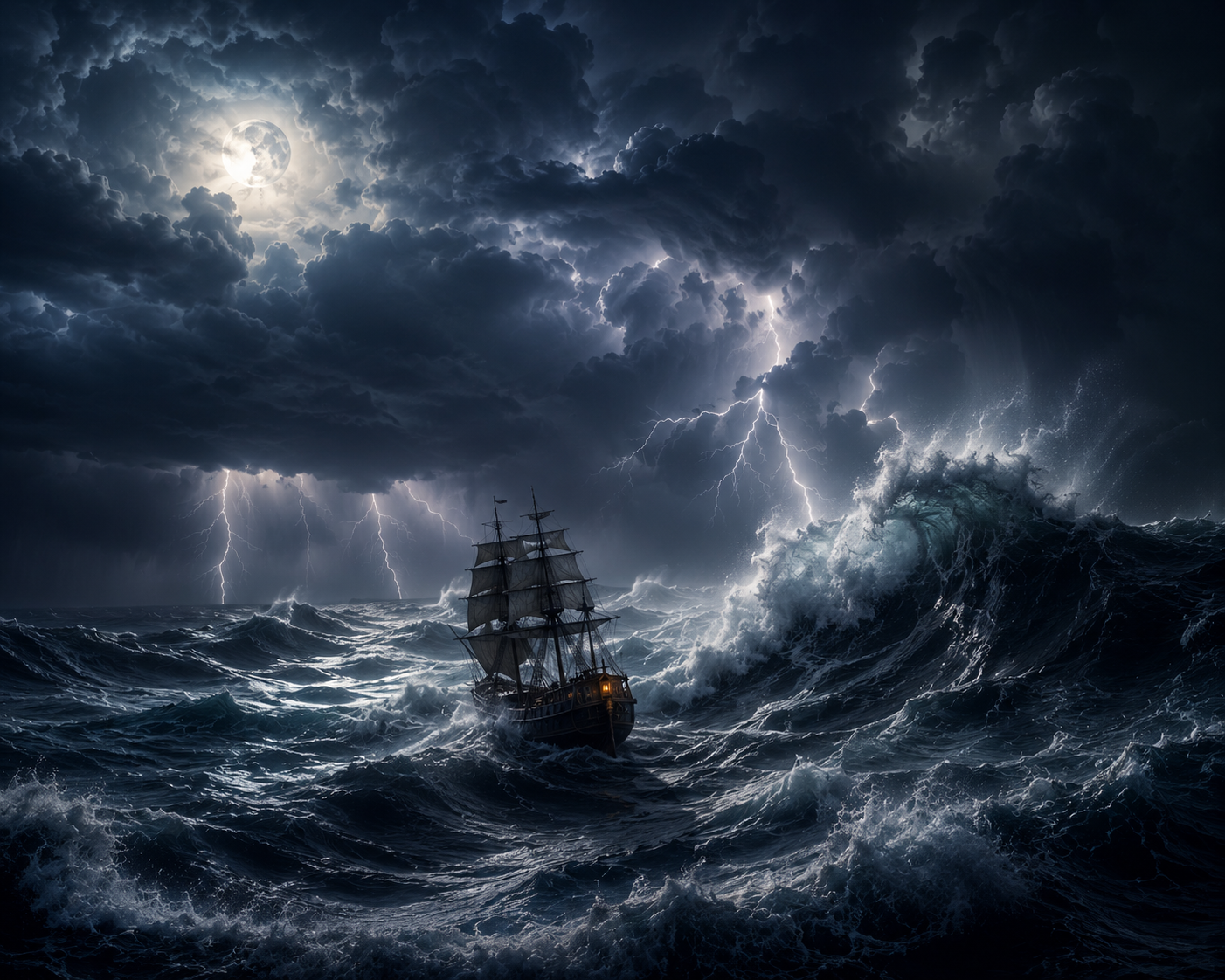
‘VOWS MADE IN STORMS
ARE FORGOTTEN IN CALM’
-Thomas Fuller
Storms: An Environmental, Geographical, and Scientific Summary
Storms are powerful atmospheric disturbances characterized by strong winds, precipitation, lightning, thunder, and rapid changes in weather conditions. They occur when differences in temperature, air pressure, and moisture create instability within the atmosphere. Storms range from brief local thunderstorms lasting only minutes to massive hurricanes and cyclones that can span hundreds of miles and persist for days or even weeks. While storms are capable of causing widespread destruction, they also play vital roles in regulating Earth’s climate, distributing heat and moisture, replenishing freshwater supplies, and maintaining healthy ecosystems.
Scientific Understanding
Storms develop when warm, moist air rises into cooler layers of the atmosphere.
As the rising air cools, water vapor condenses into tiny droplets or ice crystals, forming clouds. This condensation releases heat, causing the air to continue rising and strengthening atmospheric instability. When sufficient energy accumulates, powerful storm systems develop.
Several atmospheric ingredients are generally required for storm formation:
- Warm, moist air
- Atmospheric instability
- Lifting mechanisms such as cold fronts, mountains, or sea breezes
- Wind shear (for certain severe storms)
Storm intensity depends upon temperature differences, humidity, wind patterns, ocean temperatures, and upper-atmosphere conditions.
Meteorologists study storms using satellites, weather radar, aircraft reconnaissance, ocean buoys, weather balloons, and sophisticated computer models to forecast storm development and movement.
Types of Storms
Storms occur in many forms.
Thunderstorms
Thunderstorms are among the most common storms worldwide. They produce:
- Lightning
- Thunder
- Heavy rainfall
- Strong wind gusts
- Hail
- Occasionally tornadoes
Many thunderstorms last less than one hour, although severe storm systems may persist much longer.
Tropical Cyclones
Known by different names depending on their location:
- Hurricanes (Atlantic and eastern Pacific Oceans)
- Typhoons (western Pacific Ocean)
- Cyclones (Indian Ocean and southern Pacific)
These enormous rotating storm systems develop over warm tropical oceans and contain sustained high winds, torrential rainfall, and dangerous storm surges capable of producing catastrophic coastal flooding.
Tornadoes
Tornadoes are rapidly rotating columns of air extending from thunderstorms to the ground.
Although relatively narrow compared with hurricanes, tornadoes often produce the strongest winds found anywhere on Earth and can cause extreme localized damage within minutes.
Winter Storms
Winter storms bring combinations of:
- Snow
- Freezing rain
- Sleet
- Ice
- Strong winds
- Blizzards
These storms may disrupt transportation, damage infrastructure, and create dangerous travel conditions.
Dust and Sand Storms
In arid and semi-arid regions, strong winds can lift enormous quantities of dust and sand into the atmosphere, reducing visibility and affecting both air quality and transportation.
Geographical Distribution
Storms occur across every continent except Antarctica’s interior, though their frequency and intensity vary by region.
Tropical Regions
Warm ocean waters near the equator provide ideal conditions for hurricanes, typhoons, and cyclones.
Temperate Regions
Mid-latitude areas commonly experience thunderstorms, tornadoes, and winter storms as warm and cold air masses collide.
Mountainous Regions
Mountains force air upward, increasing cloud formation and precipitation while creating localized storm development through a process known as orographic lifting.
Coastal Areas
Coastlines frequently experience stronger storms because of interactions between land, ocean temperatures, and atmospheric circulation.
Environmental Importance
Although storms can be destructive, they perform several essential environmental functions.
Storms:
- Distribute freshwater through rainfall.
- Recharge rivers, lakes, and groundwater.
- Transport heat from the tropics toward higher latitudes.
- Help regulate global climate.
- Remove pollutants from the atmosphere through precipitation.
- Support agricultural productivity.
- Maintain wetlands and freshwater ecosystems.
- Trigger natural ecological succession.
Lightning associated with thunderstorms also converts atmospheric nitrogen into forms that become available to plants after rainfall, enriching soils naturally.
Ocean and Climate Connections
Oceans provide the energy that fuels many powerful storms.
Warm sea-surface temperatures increase evaporation, supplying moisture and heat to developing weather systems.
Large-scale climate patterns such as El Niño and La Niña influence storm frequency, intensity, rainfall distribution, and hurricane activity in many parts of the world.
Scientists continue studying how long-term climate change may influence storm behavior, including changes in rainfall intensity, storm surge, and the proportion of storms reaching higher intensities. While individual storms cannot be attributed solely to climate change, warmer air and oceans can increase the atmosphere’s capacity to hold moisture and provide additional energy for some storm systems.
Ecological Effects
Storms continually reshape natural landscapes.
Positive ecological effects include:
- Dispersing seeds.
- Clearing dead vegetation.
- Replenishing wetlands.
- Redistributing nutrients.
- Creating new wildlife habitats.
- Supporting forest regeneration.
However, severe storms may also:
- Uproot forests.
- Destroy coral reefs.
- Cause coastal erosion.
- Trigger landslides.
- Produce flooding.
- Damage ecosystems.
- Increase sediment entering rivers and lakes.
Recovery often demonstrates the resilience of natural ecosystems, although repeated severe disturbances may alter habitats permanently.
Human Impact
Storms represent some of the most significant natural hazards affecting human populations.
Major hazards include:
- Flooding
- Lightning strikes
- High winds
- Storm surge
- Hail
- Tornadoes
- Coastal erosion
- Landslides
- Falling trees
- Power outages
- Infrastructure damage
Communities vulnerable to severe storms often invest in flood-control systems, improved building standards, emergency planning, and early warning networks to reduce loss of life and property.
Historical Significance
Throughout history, storms have shaped civilizations.
Major storms have influenced:
- Agricultural success
- Maritime exploration
- Military campaigns
- Settlement patterns
- Engineering practices
- Disaster preparedness
Ancient societies carefully observed seasonal weather patterns to guide farming, navigation, and trade. Many historical storms became defining events that changed coastlines, altered river systems, or prompted advances in architecture and emergency management.
Forecasting and Technology
Modern meteorology has dramatically improved storm prediction.
Scientists use:
- Weather satellites
- Doppler radar
- Computer forecasting models
- Ocean monitoring systems
- Weather balloons
- Aircraft reconnaissance
- Artificial intelligence
- Climate simulations
These technologies allow emergency managers to issue warnings hours or even days before dangerous storms arrive, significantly reducing fatalities compared with previous centuries.
Cultural Importance
Storms have long inspired mythology, religion, literature, music, and art.
Across cultures, storms often symbolize:
- Power
- Transformation
- Renewal
- Conflict
- Judgment
- Cleansing
- Uncertainty
- Nature’s overwhelming force
Many ancient civilizations attributed storms to gods or supernatural beings who controlled thunder, lightning, wind, and rain. Even today, storms remain powerful symbols in storytelling, representing periods of struggle that may ultimately lead to growth or renewal.
Symbolic Meaning
Symbolically, storms often represent periods of emotional upheaval, uncertainty, or major transition. Just as storms temporarily disrupt landscapes before calm returns, they frequently symbolize life’s challenges, personal transformation, and the resilience required to endure adversity.
Rain following storms also symbolizes renewal, restoration, and new beginnings, reflecting the idea that periods of hardship are often followed by growth and recovery.
These symbolic meanings are cultural and literary interpretations rather than scientific explanations.
Conclusion
Across science, geography, and environmental studies, storms are recognized as essential components of Earth’s dynamic climate system. They regulate weather, distribute heat and water, replenish ecosystems, and shape landscapes across the globe. Although capable of causing tremendous destruction, storms also sustain life by delivering freshwater, maintaining ecological balance, and driving many of the natural processes upon which human civilization depends. Understanding storms continues to improve through advances in meteorology, climate science, and environmental research, helping societies better prepare for and adapt to one of nature’s most powerful forces.

Sigmund Freud on the Representation of Storms Within Dreams
Sigmund Freud did not establish storms as dream symbols possessing one fixed or universal meaning. In his method, the meaning of any dream image depended upon the dreamer’s memories, present circumstances, emotional conflicts, unconscious wishes, and personal associations. A storm could therefore represent fear and destruction in one dream, but excitement, relief, freedom, or concealed satisfaction in another.
Freud’s central concern would not be, “What does a storm always mean?” Instead, he would ask why the individual dreamer’s mind selected a storm to represent the thoughts and feelings operating beneath the dream.
In The Interpretation of Dreams, Freud argued that dreams are meaningful psychological constructions connected to waking life. He distinguished the dream as remembered from the unconscious thoughts that produced it and examined the processes through which those thoughts became transformed into visual scenes.
Storms as Dramatic Representations of Emotion
A storm may provide the mind with a vivid and dramatic way of representing emotional disturbance. Dark clouds, thunder, lightning, violent winds, heavy rain, and flooding can transform invisible psychological tension into a visible event.
The dreamer may be experiencing:
- Repressed anger
- Fear of confrontation
- Emotional frustration
- Guilt over an unacceptable wish
- Anxiety about losing control
- Resentment toward another person
- Sexual tension
- Fear of punishment
- Uncertainty about an approaching change
The storm does not necessarily reveal these emotions directly. It may conceal them by transferring the emotional intensity of a real conflict onto the weather.
For example, a person who is secretly furious with a family member may not dream of openly attacking that person. Instead, the dream may present a violent storm destroying the family home. The storm allows aggression to appear while disguising the dreamer’s personal responsibility for it.
Manifest and Latent Content
Freud distinguished between the manifest content and the latent content of a dream.
The manifest content is the dream as the person remembers it. It may include black clouds, thunder, rain, lightning, damaged buildings, rising water, or an attempt to escape.
The latent content consists of the concealed thoughts, memories, wishes, fears, and conflicts that contributed to the dream.
A dreamer may remember being trapped in a hurricane, but the true psychological concern may involve an unstable relationship, fear of dismissal from work, financial pressure, family conflict, or guilt over a hidden desire. The hurricane is the dramatic dream image through which those concealed concerns are represented.
The visible storm may therefore be compared to a stage production. The weather is what appears on the stage, while the latent thoughts remain behind the scenes.
Freud’s Own Storm-Related Example
Freud included a dream containing “a terrible storm” outside a miserable hotel, with water dripping from the walls and damp beds. His analysis did not treat the storm as a universal symbol of anger, fear, or disaster.
Instead, he connected the excessive water and dampness with a verbal representation involving the idea of something being “superfluous,” “overflowing,” or excessively fluid. The dream converted an abstract thought into a concrete collection of water-filled images.
This example is important because it demonstrates Freud’s actual method. Even when a storm appears in a dream, its meaning may arise from language, wordplay, sound, memory, or an association that would be impossible to discover through a general dream dictionary.
Freud warned that isolated examples lose their significance when removed from the dreamer’s complete chain of associations.
Storms and Repressed Anxiety
A violent storm may represent anxiety produced by thoughts or wishes that the conscious mind has attempted to repress.
Repression does not eliminate a troubling thought. It prevents the thought from becoming directly conscious. The emotional force connected to it may nevertheless return in disguised form.
A dreamer who cannot admit feeling hatred toward a respected authority figure might experience that hostility as thunder, violent wind, or lightning. The dangerous weather carries the emotion without clearly identifying its true target.
The dreamer may awaken believing that the dream was simply about bad weather. Freudian analysis would investigate whether the storm borrowed its emotional intensity from a conflict that the dreamer has been unable to acknowledge.
Storms and Fear of Losing Control
Because storms are unpredictable and difficult to control, they may provide suitable imagery for a fear that powerful emotions or impulses will overwhelm the dreamer.
The dreamer may be struggling to control:
- Anger toward a spouse or relative
- Sexual desire
- Jealousy
- Grief
- Hostility
- A desire to rebel
- An urge to abandon responsibilities
- Fear of emotional collapse
Being swept away by wind may represent fear of being carried away by emotion. Rising floodwater may represent psychological pressure that can no longer be contained. A roof being torn from a house may represent the failure of a protective structure.
These meanings would remain possibilities rather than automatic conclusions. Freud would require the dreamer’s associations before deciding what the storm represented.
Destruction as Disguised Wish Fulfillment
Freud maintained that dreams may fulfill wishes even when they appear frightening or unpleasant. The wish may be so unacceptable that it must be distorted before it can appear in the dream.
A destructive storm may secretly accomplish something the dreamer desires.
The storm might:
- Destroy an unwanted workplace
- Cancel an obligation
- Separate the dreamer from a difficult person
- Remove a financial burden
- End an unsatisfying living arrangement
- Prevent an unwanted journey
- Create an excuse to remain home
- Destroy an object associated with guilt or resentment
The dreamer may consciously fear the destruction while unconsciously receiving satisfaction from its result.
For example, a person exhausted by work may dream that a tornado destroys the office. The manifest experience is frightening, but the latent wish may be freedom from the workplace. The storm performs the destructive act so that the dreamer does not have to accept responsibility for wanting it.
Expanded Examples of Freudian Storm Interpretation
The following examples are hypothetical applications of Freud’s method. They are not fixed definitions and should not be treated as dreams personally interpreted by Freud.
Example One: A Storm Approaching Before an Important Meeting
A dreamer sees enormous black clouds approaching while preparing to attend an important meeting. The dream ends before the rain begins.
The approaching storm may represent anticipatory anxiety. The fact that the storm has not yet arrived may reflect fear of an event that has not yet occurred. The meeting may be the obvious source of anxiety, but free association might uncover a deeper fear of judgment, humiliation, punishment, or failure.
The clouds may also connect the present meeting to earlier experiences involving strict parents, teachers, or authority figures.
Example Two: Lightning Strikes the Dreamer’s Employer
A dreamer watches lightning strike the building in which a disliked supervisor works.
A Freudian interpretation would examine possible hostility toward the supervisor. The lightning may allow an aggressive wish to be fulfilled without the dreamer directly causing harm.
The dreamer’s fear after the lightning strike may represent guilt or anxiety produced by the hostile wish. The frightening emotion does not necessarily disprove wish fulfillment. It may reveal the conflict between the unconscious desire and the dreamer’s moral objections to it.
Example Three: A Storm Destroys the Dreamer’s Home
A dreamer watches a hurricane tear apart the family home.
The home may represent safety, family relationships, childhood memories, or the dreamer’s present domestic life. The storm may express fear that the family structure is becoming unstable.
However, the destruction could also fulfill a hidden wish to escape the home, end a relationship, or break free from family expectations. The dreamer’s personal feelings about the house would determine which interpretation is more appropriate.
Example Four: Hiding in a Childhood Bedroom
An adult dreams of hiding from thunder in the bedroom where they slept as a child.
The dream may revive an early experience of helplessness and dependence. A present-day problem may have recreated an emotional condition first experienced during childhood.
The adult may consciously believe that the problem is new, while the dream reveals that its emotional pattern is much older. The storm connects present anxiety with a childhood need for protection.
Example Five: A Parent Protects the Dreamer
A dreamer is caught in heavy rain until a deceased or absent parent arrives and provides shelter.
The dream may fulfill a wish for reunion, protection, or emotional reassurance. The storm creates the danger that makes the parent’s return necessary.
The frightening weather and the comforting rescue belong to the same wishful construction. Without the storm, the dream would have no reason to restore the protective parent.
Example Six: Watching the Storm Through a Window
A dreamer calmly watches a violent storm through a strong window.
The window may represent psychological distance. The dreamer can observe threatening emotions without being directly overwhelmed by them.
The scene could express a wish to remain protected while witnessing conflict elsewhere. It might also reflect curiosity about forbidden or frightening emotions that the dreamer is not ready to experience directly.
If the window suddenly breaks, the dream may represent fear that this psychological protection is failing.
Example Seven: Floodwater Enters the House
A dreamer repeatedly attempts to stop rainwater from entering beneath the front door.
The water may represent emotional material that the dreamer is trying to keep outside conscious awareness. Towels, barriers, and locked doors may represent defensive efforts.
The increasing water level may dramatize the failure of repression. A feeling, memory, or desire that has been resisted is becoming increasingly difficult to exclude.
The front door may also have a personal association involving visitors, family members, unwanted contact, or fear of intrusion.
Example Eight: The Dreamer Feels Joy During the Storm
A dreamer runs outside during a thunderstorm and feels excited rather than afraid.
This example shows why the dreamer’s emotional response is essential. The storm should not automatically be interpreted as anxiety.
It may represent liberation from restraint, a wish to abandon caution, sexual excitement, emotional release, or pleasure in rebellion. The dreamer may experience the storm as freedom from an overly controlled waking life.
The same storm imagery that represents terror in another dream may represent exhilaration in this one.
Example Nine: A Storm Cancels a Journey
A dreamer prepares for an unwanted trip, but severe weather prevents the airplane from leaving.
The dream may fulfill a straightforward wish to avoid the journey. The storm provides an acceptable external reason for remaining behind.
The dreamer can experience relief without consciously admitting that they did not want to travel. Anxiety about the storm may help disguise the satisfaction created by the cancellation.
Example Ten: A Storm at Sea
A dreamer is trapped on a small boat during a violent ocean storm.
The boat may represent a fragile sense of security surrounded by powerful emotional forces. The dreamer may feel unable to escape a conflict or may fear being overwhelmed by grief, anger, or desire.
The identity of the other passengers would be especially important. Being alone may suggest isolation, while being accompanied by a spouse, parent, or child may connect the danger to that relationship.
Reaching land could fulfill a wish for safety. Sinking might express fear of failure, but it could also disguise a wish to abandon an exhausting struggle.
Example Eleven: The Storm Destroys Everything Except One Object
A tornado destroys an entire neighborhood, but one photograph remains untouched.
The surviving object may represent the true center of the dream. The widespread destruction may serve to emphasize the emotional importance of the photograph.
The photograph could be connected to grief, guilt, love, resentment, childhood, or an unresolved relationship. Freud’s method would focus upon the dreamer’s associations with the object rather than assuming that the storm itself contains the main meaning.
Example Twelve: The Dreamer Causes the Storm
A dreamer raises a hand and causes thunder and lightning to appear.
The dream may fulfill a wish for power, control, revenge, or recognition. A person who feels powerless in waking life may create a dream in which nature responds to their commands.
The dream could restore a childhood fantasy of omnipotence—the belief that one’s wishes or emotions possess extraordinary power. It might also express guilt if the dreamer believes their anger can harm others.
Example Thirteen: The Storm Suddenly Becomes Calm
A dreamer expects complete destruction, but the storm abruptly ends and sunlight appears.
The ending may fulfill a wish for reassurance. The dream allows anxiety to rise and then resolves it through safety, survival, or relief.
The sudden calm could represent hope that a waking conflict will disappear without confrontation. It may also provide mastery over a fear by allowing the dreamer to experience danger and survive it.
Example Fourteen: Thunder Incorporates an External Sound
A sleeping person hears an alarm, a slammed door, heavy traffic, or another loud sound and dreams that it is thunder.
Freud recognized that external sensations can be incorporated into dreams. However, the external stimulus does not necessarily explain the entire dream. The mind may select a particular scene because it can connect the sound with existing memories, concerns, or wishes.
In The Interpretation of Dreams, Freud discussed how sensations such as light, sounds, touch, temperature, and physical discomfort can be woven into elaborate dream scenes rather than reproduced exactly as they occur.
The question would therefore be not only why the dreamer heard a sound, but why the mind transformed that sound into a storm.
Thunder as Emotional Discharge
Thunder may represent an explosive release of tension. Its meaning may be connected to anger, confrontation, punishment, authority, or a frightening childhood memory.
A dreamer who associates thunder with an angry parent may be recreating the emotional atmosphere of that relationship. Another dreamer may associate thunder with excitement, summer vacations, or safety inside a family home.
Thunder may also represent words that the dreamer wishes to speak forcefully but suppresses in waking life.
Lightning as Sudden Impact
Lightning may represent a sudden emotional shock, an abrupt recognition, or a forceful act of destruction.
The target of the lightning is particularly important. If it strikes a person, the dream may contain hostility, fear for that person, or fear of punishment. If it strikes the dreamer, it may represent anxiety about exposure, judgment, injury, or sudden change.
Lightning illuminating a dark landscape may represent a brief moment in which something hidden becomes visible. However, Freud would still require the dreamer’s personal associations before treating this as the dream’s meaning.
Heavy Rain and Flooding
Rain could be associated with sadness, bodily sensations, fertility, sexuality, punishment, cleansing, childhood memories, or relief from oppressive heat.
Flooding may represent emotional or instinctual pressure that has exceeded the dreamer’s usual defenses. Water entering a protected place may dramatize unconscious material entering conscious life.
Yet water imagery can also arise from physical conditions during sleep. Thirst, perspiration, the need to urinate, temperature, or actual rain sounds may contribute material to the dream. Freud’s analysis would examine both bodily stimulation and psychological meaning rather than assuming only one cause.
Storms and Childhood Memory
Freud believed dreams frequently draw upon childhood experiences, including memories that are no longer easily accessible during waking life.
A storm dream may revive:
- Fear of thunder
- Dependence upon a parent
- Memories of hiding under blankets
- A family argument during severe weather
- Damage to a childhood home
- Excitement over school being canceled
- Feelings of safety while indoors
- An early experience of helplessness
The storm may combine a current conflict with an older emotional memory. The present problem supplies the immediate reason for the dream, while childhood experience supplies its emotional form.
Day Residues
Recent events often provide material for dreams. Freud referred to impressions from the preceding day that contribute to dream formation.
A storm dream may follow:
- Watching a weather report
- Seeing a disaster film
- Hearing thunder before sleep
- Reading about a hurricane
- Arguing with another person
- Receiving threatening news
- Feeling trapped in a stressful situation
- Remembering an earlier storm
The recent event may explain why storm imagery was available, but it may not explain why that imagery became emotionally important. The day residue can serve as the surface material through which older wishes and conflicts are represented.
Free Association and the Meaning of the Storm
Freud’s primary method would be to ask the dreamer to describe every thought connected with each part of the storm.
Questions might include:
- What do storms personally remind you of?
- Who was present in the dream?
- Where did the storm occur?
- What was threatened or destroyed?
- Did you feel fear, excitement, relief, or pleasure?
- Did you attempt to escape?
- Who provided protection?
- What survived the storm?
- What happened immediately before it began?
- What recent event produced a similar feeling?
- Was there anything the storm prevented you from doing?
- Did the destruction create any hidden advantage?
The first answer may not reveal the deepest meaning. Freud encouraged the dreamer to continue speaking without rejecting thoughts that appeared irrelevant, embarrassing, absurd, or unpleasant.
The meaning emerges from the dreamer’s associations, not from the analyst imposing a predetermined definition.
Conclusion
In Freudian dream analysis, a storm may represent repressed emotion, unconscious anxiety, concealed hostility, fear of losing control, childhood helplessness, instinctual pressure, or a disguised wish for destruction, escape, protection, or change.
The storm may also arise through wordplay, external sensations, bodily conditions, recent experiences, or memories that have been displaced into weather imagery. Freud’s own storm-related example demonstrates that a storm can represent an abstract thought through verbal association rather than simply symbolizing emotional turmoil.
A storm destroying a workplace may fulfill a wish to escape employment. A parent rescuing the dreamer may fulfill a wish for protection. A lightning strike may disguise hostility. Rising water may dramatize emotional pressure. Joyfully entering a storm may express a desire for liberation. Watching from safety may represent psychological distance.
None of these interpretations should be imposed automatically. The storm is the manifest image. Its latent meaning can be discovered only by examining the dreamer’s experiences, emotions, memories, wishes, and personal associations.
Bibliography
Freud, Sigmund. The Interpretation of Dreams. Translated by A. A. Brill. New York: Macmillan, 1913. Originally published as Die Traumdeutung in 1900. The 1913 English publication identifies Brill as the translator of the third German edition.
Freud, Sigmund. “On Dreams.” 1901. In The Standard Edition of the Complete Psychological Works of Sigmund Freud, vol. 5, translated and edited by James Strachey, 629–686. London: Hogarth Press, 1953.
Freud, Sigmund. Introductory Lectures on Psycho-Analysis: A Course of Twenty-Eight Lectures Delivered at the University of Vienna. Translated by Joan Riviere. London: George Allen & Unwin, 1922. The lectures include Freud’s systematic discussions of dreams, dream-work, repression, anxiety, and unconscious mental processes.
Freud, Sigmund. New Introductory Lectures on Psycho-Analysis. Translated by W. J. H. Sprott. New York: W. W. Norton, 1933. The volume includes “Revision of the Theory of Dreams” and “Anxiety and Instinctual Life.”
Carl Jung on the Representation of Storms Within Dreams
Carl Jung did not assign storms one fixed or universal meaning in dreams. He believed that every important dream image must first be examined within the dreamer’s personal circumstances, emotional condition, memories, relationships, and associations. Jung called this process “taking up the context.” Only after establishing what the image means to the individual could its broader symbolic or archetypal significance be considered.
Within Jung’s analytical psychology, a storm may represent a powerful movement within the psyche. It can symbolize emotional upheaval, the activation of unconscious material, a conflict between conscious and unconscious attitudes, the destruction of an outdated way of living, or the beginning of psychological transformation.
The meaning depends greatly upon the storm’s form, location, intensity, effect, and conclusion. A storm approaching in the distance may carry a different meaning from one already destroying the dreamer’s home. A storm that inspires terror differs psychologically from one that produces excitement, wonder, or relief.
Storms as Movements of the Unconscious
Jung regarded dreams as natural and spontaneous expressions of the unconscious. Dreams may present perspectives that differ sharply from the dreamer’s conscious beliefs and intentions. He described the unconscious as possessing a degree of autonomy, meaning that it does not merely obey the wishes or expectations of the conscious mind.
A storm may therefore represent unconscious forces becoming active. The dreamer’s ordinary conscious attitude may have become too narrow, controlled, rigid, or one-sided. The storm enters the dream as a force that cannot be managed through ordinary reason or willpower.
Dark clouds may suggest that something unknown is gathering below the level of awareness. Rising winds may symbolize increasing psychological tension. Thunder and lightning may indicate that the unconscious is making its presence felt with unusual force.
The storm may not necessarily represent something harmful. It may be disturbing because it challenges the dreamer’s established identity, beliefs, relationships, or way of life.
Psychic Compensation
One of Jung’s central ideas was that dreams may compensate for an unbalanced conscious attitude. When a person becomes excessively identified with one position, the dream may present an opposing image that restores psychological balance. The dream may contradict, modify, or strengthen the dreamer’s waking viewpoint depending upon what the psyche requires.
A storm dream may compensate for a waking personality that is too controlled or emotionally restrained. Someone who insists that everything is fine may dream of violent winds tearing apart a carefully maintained house. The dream may reveal emotional instability that the conscious personality refuses to acknowledge.
A person who avoids confrontation may dream of thunder, lightning, and destruction. The storm may supply the emotional force that is missing from waking behavior.
Conversely, someone whose waking life is chaotic may dream of calmly observing a storm from a secure building. In that case, the dream could present an image of inner stability and containment.
The symbolic meaning depends upon the relationship between the dream and the dreamer’s conscious attitude.
Emotional Upheaval
Storms frequently provide suitable imagery for intense emotion because they transform the entire environment. A peaceful landscape becomes dark, dangerous, and unpredictable. In psychological terms, this may reflect a condition in which powerful feelings alter the dreamer’s normal perception of life.
The storm may correspond to:
- Anger that has not been acknowledged.
- Grief that threatens to overwhelm the dreamer.
- Fear surrounding an approaching change.
- Emotional conflict within a relationship.
- Anxiety about losing control.
- Excitement connected with a new stage of life.
- A spiritual or psychological crisis.
- The release of long-restrained energy.
The dreamer’s emotional response is essential. Fear may suggest that the ego feels threatened by what is emerging. Excitement may indicate readiness for change. Awe may suggest contact with something greater than the dreamer’s ordinary conscious identity.
The Storm and the Ego
In Jung’s psychology, the ego is the center of conscious awareness, but it is not the whole personality. The unconscious contains emotions, instincts, memories, possibilities, and symbolic patterns that the ego may not recognize.
A storm can portray the ego’s encounter with forces beyond its control. The dreamer may attempt to hide, escape, strengthen a building, rescue another person, or survive until the weather passes.
The dreamer’s actions reveal how the conscious personality relates to the unconscious:
- Running away may indicate avoidance.
- Seeking shelter may represent a need for protection or containment.
- Repairing a damaged structure may show an effort to preserve stability.
- Standing calmly within the storm may suggest acceptance.
- Becoming paralyzed may reflect helplessness before emotional change.
- Guiding others to safety may symbolize developing psychological leadership.
- Attempting to control the storm may reveal an inflated belief in the ego’s power.
The dream does not merely show that a storm exists. It portrays the relationship between the dreamer and the storm.
Storms and the Shadow
Jung used the term shadow for qualities of the personality that the conscious individual rejects, denies, neglects, or fails to develop. The shadow may include anger, selfishness, aggression, fear, envy, ambition, sexuality, creativity, courage, or instinctive strength.
A violent storm may symbolize shadow material breaking into awareness. The dreamer may believe themselves to be consistently calm, gentle, or reasonable while unconsciously carrying intense resentment. The storm expresses the emotional force that has been excluded from the conscious personality.
The storm’s destruction may show what happens when neglected qualities accumulate without recognition. The more completely the ego denies an emotion, the more extreme its symbolic appearance may become.
The purpose of such a dream may not be to encourage destructive behavior. It may invite the dreamer to acknowledge, understand, and responsibly integrate the rejected emotional energy.
Storms as Archetypal Images
Some dreams carry a power that extends beyond ordinary personal concerns. Jung described especially vivid and emotionally compelling dreams as “big” or meaningful dreams. Such dreams may arise from the collective unconscious and use images connected with recurring human experiences. They often appear during major transitions or critical stages of life.
A vast storm covering the entire world may therefore possess an archetypal quality. It may symbolize chaos, divine judgment, destruction, renewal, conflict between cosmic forces, or the collapse of an established order.
Storm imagery appears throughout mythology, religion, folklore, and literature as an expression of powers greater than the individual. In a dream, such imagery may indicate that the dreamer is confronting a fundamental human problem rather than an ordinary daily inconvenience.
The dream may concern mortality, identity, spiritual meaning, moral responsibility, psychological rebirth, or the struggle to become a more complete person.
Storms and Transformation
A storm disrupts the existing order. It uproots trees, floods roads, destroys weak structures, and changes the landscape. Within a Jungian interpretation, this destructive power may represent a process of transformation.
Something in the dreamer’s life or personality may no longer be able to continue in its present form. The storm may remove an outdated identity, belief, relationship, ambition, or psychological defense.
This destruction can be frightening because the ego often experiences change as danger. Yet the loss of an old structure may create room for new development.
The condition of the landscape after the storm is especially meaningful:
- Clear skies may suggest renewed understanding.
- Fresh air may indicate emotional release.
- A flooded landscape may show that unconscious material remains overwhelming.
- New sunlight may represent hope or emerging consciousness.
- A surviving tree may symbolize endurance.
- A destroyed house may show that an old psychological structure can no longer provide safety.
- New growth after rain may suggest renewal and development.
A storm ending in calm may represent successful passage through a psychological crisis.
Thunder
Thunder may represent a powerful announcement from the unconscious. It is heard before its source can necessarily be seen, making it suitable imagery for something sensed emotionally but not yet understood consciously.
Thunder may accompany:
- A warning that the dreamer has ignored.
- The approach of a significant realization.
- Accumulated emotional energy.
- Fear of authority or judgment.
- An urgent demand for attention.
- An awakening of instinctive strength.
A single thunderclap may mark the decisive turning point of the dream. Continuous thunder may indicate sustained psychological tension.
The dreamer should consider personal associations. Thunder may evoke childhood fear, religious awe, memories of home, military experience, family conflict, excitement, or a sense of nature’s majesty.
Lightning
Lightning illuminates darkness suddenly and briefly. It may therefore symbolize a rapid insight, revelation, shock, or breakthrough into consciousness.
A flash of lightning revealing a hidden object may suggest that the dreamer is becoming momentarily aware of something previously unconscious. The object revealed can be more important than the lightning itself.
Lightning striking a tree, house, vehicle, or person may portray a sudden transformation affecting what that target represents.
For example:
- A tree struck by lightning may involve the dreamer’s growth, ancestry, or established identity.
- A house struck by lightning may indicate a sudden disturbance within the personality or family life.
- A church struck by lightning may concern established spiritual beliefs.
- A workplace struck by lightning may symbolize a crisis involving occupation or public identity.
- The dreamer being struck may represent overwhelming insight or a life-changing psychological event.
Lightning can be destructive, but it can also bring illumination. Its meaning lies in this union of danger and revelation.
Wind
Wind is invisible, yet its effects can be seen and felt. It may symbolize an unseen psychological force influencing the dreamer’s direction.
A gentle wind may suggest inspiration, movement, or the arrival of change. Violent wind may represent destabilization, emotional pressure, or unconscious forces challenging the dreamer’s control.
Being carried by the wind may indicate that the ego is being moved by energies it does not understand. Fighting against the wind may represent resistance to necessary change. Allowing the wind to guide the dreamer may suggest trust in a larger psychological process.
Objects carried away by the wind may represent attitudes, possessions, relationships, or identities that the psyche is attempting to remove.
Heavy Rain
Rain may represent emotion, release, purification, fertility, sadness, or renewal. Its meaning depends upon its intensity and the dreamer’s response.
Heavy rain during a storm may suggest an emotional release that has become difficult to control. The dreamer may be confronting grief, compassion, loneliness, or feelings that have remained unexpressed.
Rain that revives dry land may symbolize healing. Rain that causes flooding may indicate that emotional or unconscious material has exceeded the ego’s ability to contain it.
Walking peacefully through rain may suggest acceptance of emotion. Desperately attempting to remain dry may represent avoidance of feeling.
Flooding During a Storm
Floodwater commonly depicts a situation in which the unconscious overwhelms established boundaries. Roads disappear, familiar locations become unrecognizable, and ordinary movement becomes impossible.
Water entering a house may symbolize unconscious material entering the dreamer’s personal psychological space. Water rising from a basement can be especially significant because lower levels of buildings may represent deeper or less conscious areas of the psyche.
Flooding does not automatically indicate disaster. It may also bring necessary emotional material into awareness. The central question is whether the dreamer can respond to the water without being completely overcome by it.
The House in a Storm
Jung often treated dream structures as potentially representing aspects of the psyche. A house endangered by a storm may therefore portray the condition of the dreamer’s personality.
Different parts of the house may suggest different psychological functions:
- The roof may represent beliefs, ideals, or conscious protection.
- The windows may represent perception and awareness.
- The doors may concern access, boundaries, and relationships.
- The basement may represent deeper unconscious material.
- The bedroom may involve privacy, vulnerability, intimacy, or rest.
- The foundation may symbolize basic psychological stability.
A storm tearing away the roof may suggest that established beliefs no longer provide protection. Broken windows may indicate that outside or unconscious influences are entering consciousness. A strong house surviving the storm may symbolize psychological resilience.
Seeking Shelter
Shelter may symbolize the psychological resources available to the dreamer during a crisis.
A sheltering place could represent:
- A relationship that provides emotional security.
- A spiritual belief.
- A memory of parental protection.
- An inner capacity for reflection.
- A defensive withdrawal from experience.
- A stable part of the personality.
- The therapeutic process.
The quality of the shelter is important. A strong shelter may indicate sufficient inner resources. A collapsing shelter may reveal that the dreamer’s usual defenses are no longer adequate. Refusing to enter available shelter may suggest pride, distrust, or resistance to support.
Expanded Examples
The following examples illustrate possible applications of Jung’s method. They are not universal definitions.
Example One: Dark Clouds Over a Peaceful City
A dreamer sees dark clouds gathering over a city while everyone continues daily activities as though nothing is happening.
The dream may compensate for the dreamer’s denial of an approaching emotional or social problem. The unaware citizens may represent parts of the personality that refuse to recognize danger. The dreamer’s awareness of the clouds suggests that some portion of the psyche already senses the coming change.
Example Two: A Storm Destroys an Empty Workplace
A storm destroys the dreamer’s workplace at night, but no one is injured.
The workplace may represent the dreamer’s public identity, career, duties, or social role. Its destruction may suggest that the existing professional identity has become psychologically unsustainable.
Because the building is empty, the dream may emphasize transformation rather than literal harm. The psyche may be showing that a role must change without implying that the people connected with it should suffer.
Example Three: Standing Calmly in a Hurricane
The dreamer stands at the center of a hurricane but feels peaceful.
The calm center may symbolize an emerging inner point of stability surrounded by emotional chaos. The dreamer may be discovering that psychological balance does not require the outer world to become calm.
The image could also represent the Self as an organizing center of the total personality, especially if the dream carries unusual beauty, awe, or sacredness.
Example Four: Running From Thunder
The dreamer runs whenever thunder sounds but never sees lightning.
This may indicate fear of an unconscious demand that has not yet become clear. The dreamer hears the warning but cannot identify its source.
The dream may ask the individual to stop fleeing long enough to discover what the thunder announces.
Example Five: Lightning Reveals a Hidden Door
During a storm, lightning briefly illuminates a door in a wall that the dreamer had never noticed.
The storm may represent psychic tension, while the lightning provides a moment of insight. The hidden door may symbolize a new possibility, neglected talent, forgotten memory, or entrance into a previously unconscious area of life.
The dream’s central message may be less about destruction than discovery.
Example Six: A Childhood Home Survives the Storm
A violent storm destroys the surrounding neighborhood, but the dreamer’s childhood home remains standing.
The house may represent a lasting psychological foundation established during childhood. It could symbolize resilience, family influence, or an emotional pattern that has survived later changes.
Whether this survival is positive depends upon the dreamer’s associations with the home. It could represent dependable roots or an outdated childhood structure that remains unusually powerful.
Example Seven: The Dreamer Opens the Windows
A storm approaches, but instead of closing the windows, the dreamer opens them.
This action may indicate readiness to encounter unconscious emotion or change. The dreamer is no longer attempting to keep the storm outside.
The opening may represent acceptance, courage, curiosity, or a willingness to allow fresh psychological energy into a closed life.
Example Eight: Rescuing a Child During a Storm
The dreamer finds a frightened child outside and carries the child to safety.
The child may represent a vulnerable, undeveloped, or neglected part of the personality. The storm creates the crisis that forces the conscious dreamer to recognize and protect this inner vulnerability.
The rescue may symbolize an emerging capacity for self-care and emotional responsibility.
Example Nine: Enjoying a Thunderstorm
The dreamer watches lightning and feels intense joy.
The storm may symbolize liberation, renewed vitality, creativity, or contact with a powerful dimension of the psyche. The dreamer’s positive emotion indicates that the unconscious energy is not experienced merely as a threat.
The dream may compensate for a waking life that has become excessively predictable, controlled, or emotionally lifeless.
Example Ten: A Storm That Never Arrives
The dreamer spends the entire dream preparing for a storm that does not appear.
This may reflect anxiety about a crisis that exists mainly in anticipation. The dreamer may be organizing life around fear of something that has not happened.
The dream could invite examination of whether constant preparation is preventing actual living.
Example Eleven: Rebuilding After the Storm
The dream begins after the storm has ended. The dreamer joins others in rebuilding damaged homes.
The focus is not the crisis but the psychological work following it. The dream may indicate that a period of destruction or emotional upheaval has passed and that reconstruction is now possible.
The other workers may represent supportive relationships or cooperative parts of the personality.
Example Twelve: The Storm Speaks
The dreamer hears a voice within the thunder giving instructions.
A speaking storm may possess an archetypal or numinous character. The unconscious message is personified through a force of nature greater than the ego.
The dreamer should neither obey the message blindly nor dismiss it automatically. Jung’s approach would require careful examination of the message, the emotional atmosphere, and its relationship to the dreamer’s life.
The Ending of the Storm Dream
Jung observed that many dreams possess a structure resembling a drama: an opening situation, development, decisive turning point, and final outcome. The conclusion may reveal the psychological direction of the dream.
A storm dream that ends in destruction differs from one that ends in sunlight, rescue, discovery, or rebuilding.
The conclusion may indicate:
- The present state of the conflict.
- The attitude the dreamer needs to develop.
- A potential resolution.
- A warning that no resolution has yet been found.
- The psychological consequences of continued resistance.
- The beginning of a new stage of development.
A dream that ends before the storm arrives may leave the conflict unresolved. A dream that ends with the dreamer calmly surveying the damage may suggest growing acceptance of change.
Personal Associations and Amplification
The dreamer’s personal associations remain the starting point. Jung would ask what storms mean to that individual: terror, beauty, childhood safety, destruction, excitement, divine power, family conflict, seasonal change, or something else.
When the dream possesses an archetypal quality, the image may also be amplified through mythology, religion, literature, folklore, and cultural history. Amplification does not replace the dreamer’s personal meaning. It enlarges the symbolic context in which the image can be understood.
Questions useful for examining a storm dream include:
- Where did the storm begin?
- What was happening before it appeared?
- Who was present?
- What did the storm threaten?
- What survived?
- How did the dreamer respond?
- Was the dreamer frightened, excited, calm, or fascinated?
- Did the storm reveal anything?
- Did it destroy something that needed to change?
- What happened after it passed?
- What waking situation carries the same emotional atmosphere?
Conclusion
Within Jung’s analytical psychology, storms in dreams may represent the activation of unconscious forces, emotional upheaval, psychic compensation, confrontation with the shadow, archetypal power, or a process of transformation.
Thunder may announce an urgent unconscious message. Lightning may represent sudden illumination or psychological shock. Wind may express an unseen force of change. Heavy rain may indicate emotional release, while flooding may show unconscious material overwhelming established boundaries.
A storm can destroy, but it can also cleanse, awaken, reveal, and renew. Its meaning depends upon what it affects, how the dreamer responds, and what condition remains when the storm has passed.
The storm should not be reduced to a fixed definition. It is a living symbolic event whose meaning emerges from the relationship between the dream image, the dreamer’s conscious life, and the deeper movements of the psyche.
Bibliography
Jung, C. G. Dreams. Translated by R. F. C. Hull, with a foreword by Sonu Shamdasani. Princeton University Press, 2010. This collection includes Jung’s major essays on dream psychology, dream analysis, compensation, context, and symbolic interpretation.
Jung, C. G. “General Aspects of Dream Psychology.” In The Structure and Dynamics of the Psyche, Collected Works of C. G. Jung, vol. 8. Translated by R. F. C. Hull. Princeton University Press.
Jung, C. G. “On the Nature of Dreams.” In The Structure and Dynamics of the Psyche, Collected Works of C. G. Jung, vol. 8. The essay explains Jung’s contextual method, the autonomy of the unconscious, meaningful dreams, and the dramatic structure of dream narratives.
Jung, C. G. “The Practical Use of Dream-Analysis.” In The Practice of Psychotherapy, Collected Works of C. G. Jung, vol. 16. Translated by R. F. C. Hull. Princeton University Press.
Jung, C. G. The Archetypes and the Collective Unconscious. Collected Works of C. G. Jung, vol. 9, part 1. Translated by R. F. C. Hull. Princeton University Press.
Jung, C. G. Psychology and Alchemy. Collected Works of C. G. Jung, vol. 12. Translated by R. F. C. Hull. Princeton University Press.
Jung, C. G. Man and His Symbols. Originally published in 1964. The work presents Jung’s account of dreams, symbols, unconscious communication, and the role of symbolic understanding in the development of psychological wholeness.
Ibn Sirin on the Representation of Storms Within Dreams
The interpretations presented here come from the classical Islamic dream tradition associated with Muhammad ibn Sirin. An important historical qualification is necessary: Ibn Sirin was widely remembered as an early Muslim authority on dreams, but the large dream dictionaries published under his name were compiled and expanded after his lifetime. Their contents are therefore most accurately described as traditional interpretations attributed to Ibn Sirin, rather than statements that can always be proven to have been written personally by him.
Within this attributed tradition, a storm is not interpreted through one isolated definition. Its meaning depends upon the elements that accompany it: wind, rain, thunder, lightning, darkness, dust, flooding, destruction, the season, the location affected, and the dreamer’s personal circumstances.
A destructive storm generally represents calamity, fear, public disorder, severe hardship, illness, punishment, or the power of a ruler. A storm that brings beneficial rain without destruction may instead signify mercy, relief, prosperity, restored land, healing, or an improvement in the condition of the people.
Storms as Signs of Calamity
A violent storm that damages homes, uproots trees, scatters animals, or terrifies an entire community may represent a serious calamity affecting the region shown in the dream.
The calamity could take the form of:
- Political disorder
- Oppression by a ruler
- War or attack
- Epidemic illness
- Famine or economic distress
- Community conflict
- Fear and public confusion
- Natural destruction
- Collective punishment
Stormy winds are traditionally associated with destruction, plague, and adversity, particularly when they cause visible damage. A tornado or violently rotating wind is treated as an especially severe image of destruction and calamity.
The condition of the place after the storm is important. A storm that passes without causing harm may not carry the same warning as one that leaves houses collapsed, crops destroyed, or people missing.
The Meaning of Wind
Wind occupies an important place in the storm imagery attributed to Ibn Sirin. It can represent power, authority, movement, victory, prosperity, illness, punishment, or destruction, depending upon its behavior.
A gentle and beneficial wind may signify:
- Success
- Victory
- Prosperity
- Fertile crops
- Pollination
- Productive change
- The arrival of assistance
- Movement toward a desired goal
A violent wind may signify:
- Calamity
- Destruction
- Disease
- Fear
- Political oppression
- Forced displacement
- Social instability
- A sudden reversal of circumstances
The same natural force can therefore indicate either benefit or hardship. The distinction is determined by what the wind does.
Wind that carries clouds and beneficial rain may announce mercy and provision. Wind that darkens the sky, raises dust, destroys buildings, or carries people away suggests terror and affliction. The attributed tradition explicitly connects stormy wind with calamities and destruction while also recognizing that beneficial wind can represent harvest, prosperity, victory, or success.
Being Carried Away by the Wind
A dreamer who is lifted or carried away by a powerful wind may be facing circumstances stronger than their personal control.
The dream could concern:
- A forced journey
- Separation from home
- A major change in social position
- Submission to a powerful authority
- Loss of control over personal affairs
- Sudden displacement
- Fear of an approaching crisis
The destination matters. Being carried to a known and pleasant place may indicate movement toward opportunity or advancement. Being thrown into a dangerous or unknown place may suggest uncertainty, loss, or hardship.
The dreamer’s feelings must also be considered. Feeling peaceful while being carried may indicate acceptance of a major transition. Terror may indicate fear of being overpowered by external events.
Storms and the Power of a Ruler
In the classical Islamic symbolic system, powerful natural forces can represent rulers, governors, armies, or authorities because such forces affect many people and cannot easily be resisted.
A storm passing through a city may symbolize:
- The arrival of a powerful ruler
- A harsh governmental order
- An invading army
- Widespread taxation or economic pressure
- Punishment imposed by authority
- Political fear
- Sudden changes affecting the population
Thunder may resemble the voice or warning of an authority, while violent wind may represent the authority’s power. Destruction caused by the storm may indicate the harmful consequences of unjust rule.
A storm concentrated over one house, workplace, or district may suggest that the warning concerns that specific household, occupation, or community rather than the entire region.
Rain Within the Storm
Rain greatly changes the interpretation of a storm.
Beneficial rain falling in its proper season may represent:
- Divine mercy
- Relief from hardship
- A productive year
- Revived land
- Renewed livelihood
- Fulfilled promises
- Recovery and improvement
- Prosperity for farmers and communities
The attributed interpretations describe ordinary rain as a sign of relief, a good year, revival, and mercy, especially when it falls in the proper season and causes no damage.
Rain that is destructive, excessively violent, hot, bloody, polluted, or accompanied by fire may represent:
- Punishment
- Disease
- War
- Public suffering
- Severe conflict
- Unusual calamity
- Oppression
- Loss of property or crops
Thus, the interpretation does not depend merely upon the presence of rain. It depends upon whether the rain gives life or causes destruction.
A Storm That Brings Needed Rain
A thunderstorm arriving during drought or at a time when rain is urgently needed may be interpreted favorably.
It may signify:
- Relief after deprivation
- A successful harvest
- Renewed hope
- Financial improvement
- Assistance arriving at the proper time
- Healing after illness
- Reconciliation after conflict
Traditional entries attributed to Ibn Sirin state that a thunderstorm accompanied by needed rain can represent a good harvest for that year.
In this situation, the noise and force of the storm do not necessarily indicate disaster. They may announce that hardship is ending and provision is arriving.
Destructive Rainstorms
A storm whose rain tears down homes, uproots trees, destroys crops, or drowns people carries a much more serious meaning.
Such a dream may indicate:
- A trial affecting the inhabitants of the area
- Punishment for widespread wrongdoing
- Oppression or warfare
- Epidemic disease
- Destruction of livelihood
- Fear imposed upon the population
- Grief affecting a particular household
Heavy rain falling only upon one place may indicate sorrow or hardship concentrated upon the inhabitants of that location. Rain falling everywhere without harm is more commonly associated with widespread prosperity and joy.
Thunder
Thunder may represent a warning, reprimand, frightening announcement, ultimatum, or command from a powerful person.
Hearing thunder may signify:
- Being warned by an authority
- Receiving serious news
- Fear of punishment
- A promise or official command
- The approach of a significant event
- Repayment of debts
- Recovery from illness in certain circumstances
Thunder without rain can indicate fear, warning, or an ultimatum. It can also represent authoritative speech or an announcement that demands attention.
The time and atmosphere of the thunder are significant. Thunder heard in complete darkness without visible lightning is treated more severely than thunder accompanying beneficial rain.
Thunder Without Rain
Thunder without rain may symbolize a warning that brings fear but no immediate benefit.
It may represent:
- Threatening words
- A harsh reprimand
- An unfulfilled promise
- Fear of authority
- Rumors or false reports
- Public tension
- A warning of approaching hardship
A person who hears thunder but sees no rain may be receiving signs of danger without yet seeing the full nature of the event.
In some attributed entries, thunder without visible lightning is associated with deception, falsehood, slander, or concealed violence.
Lightning
Lightning may indicate fear, sudden news, punishment, guidance, exposure, or unexpected change.
The presence or absence of rain modifies its meaning.
Lightning without rain is traditionally regarded as a warning of impending hardship or unrealized expectations. Lightning accompanied by rain may carry a more hopeful meaning, including healing or relief for a sick person.
Lightning can therefore symbolize:
- A sudden warning
- Fear of an authority
- A rapid change in circumstances
- Exposure of something concealed
- News arriving unexpectedly
- Threat followed by relief
- Illness followed by recovery
- A promise that may or may not be fulfilled
Lightning Striking a Particular Place
When lightning strikes a specific house, field, town, building, or person, the interpretation becomes concentrated upon that target.
For example:
- Lightning striking a home may concern the family living there.
- Lightning striking a field may concern crops, livelihood, or food supply.
- Lightning striking a marketplace may concern trade and economic conditions.
- Lightning striking a ruler’s residence may concern political authority.
- Lightning striking the dreamer may indicate sudden hardship, fear, exposure, or drastic personal change.
Fire caused by lightning intensifies the warning. It may represent severe conflict, punishment, destruction, or harm connected with authority.
However, if the lightning illuminates a dark path without causing destruction, it may suggest direction, discovery, or the sudden appearance of a solution.
Darkness During the Storm
A storm that produces unnatural darkness may represent confusion, fear, oppression, or a period in which people cannot clearly distinguish the correct course of action.
Darkness combined with violent wind and dust may signify:
- Collective fear
- Political confusion
- Loss of direction
- Public disorder
- Hardship affecting an entire community
- Concealed danger
- Uncertainty about the future
A dreamer unable to find the road during the storm may be struggling to make an important decision. Reaching light or shelter may indicate eventual relief or guidance.
Black clouds are not always unfavorable. In some attributed entries, black clouds may signify wisdom, knowledge, dignity, or benefit. When they produce terror or appear threatening, however, they may indicate reprimand or fear associated with a wise or powerful person.
Dust Storms
A storm filled with dust may represent confusion, poverty, adversity, warfare, or an event whose true nature remains hidden.
Dust prevents clear vision. Symbolically, this may indicate:
- Rumors
- Conflicting information
- Uncertainty
- Public panic
- A hidden threat
- Business or financial disturbance
- Difficulty recognizing truth
- Fear spreading through a population
If the dust settles and the dreamer can see clearly again, the confusion may be temporary. If the dust enters the house and remains there, the trouble may directly affect the household.
Dust following thunder, lightning, or rain may also be associated with drought or adversity in the attributed tradition.
Flooding Caused by a Storm
Flooding intensifies the meaning of storm imagery. A flood may represent an enemy attack, overwhelming hardship, disease, oppressive power, or a calamity affecting the people.
Traditional entries attributed to Ibn Sirin connect floods with attack by an enemy, while storm floods and tornadoes are linked with disaster and destruction.
Floodwater entering a town may indicate:
- An invading force
- Epidemic illness
- Political oppression
- Fear spreading among the population
- Widespread loss
- Economic hardship
- A trial affecting many households
The nature of the water matters. Clear water that causes little harm may signify provision or renewal. Muddy, foul, hot, bloody, or destructive water suggests affliction.
Escaping the Storm
Escaping a storm may indicate deliverance from danger, illness, oppression, debt, conflict, or fear.
Reaching shelter can signify:
- Protection
- Repentance
- Assistance from a powerful person
- Safety after hardship
- Preservation of faith
- Recovery from illness
- Rescue from an enemy
- Relief from an unjust authority
The person or place providing shelter may reveal the source of assistance. A mosque may symbolize spiritual refuge. A strong house may represent family protection. A mountain or fortress may represent safety under a powerful authority.
If the dreamer escapes while others remain trapped, the dream may indicate personal deliverance from a broader community crisis.
A House Surviving the Storm
A house that remains standing while surrounding structures collapse may symbolize protection granted to that household.
It may represent:
- Security during a public crisis
- Preservation of livelihood
- Strength of faith
- Family unity
- Escape from illness
- Protection from an enemy
- Survival through economic hardship
If only one part of the house is damaged, the meaning may relate to the person or activity associated with that area.
A damaged roof may concern the household’s protector or authority. A broken door may signify weakened security. Floodwater entering through the floor may suggest that hardship is entering gradually or from an unexpected source.
A Storm Destroying the Dreamer’s Home
When the dreamer’s own home is destroyed, the dream may indicate serious disruption involving family, security, reputation, livelihood, or leadership within the household.
Possible meanings include:
- Family separation
- Illness affecting a household member
- Financial collapse
- Loss of protection
- Conflict with authority
- Forced relocation
- Death or prolonged absence of an important person
- Breakdown of household stability
The interpretation would depend upon what happened to the inhabitants. A destroyed house whose family escapes safely may indicate major change without complete loss. Destruction accompanied by death or disappearance carries a more severe warning.
Storms at Sea
A storm at sea may indicate danger during travel, fear surrounding livelihood, political instability, or overwhelming circumstances.
For a traveler, merchant, sailor, or person preparing for a journey, it may warn of:
- Delay
- Financial loss
- Fear during travel
- Unreliable companions
- Conflict with authorities
- Illness
- Uncertain return
Thunder, lightning, and rain together may represent fear for the traveler or greed and concern for the merchant.
Reaching shore indicates safety. A damaged ship may represent weakened protection. A ship surviving high waves may symbolize endurance through a severe trial.
Examples of Storm Dreams
The following examples apply the traditional interpretive principles attributed to Ibn Sirin. They should not be treated as direct historical interpretations of particular dreams by Ibn Sirin himself.
Example One: A Storm Destroys an Entire Town
A dreamer sees violent wind uprooting trees and destroying homes throughout a town.
This may represent a widespread calamity, oppressive authority, epidemic illness, warfare, or severe social disorder. Because the entire town is affected, the interpretation concerns the community rather than only the individual dreamer.
Example Two: Rain Falls Without Causing Damage
A strong storm arrives after a long drought. The rain fills wells and revives dead crops, but no homes are damaged.
This may signify mercy, relief, prosperity, a productive year, or the revival of a matter that had appeared hopeless.
Example Three: Thunder Without Rain
The dreamer hears terrifying thunder, but the sky produces no rain.
This may indicate a warning, threat, reprimand, frightening news, or fear of a powerful authority. The absence of rain suggests that the fear is not accompanied by immediate benefit.
Example Four: Lightning and Healing Rain
A sick dreamer sees lightning followed by gentle rain falling upon their home.
This may signify hope of treatment, recovery, relief, or mercy after fear. The beneficial rain modifies the threatening appearance of the lightning.
Example Five: A Tornado Carries Away Houses
A tornado tears homes from their foundations and scatters them across the land.
This may represent severe destruction, forced displacement, death, warfare, or a calamity that overturns the established order of the community.
Example Six: The Dreamer Finds Shelter in a Mosque
The dreamer escapes a dangerous storm by entering a mosque.
This may symbolize safety through faith, repentance, prayer, righteous guidance, or protection from hardship. The storm represents the trial, while the mosque represents the source of refuge.
Example Seven: A Storm Attacks Only One House
A storm passes through a neighborhood but damages only one family’s home.
The dream may concern a hardship concentrated upon that household, such as illness, grief, financial loss, conflict, or punishment. The identity and condition of the family would help determine the specific meaning.
Example Eight: Strong Wind Pushes the Dreamer Forward
A powerful wind carries the dreamer rapidly toward a known and desirable destination without causing injury.
Because the wind assists rather than harms, it may represent success, advancement, victory, travel, or powerful support that moves the dreamer toward an important objective.
Example Nine: Dust Makes the Road Invisible
The dreamer becomes lost because a storm fills the air with dust.
This may indicate confusion, rumors, hidden danger, uncertainty, or inability to recognize the correct decision. Finding the road after the dust clears suggests that clarity will return.
Example Ten: Floodwater Enters a Marketplace
A storm floods a market and destroys the merchants’ goods.
This may warn of economic hardship, losses in trade, oppressive taxation, interrupted commerce, or a public crisis affecting livelihood.
Example Eleven: The Dreamer Commands the Storm to Stop
A dreamer raises their hand, and the storm immediately becomes calm.
This may signify authority, victory over an enemy, resolution of a dispute, recovery from hardship, or the dreamer gaining control over a difficult matter. It could also represent assistance received through a powerful and influential person.
Example Twelve: The Storm Passes and the Sun Appears
After a frightening storm, the clouds separate and bright sunlight covers the land.
This may signify relief after hardship, restored security, recovery from illness, an end to oppression, reconciliation, or renewed prosperity.
The Importance of the Dreamer’s Circumstances
The same storm can carry different meanings depending upon the dreamer.
For a farmer, needed rain may signify prosperity and harvest. For a traveler, thunder and lightning may signify fear or delay. For a sick person, rain accompanying lightning may signify treatment or recovery. For a ruler, a storm may concern authority, rebellion, or the condition of the people. For a merchant, it may indicate profit, loss, interrupted trade, or anxiety about wealth.
The season also matters. Rain in its proper season is generally more favorable than destructive or unusual rain arriving at the wrong time.
The interpreter must therefore consider:
- The dreamer’s occupation
- Health
- Religious condition
- Family circumstances
- Travel plans
- Financial condition
- Social position
- Location
- Season
- Emotional reaction
- Damage caused by the storm
- Events occurring after it
Conclusion
Within the traditional dream interpretations attributed to Ibn Sirin, storms may represent calamity, political fear, illness, attack, punishment, oppression, or major disruption. This is especially true when violent wind, darkness, dust, fire, flooding, uprooted trees, and destroyed homes accompany the storm.
A storm is not always unfavorable. When it brings clean and needed rain without causing damage, it may represent mercy, prosperity, healing, revived livelihood, relief from hardship, and a productive year.
Thunder may signify warning, authority, or important news. Lightning may indicate fear, sudden change, exposure, punishment, or relief when accompanied by beneficial rain. Wind may represent destructive power or, when favorable, victory, movement, prosperity, and success. Flooding may symbolize enemy attack or overwhelming communal hardship, while escaping the storm may signify protection and deliverance.
The storm’s meaning ultimately depends upon whether it gives life or destroys, whether it affects one person or an entire community, and whether the dream concludes in danger, protection, loss, or relief.
Bibliography
Al-Akili, Muhammad M. Ibn Seerin’s Dictionary of Dreams: According to Islamic Inner Traditions. Philadelphia: Pearl Publishing House, 1992. This modern English compilation presents traditional Islamic dream interpretations commonly attributed to Ibn Sirin.
Ibn Sirin, Muhammad. The Interpretation of Dreams. London: Dar al-Taqwa, 1994. Bibliographic records identify this English-language edition as a collection published under Ibn Sirin’s name.
Mavroudi, Maria. A Byzantine Book on Dream Interpretation: The Oneirocriticon of Achmet and Its Arabic Sources. Leiden: Brill, 2002. This scholarly study discusses Arabic dream literature and the historical transmission and attribution of dream manuals associated with Ibn Sirin.
“Great Book of Interpretation of Dreams.” Traditional Arabic dream manual commonly attributed to Ibn Sirin and organized into chapters that include wind, rain, lightning, earthquakes, and other natural phenomena. Modern historical descriptions indicate that the surviving compilation took shape centuries after Ibn Sirin’s lifetime.
Artemidorus of Daldis on the Representation of Storms Within Dreams
Artemidorus of Daldis was a professional dream interpreter who lived during the second century CE. His surviving work, the five-book Oneirocritica, presents dreams as signs whose meanings can vary according to the dreamer’s occupation, wealth, health, social position, personal circumstances, and the precise details of the dream. He gathered interpretations through travel, written sources, professional experience, and reports of dreams whose predicted outcomes were believed to have occurred.
Artemidorus does not provide one isolated definition for every possible storm. Instead, he interprets the individual elements that form storm imagery: troubled air, clouds, wind, heavy rain, hail, thunder, lightning, flooding, celestial fire, and the sudden return of calm weather. When these elements appear together, their meanings must be combined while considering whom the dream concerns and what happens during the storm.
Within his system, a storm most commonly foretells obstacles, anger, danger, uncertainty, loss, public trouble, or an abrupt reversal of circumstances. However, the same storm can be favorable for certain dreamers, particularly when it promises the quick end of an already difficult condition.
Storms as Predictive Dreams
Artemidorus distinguished dreams reflecting a person’s immediate physical or emotional condition from dreams believed to indicate future events. His principal interest was in predictive dreams, especially allegorical dreams in which the future is expressed indirectly through symbolic images.
A significant storm dream would therefore be examined as a possible omen of events yet to come. The condition of the sky, the severity of the rain, the presence of lightning, the damage caused, and the dreamer’s circumstances would reveal whether the approaching event was beneficial or harmful.
A storm could predict:
- Delays and obstacles
- Conflict or anger
- Business difficulties
- Danger during travel
- Financial loss
- Exposure of hidden matters
- A change of residence
- Separation between friends or spouses
- Sudden advancement or public recognition
- Deliverance from an existing hardship
The interpretation depends upon the storm’s effects rather than simply upon its frightening appearance.
Clear Air and Troubled Air
Artemidorus begins his treatment of weather by considering the condition of the air. Clear and pure air is favorable, especially for people searching for lost property and those preparing to travel. Troubled, darkened, or cloudy air signifies hindrance and anger.
A dream in which a previously clear sky becomes covered by storm clouds may therefore announce that an undertaking will encounter opposition. Plans that initially appeared easy may become complicated by conflict, delay, or changing circumstances.
A clouded road may signify difficulty during a journey. A dark sky over a workplace may indicate obstacles affecting the dreamer’s occupation. Clouds gathering over a home may point toward anger, disputes, or trouble involving the household.
The location of the disturbed air helps identify the area of life in which the predicted difficulty may occur.
Rain Without a Violent Storm
Rain without strong wind or violent weather is generally favorable in Artemidorus’s system. It can represent benefit, growth, or gain. It is less favorable, however, for people preparing to travel abroad and for those whose occupations require them to work outdoors without shelter.
This distinction reflects Artemidorus’s practical method. The same rain that benefits a farmer can obstruct a traveler or outdoor laborer.
Gentle rain may therefore signify:
- Modest profit
- Fertility of land
- Gradual progress
- Improvement in livelihood
- A beneficial development
- Success requiring patience
Small showers or drops of rain are especially favorable for agricultural workers. For other dreamers, they may indicate only a small financial gain rather than great prosperity.
Violent and Tempestuous Rain
Artemidorus treats great, storm-driven rain more severely. Tempestuous rain foretells trouble, injury, or danger for most dreamers.
The force of the rain suggests the force of the approaching adversity. A brief but violent downpour may signify a sudden conflict or crisis. Rain that prevents movement may predict delays. Rain that damages property may announce financial or domestic loss.
The interpretation becomes more serious when the storm:
- Destroys buildings
- Prevents the dreamer from traveling
- Damages crops or possessions
- Causes injury
- Separates the dreamer from companions
- Continues without any sign of clearing
A storm that makes ordinary activity impossible indicates that outside circumstances may temporarily overpower the dreamer’s plans.
Storms as Deliverance for the Afflicted
Although severe storms generally foretell trouble, Artemidorus gives an important exception. Tempestuous rain can be favorable for servants, poor people, and those already suffering, because violent weather is normally followed by fair weather.
For someone presently experiencing hardship, the storm may signify that the difficult period is nearing its end. The sudden transition from tempest to calm becomes an image of release from suffering.
Such a dream may announce:
- Release from servitude or restriction
- The end of poverty
- Relief from an oppressive condition
- Resolution of a longstanding problem
- Freedom from fear
- A rapid reversal of misfortune
The storm does not represent the beginning of hardship in this case. It represents the final and most intense stage before relief.
Storms and Reversal of Fortune
Artemidorus explicitly connects changes in human fortune with changes in the weather. He explains that the human spirit has an affinity with the surrounding air: just as fair weather changes into tempest and tempest changes into calm, human circumstances can change from sorrow to joy and from joy to sorrow.
This principle is essential to understanding storms in his dream system.
For a happy and prosperous dreamer, a gathering storm may warn that present comfort will be interrupted. For someone who is already miserable, the passing storm may predict approaching relief.
The storm therefore frequently represents a change of condition:
- Prosperity becoming difficulty
- Peace becoming conflict
- Grief becoming happiness
- Restriction becoming freedom
- Security becoming danger
- Uncertainty becoming clarity
The dream’s conclusion indicates the direction of the change. A storm beginning at the end of a dream may announce approaching trouble. A storm clearing before the dream ends may promise improvement.
Hail
Hail represents trouble and sorrow. Artemidorus also associates it with the disclosure of secrets.
Unlike gentle rain, hail does not nourish what it touches. It strikes, damages, and exposes. A hailstorm may therefore announce a painful event accompanied by revelation.
Possible applications include:
- A concealed matter becoming public
- A damaging accusation
- Financial trouble caused by disclosure
- Conflict arising from exposed information
- Emotional distress connected with gossip
- Damage to work, property, or reputation
If hail breaks the roof or windows of a house, the dream may indicate that private affairs will no longer remain protected. If it damages a field, it may signify trouble affecting income or the results of one’s labor.
Thunder
Artemidorus does not interpret thunder identically in every circumstance. Thunder must be examined in relation to lightning and to the dreamer’s position.
In the early English rendering of Oneirocritica, thunder without lightning is associated with trouble and falsehood for servants.
Thunder is heard publicly and over a great distance. It can therefore signify noise, announcements, accusations, threats, or matters that attract attention. An ancient interpretation preserved through Artemidorus also connects thunder with the discovery of people or matters that were attempting to remain hidden.
A thunder-filled storm may consequently announce:
- Public controversy
- Threatening words
- News that causes alarm
- Exposure of hidden conduct
- Trouble involving a master or employer
- A dispute that becomes widely known
- An accusation or false report
Thunder heard without visible lightning may suggest that the dreamer hears threats or rumors without yet seeing their actual source.
Lightning Without Thunder
Artemidorus states that lightning without thunder signifies empty or groundless fear.
The dreamer sees something sudden and frightening, but the feared consequences may not occur. The image warns against being disturbed by appearances before the true facts are known.
Lightning without thunder may apply to:
- A threat that is never carried out
- A frightening rumor
- Fear of punishment without actual punishment
- Anxiety over a journey that proves safe
- Alarm caused by a dramatic but harmless event
- Suspicion unsupported by evidence
The lightning is visually powerful but lacks the accompanying sound that would confirm the danger.
Lightning Near the Dreamer
Lightning falling near a person without touching the body signifies a change of place. If it falls directly in front of the dreamer, Artemidorus says that it advises against traveling.
A near lightning strike may therefore announce:
- Relocation
- A change of residence
- Transfer to another position
- Forced departure
- A journey interrupted by danger
- A warning to postpone travel
The dream’s geography matters. Lightning falling behind the dreamer may concern something being left behind. Lightning striking the road ahead may signify that the planned direction is unsafe or blocked.
Being Struck by Lightning
Being struck by lightning has several possible meanings in Artemidorus’s system. The result depends heavily upon the dreamer’s wealth, status, family condition, and ambitions.
For people whose poverty or wrongdoing has been concealed, the strike can signify exposure. What has remained hidden becomes publicly revealed.
For wealthy and powerful people who possess honors or symbols of authority, being struck may be favorable because the brightness of the fire resembles gold. It may foretell distinction, elevated rank, or visible honor.
For many ordinary dreamers, however, the strike may signify loss of property.
Thus, the same lightning strike can indicate:
- Exposure of poverty
- Discovery of wrongdoing
- Public recognition
- Higher office or dignity
- Financial loss
- Sudden and unavoidable change
The dreamer’s existing social position determines which resemblance is most relevant.
Lightning and Marriage
Artemidorus gives lightning a complicated relationship with marriage. Being struck by lightning can foretell marriage for an unmarried person. For an existing marriage, however, lightning can signify separation. It may also turn friends into enemies because, in Artemidorus’s reasoning, lightning divides rather than unites.
A lightning storm may therefore predict:
- A sudden marriage
- An unexpected romantic union
- Separation between spouses
- The breaking of a partnership
- Conflict between close friends
- The collapse of an agreement
The marital status of the dreamer must be established before the image can be interpreted.
Lightning and Children
Artemidorus associates being struck by lightning with danger to the dreamer’s children. He explains the analogy through a tree struck by lightning: the damaged tree loses its fruit, blossoms, and buds.
Because fruit and young growth correspond to offspring, the lightning-damaged tree becomes an omen involving children or the continuation of the family.
A dream in which lightning strikes a fruit-bearing tree may therefore indicate:
- Anxiety or misfortune involving children
- Interruption of family plans
- Loss of expected growth
- A setback affecting descendants
- Damage to something the dreamer has produced or nurtured
The image may also apply more broadly to projects, businesses, or works regarded as the dreamer’s “offspring.”
Lightning and Public Recognition
Lightning is favorable for athletes, public speakers, and people seeking to make themselves visible. Artemidorus says that it can bring honor to competitors and distinction to orators and others who wish to display themselves publicly.
The brightness of lightning corresponds to sudden visibility. A person previously unnoticed may become the center of public attention.
For these dreamers, lightning can announce:
- Victory in competition
- Public praise
- A successful speech
- Recognition of talent
- Increased reputation
- A dramatic rise in visibility
The same image that threatens a private person may benefit someone whose success depends upon being seen.
Lightning and Legal Disputes
Artemidorus considers lightning favorable in legal matters involving honor or reputation but unfavorable in disputes over houses and possessions.
A dreamer involved in a case concerning accusation, social standing, or public recognition may receive a favorable outcome. A person attempting to secure property, enter a building, or gain possession may instead face obstruction or loss.
A lightning dream should therefore be interpreted differently depending upon whether the legal dispute concerns:
- Reputation
- Public honor
- Ownership
- Land
- A house
- Entry into property
- Financial possession
The precise object of the dispute controls the omen.
Lightning and Returning Home
For someone living in a foreign country, being struck by lightning may signify a return home. For someone already in their native place, Artemidorus gives the image a much more severe meaning.
The lightning strike marks a decisive connection between the dreamer and a particular place. It brings the person back to the land with which they are most deeply associated or indicates that they will remain there permanently.
The dreamer’s location at the time of the dream must therefore be known before the sign can be interpreted.
Complete Destruction by Lightning
Artemidorus distinguishes being touched or partially burned by lightning from being completely consumed by it. Total destruction by lightning is an omen of death.
He also considers the dream less favorable when the person is struck while lying face down, lying on the back, or traveling in a ship. It is more favorable when the dreamer remains standing upright or sits in a majestic seat.
Posture expresses condition and dignity:
- Standing suggests strength and public presence.
- Sitting upon an elevated seat suggests authority.
- Lying helplessly suggests vulnerability.
- Being aboard a ship adds the danger of uncertain travel.
Celestial Fire During a Storm
Artemidorus also discusses fire appearing in the sky. A small, clear celestial fire may signify threats against noble or important people. A large and dense fire can foretell approaching enemies, poverty, or famine.
The direction from which the fire appears can indicate the direction from which the danger will come.
A storm filled with unnatural fire may therefore represent:
- Military danger
- Political conflict
- Threats against powerful people
- Economic hardship
- Famine
- Danger approaching from a particular region
- Widespread public crisis
Fire falling from the sky upon trees, settlements, or stored wood intensifies the warning and may indicate physical destruction or extreme danger to life.
The Scale of the Storm
Artemidorus believed that the scale of a dream image should correspond to the scale of the predicted event. Celestial and cosmic dreams could concern events affecting an entire population when dreamed by rulers or other powerful people. When dreamed by an ordinary person, large heavenly images could instead indicate events far in the future.
A storm covering an entire kingdom might concern public affairs when seen by a ruler. The same immense storm seen by an ordinary individual might represent a distant but significant personal event.
A storm affecting only one house, road, field, or ship is more likely to concern the people and activities associated with that location.
Examples of Storm Dreams
The following examples apply Artemidorus’s interpretive rules. They are illustrative reconstructions rather than dreams personally recorded by him.
Example One: Dark Clouds Gather Over a Road
A traveler dreams that the road ahead becomes covered by dark storm clouds.
Because troubled air signifies hindrance and because the storm appears over the road, the dream warns of obstruction, delay, anger, or danger during the planned journey.
If lightning falls directly in front of the traveler, the warning against travel becomes stronger.
Example Two: Gentle Rain Falls on a Farmer’s Field
A farmer dreams that steady rain falls upon dry crops without wind, hail, or flooding.
Rain without a violent storm is favorable, and small rains are especially beneficial for agricultural workers. The dream may predict productive labor, improved crops, or moderate financial gain.
Example Three: A Laborer Is Trapped in Heavy Rain
A person whose occupation requires outdoor work dreams of being unable to work because of continuous rain.
Although ordinary rain can be favorable, it is unfavorable to those whose livelihood depends upon remaining outdoors. The dream may foretell interrupted employment, reduced earnings, or delay in completing a task.
Example Four: A Poor Person Sees a Violent Storm End
A person suffering severe financial hardship dreams of a violent storm followed immediately by clear skies.
For the already afflicted, the storm may represent the final stage of hardship. The return of fair weather foretells relief, improved circumstances, or release from the condition causing suffering.
Example Five: Hail Breaks the Windows of a House
The dreamer sees hailstones shatter the windows of the family home.
Hail signifies sorrow and the revelation of secrets. Broken windows suggest that private household matters may become exposed, producing conflict or grief.
Example Six: Thunder Sounds but Nothing Appears
A servant hears terrifying thunder but sees no lightning or rain.
Thunder without lightning may signify trouble and falsehood involving the servant’s position. The dream could warn of accusations, deceptive instructions, workplace conflict, or threatening words from a superior.
Example Seven: Silent Lightning Appears in the Distance
A dreamer sees brilliant lightning without hearing thunder and awakens frightened.
Lightning without thunder signifies fear without sufficient cause. The dream may indicate that an alarming event, rumor, or threat will appear more dangerous than it truly is.
Example Eight: Lightning Strikes Before a Journey
A traveler dreams that lightning hits the road immediately in front of them.
Because lightning falling before a person forbids travel, the dream advises postponement or warns that the intended route will be blocked or dangerous.
Example Nine: An Unmarried Person Is Struck but Unharmed
An unmarried dreamer is struck by lightning but remains alive and uninjured.
For an unmarried person, the strike may signify marriage or a sudden union. The unexpected nature of the lightning suggests that the development may occur rapidly.
Example Ten: Lightning Strikes Between Two Friends
Two friends stand together when lightning strikes the ground between them.
Because lightning divides rather than joins, the dream may predict disagreement, separation, or the ending of their friendship.
Example Eleven: An Orator Is Illuminated by Lightning
A public speaker dreams that lightning flashes above them while a crowd watches.
Lightning is favorable for orators and those seeking public visibility. The dream may announce recognition, a successful public appearance, or increased reputation.
Example Twelve: Lightning Destroys a Fruit Tree
A parent dreams that lightning strikes a fruit-bearing tree and causes its fruit and blossoms to fall.
The tree’s fruit and young growth correspond to children or future family development. The dream warns of trouble affecting offspring or something the dreamer has nurtured like a child.
Example Thirteen: A Storm Damages a Disputed House
A person involved in litigation over a house dreams that lightning strikes the building and breaks its entrance.
Lightning is unfavorable in disputes over houses and possession. The damaged entrance may indicate difficulty gaining control of the property or an adverse development in the dispute.
Example Fourteen: A Foreigner Is Struck by Lightning
A person living far from home dreams of being struck by lightning but not consumed.
Artemidorus associates this image with the foreign resident returning to their native land. The dream may predict sudden circumstances that bring the person home.
Example Fifteen: Fire Fills the Storm Clouds
A ruler dreams that enormous, dense fire appears among dark storm clouds in the northern sky.
Large celestial fire can signify enemies, poverty, or famine. Its direction identifies the region from which the threat may approach. Because the dreamer holds authority, the dream may concern events affecting the wider population.
Questions Required for Interpretation
Artemidorus’s method requires more than identifying the presence of a storm. The interpreter must determine:
- Was the air clear, cloudy, or unnaturally dark?
- Was the rain gentle or destructive?
- Did the storm contain hail?
- Was thunder accompanied by lightning?
- Did lightning appear without sound?
- What did the lightning strike?
- Was the dreamer injured, exposed, honored, or completely consumed?
- Was the dreamer married or unmarried?
- Did the dreamer have children?
- Was the dreamer wealthy, poor, free, enslaved, powerful, or afflicted?
- Was a journey being planned?
- Did the storm affect a road, house, field, workplace, ship, or entire city?
- Did the storm begin or end during the dream?
- Did clear weather return afterward?
These circumstances determine whether the storm predicts danger, delay, exposure, advancement, separation, marriage, travel, financial loss, or deliverance.
Conclusion
Within Artemidorus’s Oneirocritica, a storm is a collection of predictive signs rather than a single universal symbol. Troubled air signifies hindrance and anger. Gentle rain may indicate benefit, especially for farmers, while tempestuous rain generally foretells trouble, injury, and danger. For poor, restricted, or afflicted people, however, a violent storm followed by clear weather may promise rapid deliverance.
Hail represents sorrow and the exposure of secrets. Thunder can signify trouble, falsehood, public noise, or the discovery of hidden matters. Lightning without thunder represents groundless fear. Lightning falling near the dreamer may announce relocation, while lightning striking the road ahead warns against travel.
Being struck by lightning can signify exposure, loss, marriage, separation, honor, public recognition, legal consequences, danger to children, return from a foreign land, or death. The correct interpretation depends upon the dreamer’s social position, occupation, marital status, family, location, posture, and ambitions.
The most important general principle is the reversal represented by changing weather. Just as fair weather becomes stormy and a tempest eventually returns to calm, the dreamer’s circumstances may move from happiness to sorrow or from suffering to relief.
Bibliography
Artemidorus. The Interpretation of Dreams. Translated by Martin Hammond. Oxford World’s Classics. Oxford University Press, 2020.
Artemidorus. Artemidorus’ Oneirocritica: Text, Translation, and Commentary. Edited and translated by Daniel E. Harris-McCoy. Oxford University Press, 2012. This edition presents the Greek text with an English translation and extensive commentary.
Artemidorus. The Interpretation of Dreams: Oneirocritica. Translated by Robert J. White. Noyes Classical Studies. Park Ridge, New Jersey: Noyes Press, 1975.
Artemidorus. The Interpretation of Dreams Digested into Five Books. London, 1644. This early English edition contains the weather interpretations concerning clear and troubled air, rain, tempest, hail, thunder, lightning, celestial fire, and changes between storm and calm. Its language and spelling are archaic and should be consulted alongside a modern critical translation.
Sukava, Emily. “Heavenly Dreams: Meteorological Elements in Ancient and Byzantine Dream Interpretation.” In Meteorology Beyond Borders: Ancient and Modern Reflections. This study examines how Artemidorus uses celestial and atmospheric imagery as predictive language, including rain, clouds, thunder, lightning, wind, and other meteorological phenomena.
Thonemann, Peter. An Ancient Dream Manual: Artemidorus’ The Interpretation of Dreams. Oxford University Press, 2020. The volume provides historical and interpretive context for Artemidorus’s work and methods.
Ann Faraday on the Representation of Storms Within Dreams
Ann Faraday approached dreams as practical communications that could help people recognize emotions, conflicts, physical conditions, relationships, and problems affecting their waking lives. Her books Dream Power and The Dream Game were written as accessible guides through which dreamers could examine and interpret their own dreams.
Faraday did not encourage dreamers to assign an automatic meaning to every image. The dreamer’s own associations, recent experiences, emotional reactions, and present circumstances were essential. The same image could carry very different meanings for different people. An image might also operate literally, metaphorically, emotionally, or through a play on words.
Accordingly, a storm would not possess one unchanging meaning. It could represent emotional turmoil, a conflict developing in the dreamer’s environment, fear of an approaching crisis, the release of accumulated tension, or a cleansing change. It might also reflect an actual storm, a weather report, sounds heard during sleep, or an ordinary concern from the previous day.
The storm’s meaning would be discovered by asking what was happening in the dreamer’s life and what the storm personally brought to mind.
Storms as Reflections of Recent Concerns
One of Faraday’s important practical observations was that dreams frequently reflect matters that have occupied the dreamer’s attention during the preceding day or two.
A storm dream may therefore develop from a recent experience such as:
- An argument with a spouse or relative.
- Uncertainty about employment.
- Financial pressure.
- Fear of receiving bad news.
- An approaching court hearing or medical appointment.
- A stressful family situation.
- Watching a weather forecast.
- Hearing thunder during sleep.
- Seeing news coverage of a hurricane or flood.
- Feeling that several problems are developing simultaneously.
The recent event supplies the dream with its immediate material. The storm then dramatizes the emotional atmosphere surrounding that event.
For example, someone who spent the day worrying about an employment dispute might dream of dark clouds gathering over a workplace. The dream may be expressing the person’s belief that trouble is approaching, even though the exact outcome remains unknown.
The dream should first be connected with recent waking life before the storm is assigned a distant, mystical, or universal meaning.
Storms as Emotional Atmospheres
Faraday’s approach gives particular importance to the emotional tone of a dream. A storm may turn an internal emotional condition into an external landscape.
The dreamer may feel:
- Angry.
- Frightened.
- Pressured.
- Confused.
- Emotionally overwhelmed.
- Unable to predict what will happen next.
- Excited about change.
- Relieved by the release of tension.
- Energized by conflict or challenge.
A person may maintain a calm appearance during the day while carrying intense emotional pressure. In the dream, the emotion may become thunder, wind, rain, lightning, or flooding.
The storm visually communicates the intensity of the feeling.
A mild rainstorm may reflect manageable worry. A hurricane destroying everything around the dreamer may reflect a belief that life has become uncontrollable. A storm that is frightening but causes no damage may indicate emotional alarm without an actual disaster.
The dreamer’s feelings are more informative than the weather alone. Fear, excitement, peace, fascination, and relief each point toward a different interpretation.
The Storm as an Outer-Life Metaphor
A storm can depict conflict occurring around the dreamer rather than solely within the dreamer.
The weather may represent:
- A hostile workplace.
- A turbulent family environment.
- An unstable relationship.
- Conflict between other people.
- Public controversy.
- Legal or financial pressure.
- An unpredictable authority figure.
- A series of rapidly developing problems.
A dreamer surrounded by arguing relatives may later dream of being trapped in a thunderstorm. The storm may be a visual metaphor for the emotional climate of the family.
Someone working under an angry supervisor may dream of thunder shaking the office. The thunder may express the threatening atmosphere associated with that person’s behavior.
The location of the storm helps identify what area of life is involved. A storm over the family home points toward domestic matters. A storm over a school may concern learning, performance, or social pressure. A storm over a workplace may concern employment, authority, or financial security.
The Storm as an Inner-Life Metaphor
The storm may also represent emotions or conflicts taking place within the dreamer.
Dark clouds may symbolize thoughts or feelings that are becoming increasingly difficult to ignore. Strong winds may express instability. Thunder may represent anger demanding expression. Flooding may indicate that emotions have exceeded the dreamer’s ability to contain them.
A person who refuses to acknowledge grief may dream of continuous rain. Someone suppressing anger may dream of violent thunder. A person attempting to control every aspect of life may dream of winds tearing apart carefully organized surroundings.
These possibilities are not fixed definitions. Faraday’s method would require the dreamer to test each interpretation against waking life.
The useful interpretation is the one that produces recognition: the moment when the dreamer realizes how the image connects with an actual concern, emotion, relationship, or behavior.
Literal Possibilities
Before assuming that the storm is entirely symbolic, a Faraday-style examination would consider whether it has a literal connection to waking life.
The dream may have incorporated:
- Rain striking a window.
- Wind moving objects outside.
- An alarm or vehicle sounding like thunder.
- Flashing lights resembling lightning.
- A room becoming cold.
- Concern about an approaching real storm.
- Recent exposure to storm footage.
- Memories of surviving severe weather.
A person who falls asleep while rain is hitting the roof may construct a dream around a hurricane. The dream can still carry emotional meaning, but the physical sound may have helped shape its imagery.
A literal warning should also be considered when appropriate. A dream of storm damage may prompt a person to inspect a leaking roof, secure outdoor property, reconsider unsafe travel, or take an actual weather warning seriously. Faraday’s practical method allowed dreams to be tested against objective circumstances rather than automatically treating every image as abstract symbolism.
Storms and Everyday Expressions
Faraday paid attention to visual puns, colloquial expressions, and metaphors made literal by dreams. Her work describes how dreams can convert ordinary language into pictures and actions.
A storm dream may therefore illustrate expressions such as:
- “A storm is brewing.”
- “The calm before the storm.”
- “A stormy relationship.”
- “Weathering the storm.”
- “Under a dark cloud.”
- “A cloud hanging over me.”
- “A whirlwind of activity.”
- “Flooded with emotion.”
- “A lightning-fast decision.”
- “A thunderous argument.”
- “Trouble is on the horizon.”
- “Waiting for the clouds to clear.”
Someone who senses an approaching disagreement may dream of watching storm clouds gather. The dream has transformed “a storm is brewing” into a literal visual scene.
A person enduring financial trouble may dream of protecting a house from violent rain. The dream may be showing that the person is trying to “weather the storm.”
A dream of sunlight appearing after destructive weather may picture the hope that “the clouds will clear.”
Faraday’s method would ask whether any expression connected with storms has recently been used, heard, thought, or experienced by the dreamer.
Dark Clouds
Dark clouds may represent an approaching concern that has not yet fully developed.
They can suggest:
- Anticipation.
- Uncertainty.
- Suspicion.
- A worsening emotional atmosphere.
- Unspoken conflict.
- Fear about the future.
- Awareness that a problem is forming.
The distance of the clouds is important. Clouds barely visible on the horizon may concern an early warning. Clouds directly overhead may indicate that the situation already feels immediate.
A dreamer who notices the clouds while everyone else remains unconcerned may feel that they alone recognize a developing problem. The dream could be encouraging closer attention, or it could be revealing excessive worry that others do not share.
The dreamer should ask what currently feels as though it is “hanging overhead.”
Wind
Wind may represent movement, instability, pressure, or an influence that cannot be seen directly.
A gentle wind may indicate:
- Welcome change.
- Emotional refreshment.
- New ideas.
- Freedom.
- Movement out of stagnation.
Violent wind may indicate:
- External pressure.
- Sudden disruption.
- Loss of stability.
- Rapid change.
- Fear of being pushed in an unwanted direction.
Being blown backward may reflect difficulty making progress. Being carried forward may indicate that events are moving faster than the dreamer expected. Fighting against the wind may show resistance to circumstances that cannot easily be controlled.
Objects carried away by the wind may represent responsibilities, relationships, possessions, or plans the dreamer fears losing.
Thunder
Thunder may express emotional force, warning, anger, confrontation, or the anticipation of something significant.
The source of the thunder may not be visible. This can correspond with a waking situation in which the dreamer senses danger or hostility without fully understanding where it comes from.
Thunder may represent:
- An angry voice.
- A threatening authority figure.
- An argument that continues to echo emotionally.
- News expected to arrive.
- A warning the dreamer has ignored.
- The need to say something forcefully.
A single thunderclap may correspond with one shocking statement or event. Continuous thunder may reflect prolonged tension.
A person who grew up fearing thunder may connect it with vulnerability. Another person may associate it with excitement, family safety, or the pleasure of watching storms. Personal history determines the emotional meaning.
Lightning
Lightning may represent sudden awareness, shock, exposure, danger, or an idea appearing unexpectedly.
A flash that briefly illuminates the landscape may suggest that the dreamer sees the truth about a situation for only a moment. Something previously hidden becomes visible.
Lightning striking a particular object directs attention toward what that object represents:
- A house may concern family or personal security.
- A workplace may concern employment.
- A tree may concern growth or stability.
- A vehicle may concern movement or personal direction.
- A telephone may concern communication.
- A person may concern that relationship.
A lightning strike may also picture the expression “a bolt from the blue,” representing unexpected news or an event for which the dreamer felt unprepared.
The dreamer’s reaction remains decisive. Terror suggests perceived danger. Fascination may suggest excitement about sudden change. Relief may indicate that uncertainty has finally ended.
Heavy Rain
Rain may represent emotion becoming visible and released. It can correspond with sadness, crying, relief, cleansing, frustration, or renewal.
The meaning depends upon what the rain does.
Rain that gently cools the dreamer may suggest comfort or emotional release. Rain that prevents movement may reflect feelings that interfere with ordinary functioning. Rain that cleans dirt from a building may symbolize a desire to resolve emotional residue from an earlier conflict.
A dreamer who enjoys walking in the rain may be accepting emotion rather than avoiding it. A dreamer desperately trying to remain dry may be resisting sadness, vulnerability, or emotional involvement.
Faraday used examples showing that water-related images can operate as metaphors for emotional control. A leak, overflow, or uncontrolled flow may represent feelings that are escaping ordinary restraint.
Flooding
Flooding may indicate that the dreamer feels overwhelmed by emotion, responsibility, information, demands, or conflict.
The location of the flood is especially important:
- A flooded bedroom may concern intimacy, rest, or private feelings.
- A flooded kitchen may concern care, nourishment, or household responsibilities.
- A flooded workplace may concern excessive demands.
- A flooded road may concern blocked progress.
- A flooded basement may concern neglected problems.
- A flooded school may concern performance or learning pressure.
Trying to remove the water with inadequate tools may show that the dreamer’s present coping methods are insufficient.
A flood that carries away unnecessary objects may also have a constructive meaning. It may represent the removal of accumulated burdens. The dreamer may fear the process while also needing the change it creates.
Seeking Shelter
Shelter during a storm can represent whatever provides safety, stability, or emotional support.
It may correspond with:
- A trusted person.
- Family.
- Home.
- Faith.
- Therapy or counseling.
- Financial preparation.
- Withdrawal from conflict.
- A personal coping strategy.
- A need for rest.
The condition of the shelter is significant.
A strong building may indicate confidence in existing support. A leaking roof may suggest that protection is incomplete. A shelter without doors may show vulnerability. A shelter that becomes a prison may indicate that the dreamer’s attempt to avoid difficulty has become overly restrictive.
The identity of anyone sharing the shelter may reveal whom the dreamer trusts during times of conflict.
The House During a Storm
A house may represent the dreamer’s personal life, family circumstances, security, or present state of mind.
Different forms of storm damage may point toward different concerns:
- A damaged roof may suggest weakened protection.
- Broken windows may indicate vulnerability to outside influences.
- Water entering through the walls may represent emotional pressure crossing personal boundaries.
- A damaged foundation may indicate insecurity about basic stability.
- A door blown open may represent an unwanted intrusion.
- One safe room may indicate that part of life remains dependable.
A house that survives a severe storm may demonstrate resilience. The dream may remind the person that they have already endured difficult circumstances and possess more strength than they consciously recognize.
Storms and Relationships
A storm may represent the condition of a relationship, particularly when the dream includes a spouse, relative, friend, or coworker.
Important questions include:
- Does the other person help or abandon the dreamer?
- Do they cause the storm?
- Do they remain calm while the dreamer panics?
- Do they refuse to seek shelter?
- Are they separated from the dreamer?
- Do they rebuild after the storm?
A couple trapped in a storm may be confronting shared pressure. A partner who locks the dreamer outside may represent feelings of rejection or emotional abandonment. Two people successfully protecting a home may show cooperation during hardship.
The storm should be connected with the actual emotional climate of the relationship.
Storms as Warnings
Faraday treated some dreams as practical warnings, although a warning need not predict a supernatural future event. A warning dream may reveal information the dreamer has already noticed unconsciously but has not consciously accepted.
The dreamer may have observed signs that:
- A relationship is deteriorating.
- A confrontation is approaching.
- Work pressure is becoming unmanageable.
- A financial problem is worsening.
- Health-related stress requires attention.
- A plan has serious weaknesses.
- Emotional exhaustion is nearing a breaking point.
The storm dramatizes the likely consequences of ignoring those signs.
A person may consciously insist that a situation is manageable while dreaming repeatedly of a roof beginning to collapse. The dream could be urging the person to address the problem before it becomes more damaging.
Dream warnings should be tested responsibly against reality. They should prompt observation, preparation, and reflection rather than panic.
Storms as Release and Cleansing
Not every storm represents danger. A storm can end oppressive heat, clear the air, refill dry land, or wash away accumulated dirt.
Such a storm may represent:
- Emotional release.
- Honest confrontation.
- The end of prolonged tension.
- Crying after suppressing grief.
- Relief following an important decision.
- Freedom from an unhealthy situation.
- Renewal after conflict.
A dreamer who feels peaceful while rain pours down may be ready to express emotion. A person who opens windows during the storm may be allowing change rather than resisting it.
The condition after the storm helps determine whether the event was destructive or restorative.
The End of the Storm
The dream’s conclusion often reveals how the dreamer views the underlying situation.
A storm that grows stronger before awakening may indicate unresolved anxiety. A storm that suddenly stops may express hope that the problem will pass. Sunlight appearing through the clouds may indicate growing optimism or clarity.
Possible endings include:
- The dreamer survives: confidence in endurance.
- The house remains standing: stability despite pressure.
- The dreamer finds another person: support becomes available.
- The sky clears: confusion begins to resolve.
- The landscape is destroyed: fear of irreversible change.
- New growth appears: renewal after emotional release.
- The storm returns: the underlying issue remains unresolved.
- The dreamer begins rebuilding: readiness to repair life after disruption.
The aftermath may be more meaningful than the storm itself.
Recurring Storm Dreams
A recurring storm may indicate that the waking-life problem represented by the dream has not been recognized or resolved.
The details should be compared from one dream to the next:
- Is the storm becoming stronger?
- Is it moving closer?
- Is the dreamer responding differently?
- Is the shelter improving?
- Does someone new appear?
- Does the storm finally end?
- Is the same building repeatedly damaged?
Changes in the recurring dream may reflect changes in the dreamer’s attitude or circumstances.
A person who originally runs helplessly may later begin securing the house. In a later dream, the person may stand outside calmly. This progression could show increasing confidence in confronting the underlying problem.
Expanded Examples
The following examples demonstrate how storm imagery might be examined through Faraday’s practical method. They are hypothetical applications rather than interpretations Faraday personally recorded.
Example One: Clouds Over the Workplace
A dreamer sees black clouds gathering over the building where they work.
The dreamer should examine recent employment concerns. The storm may represent fear of disciplinary action, conflict with management, layoffs, changing duties, or an emotionally hostile atmosphere.
The phrase “trouble is brewing at work” may have become a visual dream scene.
Example Two: A Storm Destroys an Empty Office
A storm destroys the dreamer’s workplace while no employees are inside.
The dream may express fear of job loss. It may also reveal a wish to be released from an exhausting occupation without personally choosing to resign.
The dreamer’s emotion after the destruction is important. Grief suggests attachment and insecurity. Relief suggests that the job has become burdensome.
Example Three: Protecting Children During a Storm
A parent attempts to move children into a secure room while violent winds damage the house.
The dream may reflect concern about protecting the children from family conflict, financial pressure, illness, or instability. It could also reveal the parent’s fear that their own anxiety is affecting the household.
The secure room may represent the kind of protection the parent wishes to provide.
Example Four: A Partner Refuses to Enter the Shelter
The dreamer calls a partner inside, but the partner remains outside in dangerous weather.
The dream may reflect frustration that the partner is ignoring a real problem. It may also show that the dreamer feels responsible for someone who refuses help.
The dreamer should ask where this same pattern appears in the relationship.
Example Five: Lightning Reveals a Hidden Road
A flash of lightning briefly shows the dreamer a road leading away from danger.
The storm may represent confusion, while the lightning represents a sudden idea or realization. The hidden road may correspond with an option the dreamer has recently overlooked.
The dream may be encouraging closer attention to a brief insight that occurred during waking life.
Example Six: Thunder Without Damage
The dreamer hears deafening thunder but discovers that nothing has been harmed.
The dream may be showing that fear is greater than the actual danger. Someone’s threatening words may sound powerful but have little practical effect.
The dreamer should consider whether they are reacting to noise, anger, or intimidation rather than to real consequences.
Example Seven: Rain Enters Through the Roof
The dreamer places containers beneath several leaks, but more leaks continue to appear.
The dream may reflect an attempt to manage multiple emotional or practical problems through temporary solutions. The containers handle the immediate water but do not repair the roof.
The dream could be asking the person to address the source of the problem rather than repeatedly managing its consequences.
Example Eight: Enjoying the Storm
The dreamer stands in heavy rain, laughs, and feels completely free.
Because the dreamer experiences joy rather than fear, the storm may represent emotional liberation. It may express a desire to abandon excessive control, release tension, or live more spontaneously.
The dreamer’s pleasure prevents the storm from being reduced to a symbol of danger.
Example Nine: A Storm Cancels an Unwanted Event
Severe weather prevents the dreamer from attending an obligation they have been dreading.
The dream may express a direct wish for escape. The storm supplies an external excuse, allowing the dreamer to avoid the event without guilt.
The practical question becomes whether the dreamer should reconsider the obligation or honestly acknowledge their reluctance.
Example Ten: A Storm at Sea
The dreamer is alone in a small boat as enormous waves rise.
The dream may represent feeling isolated while facing intense emotional or practical pressure. The small boat could symbolize limited resources or fragile confidence.
The dreamer should identify what present situation feels vast, unstable, and difficult to navigate.
Example Eleven: A Strong House Survives
The dreamer expects the home to collapse, but it remains standing after the storm.
The dream may acknowledge fear while also demonstrating resilience. The person may be more capable of surviving present difficulties than they believe.
The undamaged house can function as evidence within the dream that the dreamer’s foundation remains strong.
Example Twelve: A Storm Approaches but Never Arrives
The dreamer spends hours preparing for severe weather, but the sky eventually clears.
The dream may reflect anxiety about an event that never occurs. The person may be devoting excessive energy to imagined disasters.
It could also show that preparation successfully reduced the danger. Waking circumstances would determine which possibility fits.
Example Thirteen: The Dreamer Causes the Storm
The dreamer becomes angry, and thunder immediately shakes the sky.
The dream may be making the dreamer’s emotional impact visible. The person may fear that their anger affects everyone around them.
It may also express a wish to possess greater power or to make others recognize feelings that have been ignored.
Example Fourteen: The Storm Washes Away a Burial Place
Heavy rain removes soil from an old grave and exposes something hidden.
The dream may concern grief, memory, family history, or an issue the dreamer believed was permanently buried. The storm brings concealed material back into awareness.
The dreamer should consider what past matter has recently resurfaced.
Example Fifteen: Rebuilding With Others
After the storm ends, the dreamer joins family members in repairing the house.
The dream may acknowledge damage while emphasizing cooperation and recovery. It could reflect the possibility of rebuilding trust after conflict or restoring stability after hardship.
The people who help may identify the relationships the dreamer believes are dependable.
Questions for Examining a Storm Dream
Faraday’s practical method would encourage the dreamer to record the complete dream and then ask:
- What happened during the previous day or two?
- What currently feels turbulent or unpredictable?
- Where did the storm occur?
- Who was present?
- What was threatened?
- What was damaged?
- What remained safe?
- How did I feel during the storm?
- Did I fear it or enjoy it?
- Did anyone help me?
- Did anyone refuse to help?
- Was the storm approaching, active, or ending?
- Does the dream illustrate an everyday expression?
- Is there a literal weather concern involved?
- What in my life needs protection?
- What emotion may require release?
- What problem am I trying to avoid?
- What changed after the storm passed?
- What practical action does the dream suggest?
The dreamer should test possible meanings against real circumstances. An interpretation that sounds dramatic but has no recognizable connection to waking life is less useful than one that identifies an actual emotional or practical issue.
Conclusion
Within Ann Faraday’s practical approach to dream interpretation, a storm does not carry one universal meaning. It must be examined in relation to the dreamer’s recent experiences, emotional reactions, personal associations, current problems, and everyday language.
A storm may portray emotional turmoil, conflict in the dreamer’s environment, fear of approaching trouble, pressure that has become difficult to contain, or a warning based upon signs the dreamer has unconsciously noticed.
Dark clouds may indicate growing concern. Wind may represent instability or change. Thunder may express anger, warning, or threatening words. Lightning may represent shock, sudden awareness, or unexpected news. Heavy rain may reflect emotional release, while flooding may show that emotions or responsibilities feel overwhelming.
Storms can also be constructive. They may clear the air, release tension, wash away accumulated difficulties, or mark the beginning of renewal. A storm ending in calm may reflect hope and resolution. A home surviving the storm may demonstrate resilience. Rebuilding afterward may indicate readiness to repair what has been damaged.
The decisive questions are not simply what the storm traditionally symbolizes, but what it reminds the dreamer of, what happened recently, what emotion dominates the dream, and what waking situation has the same atmosphere.
Bibliography
Faraday, Ann. Dream Power. New York: Coward, McCann & Geoghegan, 1972. Later editions were published under the title Dr. Ann Faraday’s Dream Power. The book presents Faraday’s practical approach to remembering, examining, and using dreams for personal insight.
Faraday, Ann. The Dream Game. London: Maurice Temple Smith, 1975. American editions were published by Harper & Row. The work provides a step-by-step method for understanding and using dreams and includes discussion of personal associations, metaphorical images, and verbal or visual puns.
Faraday, Ann. Factors Affecting the Experimental Recall of Dreams. Doctoral thesis, University College London, 1969. Faraday’s early academic research examined factors affecting the recollection of dreams.
Related Themes:
- Dreaming of Lightning
- Dreaming of Rain
- Dreaming of Thunder
- Dreaming of Tornandoes
- Dreaming of Clouds

“Sharing is Caring”

Leave a Reply
You must be logged in to post a comment.