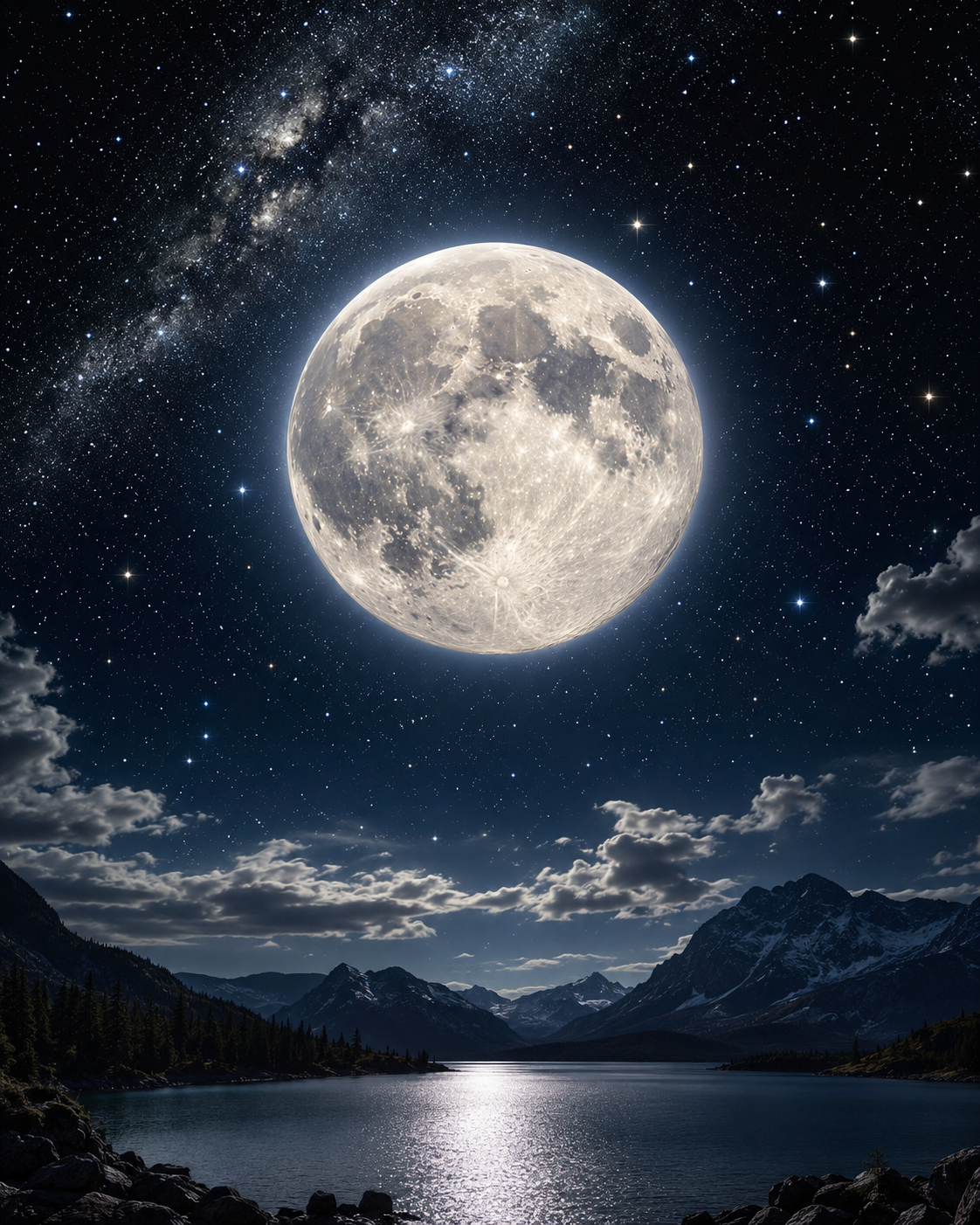
“SHOOT FOR THE MOON AND IF YOU MISS
YOU WILL BE AMONG THE STARS.“
-Les Brown
The Moon: A Historical, Scientific, Religious, and Cultural Summary
The Moon is Earth’s only natural satellite and one of the most recognizable objects in the night sky. Orbiting our planet for more than 4.5 billion years, it has profoundly influenced Earth’s environment, human civilization, religious beliefs, mythology, science, and culture. The Moon governs ocean tides, stabilizes Earth’s axial tilt, illuminates the night sky, and serves as a natural calendar for many societies. Throughout history, it has inspired countless myths, works of art, scientific discoveries, and spiritual traditions, making it one of humanity’s most enduring symbols of mystery, change, and continuity.
Scientific Overview
The Moon formed approximately 4.5 billion years ago, most likely after a Mars-sized body, often called Theia, collided with the young Earth. Debris from this massive impact eventually coalesced to form the Moon.
The Moon has an average diameter of about 2,159 miles (3,475 kilometers), making it the fifth-largest natural satellite in the Solar System. It orbits Earth at an average distance of 238,855 miles (384,400 kilometers) and completes one orbit approximately every 27.3 days. Because its rotation period matches its orbital period—a phenomenon known as tidal locking—the same side of the Moon always faces Earth.
Unlike Earth, the Moon has virtually no atmosphere capable of supporting weather or liquid water on its surface. As a result, its landscape remains largely unchanged except for impacts from meteoroids. The lunar surface consists of mountains, valleys, vast lava plains called maria, and millions of impact craters formed over billions of years.
Influence on Earth
The Moon plays a vital role in maintaining Earth’s stability.
Its gravitational pull produces the ocean tides, influencing marine ecosystems, coastal environments, and navigation. Many marine organisms synchronize feeding, reproduction, and migration with the lunar cycle.
The Moon also stabilizes Earth’s axial tilt, helping maintain relatively consistent seasons over long periods. Without the Moon’s stabilizing influence, Earth’s climate might fluctuate far more dramatically.
Scientists also believe the Moon contributed significantly to Earth’s early geological and biological development, making conditions more favorable for the emergence and evolution of life.
Phases of the Moon
As the Moon orbits Earth, different portions of its sunlit surface become visible, creating the familiar lunar phases:
- New Moon
- Waxing Crescent
- First Quarter
- Waxing Gibbous
- Full Moon
- Waning Gibbous
- Last Quarter
- Waning Crescent
A complete cycle of phases, known as the synodic month, lasts approximately 29.5 days. These phases have served as natural calendars for civilizations throughout history.
Lunar Eclipses
A lunar eclipse occurs when Earth passes directly between the Sun and the Moon, casting Earth’s shadow across the lunar surface.
During a total lunar eclipse, sunlight passing through Earth’s atmosphere is refracted, causing the Moon to appear reddish in color. This phenomenon is commonly known as a Blood Moon.
Unlike solar eclipses, lunar eclipses are safe to observe without eye protection and can often be seen across large portions of the night side of Earth.
Historical Significance
The Moon has guided humanity for thousands of years.
Ancient civilizations relied upon lunar observations to:
- Measure time.
- Develop calendars.
- Predict seasons.
- Schedule agricultural activities.
- Navigate during nighttime travel.
- Plan religious festivals.
- Track celestial events.
Many of the world’s earliest calendars were lunar or lunisolar, including those used in Mesopotamia, Egypt, China, India, and Mesoamerica.
The Moon also served as an essential navigational reference for sailors long before modern navigation technologies were developed.
Religious Perspectives
The Moon occupies an important place in many of the world’s religions.
Christianity
The Bible frequently uses the Moon as a symbol of God’s creative power, the order of creation, and the passage of time. The Moon marks seasons and sacred festivals and appears in prophetic passages describing extraordinary celestial events.
Judaism
The Jewish calendar is lunisolar, meaning that months begin with the appearance of a new lunar cycle while adjustments keep the calendar aligned with the solar year. Important observances, including Passover, Rosh Hashanah, and Sukkot, are determined in part by the Moon’s phases.
Islam
The Islamic calendar is entirely lunar, consisting of twelve lunar months. The sighting of the crescent Moon determines the beginning and end of months, including the start and conclusion of Ramadan, as well as the timing of Eid al-Fitr, Eid al-Adha, and the annual pilgrimage of Hajj.
Hinduism
The Moon, known as Chandra, is revered as a deity associated with beauty, emotion, fertility, and the passage of time. Lunar phases influence many Hindu festivals, fasting traditions, and religious observances. The Moon also plays an important role in Hindu astrology.
Buddhism
Many significant Buddhist observances occur on full-moon days. According to tradition, important events in the life of the Buddha—including his birth, enlightenment, and passing into Parinirvana—are commemorated during full-moon festivals in various Buddhist traditions.
Mythological Perspectives
The Moon has inspired countless myths throughout history.
Greek Mythology
The Moon was personified as the goddess Selene, who drove her silver chariot across the night sky. Later traditions also associated the Moon with Artemis, goddess of the hunt and wilderness.
Roman Mythology
The Roman Moon goddess Luna represented the nightly journey of the Moon across the heavens and became an enduring symbol of beauty and mystery.
Norse Mythology
In Norse tradition, the Moon was personified by Máni, who guided the Moon across the sky while being pursued by a cosmic wolf destined to catch him during Ragnarök.
Chinese Mythology
Chinese tradition tells the story of Chang’e, the Moon goddess who resides upon the Moon after drinking an elixir of immortality. Her story is celebrated during the annual Mid-Autumn Festival, one of East Asia’s most cherished cultural celebrations.
Indigenous Traditions
Many Indigenous cultures view the Moon as a protector, ancestor, guide, or guardian of natural cycles. Lunar phases often influence storytelling, hunting practices, ceremonies, and seasonal observations.
Cultural Importance
Few celestial bodies have influenced culture as profoundly as the Moon.
It has inspired:
- Poetry
- Music
- Literature
- Painting
- Sculpture
- Architecture
- Folklore
- Festivals
- Navigation
- Timekeeping
Expressions such as “once in a blue moon,” “honeymoon,” and “moonlit night” reflect the Moon’s lasting influence on language and everyday life.
The Moon has long been associated with romance, mystery, contemplation, dreams, imagination, and artistic inspiration.
Exploration
The twentieth century marked a new chapter in humanity’s relationship with the Moon.
In 1969, the Apollo 11 mission became the first successful crewed lunar landing, when astronauts Neil Armstrong and Buzz Aldrin walked on the Moon while Michael Collins remained in lunar orbit. Armstrong’s first steps represented one of the greatest achievements in the history of science and exploration.
Since then, numerous robotic missions have studied the Moon’s geology, searched for water ice near its poles, and explored its potential as a future base for scientific research and human exploration.
Symbolic Meaning
Throughout history, the Moon has symbolized:
- Change
- Cycles
- Renewal
- Reflection
- Mystery
- Intuition
- Time
- Hope
- Guidance
- Beauty
- Transformation
- The passage of life
Because it continually changes appearance while remaining constant in its orbit, the Moon has become a universal symbol of growth, resilience, and the natural rhythms of existence.
In literature and art, it often represents contemplation, longing, romance, inspiration, hidden truths, and humanity’s fascination with the unknown.
Conclusion
Across science, history, religion, and culture, the Moon remains one of Earth’s most influential and captivating natural wonders. It shapes the tides, stabilizes our planet, guides calendars, and has inspired countless beliefs, myths, artistic works, and scientific discoveries. From ancient civilizations that measured time by its phases to modern astronauts who have walked upon its surface, the Moon continues to connect humanity with the cosmos, reminding us of both our place in the universe and our enduring curiosity about the world beyond our own.

Sigmund Freud on the Representation of the Moon and Its Phases Within Dreams

Sigmund Freud regarded dreams as psychologically meaningful formations shaped by unconscious wishes, repressed thoughts, childhood experiences, recent waking events, bodily sensations, and unresolved emotional conflicts. In The Interpretation of Dreams, he explained that the remembered dream—called the manifest content—disguises the underlying thoughts and wishes known as the latent content.
Freud did not establish a fixed system assigning a separate universal meaning to the new moon, crescent moon, quarter moon, full moon, or waning moon. He would not assume that one lunar phase meant the same thing for every dreamer. The meaning of the moon would have to be discovered through the dreamer’s personal associations, recent experiences, memories, relationships, desires, fears, and emotional responses.
The moon’s phases nevertheless provide dream-work with powerful visual material. The moon repeatedly appears, disappears, grows, reaches fullness, diminishes, and returns. These visible transformations can be used by the dreaming mind to represent psychological concerns involving development, anticipation, completion, decline, concealment, repetition, separation, bodily cycles, sexuality, parenthood, aging, loss, and renewal.
The central Freudian question is not “What does the moon always symbolize?” It is:
“What unconscious wish, conflict, memory, or emotional experience has been transformed into this particular image of the moon?”
Historical Caution
Freud did not publish a comprehensive lunar dream dictionary. He did not state that every new moon represents a beginning, every full moon represents completion, or every waning moon represents decline.
The interpretations of individual lunar phases presented below are therefore applications of Freud’s documented method, not fixed definitions directly assigned by Freud. A psychoanalytic interpretation would require the dreamer’s own associations before any conclusion could be reached.
The Moon and Dream-Work
Freud described several processes through which latent thoughts are transformed into dream imagery.
Condensation
A single image may represent several people, memories, emotions, and wishes simultaneously. The moon might combine associations with:
- A parent
- A romantic partner
- A child
- A childhood home
- Nighttime experiences
- Pregnancy or menstruation
- Loneliness
- Travel
- Religion
- Death
- A particular song, film, or story
A full moon might therefore represent several emotionally important ideas condensed into one luminous image.
Displacement
Emotional importance may be transferred from a disturbing thought to a safer or more distant image. Anxiety involving a relationship, bodily change, aging, pregnancy, sexuality, or loss might be displaced onto the changing moon.
Instead of directly portraying the feared situation, the dream may show the moon shrinking, darkening, breaking, disappearing, or being eclipsed.
Pictorial Representation
Dreams transform abstract thoughts into visual scenes. Expressions such as “a new phase,” “going through changes,” “coming full circle,” or “being kept in the dark” can become literal lunar imagery.
A person entering “a new phase of life” may dream of a crescent moon. Someone who feels that an opportunity is disappearing may dream of a waning moon. These meanings would arise from language and personal circumstances rather than from an automatic lunar code.
Secondary Revision
Upon awakening, the mind attempts to organize the dream into a coherent story. A disconnected collection of images may therefore be remembered as a structured scene involving a moonlit sky, a changing lunar phase, or a journey beneath the moon.
The Moon and Personal Associations
Freud’s method would begin by asking the dreamer to say whatever comes to mind about the moon without rejecting thoughts that seem irrelevant, embarrassing, irrational, or trivial. This process is known as free association.
The moon may remind the dreamer of:
- A childhood bedtime
- A parent pointing toward the sky
- A romantic evening
- A frightening nighttime experience
- A religious teaching
- A nursery rhyme
- A deceased relative
- A menstrual cycle
- Pregnancy or childbirth
- A particular vacation
- A favorite book or film
- Loneliness
- Insomnia
- An important nighttime conversation
- A desire to escape
These personal memories are more important than a generalized symbolic definition.
The Moon and Recent Waking Experiences
Freud observed that dreams frequently incorporate material from the preceding day. These recent impressions are commonly described as day residues.
A moon dream may follow:
- Seeing the moon before sleeping
- Reading about a lunar eclipse
- Watching a film set at night
- Discussing astronomy
- Hearing a song about the moon
- Planning a nighttime journey
- Looking at a calendar
- Thinking about menstruation or pregnancy
- Experiencing insomnia
- Discussing an approaching deadline
- Beginning or ending an important project
The recent event may supply the dream’s image without explaining its entire meaning. Dream-work can connect an ordinary observation of the moon with much older memories and unconscious emotional concerns.
The Moon and Unconscious Wishes
Freud believed that dreams express wishes, although the wish may be disguised, conflicted, or combined with anxiety. The moon may become involved in wishes concerning:
- Romantic closeness
- Emotional protection
- Escape from responsibility
- Return to childhood
- Sexual intimacy
- Pregnancy or parenthood
- Recognition
- Completion of a difficult task
- Recovery of something lost
- Beginning life again
- Withdrawal from other people
- Control over time and change
A calm moonlit landscape might disguise a wish for privacy, intimacy, or freedom. A moon that grows rapidly might express impatience for a desired event. A disappearing moon might represent a wish to avoid attention or escape an obligation.
The Dark Moon
The dark moon refers to the period when the moon is not visibly illuminated from Earth. Within a Freudian interpretation, darkness may provide an image for something hidden, unavailable, avoided, or temporarily absent.
A dark moon may be associated with:
- A concealed wish
- Repressed emotion
- Uncertainty
- Fear of abandonment
- Emotional withdrawal
- A missing person
- Lack of recognition
- A period the dreamer cannot remember clearly
- The wish to remain unseen
- Anxiety about what cannot be known
The dreamer’s feelings are essential. Fear may indicate anxiety about loss or concealment. Relief may reveal a wish to escape observation. Peace may suggest a desired retreat from external demands.
The New Moon
A new moon is largely invisible, although it marks the beginning of another lunar cycle. Dream-work could use this condition to represent something that has begun but is not yet visible.
Possible associations include:
- A hidden beginning
- A private wish
- An unannounced plan
- An early pregnancy
- An emerging relationship
- A developing idea
- Hope that has not yet taken form
- Fear that progress cannot be seen
- The wish to start over
The new moon should not automatically be interpreted as renewal. If the dreamer feels frightened, it may represent uncertainty or absence. If the dreamer feels hopeful, it may express anticipation. If the dreamer cannot find the moon, the dream may involve disappointment, abandonment, or lack of direction.
The Waxing Crescent Moon
The waxing crescent gradually becomes more visible. Within dream-work, this visual growth may represent an idea, wish, relationship, or conflict becoming increasingly noticeable.
It may be associated with:
- Developing confidence
- Growing desire
- Increasing emotional attachment
- Early progress
- Anticipation
- Emerging awareness
- A secret becoming more difficult to conceal
- Anxiety that is gradually increasing
The crescent’s shape may also produce entirely personal associations. It might remind the dreamer of a smile, cradle, boat, horn, blade, religious symbol, or childhood illustration. That association may become more important than the lunar phase itself.
The First-Quarter Moon
At the first quarter, half of the moon’s visible surface appears illuminated. This divided appearance may be used to represent conflict, ambivalence, or a situation that feels incomplete.
Possible associations include:
- Being divided between two choices
- Partial success
- A developing plan
- Conflict between desire and restraint
- Incomplete understanding
- Emotional hesitation
- Progress accompanied by resistance
- Feeling “halfway there”
A divided moon could picture opposition between conscious intentions and unconscious wishes. One part is visible while the other remains hidden. However, this interpretation would need confirmation through the dreamer’s associations.
The Waxing Gibbous Moon
A waxing gibbous moon is approaching fullness but has not yet reached it. The dreaming mind may use this nearly complete form to represent anticipation, impatience, preparation, or fear of an approaching outcome.
It may relate to:
- A goal nearing completion
- Growing emotional intensity
- Anticipation of recognition
- A relationship approaching commitment
- Anxiety before an important event
- Pressure to finish something
- Fear of what success will require
- A wish that has almost been fulfilled
A dreamer who feels excited may be anticipating completion. A dreamer who feels threatened may fear that a hidden matter is about to become fully exposed.
The Full Moon
The full moon is visually complete, bright, and highly noticeable. It may offer dream-work an image of fullness, exposure, culmination, intensity, or being seen.
Depending upon the dreamer’s circumstances, it may be associated with:
- Fulfillment of a wish
- Completion
- Emotional intensity
- Sexual desire
- Pregnancy or fertility
- Visibility
- Public recognition
- Fear of exposure
- A relationship reaching a decisive point
- An emotion that can no longer remain hidden
A beautiful full moon may express satisfaction or the wish for emotional completeness. An overwhelmingly large full moon may indicate that a desire, fear, person, or responsibility has become psychologically dominant.
The full moon’s brightness may also symbolize unwanted visibility. The dreamer may feel watched, exposed, judged, or unable to hide. Thus, fullness is not automatically favorable; it can be experienced as completion or as excessive emotional pressure.
The Waning Gibbous Moon
After fullness, the moon begins to diminish. Dream-work may use this change to represent something that has reached its height and is now decreasing.
Possible concerns include:
- Declining excitement
- Emotional separation
- Reduced influence
- The aftermath of success
- Fear of aging
- A relationship losing intensity
- Recovery from overwhelming emotion
- Relief after a demanding experience
- The wish for pressure to decrease
If the dreamer feels grief, the waning moon may picture unwanted loss. If the dreamer feels relief, it may express the wish for a stressful situation to become less powerful.
The Last-Quarter Moon
The last-quarter moon again appears divided between light and darkness, but it is moving toward disappearance rather than fullness. It may provide an image for unresolved feelings surrounding separation, decline, or release.
It may be associated with:
- Difficulty letting go
- Divided feelings about an ending
- A weakening attachment
- Reduced confidence
- Conflict about completing a separation
- Recognition that a situation is ending
- The wish to preserve what remains
- The wish to be free of an obligation
The dreamer may consciously want an ending while unconsciously resisting it. The divided moon can picture this ambivalence.
The Waning Crescent Moon
The waning crescent is the final visible portion of the lunar cycle before the moon becomes dark. It may represent something fading from awareness or approaching disappearance.
Possible associations include:
- Emotional exhaustion
- A diminishing relationship
- Fear of being forgotten
- Declining hope
- Withdrawal
- The ending of a responsibility
- A memory becoming less vivid
- The wish to disappear temporarily
- Preparation for a new beginning
The emotional tone determines whether the image expresses loss or release. Sadness may indicate grief over something fading. Peace may indicate the wish to rest, withdraw, or end a difficult period.
The Complete Lunar Cycle
A dream in which the moon passes rapidly through all its phases may condense an extended period into a single image. Freud observed that dreams can represent complex relationships and long sequences through compressed visual scenes.
A complete lunar cycle may express:
- Awareness of time passing
- Anxiety about aging
- The history of a relationship
- Repeated emotional patterns
- Development followed by decline
- A wish to complete a process quickly
- Fear that happiness cannot last
- Recognition of recurring conflicts
- Bodily or reproductive concerns
The dream may also represent a repetitive cycle in waking life: attraction, fulfillment, disappointment, separation, and renewed desire.
A Lunar Eclipse
During an eclipse, the moon is obscured by the Earth’s shadow. A Freudian analysis could treat the eclipse as an image of interruption, concealment, competition, repression, or loss of access to something emotionally important.
It may be associated with:
- A relationship overshadowed by another person
- Fear that love or recognition will be withdrawn
- Repression of a wish
- Interruption of sexual or emotional intimacy
- A parent or authority figure blocking independence
- Temporary loss of confidence
- Anxiety about an approaching event
- The wish to hide
The object casting the shadow may be psychologically important. The dreamer should ask what person, responsibility, fear, or prohibition is currently “overshadowing” something valuable.
A Blood Moon or Red Moon
A red moon may combine lunar associations with the emotional significance of blood and the color red.
Depending upon the dreamer, it may evoke:
- Menstruation
- Pregnancy
- Childbirth
- Sexuality
- Anger
- Injury
- Family ties
- Death
- Passion
- Danger
Freud would require the dreamer’s associations rather than assuming that a red moon has one meaning. A person recently hearing the phrase “blood moon” may be reproducing recent material. Another person may connect the image to bodily anxiety, religious fear, violence, or intense desire.
A Blue, Golden, or Unnaturally Colored Moon
An unusually colored moon may result from condensation and displacement. The color may carry associations independent of the moon.
The dreamer should consider:
- Who or what is associated with that color?
- Was the color seen recently?
- Did it feel beautiful, artificial, sickly, sacred, or frightening?
- Does the color recall clothing, a room, a person, or an event?
- Is there a familiar phrase such as “once in a blue moon”?
A blue moon could literally represent something rare if the dreamer uses that expression. It could also relate to sadness, distance, or a specific memory. The personal linguistic association is crucial.
Multiple Moons
Dreaming of two or more moons may reflect condensation, duplication, conflict, or competing emotional attachments.
Multiple moons may represent:
- Two important people
- Divided loyalty
- Competing desires
- Conflicting versions of the same person
- Repetition
- Uncertainty about reality
- Several wishes sharing one image
- A relationship triangle
- Confusion about which direction to follow
Two moons may also emerge from an expression, fantasy, story, film, or recent visual experience. The dreamer should identify what each moon seemed to do and whether one was brighter, closer, or more threatening.
The Moon Falling From the Sky
A falling moon may transform fear of collapse, loss, or catastrophe into a dramatic visual image.
It may be associated with:
- Loss of an ideal
- Fear that a powerful person will fail
- Collapse of emotional security
- Anxiety about a relationship
- Fear of death
- Loss of childhood beliefs
- An overwhelming wish approaching too closely
- The breakdown of something once considered permanent
If the dreamer catches or saves the moon, the scene may express a wish to rescue a relationship, parent, ideal, or emotionally valuable part of life.
The Moon Appearing Extremely Close
An enormous or nearby moon may indicate that a thought or feeling has acquired extraordinary psychological intensity.
It may represent:
- An approaching desire
- A powerful emotional attachment
- Fear of being overwhelmed
- A wish becoming imaginable
- Sexual or romantic excitement
- A parent or partner experienced as dominating
- Anxiety about an unavoidable event
The exaggerated size reflects psychic importance rather than necessarily predicting an external event.
Traveling to the Moon
Traveling toward the moon may express:
- Pursuit of a difficult wish
- Desire to escape ordinary life
- Longing for isolation
- Romantic fantasy
- Ambition
- Return to childhood imagination
- Withdrawal from relationships
- Desire to reach an idealized person or state
Reaching the moon may stage wish fulfillment. Discovering that it is empty or disappointing may reveal conflict between fantasy and reality.
Being Trapped on the Moon
Isolation on the moon may represent:
- Emotional detachment
- Loneliness
- Fear of abandonment
- Withdrawal from intimacy
- The wish to escape social demands
- Feeling unreachable
- Punishment for forbidden wishes
- Separation from family or ordinary life
The dream may contain both wish and punishment. The dreamer may wish to escape responsibilities while simultaneously fearing the loneliness that escape would create.
Moonlight
Moonlight illuminates without producing daylight. It may therefore be used by dream-work to represent partial visibility, secrecy, romance, uncertainty, or indirect recognition.
Moonlight may be associated with:
- A concealed relationship
- Romantic wishes
- Partial understanding
- A childhood nighttime memory
- Fear of what remains in shadow
- The wish to see without being seen
- Indirect awareness of a repressed concern
Bright moonlight may reveal something the dreamer has attempted to avoid. Weak moonlight may suggest difficulty understanding an emotional situation.
The Moon Reflected in Water
A reflected moon combines a celestial image with water, movement, distortion, and duplication. Its meaning would depend upon what the dreamer associates with the water and reflection.
Possible themes include:
- An indirect image of a desired person
- Uncertainty about what is real
- Emotional instability
- Narcissistic self-concern
- An idealized image
- A memory altered by emotion
- A wish that cannot be directly possessed
Attempting to grasp the moon’s reflection may dramatize the pursuit of something desired but unavailable.
The Moon and Childhood Memory
Freud emphasized the importance of childhood in dream formation. The moon frequently appears in nursery rhymes, bedtime stories, picture books, prayers, fairy tales, and family experiences.
A moon dream may revive:
- Being placed in bed
- Fear of darkness
- A parent’s presence or absence
- Childhood loneliness
- Bedtime comfort
- Nightmares
- Family travel
- Stories about the moon
- Early questions about birth and the body
- Childhood wishes to fly or escape
An adult dream about the moon may therefore contain memories and wishes originating much earlier in life.
The Moon and Bodily Cycles
Because lunar language is culturally connected with monthly cycles, some dreamers may personally associate the moon with:
- Menstruation
- Pregnancy
- Fertility
- Sexual maturity
- Fear of pregnancy
- Desire for a child
- Aging
- Bodily change
- Medical concerns
These meanings should not be imposed upon every dreamer. They become relevant only when the dreamer’s associations, circumstances, and emotional life support them.
Bodily sensations experienced during sleep may also contribute to the dream. Pain, hormonal concerns, temperature, bladder pressure, or physical discomfort can be incorporated into lunar or nighttime imagery.
Emotional Responses to the Moon
Awe
Awe may express:
- Attraction toward an ideal
- Intense desire
- Recognition of something psychologically important
- Longing for beauty, love, or completion
Fear
Fear may indicate:
- Anxiety about unconscious wishes
- Fear of exposure
- Loss of control
- Bodily anxiety
- A powerful person or emotion becoming overwhelming
Sadness
Sadness may relate to:
- Separation
- Loneliness
- Fading attachment
- Grief
- A memory associated with nighttime or the moon
Peace
Peace may indicate:
- A wish for privacy
- Emotional protection
- Retreat from external demands
- Satisfaction of a romantic or childhood wish
Confusion
Confusion may suggest:
- Conflict between wishes
- Difficulty understanding a relationship
- Disorientation during a period of change
- Uncertainty about what is hidden and what is visible
Questions for Freudian Interpretation
A psychoanalytic examination of a moon dream would ask:
- What is my first memory of the moon?
- What person does the moon bring to mind?
- What happened during the day before the dream?
- Was the moon growing, full, shrinking, or hidden?
- How did its phase make me feel?
- What in my life is beginning, developing, completing, or fading?
- What do I wish would change?
- What am I afraid of losing?
- Did the moon remind me of childhood?
- Did it evoke romance, sexuality, pregnancy, family, religion, death, or loneliness?
- Was I watching the moon or being watched by it?
- Did I want to approach it, escape it, hide from it, or possess it?
- What familiar saying, song, story, or film might have supplied the image?
- What remained concealed in the dream?
- What wish might the lunar image have disguised?
These questions are intended to generate associations, not to impose a predetermined explanation.
Key Themes Associated With the Moon and Its Phases
- Unconscious wishes
- Repression
- Childhood memories
- Romantic and sexual desire
- Bodily cycles
- Pregnancy and parenthood
- Emotional development
- Completion
- Decline
- Repetition
- Aging
- Concealment
- Exposure
- Loss
- Renewal
- Ambivalence
- Day residue
- Wish fulfillment
Conclusion
According to Sigmund Freud’s psychoanalytic method, the moon and its phases within dreams cannot be assigned one fixed symbolic meaning. The moon becomes meaningful through the dreamer’s memories, wishes, fears, bodily experiences, relationships, language, and recent waking circumstances.
The new moon may picture something beginning but not yet visible. The waxing crescent may represent a desire, conflict, or relationship becoming more noticeable. The quarter moon may portray division or ambivalence. The waxing gibbous moon may express anticipation as a wish approaches fulfillment. The full moon may represent completion, emotional intensity, visibility, sexual desire, or fear of exposure. The waning phases may portray loss, withdrawal, relief, aging, separation, or the wish for an overwhelming situation to diminish.
An eclipse may represent interruption or concealment. A red moon may draw upon associations with blood, sexuality, anger, family, or bodily cycles. Multiple moons may condense competing relationships or wishes. A falling moon may portray the collapse of an ideal, while an enormous moon may show that a person, wish, or fear has become psychologically dominant.
None of these possibilities should be treated as an automatic definition. Freud’s method requires movement from the manifest image to the dreamer’s latent thoughts through free association. The moon’s phase provides the dream’s visible form, but the dreamer’s personal history reveals what that form conceals.
Ultimately, the changing moon may give dream-work an effective visual language for representing wishes and conflicts that develop, reach intensity, diminish, disappear, and return. Its deepest meaning lies not in the sky itself, but in the unconscious emotional material that the dreaming mind has chosen to illuminate through it.
Bibliography
Freud, Sigmund. The Interpretation of Dreams. 1900.
Freud, Sigmund. Three Essays on the Theory of Sexuality. 1905.
Freud, Sigmund. Creative Writers and Day-Dreaming. 1908.
Freud, Sigmund. Formulations on the Two Principles of Mental Functioning. 1911.
Freud, Sigmund. Introductory Lectures on Psycho-Analysis. 1916–1917.
Freud, Sigmund. The Ego and the Id. 1923.
Freud, Sigmund. New Introductory Lectures on Psycho-Analysis. 1933.
Freud, Sigmund. The Standard Edition of the Complete Psychological Works of Sigmund Freud. Edited and translated by James Strachey.
Historical Note
Freud did not leave a documented phase-by-phase system of lunar interpretation. The discussion of the new, waxing, full, waning, and eclipsed moon in this entry applies his established concepts of free association, wish fulfillment, day residue, condensation, displacement, repression, pictorial representation, and childhood memory. These applications should not be quoted as universal lunar meanings directly stated by Freud.
Carl Jung on the Representation of the Moon and Its Phases Within Dreams

Carl Gustav Jung regarded dreams as natural and purposeful expressions of the psyche. Dreams may reveal unconscious material, compensate for an unbalanced conscious attitude, anticipate psychological development, and guide the dreamer toward greater integration. Within this framework, the moon is a potentially powerful image because it combines darkness and light, concealment and revelation, constancy and change.
Jung did not establish a dream dictionary assigning one fixed meaning to each lunar phase. He would interpret the moon according to the dreamer’s personal associations, present psychological situation, cultural background, emotional response, and the complete structure of the dream. He would also amplify the image by examining lunar themes in mythology, religion, folklore, and alchemy.
In Jung’s alchemical studies, the moon—Luna—frequently appears as the counterpart of the sun, or Sol. Luna may represent the receptive, relational, instinctive, bodily, reflective, or unconscious side of psychic life. However, Jung’s treatment of lunar symbolism is complex. The moon should not automatically be equated with the unconscious or assigned exclusively to women. Its meaning changes according to the dreamer and the psychological opposites active within the dream.
The central Jungian question is:
“What changing aspect of the psyche is the moon revealing, and how is that image attempting to restore balance or guide the dreamer toward greater wholeness?”
Historical Caution
Jung discussed lunar symbolism extensively in relation to mythology, religion, alchemy, the mother archetype, the anima, consciousness, psychic opposites, and transformation. He did not, however, publish a systematic interpretation of every lunar phase as it appears in dreams.
The phase-by-phase interpretations below are therefore applications of Jung’s established concepts rather than fixed definitions directly assigned by him. An actual Jungian interpretation would require the dreamer’s personal associations and the surrounding dream narrative.
The Moon as an Archetypal Image
An archetypal image is not a symbol with only one definition. It is an image arising from deep patterns within the collective unconscious and capable of expressing multiple, sometimes contradictory meanings.
The moon may evoke:
- Change
- Cycles
- Growth and decline
- Birth, death, and renewal
- Reflected consciousness
- The unconscious
- The mother
- The anima
- The body
- Instinct
- Fertility
- Emotional relationship
- Wisdom
- Mystery
- Time
- Transformation
- Psychic wholeness
The moon may feel nurturing in one dream and threatening in another. It may guide the dreamer through darkness, or it may create distorted shadows. It may represent a source of inner orientation, but it may also symbolize uncertainty, illusion, dependency, or emotional instability.
Its meaning emerges from the relationship between the moon, the dreamer, and the other images in the dream.
The Moon and the Unconscious
The moon is visible mainly at night, when ordinary daytime consciousness has withdrawn. Its changing light can therefore provide an image of unconscious material becoming more or less accessible.
A bright moon may suggest:
- Unconscious contents becoming visible
- Intuitive awareness
- Psychological insight
- Recognition of an overlooked feeling
- Guidance during uncertainty
- Increasing contact with the inner world
A dark or hidden moon may suggest:
- Unconscious potential
- Material not yet ready for recognition
- Psychological withdrawal
- An approaching transformation
- Fear of the unknown
- Loss of inner orientation
This does not mean that the moon always represents the unconscious. Jung emphasized that symbols must be interpreted within their specific psychological setting.
The Moon as Reflected Light
The moon does not create its own visible light; it reflects sunlight. Psychologically, this can suggest a form of awareness that is indirect, receptive, intuitive, relational, or dependent upon another source.
Reflected lunar light may represent:
- Intuition rather than rational analysis
- Awareness emerging from unconscious material
- Knowledge received through images and feelings
- A personality shaped by another person
- Indirect recognition of a psychological truth
- Emotional understanding
- A borrowed or projected identity
A moon that cannot shine without the sun may raise questions about psychological dependence. The dreamer may be relying excessively on a partner, parent, authority figure, or collective belief for identity and direction.
Alternatively, reflected light may represent the legitimate value of receptivity—the ability to receive, contain, transform, and relate rather than dominate.
Luna in Jung’s Alchemical Psychology
In Mysterium Coniunctionis, Jung examined the alchemical figure of Luna as the counterpart of Sol. In the alchemical texts he studied, Luna was described through qualities such as darkness, moisture, receptivity, embodiment, femininity, and relationship. She was personified as mother, sister, bride, or spouse and participated in the coniunctio, the symbolic union of opposites.
Jung interpreted the alchemical sun and moon as images of fundamental psychological opposites, including consciousness and unconsciousness. The union of Sol and Luna represented an attempt to reconcile divided aspects of the personality. The International Association for Analytical Psychology summarizes Jung’s treatment of Luna and the Sol–Luna opposition in Mysterium Coniunctionis.
In a dream, the moon’s relationship with the sun may therefore be especially significant. The two may represent psychological principles that require dialogue rather than the destruction of one by the other.
The Moon and the Feminine Principle
The moon has historically been associated with goddesses, fertility, motherhood, the body, and cyclical transformation. Jung used such historical patterns when amplifying dream imagery, but he did not reduce the feminine principle to biological sex.
Lunar symbolism may concern:
- The anima
- The mother archetype
- Emotional relationship
- Receptivity
- Intuition
- Embodiment
- Instinct
- Creativity
- Fertility
- The capacity to nurture
- The ability to contain experience
In a man’s dream, the moon may sometimes carry anima associations: emotional life, relationship, imagination, mood, or an unconscious inner figure. In a woman’s dream, the moon may represent an aspect of her own identity, bodily experience, consciousness, maternal inheritance, or relationship with the feminine.
The dreamer’s gender does not determine the meaning automatically. Jung’s mature treatment of lunar symbolism recognizes that the relationship between sun, moon, consciousness, and unconsciousness changes according to the individual psyche.
The Moon and the Mother Archetype
Jung included the moon among images that can carry maternal significance. It may appear as:
- A nurturing mother
- A protective presence
- A devouring or possessive mother
- A source of fertility
- The containing unconscious
- The rhythm of bodily life
- An ancestral feminine presence
- A place of origin and return
A gentle moon may indicate comfort, protection, or a positive relationship with the maternal realm. A threatening moon may point toward emotional engulfment, dependency, fear of separation, or an unresolved mother complex.
The dreamer should ask whether the moon feels like a protective presence, a distant observer, a demanding authority, or an overwhelming force.
The Moon and Individuation
Jung described individuation as the lifelong process through which conscious and unconscious aspects of personality become more fully integrated. This process is not a straight line. It involves periods of growth, conflict, illumination, darkness, dissolution, and renewal.
The lunar cycle provides an appropriate image for this process because it repeatedly moves through:
- Invisibility
- Emergence
- Growth
- Fullness
- Decline
- Disappearance
- Return
A dream containing several lunar phases may represent the dreamer’s position within a psychological transformation. It may show that development includes necessary periods of darkness and withdrawal as well as periods of clarity and achievement.
The Dark Moon
The dark moon is invisible or nearly invisible. In a Jungian interpretation, it may represent a descent into the unknown, a period of psychological latency, or an encounter with unconscious potential.
Possible themes include:
- Withdrawal
- Introversion
- Gestation
- Hidden transformation
- Loss of conscious direction
- Confrontation with the shadow
- A state preceding renewal
- The unknown future
- Fear of psychic emptiness
The dark moon may resemble the alchemical nigredo, the blackening stage in which established forms dissolve. Although such a period may feel depressing or disorienting, it can prepare the personality for transformation.
The dreamer’s emotional response is decisive. Terror may indicate fear of losing conscious control. Peace may suggest that withdrawal and rest are psychologically necessary.
The New Moon
The new moon begins a cycle while remaining mostly invisible. It may represent a new psychological development that has not yet entered full consciousness.
It may be associated with:
- Unrecognized potential
- A new attitude forming
- The beginning of individuation
- A creative impulse
- A developing relationship
- Spiritual or emotional renewal
- Inner change not yet visible externally
- The emergence of a new identity
The new moon does not guarantee a favorable beginning. It may also produce anxiety because the dreamer cannot yet see where the process is leading.
A Jungian interpretation would ask what new possibility is present in hidden form and what conscious attitude is needed to protect its development.
The Waxing Crescent Moon
The waxing crescent is the first visible evidence that the moon is returning. It may symbolize unconscious content beginning to emerge.
Possible meanings include:
- The first recognition of an inner need
- Growing intuition
- Developing creativity
- Increasing emotional awareness
- The return of hope
- A newly forming relationship with the unconscious
- Early recovery after psychological darkness
- A fragile but meaningful insight
Because the crescent is incomplete, the development may still require protection. The dreamer may be tempted to dismiss something that has only recently appeared.
The crescent’s shape also matters. It may resemble a cradle, boat, horn, bowl, blade, smile, or religious emblem. Each resemblance can lead to a different interpretation.
The First-Quarter Moon
The first-quarter moon appears divided between light and darkness. This can portray tension between conscious and unconscious positions.
It may represent:
- Conflict between two attitudes
- A decision that cannot be avoided
- Partial awareness
- Opposition between reason and feeling
- Resistance to psychological change
- A developing confrontation with the shadow
- The need to hold opposing truths together
From a Jungian perspective, conflict is not always evidence of failure. Tension between opposites can generate the psychic energy required for transformation.
The dream may be asking the dreamer not to choose one side prematurely, but to remain conscious of both positions until a more inclusive solution develops.
The Waxing Gibbous Moon
The waxing gibbous moon approaches fullness. It may represent a psychological process nearing conscious realization.
Possible themes include:
- An insight becoming clearer
- Growing self-awareness
- Preparation for an important transition
- Increasing psychological energy
- A relationship approaching transformation
- Creative development
- Anticipation of completion
- Pressure created by approaching change
A brightening moon may indicate that unconscious material is gaining sufficient form to be consciously understood. However, the dreamer may also feel threatened by what will be revealed when the moon becomes full.
The Full Moon
The full moon is circular, complete, luminous, and visually dominant. It may carry associations with totality and the Self.
Jung frequently regarded circular images as potential symbols of psychic wholeness, especially when they appear with a numinous or mandala-like quality. A full moon may therefore suggest:
- Wholeness
- Completion
- Integration
- Revelation
- Heightened psychic energy
- The Self
- Conscious recognition of unconscious material
- Fulfillment of a developmental stage
However, a full moon does not necessarily mean that individuation has been completed. It may represent an image of wholeness toward which the psyche is directing the dreamer.
The Danger of Inflation
A huge or overwhelming full moon may also warn of inflation, a condition in which the ego identifies with an archetypal power.
The dreamer may feel:
- Specially chosen
- Omnipotent
- Spiritually superior
- Overwhelmed by emotion
- Possessed by a collective idea
- Unable to distinguish personal identity from an archetypal experience
A numinous image should be respected, but it should not be claimed by the ego as proof of personal greatness.
The Waning Gibbous Moon
After reaching fullness, the moon begins to diminish. Psychologically, this phase may represent assimilation—the process of absorbing and integrating what has been revealed.
It may be associated with:
- Reflection after a major experience
- Integration of insight
- Withdrawal of intense psychic energy
- Acceptance that a climax has passed
- Sharing knowledge with others
- Emotional release
- Gradual reduction of an inflated attitude
- Preparation for another inward movement
If the dreamer feels grief, the waning moon may represent fear of losing power, beauty, status, or emotional intensity. If the dreamer feels calm, it may show that decline is a natural and necessary part of the cycle.
The Last-Quarter Moon
The last-quarter moon again presents a division between light and darkness, but now consciousness is moving toward greater darkness.
This phase may symbolize:
- Letting go of an old identity
- Conflict about an ending
- Separation from a former attitude
- Evaluation of what should be preserved
- A necessary sacrifice
- Resistance to psychological withdrawal
- The dismantling of an outdated persona
- Preparation for renewed contact with the unconscious
The dreamer may understand intellectually that something must end while remaining emotionally attached to it. The divided moon can reflect this tension.
The Waning Crescent Moon
The waning crescent is the final visible portion of the moon before darkness. It may represent the final stage of a psychological cycle.
Possible themes include:
- Completion of mourning
- Release of an attachment
- Surrender of an outdated identity
- Exhaustion
- Necessary rest
- Return to the unconscious
- Preparation for renewal
- Acceptance of impermanence
A fading moon may feel sorrowful because consciousness is losing something familiar. Yet the image may also indicate that continued growth requires a period of silence, emptiness, or retreat.
The Complete Lunar Cycle
A dream in which the moon rapidly moves through all of its phases may symbolize the entire pattern of psychological transformation.
It may represent:
- The individuation process
- A repeating emotional pattern
- The life cycle
- Birth, maturity, decline, death, and renewal
- Changing relationships with the unconscious
- A recurring complex
- Acceptance of psychological rhythm
- The passage through several stages of development
If the cycle repeats continuously, the dream may indicate that the dreamer is trapped in an unresolved pattern. Alternatively, it may teach that psychological life proceeds cyclically rather than through uninterrupted progress.
A Lunar Eclipse
Jung discussed eclipse symbolism within his examination of Luna and alchemical transformation. An eclipse brings shadow across the moon and may symbolize the temporary obscuring of reflective awareness, relationship, intuition, or unconscious guidance.
An eclipse may indicate:
- Confrontation with the shadow
- A wounded feminine principle
- Loss of emotional orientation
- A complex temporarily overwhelming consciousness
- Fear of transformation
- Repression of intuition
- Interruption in the relationship between conscious and unconscious
- A necessary darkening before renewal
The International Association for Analytical Psychology’s summary of Mysterium Coniunctionis notes Jung’s discussion of the moon as both a source and destroyer of light, together with the eclipse motif’s association with wounding and transformation. See the summary of “The Orphan, the Widow, and the Moon.”
A dream eclipse may therefore represent danger, but it may also mark an initiation into deeper psychological awareness.
The Sun and Moon Together
A dream containing both the sun and moon may present a coniunctio, or attempted union of opposites.
The pair may represent:
- Conscious and unconscious
- Logos and Eros
- Reason and feeling
- Activity and receptivity
- Spirit and body
- Masculine and feminine principles
- Ego and inner other
- Day consciousness and nighttime imagination
If the sun and moon are in harmony, the dream may indicate movement toward integration. If they are fighting, separating, or destroying one another, the psyche may be divided between incompatible attitudes.
If they merge, the dream may portray the possibility of a new psychological center emerging from their union.
A Blood Moon or Red Moon
A red moon combines lunar symbolism with the instinctive and emotional associations of blood and fire.
It may represent:
- Intense instinct
- Anger
- Passion
- Sacrifice
- Menstruation
- Fertility
- Bodily transformation
- Violence
- Ancestral life
- Psychological emergency
- The transformation of unconscious material
A blood moon may signal that the normally cool or reflective lunar principle has become heated by powerful emotion. The dreamer may be confronting instinctive material that can no longer remain distant or abstract.
The image should not automatically be interpreted as a prediction of disaster. Its meaning depends upon whether the dreamer experiences the red moon as sacred, beautiful, violent, wounded, or threatening.
A Blue, Golden, or Unnaturally Colored Moon
An unusually colored moon may show that the lunar image has combined with the symbolic qualities of a color.
Blue Moon
A blue moon may suggest:
- Distance
- Sadness
- Spiritual depth
- Calmness
- Rarity
- Emotional coldness
Golden Moon
A golden moon may suggest:
- Spiritual value
- Transformation
- Wisdom
- Contact between lunar and solar principles
- Emergence of the Self
- An unconscious content acquiring conscious value
Black Moon
A black moon may suggest:
- The shadow
- The unknown
- Psychic withdrawal
- Descent into the unconscious
- Hidden potential
- Fear of emptiness
These interpretations remain possibilities. The dreamer’s personal and cultural associations with the color must be examined.
Multiple Moons
Several moons may represent a multiplication or fragmentation of the psychological function associated with Luna.
Possible meanings include:
- Conflicting emotional realities
- Several anima figures
- Multiple maternal influences
- Divided loyalties
- Competing intuitions
- Psychic disorientation
- Several stages of transformation occurring simultaneously
- Expansion beyond the ego’s familiar worldview
If one moon is bright and another dark, the dream may present opposing sides of the same archetypal reality. If many moons fill the sky, the ego may be confronting an overwhelming eruption of unconscious material.
An Enormous or Approaching Moon
An unusually large moon may indicate that an archetypal content has moved very close to consciousness.
It may represent:
- A powerful encounter with the unconscious
- Emotional transformation
- The approach of a mother or anima complex
- Heightened intuition
- An overwhelming collective image
- Psychological inflation
- Fear of being consumed
- A numinous experience
The image may be inspiring, but its scale also warns that the ego is encountering something greater than itself.
The Moon Falling From the Sky
A falling moon may represent the collapse of an inner source of orientation or the descent of an archetypal image into ordinary life.
It may indicate:
- Loss of emotional guidance
- Collapse of an idealized feminine image
- Breakdown of a projection
- A mother or partner becoming recognizably human
- Unconscious material descending into consciousness
- Fear that the psychic order is disintegrating
- A transformative encounter with a formerly distant power
If the dreamer catches the moon, the dream may suggest an attempt to possess or control an archetypal energy. If the moon shatters, an old symbolic worldview may be breaking apart.
Traveling to the Moon
Travel toward the moon may symbolize a deliberate journey into the inner world.
It may involve:
- Exploration of the unconscious
- Encounter with the anima
- Search for the mother
- Withdrawal from collective life
- Spiritual aspiration
- Escape from earthly responsibility
- Discovery of an unknown part of the personality
- Movement toward psychological transformation
The condition of the moon determines the meaning. A living, fertile moon may indicate creative discovery. A barren moon may expose the emptiness of an idealized fantasy.
Being Trapped on the Moon
Being stranded on the moon may represent excessive detachment from ordinary life.
It may suggest:
- Emotional isolation
- Withdrawal into fantasy
- Loss of connection with the body
- Alienation from relationships
- Captivity within an anima or mother complex
- Overidentification with spirituality
- Difficulty returning to practical reality
The dream may be compensating for an attitude that has become too distant, abstract, or inward.
Moonlight
Moonlight illuminates darkness without eliminating it. It may therefore symbolize limited but meaningful awareness of unconscious material.
Moonlight may represent:
- Intuition
- Emotional insight
- Indirect knowledge
- Guidance during uncertainty
- Mystery
- Relationship with the unconscious
- Awareness that respects rather than destroys darkness
A moonlit path may suggest that the dreamer has enough inner guidance to continue even without complete certainty. Harsh or frightening moonlight may reveal distorted projections or unconscious contents that the ego finds threatening.
The Moon Reflected in Water
Water often carries associations with the unconscious, while the moon may represent reflected awareness or a lunar psychic principle. A moon reflected in water can therefore be an especially layered image.
It may suggest:
- Recognition of an inner feminine figure
- An archetypal image reflected through emotion
- Intuition emerging from the unconscious
- An unstable or distorted self-image
- Projection
- Beauty that cannot be possessed directly
- Contact with a deeper psychic reality
If the water is calm, the reflection may be clear. If the water is turbulent, emotional disturbance may be distorting the dreamer’s perception.
Trying to seize the reflection may indicate an attempt to possess an image that must instead be experienced symbolically.
The Moon Entering the Body
A moon entering the dreamer’s body may symbolize the internalization of a previously projected psychological quality.
It may represent:
- Integration of the anima
- Acceptance of intuition
- Embodiment of a neglected emotional function
- Contact with the Self
- Pregnancy in a literal or symbolic sense
- Creative gestation
- Assimilation of an archetypal experience
The dreamer’s response determines whether the event represents integration or possession. Peace may suggest acceptance; terror may indicate that unconscious material is overwhelming the ego.
Emotional Responses to the Moon
Awe
Awe may indicate:
- Encounter with the numinous
- Contact with an archetypal image
- Recognition of the Self
- Psychological transformation
Fear
Fear may indicate:
- Threat of unconscious invasion
- Fear of the feminine or maternal realm
- Resistance to change
- Anxiety about losing ego control
- Encounter with the shadow
Peace
Peace may suggest:
- Harmony with psychic rhythms
- Acceptance of uncertainty
- Trust in the individuation process
- Positive relationship with the inner world
Sadness
Sadness may relate to:
- Loss
- Separation
- Declining psychic energy
- A fading projection
- Mourning an earlier identity
Fascination
Fascination may indicate a powerful projection or archetypal attraction. The dreamer should respect the image while remaining aware that fascination can lead to loss of perspective or inflation.
Questions for Jungian Interpretation
A Jungian examination of a moon dream would ask:
- What personal memories do I associate with the moon?
- What phase was the moon in?
- Was it growing, full, diminishing, or hidden?
- What was happening in my life when the dream occurred?
- How might the dream compensate for my conscious attitude?
- Did the moon feel maternal, romantic, spiritual, instinctive, or threatening?
- Was the moon guiding me or watching me?
- Was it near or distant?
- What relationship existed between the moon and the sun?
- Did the image suggest union or conflict between opposites?
- Was the moon reflected, eclipsed, broken, or multiplied?
- Did it seem connected with a particular person?
- What mythological or religious associations arise?
- Does the moon resemble a circle, eye, vessel, cradle, or mandala?
- What is currently growing in my life?
- What has reached fullness?
- What needs to diminish or be released?
- What remains hidden but is preparing to emerge?
- Am I integrating the image, projecting it, or being overwhelmed by it?
Key Themes Associated With the Moon and Its Phases
- The unconscious
- The anima
- The mother archetype
- The feminine principle
- Reflection
- Intuition
- Emotional relationship
- Instinct
- Transformation
- Individuation
- Psychic opposites
- The coniunctio
- Growth and decline
- Death and renewal
- Shadow confrontation
- Wholeness
- The Self
- Projection
- Numinous experience
- Psychological inflation
Conclusion
Within Carl Jung’s analytical psychology, the moon is a complex archetypal image whose meaning changes according to the dreamer, the lunar phase, the emotional atmosphere, and the surrounding dream events. It may represent the unconscious, the anima, the mother archetype, intuition, bodily life, emotional relationship, reflected consciousness, or a transformative encounter with the unknown.
The dark and new moons may symbolize latency, descent, hidden potential, or the beginning of an unseen psychological development. The waxing crescent may show unconscious material becoming visible. The first-quarter moon may represent tension between opposing attitudes. The waxing gibbous moon may indicate that insight or transformation is approaching conscious realization.
The full moon may appear as an image of wholeness, completion, revelation, or the Self. Yet an enormous or overwhelming full moon may warn that the ego is becoming inflated or possessed by archetypal energy. The waning phases may represent assimilation, sacrifice, declining intensity, release, and preparation for another descent into the unconscious.
An eclipse may portray the shadow temporarily obscuring emotional or intuitive awareness. A blood moon may indicate that lunar symbolism has become charged with instinct, passion, sacrifice, or bodily transformation. Multiple moons may reveal divided emotional realities or an overwhelming multiplication of unconscious contents. The sun and moon appearing together may symbolize the coniunctio—the difficult but potentially transformative union of psychic opposites.
For Jung, the moon’s phases would not form a rigid predictive calendar. They would express the psyche’s changing relationship with itself. The moon grows, reaches fullness, diminishes, disappears, and returns, providing a natural image of individuation as a cyclical process. Psychological development requires illumination, but it also requires darkness, withdrawal, dissolution, and renewal.
Ultimately, the moon within a dream may reveal where the dreamer stands within a larger inner cycle: what is beginning, what is becoming conscious, what has reached completion, what must be released, and what is preparing to be reborn.
Bibliography
Jung, C. G. Symbols of Transformation. Collected Works, Volume 5.
Jung, C. G. Two Essays on Analytical Psychology. Collected Works, Volume 7.
Jung, C. G. The Structure and Dynamics of the Psyche. Collected Works, Volume 8.
Jung, C. G. The Archetypes and the Collective Unconscious. Collected Works, Volume 9, Part 1.
Jung, C. G. Aion: Researches into the Phenomenology of the Self. Collected Works, Volume 9, Part 2.
Jung, C. G. Psychology and Alchemy. Collected Works, Volume 12.
Jung, C. G. Alchemical Studies. Collected Works, Volume 13.
Jung, C. G. Mysterium Coniunctionis. Collected Works, Volume 14.
Jung, C. G. Dreams. Selected and edited by William McGuire.
Jung, C. G. Man and His Symbols. 1964.
Historical Note
Jung’s most extensive treatment of Luna appears within his studies of alchemical symbolism, particularly Mysterium Coniunctionis. He did not provide a fixed phase-by-phase dream dictionary. The interpretations of the dark moon, new moon, waxing phases, full moon, waning phases, and eclipse presented here apply his established concepts of compensation, amplification, archetypes, the shadow, anima, individuation, the Self, and the union of opposites. They should not be quoted as universal lunar definitions directly stated by Jung.
Ibn Sirin on the Representation of the Moon and Its Phases Within Dreams

In the Islamic dream-interpretation tradition associated with Muhammad ibn Sirin, the moon is a significant and highly contextual image. It may represent a ruler, minister, scholar, guide, parent, spouse, child, traveler, business, property, authority, or honored person. Its meaning depends upon the dreamer’s circumstances and upon the moon’s brightness, position, movement, condition, and relationship with other heavenly bodies.
The moon may bring favorable meanings when it is radiant, properly positioned, rising, or illuminating the darkness. It may signify difficulty when it becomes dark, disappears, declines unexpectedly, falls, splits, or is concealed by clouds. The dreamer’s occupation, family circumstances, health, intentions, and social position must also be considered.
The lunar phases are especially important in Islamic culture because the lunar calendar determines the beginning of months and the timing of religious observances. The appearance of the new crescent may therefore carry associations with announcements, promises, births, appointments, journeys, debts, pilgrimage, repentance, and the beginning of a new period.
The central interpretive question is:
“Whom or what does the moon represent in the dreamer’s life, and does its changing condition indicate advancement, fulfillment, decline, concealment, or return?”
Historical Caution
Ibn Sirin lived in Basra during the first Islamic century and became famous for his knowledge of dream interpretation. However, the large dream dictionaries now circulated under his name were compiled and expanded after his lifetime. Their contents may combine reports attributed to Ibn Sirin with interpretations from later scholars and the broader Islamic oneiromantic tradition.
The surviving material does not establish a fully authenticated interpretation for every astronomical phase. It gives substantial attention to the moon, new crescent, full moon, rising and declining crescents, lunar eclipse, disappearance, darkness, clouds, and unusual lunar events. Interpretations of the intermediate waxing and waning phases should therefore be understood as careful extensions of the traditional pattern of increase, fullness, decrease, and disappearance.
The Moon as a Ruler or Minister
Traditional texts attributed to Ibn Sirin state that the moon may represent:
- A just ruler
- A chief minister
- A governor
- A great scholar
- A religious guide
- A handsome young man
- A spouse
- A child
- A close companion
- A person entrusted with authority
When the moon appears radiant and properly placed, the condition of the person it represents may be honorable and prosperous. When the moon becomes dark, falls, disappears, or is eclipsed, the dream may concern the weakening, dismissal, illness, absence, or difficulty of an influential person.
The moon’s meaning depends partly upon the dreamer’s own position. For a ruler, it may signify a minister or the condition of government. For a student, it may represent a scholar. For a family member, it may signify a parent, spouse, or child.
The Moon as a Scholar or Guide
Because the moon provides light during darkness, it may represent a scholar, teacher, astronomer, spiritual guide, or person whose knowledge helps others.
A bright moon may indicate:
- Beneficial knowledge
- Just leadership
- Guidance
- Honor
- Recognition
- Prosperity
- The presence of a respected scholar
- Assistance from an influential person
A dimmed or concealed moon may suggest:
- Loss of guidance
- Illness of a scholar
- Removal of an official
- Confusion
- Reduced authority
- Difficulty receiving advice
The traditional compilation states that the moon can represent “a scholar, an astrologer, an astronomer or a guide.” It also associates a bright and radiant moon with justice and prosperity. See the “Moon” entry in the digitized Dictionary of Dreams.
The Moon as a Parent
The sun and moon together may represent the dreamer’s father and mother. In this setting, the moon’s condition may relate to the health, approval, absence, authority, or emotional importance of a parent.
Traditional interpretations include:
- Walking on the moon as love and attachment toward one’s mother
- The moon lying on the ground as a grave sign concerning the mother
- The sun and moon bowing before the dreamer as parental approval
- The sun and moon appearing together as the presence or condition of both parents
The dream should not be interpreted without examining the dreamer’s actual family situation.
The Moon as a Spouse or Child
The moon may also represent a wife, husband, son, daughter, sister, or another close family member.
A beautiful moon entering the home may concern:
- Marriage
- Pregnancy
- Birth
- A returning family member
- A welcomed guest
- Family honor
A moon that falls, disappears, becomes dark, or is wrapped like an infant may carry more difficult meanings involving family sorrow, separation, illness, or fear for a child.
These interpretations were formulated within a traditional symbolic system and should not be treated as certain predictions of pregnancy, illness, or death.
The Moon and Business
The moon may represent the dreamer’s:
- Business
- Craft
- Property
- Project
- Journey
- Vessel or ship
- Professional appointment
- Relationship with authority
A moon that appears, rises, or shines may suggest progress, profit, appointment, or completion. A moon that suddenly disappears may signify that a project will not be completed or that an expected matter will not materialize.
If the moon disappears and later returns, the traditional interpretation suggests that the dreamer may eventually obtain what was sought.
The Dark Moon
A moonless or completely dark sky may represent the absence of guidance, authority, support, or progress.
Possible meanings include:
- A halted project
- An absent person
- Delayed fulfillment
- Loss of influence
- Uncertainty
- Concealment
- Difficulty obtaining assistance
- A period without clear direction
A dark moon may also concern the person represented by the moon. If the moon signifies a minister, scholar, parent, spouse, or child, its darkness may indicate that this person is experiencing difficulty.
The dreamer’s emotional reaction remains important. Fear may suggest anxiety over loss or uncertainty. Calmness may indicate patience during a temporary period of concealment.
The New Moon
The astronomical new moon is invisible, while the first visible crescent announces the beginning of the lunar month. Traditional dream texts generally place the interpretive emphasis on the visible new crescent.
An invisible new moon may suggest:
- A matter not yet announced
- A beginning that has not become visible
- A delayed promise
- An intention still concealed
- Waiting for news
- Uncertainty about the beginning of a project
If the dream centers on searching for the new moon, the interpretation depends upon whether it is found, who can see it, and whether it appears in its proper place.
The New Crescent
The new crescent is among the most clearly described lunar images in the traditional material.
When it appears in its correct position, it may signify:
- The birth of a blessed child
- An important appointment
- Business profit
- Glad tidings
- Return of a traveler
- Fulfillment of a promise
- Receipt of money
- Repentance
- Relief from adversity
- Release from imprisonment
- Recovery from illness
- The beginning of a new responsibility
The crescent may also represent:
- A leader
- A newborn
- A caller making an announcement
- A preacher
- A public event
- A significant development
The traditional “Crescent” entry states that a properly positioned new crescent may indicate a blessed son, an important appointment, or business profit. It further connects the new crescent with glad tidings, the return of a traveler, fulfillment of a promise, repentance, relief, and recovery. See the “Crescent” entry in the digitized compilation.
The Crescent Appearing at the Proper Time
A crescent appearing when expected may indicate that an event will occur according to its proper time and order.
It may signify:
- A promise being fulfilled
- A pregnancy beginning
- A planned appointment
- Timely news
- A lawful or orderly beginning
- The start of a religious or personal obligation
- A project beginning under favorable circumstances
Correct timing and position strengthen the favorable meaning because order in the sky corresponds symbolically with order in the dreamer’s affairs.
The Crescent Appearing at an Unexpected Time
A new crescent appearing outside its expected time may signify:
- Unexpected news
- Return of a long-absent traveler
- A newborn child
- Money arriving
- An unforeseen appointment
- Sudden change
- An important announcement
The unusual timing does not always make the dream unfavorable. Its meaning depends upon the crescent’s beauty, brightness, location, and the dreamer’s circumstances.
The Waxing Crescent
The traditional material states that seeing the crescent rising is better than seeing it declining. A waxing crescent may therefore be understood as a favorable image of increase and development.
It may indicate:
- Increasing prosperity
- Advancement in office
- Growing knowledge
- Improvement in health
- Development of a child
- Progress in business
- Strengthening influence
- Gradual fulfillment of a promise
Because the crescent remains small, the anticipated benefit may still be in an early stage. It may require patience before reaching completion.
The First-Quarter Moon
The surviving traditional material does not assign a clearly authenticated independent meaning to the first-quarter phase. Within the broader symbolic pattern, however, a moon increasing toward fullness may indicate that an affair is progressing.
Possible themes include:
- Partial fulfillment
- A developing appointment
- Growing authority
- Progress in trade
- Increasing knowledge
- A journey reaching an important stage
- A matter that requires additional time
The dreamer should examine whether the moon appears bright and orderly. A clear moon in its proper place would be more favorable than one that appears damaged, dim, or misplaced.
The Waxing Gibbous Moon
A waxing gibbous moon is approaching fullness. As an application of the traditional increase-and-decrease pattern, it may represent an affair nearing completion.
It may be associated with:
- Approaching success
- Increasing influence
- A business project nearing profit
- A promise close to fulfillment
- A traveler approaching home
- A pregnancy progressing
- Growing public recognition
- Advancement toward leadership
If the moon becomes clouded before reaching fullness, the dream may indicate delay, interruption, or temporary difficulty.
The Full Moon
A full moon in its proper place may represent the strength, completeness, or prominence of the person or matter symbolized by it.
A radiant full moon may indicate:
- Justice
- Prosperity
- Authority
- Honor
- Fulfillment
- Beneficial leadership
- A respected scholar
- Completion of a project
- Achievement of an objective
- Family happiness
Traditional reports state that a full moon appearing during the early days of the lunar month—when only a crescent should normally be visible—may signify benefits. This is understood through the unexpected appearance of fullness and completion where only a beginning was expected.
A full moon does not automatically promise prosperity. The dreamer’s position and the moon’s behavior remain essential. A full moon that is dark, falling, split, or concealed would carry a different meaning.
The Full Moon at Its Highest Point
A moon positioned high in the sky may signify:
- Honor
- Blessings
- High appointment
- Public recognition
- Strong authority
- Advancement
- Elevated status
- Access to an influential person
The traditional compilation explicitly associates the moon at its highest point with honor and blessings.
If the dreamer is seeking employment, leadership, knowledge, marriage, or assistance from authority, the elevated moon may refer to success in that particular matter.
The Moon at Its Lowest Point
A moon appearing unusually low may indicate:
- Reduced status
- Weakening authority
- Loss of influence
- Humiliation
- Difficulty in business
- Decline in the condition of the represented person
- A project approaching failure
A low moon that later rises may suggest recovery after weakness. A moon that continues descending may strengthen the meaning of decline.
The Waning Gibbous Moon
The traditional material does not provide a distinct entry for the waning gibbous phase. However, the statement that a rising crescent is preferable to a declining one establishes a general distinction between increase and decrease.
A waning gibbous moon may therefore suggest:
- Authority beginning to weaken
- Profit decreasing
- A completed matter entering decline
- A traveler preparing to leave
- Reduced influence
- The end of an appointment
- A benefit that should be used before it passes
If the dreamer experiences relief, the decline may represent the reduction of hardship or debt. Decrease is not necessarily unfavorable when the thing diminishing is illness, conflict, fear, or financial burden.
The Last-Quarter Moon
A half-illuminated moon moving toward darkness may indicate that a matter has passed its strongest point.
Possible meanings include:
- Reduced authority
- Partial loss
- An unfinished responsibility
- Declining business
- Separation
- The approaching end of a journey or appointment
- A matter divided between benefit and harm
- The need to complete obligations before time expires
The condition of the dreamer determines whether the decrease is harmful or beneficial. For someone suffering from hardship, a diminishing moon could symbolize the reduction of distress. For someone holding office, it might suggest declining influence.
The Waning Crescent
A declining crescent may represent the final stage of a matter.
It may indicate:
- The approaching end of an appointment
- A project losing strength
- Diminishing profit
- Departure
- A promise at risk of not being fulfilled
- Weakening authority
- Reduced illness or hardship
- Completion of a temporary condition
Traditional material specifically says that seeing the crescent rising is better than seeing it declining. Yet this should not be interpreted mechanically. The decline of an undesirable condition may be favorable.
The Complete Lunar Cycle
A moon passing rapidly through all of its phases may represent the development and conclusion of an entire affair.
It may concern:
- A ruler’s period of authority
- The duration of an appointment
- The growth of a child
- A business venture
- A journey
- A marriage
- A promise
- A recurring obligation
- A period of prosperity followed by decline
- The reduction of hardship followed by relief
The speed of the lunar changes may suggest that events will occur quickly or that a benefit will not last.
The Moon Disappearing
The disappearance of the moon may indicate:
- A halted business
- An unfulfilled request
- Failure of a project
- Absence of a ruler, scholar, parent, spouse, or child
- Loss of guidance
- Removal from office
- Delay in receiving news
- A traveler who has not returned
The traditional text states that if the moon disappears, the dreamer’s business may stop or a requested matter may fail to materialize. If the moon reappears, the dreamer may receive what was sought.
The disappearance is therefore not necessarily final when the moon later returns.
The Moon Reappearing
A returning moon may signify:
- Recovery of a lost opportunity
- Completion after delay
- Return of a traveler
- Restoration of authority
- Reconciliation
- Renewal of business
- Recovery from illness
- Fulfillment of a request
The condition of the returning moon matters. A bright return is more favorable than an opaque or damaged reappearance.
A Lunar Eclipse
Traditional interpretations associate a lunar eclipse with calamity or difficulty affecting a chief minister, official, adviser, or the person represented by the moon.
A lunar eclipse may indicate:
- Trouble involving an authority figure
- Removal of a minister
- Illness of a respected person
- Loss of guidance
- Concealment of truth
- Interruption of prosperity
- Major personal change
- A temporary period of uncertainty
The “Eclipse” entry in the attributed compilation states that a lunar eclipse can represent a calamity involving the chief minister. See the digitized “Eclipse” entry.
An eclipse should not be treated as a definite prediction of calamity. Its interpretation depends upon whether the moon returns to brightness and upon whom the moon represents.
The Moon Covered by Clouds
Clouds covering the moon may indicate:
- Temporary illness
- Loss of employment
- Concealed authority
- Financial loss
- Confusion
- Delay
- Separation from a guide
- Inability to see the proper course
The traditional material associates a clouded moon with a short illness in some circumstances, loss of work in others, and loss of wealth for a rich person.
If the clouds pass and the moon shines again, the difficulty may be temporary.
A Darkened or Opaque Moon
A moon that becomes dark or opaque may represent:
- Dismissal of an official
- Weakening leadership
- Loss of guidance
- A troubled scholar
- Family difficulty
- Major change
- Reduced prosperity
- Hidden wrongdoing
If a ruler sees the moon dimmed, the traditional interpretation may involve subjects turning against him or refusing his authority.
The dreamer must identify who or what the moon represents before applying the meaning.
A Red Moon
The attributed compilation states that a moon becoming reddish may signify major changes in the dreamer’s life. A red crescent receives a more serious traditional interpretation involving pregnancy loss.
A red moon may therefore concern:
- Major change
- Family anxiety
- Pregnancy concerns
- Conflict involving authority
- Disturbance
- Warning
- An emotionally intense event
These are traditional symbolic readings, not medical diagnoses. A person worried about pregnancy or health should rely upon qualified medical care rather than a dream interpretation.
The Moon Splitting
A moon splitting into two halves may signify:
- Harm affecting a great person
- Division within leadership
- Conflict involving a family
- Separation
- A major public sign
- A significant event demonstrating divine power
- Division within a business or partnership
The setting determines whether the event is personal, familial, political, or communal.
The Moon Falling to Earth
A falling moon may represent:
- The birth of a child in some crescent traditions
- The fall of an important person
- Loss of authority
- A family event
- The arrival of something previously distant
- A major change in the dreamer’s affairs
Because different transmitted entries give different outcomes, the surrounding details are especially important. A crescent falling gently may not carry the same meaning as a full moon crashing, breaking, or causing destruction.
The Moon Entering the House
The moon entering the dreamer’s house may signify:
- Arrival of a guest
- Return of a traveler
- Marriage
- Pregnancy
- Birth
- Honor entering the household
- Visit from an influential person
- Family prosperity
If the moon is bright and welcomed, the meaning is generally more favorable. If it is dark, damaged, or frightening, it may concern family anxiety or difficulty.
Holding the Moon
Holding the moon may signify:
- Receiving a gift from a ruler or wealthy person
- Appointment to authority
- Obtaining something highly valued
- Marriage
- Responsibility for an honored person
- Benefit from someone influential
The dreamer’s ability to hold the moon safely matters. Dropping or losing it may indicate failure to preserve the benefit or responsibility received.
The Moon in the Dreamer’s Lap
A moon sitting in the dreamer’s lap is traditionally associated with marriage.
Depending upon the dreamer, it may indicate:
- An approaching marriage
- A spouse
- Intimacy
- Family formation
- Responsibility for a partner
- A highly valued relationship
The moon’s appearance may provide additional information about the perceived condition of the relationship.
The Moon Speaking
If the moon speaks to the dreamer, the traditional interpretation may involve:
- A high-ranking appointment
- Advice from a scholar
- Communication from authority
- Important news
- Guidance
- Recognition
The content of the moon’s speech should be remembered carefully. Clear, truthful, and beneficial words carry greater weight than confused or harmful speech.
The Moon Transforming Into the Sun
A moon becoming the sun may indicate:
- Honor
- Wealth
- Advancement
- Benefit through a parent or spouse
- Increased authority
- A lesser position becoming greater
- Hidden influence becoming public
The transformation from reflected light to direct radiance may signify elevation in the condition of the person or matter represented.
The Sun and Moon Together
The sun and moon together may represent:
- Father and mother
- Two rulers
- Two authorities
- Spouses
- Major family figures
- Agreement or conflict between powerful people
If both are radiant and orderly, the dream may indicate harmony, approval, or support. If they clash, darken, or surround the dreamer threateningly, the image may signify conflict, calamity, defeat, or pressure from several directions.
Several Moons or Crescents
Several crescents gathered together are traditionally associated with pilgrimage to Mecca.
Multiple moons may also concern:
- Several leaders
- A gathering of scholars
- Important announcements
- Numerous responsibilities
- Several influential people
- Extraordinary communal events
Their brightness, order, and location determine whether the gathering is favorable.
Moonlight
Moonlight may represent:
- Guidance
- Knowledge
- Justice
- Recognition
- Spiritual awareness
- Help during uncertainty
- Benefit from a ruler or scholar
However, sitting in moonlight merely talking idly may traditionally signify reverie or unproductive conversation. The dreamer’s activity under the moonlight therefore affects the interpretation.
Emotional Responses to the Moon
Joy
Joy may strengthen meanings involving:
- Glad tidings
- Marriage
- Birth
- Appointment
- Profit
- Return of a traveler
- Relief from adversity
Fear
Fear may point toward:
- Trouble involving authority
- Family anxiety
- Loss of guidance
- A disrupted project
- Uncertainty about a major change
Awe
Awe may indicate:
- Encounter with a great person
- Awareness of divine power
- Honor
- An extraordinary event
- Recognition of responsibility
Sadness
Sadness may relate to:
- Separation
- Decline
- Family concerns
- A disappearing opportunity
- A person represented by the moon
Relief
Relief as the moon wanes or disappears may suggest that illness, debt, oppression, fear, or hardship is diminishing.
Questions for Interpreting a Moon Dream
An interpretation should consider:
- Was the moon a crescent, half moon, full moon, or waning moon?
- Was it rising or declining?
- Was it in its proper position?
- Was it bright, dark, red, opaque, or clouded?
- Did it disappear and return?
- Was the moon inside the house?
- Did the dreamer hold it or speak with it?
- Was the sun present?
- Did the moon represent a ruler, scholar, parent, spouse, child, business, or journey?
- Was the dreamer seeking an appointment, marriage, child, profit, or return of a traveler?
- Was the dreamer sick, imprisoned, indebted, or distressed?
- Did the moon bring joy, fear, sorrow, or reassurance?
- Did the dream contain an actual message or announcement?
- Did the moon appear at the correct time in the lunar month?
Key Themes Associated With the Moon and Its Phases
- Leadership
- Authority
- Ministers and officials
- Scholars and guides
- Parents
- Marriage
- Children
- Business
- Property
- Travel
- Birth
- Appointment
- Promises
- Prosperity
- Guidance
- Increase and decrease
- Fulfillment
- Decline
- Concealment
- Major change
- Pilgrimage
- Repentance
- Relief from adversity
Conclusion
Within the Islamic dream tradition attributed to Ibn Sirin, the moon is a complex symbol whose meaning depends upon its phase, brightness, movement, position, and relationship to the dreamer. It may represent a ruler, minister, scholar, guide, parent, spouse, child, business, property, appointment, journey, or important personal objective.
The new crescent is the most clearly developed lunar phase in the traditional material. When it appears in its correct position, it may signify a blessed child, important appointment, business profit, glad tidings, fulfillment of a promise, return of a traveler, repentance, recovery, release from confinement, or relief from adversity.
A waxing moon may indicate increase, advancement, growing authority, developing profit, or gradual fulfillment. A full moon in its proper place may represent completion, justice, prosperity, honor, or the strength of an influential person. A moon at its highest point may signify blessing and elevation.
The waning phases may indicate reduced authority, declining profit, separation, or the conclusion of an appointment. Yet decrease may be favorable when what diminishes is illness, debt, conflict, fear, or hardship. The dreamer’s circumstances determine whether decline represents loss or relief.
A lunar eclipse, darkened moon, cloud-covered moon, or disappearing moon may indicate trouble involving authority, temporary illness, loss of employment, halted business, delayed fulfillment, or absence of guidance. If the moon reappears and shines again, the difficulty may be temporary and the desired matter may eventually return.
The moon’s phases should therefore not be treated as an isolated calendar of predictions. Their meanings arise from the condition of the moon and the identity of the person or matter it represents. A proper interpretation requires attention to the dreamer’s family, occupation, health, intentions, religious circumstances, and emotional response.
Ultimately, the moon’s movement from crescent to fullness and from fullness to disappearance provides a traditional image of matters that begin, increase, reach completion, decline, vanish, and sometimes return by the permission of God.
Bibliography
Ibn Sirin, Muhammad. Muntakhab al-Kalam fi Tafsir al-Ahlam [Selections of Speech on the Interpretation of Dreams]. Traditionally attributed.
Al-Darimi, Abu Muhammad. Sunan al-Darimi. Reports concerning dreams and their interpretation.
Al-Bukhari, Muhammad ibn Ismail. Sahih al-Bukhari. Book of Dream Interpretation.
Muslim ibn al-Hajjaj. Sahih Muslim. Book of Dreams.
Lamoreaux, John C. The Early Muslim Tradition of Dream Interpretation. State University of New York Press, 2002.
Ibn Seerin’s Dictionary of Dreams. Modern English compilation of traditional Islamic dream interpretations.
Historical Note
The extensive dictionaries published under Ibn Sirin’s name were transmitted and compiled after his lifetime. It is therefore more historically accurate to describe their contents as interpretations attributed to Ibn Sirin or belonging to the Ibn Sirin tradition. The new crescent, rising and declining moon, full moon, disappearance, eclipse, clouds, and unusual lunar conditions are present in the transmitted material. The separate treatments of the first-quarter, waxing-gibbous, waning-gibbous, and last-quarter phases apply the traditional logic of increase and decrease and should not be quoted as authenticated phase definitions personally written by Ibn Sirin.
Artemidorus of Daldis on the Representation of the Moon and Its Phases Within Dreams

Artemidorus of Daldis, writing during the second century CE, regarded some dreams as predictive signs whose meanings could be discovered through experience, analogy, wordplay, mythology, physical properties, and the circumstances of the dreamer. In the Oneirocritica, the same image may produce different outcomes according to the dreamer’s age, gender, occupation, health, social status, family relationships, and immediate concerns.
Artemidorus discusses the moon directly, but he does not provide a complete phase-by-phase system covering the new moon, crescent, quarter moon, full moon, and every waning phase. The surviving text associates the moon particularly with female relatives and with outcomes similar to those represented by the sun, though generally on a lesser scale.
An early English translation summarizes Artemidorus’s lunar associations by stating that the moon may represent the dreamer’s wife, nurse, daughter, or sister. The condition of the moon could therefore indicate the future condition of one of these women. The moon section appears in Book 2 of the digitized 1644 English edition.
The moon’s physical characteristics were also important. Its brightness, moisture, movement, position, disappearance, and relationship with the sun could determine the interpretation. Artemidorus’s central question would therefore be:
“What person, physical condition, occupation, or practical matter does this moon resemble in the dreamer’s life, and what outcome is suggested by its condition?”
Historical Caution
Artemidorus did not assign a documented universal meaning to every phase of the moon. His surviving treatment of lunar imagery is substantially narrower than many modern lists suggest.
The interpretations of the new, waxing, full, and waning phases below combine Artemidorus’s documented lunar statements with transparent applications of his analogical method. They should not be quoted as a phase-by-phase doctrine written directly by Artemidorus.
Predictive and Non-Predictive Moon Dreams
Artemidorus distinguished between dreams that merely reproduce an existing physical or emotional condition and dreams that predict future events.
A moon dream might be non-predictive when it results from:
- Looking at the moon before sleeping
- Studying astronomy
- Navigating at night
- Planning a sea voyage
- Performing religious observances
- Thinking about a wife, sister, daughter, or nurse
- Worrying about illness
- Discussing an eclipse
- Longing for an absent person
A sailor who watches the moon nightly may simply reproduce an ordinary occupational image. A person anxiously awaiting an eclipse may dream of the event because it already occupies the mind.
A predictive interpretation would become more likely when the moon behaves in an unusual, allegorical, or striking manner.
The Moon as a Female Relative
Artemidorus’s direct treatment allows the moon to represent:
- A wife
- A daughter
- A sister
- A nurse
- A woman responsible for care
- A female member of the household
The interpreter must determine which woman is most relevant to the dreamer. A married person may first associate the moon with a wife. A parent may connect it with a daughter. Someone dependent upon a caregiver may see the moon as a nurse.
The moon’s condition would then correspond to the woman’s condition:
- A bright moon may indicate health, prosperity, or favorable circumstances.
- A rising moon may indicate advancement.
- A dim moon may indicate weakness, illness, or declining influence.
- A hidden moon may indicate absence or concealment.
- A falling moon may indicate danger or loss.
- A returning moon may indicate recovery or reunion.
These outcomes must be adjusted to the dreamer’s actual family circumstances.
The Moon and the Sun
Artemidorus treats the moon as indicating matters resembling those represented by the sun, but on a lesser scale because the moon possesses less heat and power.
This distinction may signify:
- A subordinate authority
- A less powerful relative
- A woman connected with a prominent man
- A secondary office
- A smaller but similar benefit
- A lesser version of a danger
- Someone who acts under another person’s authority
If the sun represents a father, ruler, master, or powerful man, the moon may represent a wife, female relative, assistant, or secondary person within the same household or political structure.
The relationship between the two bodies is important. Harmony may indicate cooperation between household or political authorities. Conflict may suggest rivalry, disobedience, family disagreement, or a subordinate challenging a superior.
The Moon and Brightness
Artemidorus frequently interpreted the visible condition of objects according to the expected condition of what they represented. A heavenly body that is clear, bright, stable, and properly positioned would generally be more favorable than one that is dark, damaged, or displaced.
A clear moon may indicate:
- Health of a female relative
- Household prosperity
- A successful voyage
- Clarity in an undertaking
- Favor from a woman
- Stable secondary authority
- A beneficial outcome
A dim or discolored moon may indicate:
- Illness
- Weakness
- Reduced influence
- Household difficulty
- A threatened voyage
- Confusion
- Declining fortune
Brightness alone does not determine the meaning. An unnaturally bright or excessively large moon might represent a person or matter exceeding its proper limits.
The Moon and Moisture
Ancient natural philosophy commonly associated the moon with moisture. Artemidorus used this perceived quality when interpreting certain dreams.
Dreaming of sexual intercourse with the moon goddess Selene could be favorable for people whose occupations benefited from the moon and moisture, including seafarers, merchants engaged in maritime activity, and astronomers. For other dreamers, Artemidorus associated the moon’s excessive moisture with the bodily swelling then called dropsy. Modern scholarship discusses this physical analogy in connection with Oneirocritica 1.80. A scholarly discussion of the passage identifies the moon’s supposed dampness as the basis of the interpretation.
This example demonstrates Artemidorus’s method:
- The same dream can be favorable for one occupation and unfavorable for another.
- The physical qualities attributed to the image affect the outcome.
- The dreamer’s health must be considered.
- No lunar image should be interpreted without knowing who experienced it.
The Moon and Maritime Occupations
The moon was relevant to sailors, navigators, merchants, and shipowners because of nighttime travel, navigation, weather, moisture, and the sea.
A favorable moon may indicate:
- Successful navigation
- Profitable maritime trade
- Safe travel
- Advantageous weather
- Knowledge of the proper route
- Return of a ship
- Guidance at night
A dark, falling, or concealed moon may indicate:
- Loss of direction
- Delay
- Dangerous weather
- Commercial loss
- Separation from the ship
- Fear of shipwreck
- Failure of a voyage
A sailor’s moon dream must first be examined for literal occupational significance before it is applied to family or health.
The Moon and Astronomers
For an astronomer, astrologer, calendar keeper, or person studying the heavens, the moon may represent:
- Professional work
- Reputation
- Accuracy of calculation
- Employment
- Knowledge
- Recognition
- Failure or success in prediction
A clear and orderly moon may indicate professional success. An impossible lunar phase or moon moving contrary to its expected course may signify mistaken calculation, damaged reputation, or the failure of a professional undertaking.
The Dark Moon
The dark moon is the period when the moon cannot be seen. Artemidorus does not provide a separate authenticated doctrine for this phase. Following his method, invisibility could signify absence, concealment, inactivity, or the loss of something ordinarily visible.
A dark moon might indicate:
- Absence of a wife, sister, daughter, or nurse
- Concealed household matters
- Loss of guidance during travel
- Weakness of a secondary authority
- A woman withdrawing from the dreamer
- A project not yet visible
- An approaching period of uncertainty
If the moon returns during the dream, the absence may be temporary. If the dreamer searches for it but cannot find it, the image may indicate continued separation or frustration.
The New Moon
A new moon beginning its cycle may indicate the beginning of a matter represented by the moon. This is an application of Artemidorus’s analogical method rather than a documented fixed rule.
It may concern:
- A new marriage
- Birth of a daughter
- Arrival of a nurse or caregiver
- Beginning of a secondary office
- Start of a voyage
- Early commercial activity
- A developing household matter
- The first stage of recovery
Because the new moon is not yet fully visible, the affair may remain weak, private, or uncertain.
A new moon appearing at an inappropriate time may indicate disorder, premature action, an unexpected development, or something occurring before the dreamer is prepared.
The Waxing Crescent Moon
A waxing crescent increases in light. Artemidorus’s analogical reasoning could connect this increase with growth in the person or matter represented.
Possible outcomes include:
- Improving health of a female relative
- Growth of a daughter
- Increasing prosperity in the household
- Expansion of a maritime business
- Advancement in a subordinate position
- Progress in a relationship
- Return of confidence or visibility
The crescent’s resemblance to other objects must also be considered. It might resemble:
- Horns
- A curved blade
- A boat
- A bow
- A crown
- A sickle
If the crescent resembles a boat, it may have special meaning for sailors. If it resembles horns or a weapon, the interpretation might involve conflict, power, injury, or livestock.
The First-Quarter Moon
A half-illuminated moon may suggest that a matter is partly completed or divided between two conditions.
It could indicate:
- Partial success
- An unfinished voyage
- A household divided
- A female relative caught between two parties
- A secondary official with uncertain authority
- Half of an expected profit
- Improvement that remains incomplete
Artemidorus often derived meanings from visible similarities and numerical proportions. A half moon might therefore indicate a partial rather than complete outcome.
If the moon continues growing, the matter may improve. If it begins declining, the benefit may weaken.
The Waxing Gibbous Moon
A moon approaching fullness may represent an undertaking nearing completion.
Possible meanings include:
- An approaching marriage
- A daughter reaching a significant stage of life
- A voyage nearing its destination
- Commercial profit approaching realization
- A female relative recovering from illness
- A subordinate official gaining influence
- A household matter approaching resolution
The nearly full moon may be favorable when the dreamer seeks growth. It may be unfavorable when the dreamer fears that an illness, debt, conflict, or dangerous person is becoming stronger.
The Full Moon
A full moon may signify maximum development, completion, visibility, or power. Artemidorus does not provide a universal statement that every full moon is favorable.
A full and radiant moon may indicate:
- Health and prosperity of a wife, daughter, sister, or nurse
- Completion of a voyage
- Full profit from trade
- Recognition
- Successful completion of an undertaking
- Strong influence of a secondary official
- A matter becoming publicly visible
A full moon may also signify that something has reached its limit. If the represented matter is harmful, fullness could indicate maximum danger, illness, debt, or conflict.
The dreamer’s circumstances determine whether completion is desirable.
The Waning Gibbous Moon
A moon beginning to lose light may indicate that the represented person or matter is beginning to decline.
Possible meanings include:
- Reduced health
- Declining household prosperity
- A wife or daughter losing influence
- Commercial profit beginning to diminish
- A voyage entering its final stage
- The gradual departure of a caregiver
- Weakening of a subordinate official
Decline may be favorable when the moon represents something undesirable. A waning moon could signify diminishing illness, debt, litigation, rivalry, or danger.
The Last-Quarter Moon
A last-quarter moon may indicate that only part of a matter remains.
It could signify:
- An obligation partly discharged
- A voyage nearing completion
- Reduced authority
- A divided household
- Half of a possession remaining
- Declining illness
- A female relative approaching departure
- A relationship losing strength
The interpreter would need to identify whether the remaining half represents preservation or loss.
The Waning Crescent Moon
A waning crescent may represent the final stage of an affair before disappearance.
Possible meanings include:
- End of a voyage
- Departure of a woman
- Completion of service by a nurse
- Decline of a marriage or household relationship
- Loss of commercial opportunity
- Final stage of illness
- Reduction of debt or hardship
- End of a temporary office
If the moon disappears after waning, the outcome may involve absence or complete cessation. If a new crescent immediately follows, the dream may suggest replacement, renewal, or the beginning of another similar matter.
The Complete Lunar Cycle
A moon passing rapidly through all its phases may compress the development of a long event into one dream image.
It may represent:
- The entire duration of a marriage
- Growth and decline of a business
- A woman’s arrival, influence, and departure
- A sea voyage from departure to return
- The rise and fall of an official
- Development and recovery from illness
- The full course of a household dispute
- A recurring responsibility
The speed of the cycle matters. Rapid changes may indicate that events will occur quickly or that a benefit will be short-lived.
A Lunar Eclipse
Artemidorus’s surviving lunar material does not give a simple, universally applicable rule for every eclipse dream. His method would treat an eclipse as the obscuring or injury of the moon and therefore of the person or matter it represents.
A lunar eclipse might indicate:
- Illness of a wife, daughter, sister, or nurse
- Loss of influence by a subordinate official
- Temporary failure of guidance
- Concealed household trouble
- Interruption of a voyage
- Reduced commercial activity
- Fear or public confusion
If the moon returns to brightness, the trouble may be temporary. If it remains dark, the difficulty may continue.
A Red or Blood-Colored Moon
A red moon might acquire its meaning from the associations of redness with blood, heat, violence, illness, warfare, or emotional disturbance.
It could signify:
- Illness or injury affecting a female relative
- Household conflict
- Danger during travel
- Public unrest
- Bodily inflammation
- Menstrual or reproductive concerns
- Violence involving a subordinate official
Because the moon was ordinarily considered cool and moist, an intensely red or fiery moon would contradict its expected nature. Artemidorus often regarded unnatural transformations as significant signs of disorder.
A Moon Covered by Clouds
Clouds concealing the moon may signify that a person or matter remains present but cannot be clearly seen.
Possible meanings include:
- Temporary separation
- Uncertainty about a woman’s condition
- Hidden family affairs
- Lost direction at sea
- Interference with an official’s authority
- Delayed news
- Commercial uncertainty
- Temporary illness
If the clouds pass, the situation may become clear. If they grow darker, concealment or difficulty may increase.
The Moon Falling From the Sky
A falling moon may represent the fall, illness, removal, or arrival of the person represented by it.
It might indicate:
- Fall of a female relative from prosperity
- Removal of a subordinate official
- A daughter returning to the household
- A wife entering the dreamer’s immediate care
- Collapse of a household arrangement
- Danger to a ship or maritime venture
- An extraordinary public event
Whether the moon breaks, lands safely, enters the house, or is caught by the dreamer determines the outcome.
The Moon Entering the House
A moon entering the dreamer’s house may suggest that what the moon represents is entering the household.
Possible meanings include:
- Marriage
- Arrival of a wife
- Birth or return of a daughter
- Arrival of a nurse
- Visit from a sister
- A woman gaining control within the household
- A maritime profit being brought home
- A secondary official becoming personally involved
A bright moon entering peacefully would generally be more favorable than a dark or destructive moon crashing through the roof.
Holding the Moon
Holding the moon may represent gaining control of, responsibility for, or possession of the person or matter symbolized by it.
It could indicate:
- Marriage
- Authority over a female relative
- Responsibility for a daughter
- Employment of a nurse
- Receipt of maritime profit
- Acquisition of a secondary office
- Success in astronomy or navigation
If the moon is too heavy, hot, cold, or impossible to hold, the acquired responsibility may be burdensome or dangerous.
The Moon Speaking
A speaking moon would be treated according to the identity it represents and the words it delivers.
It may signify:
- A message from a wife, sister, daughter, or nurse
- Advice from a woman
- Instructions from a subordinate official
- News affecting a voyage
- A warning about health
- Guidance in an uncertain matter
Artemidorus considered words heard in dreams important, particularly when they contain names, riddles, commands, or phrases capable of literal fulfillment.
The Moon Reflected in Water
The reflected moon may be especially relevant to sailors, merchants, fishermen, and travelers.
It could signify:
- A voyage
- Maritime profit
- A female relative connected with travel
- Uncertain or unstable information
- An image that cannot be physically possessed
- A benefit dependent upon calm conditions
Calm water preserving the reflection may indicate stability. Rough water breaking the image may signify disturbance, loss of direction, or danger at sea.
Two or More Moons
Multiple moons may represent several women or several secondary authorities.
They may signify:
- Wife and sister
- Several daughters
- More than one caregiver
- Rival women
- Competing officials
- Several ships or voyages
- Divided household interests
- Multiple sources of lesser authority
If one moon is brighter, it may represent the more powerful or prosperous individual. If the moons collide, conflict between the represented persons may follow.
The Moon and Health
Artemidorus regularly considered the dreamer’s physical condition. For a sick person, lunar moisture, swelling, dimness, disappearance, or unnatural behavior could carry medical significance.
A moon dream might concern:
- Dropsy or bodily swelling
- Excessive moisture
- Weakness
- Eye trouble
- Cyclical illness
- Recovery or decline
- A female relative’s health
Ancient medical interpretations reflect the beliefs of Artemidorus’s period and should not be used for modern diagnosis. Concerning symptoms require evaluation by a qualified medical professional.
Emotional Responses to the Moon
Joy
Joy may strengthen favorable meanings involving:
- Marriage
- Family prosperity
- Safe travel
- Commercial gain
- Recovery
- Advancement
Fear
Fear may indicate:
- Danger to a relative
- Maritime risk
- Illness
- Loss of authority
- Household conflict
- An unnatural event
Grief
Grief may strengthen meanings involving:
- Separation
- Decline
- Death
- Loss of a relationship
- Failure of a voyage or business
Relief
Relief as the moon wanes or disappears may indicate:
- Decreasing illness
- Reduced debt
- End of conflict
- Departure of an unwanted responsibility
- Escape from danger
Questions for Artemidorian Interpretation
An interpreter following Artemidorus’s method would ask:
- Was the dream predictive or merely caused by waking concerns?
- What was the dreamer’s occupation?
- Was the dreamer healthy or sick?
- Was the moon connected with a wife, daughter, sister, or nurse?
- Was the dreamer preparing for a voyage?
- Was the moon bright, dim, red, clouded, or eclipsed?
- Was it growing or declining?
- Did it appear in its expected position?
- Was it unusually large or small?
- Did it enter the house, fall, speak, or reflect in water?
- Was the sun present?
- Did the moon resemble another object?
- Did the dreamer feel joy, fear, grief, or relief?
- What practical outcome followed the moon’s appearance?
Key Themes Associated With the Moon and Its Phases
- Wife
- Daughter
- Sister
- Nurse
- Female relatives
- Secondary authority
- Maritime travel
- Navigation
- Trade
- Astronomy
- Moisture
- Bodily health
- Increase
- Completion
- Decline
- Absence
- Household affairs
- Marriage
- Illness
- Contextual interpretation
Conclusion
According to Artemidorus of Daldis, the moon within dreams may represent the dreamer’s wife, daughter, sister, nurse, or another woman occupying a similar position. It can also signify matters comparable to those represented by the sun, though generally with lesser force. Its meaning changes according to the dreamer’s occupation, health, household, and social circumstances.
The moon’s physical qualities are essential. Brightness may indicate prosperity or health, while dimness may suggest weakness. Moisture makes lunar imagery particularly relevant to sailors, maritime merchants, astronomers, and bodily conditions associated in antiquity with excess fluid. The same encounter with Selene could therefore be favorable for a seafarer but medically ominous for another dreamer.
Artemidorus does not provide a documented interpretation for every lunar phase. Nevertheless, his analogical method permits cautious applications. A new or waxing moon may indicate the beginning and growth of a marriage, household matter, voyage, commercial undertaking, or woman’s influence. A full moon may signify completion or maximum strength. A waning moon may indicate decline, departure, or the conclusion of an affair. Yet decline can be favorable when illness, debt, danger, or conflict is diminishing.
A lunar eclipse or clouded moon may signify temporary difficulty affecting the represented woman, official, voyage, or business. A falling moon may indicate removal, danger, or arrival, depending upon where it lands. Multiple moons may represent several women or subordinate authorities. The moon entering the house may signify marriage, birth, return, or the arrival of a woman into the household.
Ultimately, Artemidorus would not interpret a moon dream through its phase alone. He would ask whose moon it is, what practical matter it resembles, whether its condition is natural, and whether the change benefits or harms the particular dreamer.
Bibliography
Artemidorus. The Interpretation of Dreams: Oneirocritica. Translated by Robert J. White. Noyes Press, 1975.
Artemidorus. Oneirocritica: Text, Translation, and Commentary. Edited and translated by Daniel E. Harris-McCoy. Oxford University Press, 2012.
Artemidorus. The Interpretation of Dreams. Translated by Martin Hammond. Oxford University Press, 2020.
Pack, Roger A., ed. Artemidori Daldiani Onirocriticon Libri V. Teubner, 1963.
Thonemann, Peter. An Ancient Dream Manual: Artemidorus’ The Interpretation of Dreams. Oxford University Press, 2020.
The Interpretation of Dreams Digested into Five Books. English translation attributed to R. W. London, 1644.
Historical Note
Artemidorus directly discusses the moon, Selene, female relatives, occupations connected with the sea and astronomy, and medical reasoning based upon the moon’s supposed moisture. He does not provide a complete interpretation of every lunar phase. The separate discussions of the dark moon, new moon, waxing crescent, quarter phases, full moon, and waning phases apply his documented methods of analogy, proportion, physical resemblance, occupational relevance, and attention to the dreamer’s circumstances. They should not be quoted as universal phase definitions stated verbatim in the surviving Oneirocritica.
Ann Faraday on the Representation of the Moon and All Its Phases Within Dreams

Ann Faraday approached dreams as meaningful communications that individuals could learn to examine for themselves. She encouraged dreamers to record their dreams, identify connections with recent waking experiences, explore personal associations, notice emotional reactions, and examine possible wordplay within dream imagery.
Faraday did not promote a fixed dream dictionary in which the moon or each lunar phase possessed one universal meaning. She does not appear to have published a comprehensive phase-by-phase doctrine stating that every new moon, full moon, or waning moon carries a predetermined message.
Within Faraday’s practical method, the moon’s meaning would depend upon:
- The dreamer’s personal experiences with the moon
- Events occurring before the dream
- The moon’s particular phase
- The dreamer’s emotional reaction
- The people appearing with it
- Familiar songs, stories, expressions, and beliefs
- The dreamer’s current relationships and responsibilities
- What happens to the moon during the dream
The moon’s changing phases may provide an effective visual language for experiences involving beginnings, growth, anticipation, completion, decline, disappearance, repetition, and renewal. Yet these possibilities must be tested against the dreamer’s life.
The central question is not “What does the moon always mean?” It is:
“What does this particular moon remind the dreamer of, and what present concern is being pictured through its changing light?”
Historical Caution
Faraday’s writings emphasize practical self-analysis rather than universal symbolic formulas. The phase interpretations below apply her methods of personal association, recent-event analysis, emotional examination, wordplay, and role-playing.
They should not be presented as fixed lunar meanings directly assigned by Faraday. The dreamer remains the primary source for discovering the meaning.
The Moon and Personal Associations
The dreamer should begin by writing down the first thoughts, memories, and feelings that arise in response to the moon.
The moon may personally evoke:
- Childhood
- Bedtime
- A parent
- A romantic partner
- Loneliness
- Nighttime work
- Travel
- Religion
- Menstruation
- Pregnancy
- A particular song
- A favorite film
- A deceased relative
- A frightening night
- A peaceful vacation
- Astronomy
- Spiritual beliefs
- A significant date
A person who remembers looking at the moon with a deceased parent may experience it as an image of memory or continuing attachment. Someone who associates the full moon with danger may experience the same image very differently.
The dreamer’s immediate association should be investigated before adopting a generalized explanation.
The Moon and Recent Waking Experiences
Faraday gave considerable importance to recent events and emotional reactions. A moon dream may incorporate material from the day or days preceding it.
Possible sources include:
- Seeing the moon before bed
- Reading about an eclipse
- Watching a film involving space
- Hearing a song about the moon
- Looking at a lunar calendar
- Discussing pregnancy or menstruation
- Planning a nighttime journey
- Experiencing insomnia
- Working a night shift
- Looking at old photographs
- Beginning or ending a relationship
- Entering a “new phase” of life
A recent event may supply the dream image while an older or deeper personal concern supplies its emotional meaning.
For example, watching a news report about an eclipse may provide the image, while the dream uses that image to address the dreamer’s fear that an important relationship is being overshadowed.
The Moon and Dream Wordplay
Faraday gave special attention to puns, idioms, slang, and figures of speech that dreams may convert into literal pictures. Lunar dreams are especially capable of containing this kind of language.
The moon may dramatize expressions such as:
- “Over the moon”
- “Once in a blue moon”
- “Many moons ago”
- “A new phase”
- “Coming full circle”
- “Shoot for the moon”
- “Ask for the moon”
- “Promise the moon”
- “Moonlighting”
- “Honeymoon”
- “The dark side”
- “Going through a phase”
- “Out of this world”
- “Reach for the moon”
- “Halfway there”
- “Kept in the dark”
A person who feels unusually happy may dream of being physically “over the moon.” Someone secretly working a second job may dream of laboring beneath the moon, literalizing “moonlighting.” A rare opportunity may appear beneath a blue moon because it happens “once in a blue moon.”
The dreamer should review recent conversations for words involving phases, circles, darkness, light, space, fullness, halves, eclipses, tides, or the moon.
The Moon and Change
Because the moon visibly changes throughout the month, it may picture the dreamer’s experience of change.
It may relate to:
- A developing relationship
- A changing identity
- Emotional fluctuations
- A project moving through stages
- A child growing
- A career transition
- Recovery from illness
- Aging
- Pregnancy
- A recurring family pattern
- Increasing or decreasing confidence
The phase indicates how the dreamer currently perceives the process. A waxing moon may feel like growth, while a waning moon may feel like loss or relief. The dreamer’s reaction determines whether the change is desired.
The Dark Moon
During the dark-moon period, the moon is not visibly illuminated. Within Faraday’s method, this image may reflect a situation the dreamer cannot yet see or understand.
Possible themes include:
- Uncertainty
- Concealed emotion
- Lack of direction
- A private beginning
- Emotional withdrawal
- A missing person
- Fear of abandonment
- Desire for privacy
- Rest
- Waiting
The dark moon is not automatically negative. Someone exhausted by social demands may find its darkness peaceful and protective. Someone awaiting important news may experience it as frustrating or frightening.
The dreamer should ask:
- What am I unable to see clearly?
- What am I keeping private?
- Do I need rest or information?
- Does the darkness feel protective or threatening?
The New Moon
The new moon begins another lunar cycle while remaining mostly invisible. It may picture something beginning before its effects can be clearly seen.
It may relate to:
- A new plan
- An emerging identity
- A developing relationship
- Early pregnancy
- A private decision
- A new job
- Hope
- Uncertainty
- A wish to start over
- Something not yet ready to be announced
A peaceful new moon may represent hope or preparation. An alarming new moon may reflect anxiety about entering an unfamiliar situation.
Faraday’s approach would ask what has recently begun and whether the dreamer is ready to acknowledge it.
The Waxing Crescent Moon
The waxing crescent gradually becomes visible. It may represent early development.
Possible meanings include:
- Growing confidence
- Increasing attraction
- Early progress
- A developing skill
- An emerging idea
- Recovery
- Growing concern
- A secret becoming more visible
If the dreamer feels pleased, the crescent may picture welcome growth. If the dreamer feels afraid, it may represent a problem or emotion increasing in strength.
The crescent’s shape should also be explored. It may resemble:
- A smile
- A cradle
- A boat
- A horn
- A blade
- A bowl
- A religious emblem
These resemblances may be more meaningful than the lunar phase itself.
The First-Quarter Moon
A first-quarter moon appears half illuminated and half dark. It may picture division, partial understanding, or unfinished progress.
It may relate to:
- Being halfway through a project
- Divided loyalty
- An incomplete decision
- Mixed feelings
- Partial success
- Conflict between public and private life
- Knowing only half of the story
- Uncertainty about continuing
The dream may literalize phrases such as “halfway there,” “half-hearted,” or “seeing only one side.”
The dreamer should ask what currently feels divided or incomplete.
The Waxing Gibbous Moon
A waxing gibbous moon approaches fullness. It may reflect anticipation as something nears completion.
Possible themes include:
- A project nearing completion
- A relationship approaching commitment
- Pregnancy progressing
- Increasing emotional intensity
- Preparation for an important event
- Pressure to finish
- Growing excitement
- Fear of what completion will bring
The emotional tone is crucial. Excitement may indicate welcome progress. Anxiety may show that the dreamer feels unprepared for the approaching result.
The Full Moon
The full moon is complete, bright, and highly visible. It may symbolize completion, emotional intensity, exposure, recognition, or fulfillment.
Possible associations include:
- Achieving a goal
- Emotional fullness
- Romantic fulfillment
- Pregnancy or fertility
- Public attention
- Increased confidence
- An important truth becoming visible
- Feeling watched
- Emotional overload
- A situation reaching its height
A beautiful full moon may express satisfaction. An enormous or threatening full moon may represent a person, responsibility, fear, or emotion that has become overwhelming.
The full moon may also literalize:
- “Coming full circle”
- “A full plate”
- “Full of emotion”
- “Everything is coming to light”
- “Being over the moon”
Fullness is not automatically favorable. The dreamer may feel complete, exposed, pressured, or emotionally saturated.
The Waning Gibbous Moon
After fullness, the moon begins to diminish. This may represent the period following an important event.
It may relate to:
- Emotional release
- Declining excitement
- Recovery after stress
- Reflecting on success
- A relationship becoming less intense
- Reduced pressure
- Fear of losing recognition
- Letting go after completion
A dreamer who feels calm may be accepting that an intense period has ended. A dreamer who feels grief may fear that happiness, beauty, influence, or opportunity is fading.
The Last-Quarter Moon
The last-quarter moon again appears divided, but it is moving toward darkness. It may picture mixed feelings about an ending.
Possible themes include:
- Difficulty letting go
- A decision to end something
- Divided feelings about separation
- Reduced energy
- An unfinished responsibility
- Reconsideration
- Fear of decline
- Relief that a difficult experience is ending
The dream may be asking what should be preserved and what should be released.
The Waning Crescent Moon
The waning crescent is the final visible portion before the moon becomes dark. It may represent the last stage of a situation.
It may relate to:
- Completion
- Exhaustion
- Emotional withdrawal
- Ending a relationship
- Retirement
- Departure
- Fading memory
- Acceptance
- Preparation for rest
- Anticipation of another beginning
A peaceful waning crescent may suggest readiness to release something. A frightening one may reflect fear of disappearance, aging, death, abandonment, or being forgotten.
The Complete Lunar Cycle
A dream in which the moon moves through every phase may portray the entire development of a relationship, project, emotional pattern, or period of life.
It may represent:
- Beginning, growth, completion, and ending
- A repeating relationship cycle
- Emotional highs and lows
- Work followed by exhaustion
- Recurring conflict
- Menstrual or bodily cycles
- Aging
- Recognition that change is continuous
The dreamer should ask whether the cycle feels healthy and natural or repetitive and frustrating.
If the cycle repeats rapidly, the dream may be showing a pattern that continues because something remains unresolved.
A Lunar Eclipse
During a lunar eclipse, the moon is temporarily darkened by Earth’s shadow. Within Faraday’s approach, the dreamer should identify what currently feels “eclipsed” or “overshadowed.”
An eclipse may relate to:
- A relationship overshadowed by work
- A person receiving less attention
- Loss of confidence
- Temporary emotional withdrawal
- A hidden truth
- Fear that success will be taken away
- Another person blocking the dreamer’s opportunity
- A period of uncertainty
- A dramatic recent news image
The dream does not necessarily predict disaster. It may picture the dreamer’s feeling that something important has temporarily disappeared behind another concern.
If the moon returns after the eclipse, the dream may emphasize that the condition is temporary.
A Blood Moon or Red Moon
A red moon may connect lunar imagery with the dreamer’s associations with blood and the color red.
It may evoke:
- Menstruation
- Pregnancy
- Childbirth
- Anger
- Passion
- Injury
- Family
- Danger
- Violence
- A recent image of a lunar eclipse
The meaning depends upon the dreamer’s immediate response. A red moon may feel beautiful, sacred, threatening, injured, or apocalyptic.
Faraday’s method would first ask what the dreamer recently heard or saw involving a “blood moon.” It would then examine what personal concern made that image emotionally useful.
A Blue Moon
A blue moon may literalize the phrase “once in a blue moon.”
It may represent:
- A rare opportunity
- An unusual meeting
- Something that seldom happens
- A person rarely seen
- An unlikely hope
- A long-awaited event
The color blue may separately evoke peace, sadness, distance, coldness, or a particular person. Both the phrase and the color should be examined.
A Golden Moon
A golden moon may be associated with:
- Value
- Success
- Recognition
- Wealth
- Warmth
- A treasured memory
- An idealized person
- A “golden opportunity”
If the golden moon feels artificial or painted, it may raise questions about false appearances or exaggerated expectations.
A Black Moon
A black moon may represent:
- Emotional darkness
- Something missing
- Fear of the unknown
- Privacy
- Grief
- Concealment
- Exhaustion
- An unrecognized beginning
The dreamer should distinguish between darkness that feels dangerous and darkness that feels restful.
Multiple Moons
Two or more moons may represent several people, choices, responsibilities, or emotional realities.
They may reflect:
- Divided loyalty
- Two romantic interests
- Conflicting goals
- Several “phases” occurring simultaneously
- Confusion
- Competing sources of guidance
- Feeling that ordinary rules have changed
- A recent science-fiction image
If one moon is bright and another dark, the dream may contrast visible and hidden parts of a situation. If the moons collide, the dream may portray conflict between competing responsibilities.
An Enormous Moon
A moon appearing unusually close or large may represent something that has become emotionally dominant.
It may relate to:
- An approaching deadline
- A powerful relationship
- Fear of being overwhelmed
- Pregnancy
- Intense desire
- A major opportunity
- Anxiety
- Feeling watched
- A dramatic change that can no longer be ignored
The enlarged image shows emotional importance. It does not by itself determine whether the concern is favorable or threatening.
The Moon Falling From the Sky
A falling moon may picture the collapse of something the dreamer considered stable, distant, beautiful, or permanent.
Possible themes include:
- Loss of an ideal
- Disappointment
- Fear that a relationship will fail
- Emotional security collapsing
- An extraordinary opportunity becoming available
- A distant goal coming within reach
- Fear of catastrophe
If the dreamer catches the moon, the image may represent obtaining something previously thought impossible. It may also show an excessive sense of responsibility for saving a person or situation.
The Moon Breaking Apart
A broken or shattered moon may represent:
- Fragmented emotions
- A damaged relationship
- Loss of direction
- Breakdown of a plan
- Several competing identities
- Disappointment in an idealized person
- Fear that life is becoming unstable
The pieces may contain additional meaning. If each fragment becomes another moon, the dream may concern multiplying responsibilities or possibilities.
The Moon Entering the House
A moon entering the home may bring a distant or public concern into the dreamer’s private life.
It may relate to:
- A major emotional experience
- Pregnancy
- Romance
- Family change
- Night work affecting home life
- A private realization
- An opportunity arriving
- Feeling invaded by a large responsibility
The room the moon enters is important. A bedroom may direct attention toward intimacy or rest. A kitchen may concern family care. A child’s room may relate to parenting or childhood.
Traveling to the Moon
Traveling to the moon may express:
- Pursuit of an ambitious goal
- Desire to escape
- Exploration
- Imagination
- Emotional distance
- Loneliness
- Childhood fantasy
- The wish to accomplish something extraordinary
The dream may literalize “shoot for the moon” or “reach for the moon.”
If the journey succeeds, the dreamer may feel capable of attempting an ambitious goal. If the moon proves empty or disappointing, the dream may question an unrealistic expectation.
Being Trapped on the Moon
Being stranded on the moon may reflect:
- Isolation
- Emotional distance
- Feeling unreachable
- Escape becoming imprisonment
- Separation from family
- Loneliness after achieving a goal
- Feeling disconnected from ordinary life
The dream may ask whether the dreamer has pursued independence or ambition at the cost of emotional connection.
Moonlight
Moonlight may represent:
- Romance
- Calmness
- Partial understanding
- Privacy
- Secrecy
- Indirect guidance
- Fear of what remains in shadow
- A peaceful nighttime memory
A moonlit path may show that the dreamer has enough information to proceed, even without complete clarity. Weak moonlight may indicate uncertainty. Overpowering moonlight may make the dreamer feel exposed.
The Moon Reflected in Water
A reflected moon may concern appearance, uncertainty, emotional disturbance, or something that can be seen but not directly possessed.
It may represent:
- An idealized relationship
- A distorted self-image
- Emotional reflection
- A desired goal
- Uncertainty about what is real
- A beautiful but unreachable opportunity
- A memory altered by emotion
Calm water may suggest clarity. Turbulent water may indicate that strong emotion is disturbing the dreamer’s understanding.
Trying to capture the reflection may portray the pursuit of something unavailable or based primarily upon appearance.
The Moon Speaking
A talking moon should be examined for its exact words, tone, and identity.
It may represent:
- The dreamer’s own inner advice
- A remembered voice
- A parent
- A partner
- A spiritual belief
- A warning
- A playful pun
- A message connected with a recent conversation
Faraday would encourage the dreamer to write down the moon’s words exactly rather than immediately translating them into symbolism.
Becoming the Moon
Faraday incorporated methods that allow the dreamer to speak as a dream character or object. The dreamer might imaginatively become the moon and complete statements such as:
- “I am the moon, and I…”
- “I am changing because…”
- “I disappear when…”
- “I shine upon…”
- “I am full of…”
- “My dark side contains…”
- “I am moving toward…”
- “I am moving away from…”
This role-playing exercise may reveal emotions or attitudes that ordinary association does not immediately uncover.
Recurrent Moon Dreams
If the moon appears repeatedly, the dreamer should compare all of the dreams rather than interpret each one in isolation.
Important questions include:
- Is the moon becoming brighter or darker?
- Is it approaching or moving away?
- Does its phase change across the series?
- Do the same people appear?
- Does fear decrease or increase?
- Does the dreamer eventually reach the moon?
- Does an eclipse end?
- Does the moon return after disappearing?
A sequence moving from darkness toward fullness may reflect increasing awareness or confidence. A sequence moving toward disappearance may reflect withdrawal, completion, or fear of loss. These interpretations must be checked against changes in waking life.
Emotional Responses to the Moon
Awe
Awe may indicate:
- Recognition of something important
- Ambition
- Spiritual feeling
- Emotional intensity
- Awareness of change
Fear
Fear may relate to:
- Loss of control
- An approaching responsibility
- Exposure
- Bodily anxiety
- Fear of change
- A threatening memory
Joy
Joy may indicate:
- Fulfillment
- Romance
- Recognition
- Hope
- Completion
- Emotional freedom
Sadness
Sadness may relate to:
- Loneliness
- Separation
- Fading opportunity
- Grief
- A relationship losing intensity
- Memory of someone absent
Relief
Relief may indicate:
- Pressure decreasing
- Completion of a difficult period
- Permission to rest
- Release from responsibility
- Acceptance of an ending
Practical Questions for Understanding the Dream
A Faraday-inspired examination would ask:
- What is my first personal memory of the moon?
- Did I see or discuss the moon recently?
- What phase appeared?
- Was it growing, full, fading, or hidden?
- How did I feel?
- Who was with me?
- What currently feels as though it is entering a new phase?
- What is increasing in my life?
- What has reached completion?
- What is decreasing or disappearing?
- Does the dream involve a phrase such as “over the moon” or “once in a blue moon”?
- Does the moon remind me of a song, story, film, person, or place?
- Was it guiding me, watching me, or threatening me?
- What would the moon say if I allowed it to speak?
- What happened immediately before and after the lunar image?
- What waking-life situation has the same emotional pattern?
Key Themes Associated With the Moon and Its Phases
- Personal associations
- Recent waking experiences
- Wordplay
- Beginnings
- Growth
- Anticipation
- Completion
- Emotional intensity
- Decline
- Release
- Repetition
- Renewal
- Relationships
- Pregnancy and bodily cycles
- Ambition
- Loneliness
- Secrecy
- Guidance
- Change
- Self-understanding
Conclusion
Within Ann Faraday’s practical approach, the moon and its phases do not possess fixed universal meanings. Their significance must be discovered through the dreamer’s personal memories, recent experiences, emotional reactions, language, relationships, and present circumstances.
The dark or new moon may picture uncertainty, privacy, rest, or a beginning that has not yet become visible. The waxing crescent may represent early growth, increasing confidence, or a concern becoming stronger. The first-quarter moon may show division, partial understanding, or the feeling of being halfway through a process. The waxing gibbous moon may express anticipation as a project, relationship, or emotional situation approaches completion.
The full moon may represent fulfillment, visibility, emotional intensity, or “coming full circle.” It may also indicate feeling watched, exposed, or overwhelmed. The waning phases may picture declining pressure, fading opportunity, emotional withdrawal, completion, or the need to let go. Whether the decrease is welcome depends upon what is diminishing.
An eclipse may portray something important being overshadowed. A blue moon may represent rarity or literalize “once in a blue moon.” A red moon may connect with blood, passion, menstruation, pregnancy, anger, or a recent image. Multiple moons may represent conflicting goals or emotional realities. A falling moon may show the collapse of an ideal or an impossible goal coming within reach.
Faraday’s emphasis on dream wordplay is particularly useful with lunar imagery. Expressions such as “over the moon,” “moonlighting,” “shoot for the moon,” “kept in the dark,” and “going through a phase” may appear as literal dream scenes.
Ultimately, the dreamer must ask what the moon personally recalls, what changed before the dream, and what waking situation follows the same pattern of darkness, growth, fullness, decline, and return. The phase supplies the visual form, but the dreamer’s own life provides the meaning.
Bibliography
Faraday, Ann. Dream Power. New York: Coward, McCann & Geoghegan, 1972.
Faraday, Ann. The Dream Game. London: Maurice Temple Smith, 1974; later editions published by Harper & Row.
Kilroe, Patricia A. “The Dream Pun: What Is a Play on Words Without Words?” Dreaming 10, no. 4 (2000): 193–209.
Historical Note
Ann Faraday did not publish a verified phase-by-phase lunar dream dictionary. The interpretations of the dark moon, new moon, waxing phases, full moon, waning phases, eclipse, and unusually colored moons in this entry apply her documented methods of personal association, recent-event analysis, emotional examination, dream journaling, wordplay, and role-playing. They should be treated as questions for exploration rather than universal meanings directly assigned by Faraday.
Related Themes:
- Dreaming of the Sun
- Dreaming of the Ocean
- Dreaming of the Stars
- Dreaming of Clouds

In astrology, the Moon represents emotions, instincts, intuition, inner needs, and the private self. It reflects how a person responds emotionally, seeks comfort, handles vulnerability, and experiences security.
A person’s Moon sign describes their emotional nature, habits, nurturing style, and subconscious reactions. It is also associated with home, family, memory, imagination, and the influence of early childhood.
“Sharing is Caring”

Leave a Reply
You must be logged in to post a comment.