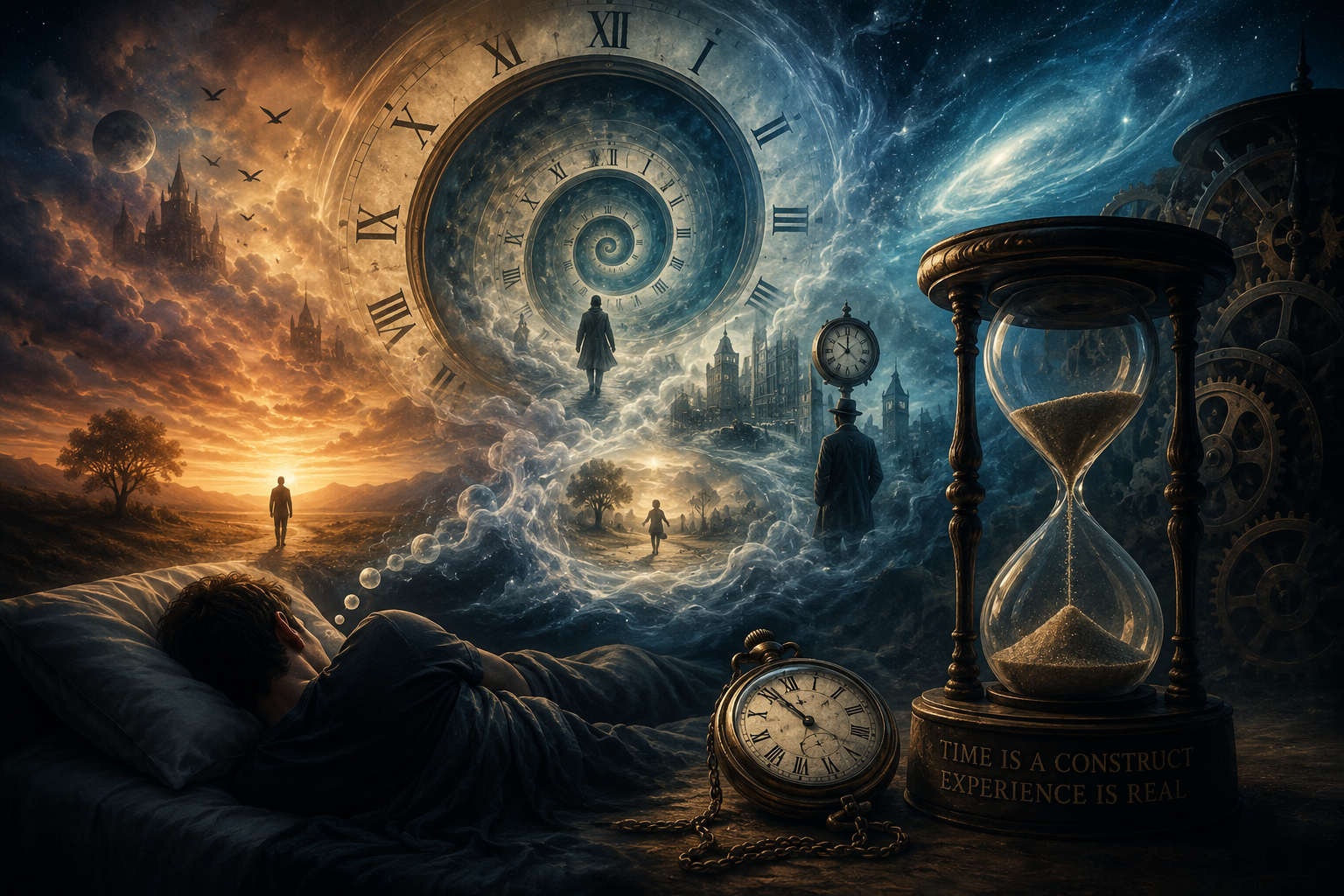
Every person dreams, whether they remember those dreams or not. A single dream can feel as though it spans days, years, or even an entire lifetime. Some dreamers awaken convinced they have lived through lengthy adventures, while others recall only fleeting images lasting a few seconds. This strange distortion of time has fascinated philosophers, scientists, psychologists, and theologians for centuries.
Modern neuroscience has uncovered much about when dreams occur and how long they typically last, yet one of the greatest mysteries remains unanswered: Why can a dream lasting only minutes seem to contain hours—or even years—of experiences?
The answer lies at the intersection of sleep science, psychology, and perhaps even our understanding of time itself.
What Is a Dream?
A dream is a sequence of thoughts, emotions, sensations, memories, and perceptions experienced during sleep. Although dreams can occur during multiple stages of sleep, the most vivid and story-like dreams usually occur during Rapid Eye Movement (REM) sleep, when brain activity resembles that of wakefulness.
During dreaming, the brain is remarkably active. Regions associated with emotion, memory, and visual imagery become highly engaged, while areas responsible for logical reasoning and critical judgment are generally less active. This combination creates experiences that feel intensely real despite often containing impossible events.
Understanding REM Sleep
Sleep is divided into two broad categories:
- Non-REM (NREM) sleep
- Rapid Eye Movement (REM) sleep
A typical adult cycles through these stages approximately every 90 to 110 minutes, completing four to six cycles during a normal night’s sleep.
Stage 1 (NREM)
This is the transition between wakefulness and sleep. It usually lasts only a few minutes.
Stage 2 (NREM)
Heart rate slows, body temperature drops, and the brain begins consolidating memories.
Stage 3 (NREM)
Often called deep sleep, this stage is essential for physical restoration, immune function, and tissue repair.
REM Sleep
After progressing through the NREM stages, the brain enters REM sleep.
During REM:
- Eyes move rapidly beneath closed eyelids.
- Brain activity increases dramatically.
- Most skeletal muscles become temporarily paralyzed (REM atonia), preventing the body from acting out dreams.
- Emotional and visual brain centers become highly active.
- Most vivid dreams occur.
The first REM period usually lasts about 10 minutes, while later REM periods can last 30 to 60 minutes before awakening.
How Long Do Dreams Actually Last?
Contrary to the popular belief that dreams happen only moments before waking, research indicates that dreams often unfold in real time.
Scientific sleep laboratory studies show:
- Early-night dreams often last 5–10 minutes.
- Middle-of-the-night dreams typically last 15–25 minutes.
- Dreams occurring just before awakening may last 30–60 minutes.
This means a person sleeping eight hours may spend nearly two hours dreaming, distributed across several REM periods.
Do Dreams Occur in Real Time?
Researchers awakened volunteers during REM sleep and asked them to estimate how long their dreams lasted.
The findings consistently suggested that dream time often closely matches actual elapsed time.
If someone spent fifteen minutes in REM sleep, the dream narrative usually represented roughly fifteen minutes of subjective experience.
However, subjective perception can vary dramatically.
Why Dreams Feel Much Longer
Nearly everyone has experienced a dream that seemed to last days, weeks, or years.
Several factors contribute to this illusion.
Memory Compression
The brain does not replay every second of a dream upon waking.
Instead, it recalls key scenes, much like remembering highlights from a movie.
When the mind reconstructs these memories, it fills in gaps, creating the impression of a much longer experience.
Narrative Construction
Dreams frequently imply the passage of time without actually depicting it.
For example, a dream may begin with:
“I had been living there for twenty years.”
The dreamer instantly accepts this history without actually experiencing twenty years.
Emotional Intensity
Emotion influences perceived duration.
Fear, grief, excitement, and wonder can make experiences seem much longer than they objectively are.
Because dreams often amplify emotion, they naturally distort time perception.
Rapid Scene Changes
Dreams effortlessly shift from childhood to adulthood, from one country to another, or from one season to the next without explanation.
These transitions create the illusion that enormous amounts of time have passed.
Why Can’t We Tell We’re Dreaming?
During REM sleep, parts of the brain responsible for logical evaluation become less active.
Meanwhile:
- imagination increases
- emotional processing intensifies
- visual processing flourishes
This neurological combination allows impossible events to seem perfectly reasonable while dreaming.
Time in Lucid Dreams
Lucid dreams occur when the dreamer realizes they are dreaming while remaining asleep.
Scientific experiments involving eye movement signaling have demonstrated that many actions performed inside lucid dreams take approximately the same amount of time as performing those actions while awake.
For example:
- counting to ten
- walking across a room
- performing simple physical movements
These tasks generally require similar durations in both dreaming and waking states.
This suggests that dream time often operates at a pace comparable to waking time, even though the dreamer’s perception of the overall experience may differ dramatically.
Historical Views of Dream Duration
Throughout history, dreams have often been viewed as existing outside ordinary time.
Ancient cultures frequently regarded dreams as journeys into spiritual realms where earthly concepts of time no longer applied.
Religious traditions likewise describe visionary experiences that appear to transcend ordinary chronology, reinforcing the idea that dreams can feel detached from the constraints of everyday life.
Joseph Dream Catcherz: Dreams and the Illusion of Time
At Joseph Dream Catcherz, dreams are viewed as offering more than symbolic messages—they also raise profound questions about the nature of time itself.
Modern physics generally treats time as a fundamental dimension of the universe, intertwined with space. While our perception of time can vary depending on context, the underlying physical passage of time remains a central part of current scientific theories.
Joseph Dream Catcherz offers a different philosophical perspective. In this view, dreams suggest that our human experience of time is a mental framework rather than an absolute feature of consciousness.
During a dream, a person may:
- relive childhood in moments,
- experience conversations that seem to last hours,
- witness decades of imagined events,
- or instantly “know” the history of places they have never visited.
Yet only minutes may have elapsed in the sleeping brain.
From this perspective, dreams reveal that the mind is capable of organizing experience independently of clocks and calendars. Rather than concluding that physics itself is disproved, this interpretation proposes that human consciousness is not always bound to the way people ordinarily measure time.
Joseph Dream Catcherz therefore views dreams as evidence that our psychological experience of time is remarkably flexible. Dreams demonstrate that awareness can construct meaningful narratives without following the steady, linear progression marked by clocks. Whether this flexibility reflects only the workings of the brain or points toward deeper aspects of consciousness remains an open philosophical question rather than an established scientific fact.
What Science Still Cannot Explain
Despite remarkable advances in sleep research, many questions remain unanswered:
- Why do some dreams feel like entire lifetimes?
- Why do recurring dreams return years apart with identical settings?
- Why can dreams produce convincing memories of events that never occurred?
- Why do emotions become so vivid during REM sleep?
- Why do certain dreams remain unforgettable while others disappear within seconds?
These mysteries continue to inspire research in neuroscience, psychology, philosophy, and the study of consciousness.
Conclusion
Dreams are among the most extraordinary experiences of the human mind. Although most REM dreams last anywhere from several minutes to about an hour, they can feel vastly longer because of memory compression, emotional intensity, and the brain’s remarkable ability to construct narratives that leap across time.
Sleep science has shown that dreaming follows predictable biological rhythms during REM sleep, yet the subjective experience of time inside dreams remains one of the most intriguing aspects of human consciousness.
Whether dreams simply reflect the brain’s creative processes or reveal something deeper about how consciousness experiences time, they remind us that the passage of time is not always felt in a straight line. Each night, as the mind enters the dream world, minutes can seem like years, and the ordinary rules by which we measure our waking lives temporarily give way to an entirely different experience of reality.
Peace and Blessings-
Bibliography
American Academy of Sleep Medicine. (2023). International Classification of Sleep Disorders (3rd ed., text rev.). Darien, IL: American Academy of Sleep Medicine.
Carskadon, M. A., & Dement, W. C. (2017). Normal Human Sleep: An Overview. In M. H. Kryger, T. Roth, & W. C. Dement (Eds.), Principles and Practice of Sleep Medicine (6th ed.). Philadelphia, PA: Elsevier.
Faraday, A. (1972). The Dream Game. New York, NY: Harper & Row.
Freud, S. (1900/2010). The Interpretation of Dreams. (J. Strachey, Trans.). New York, NY: Basic Books.
Hobson, J. A. (2002). Dreaming: An Introduction to the Science of Sleep. Oxford University Press.
Jung, C. G. (1964). Man and His Symbols. Garden City, NY: Doubleday.
Jung, C. G. (1968). The Structure and Dynamics of the Psyche. Collected Works of C. G. Jung (Vol. 8). Princeton University Press.
Kryger, M. H., Roth, T., & Dement, W. C. (Eds.). (2017). Principles and Practice of Sleep Medicine (6th ed.). Elsevier.
Nielsen, T. A. (2017). Dreaming. In M. H. Kryger, T. Roth, & W. C. Dement (Eds.), Principles and Practice of Sleep Medicine (6th ed.). Elsevier.
Revonsuo, A. (2000). The reinterpretation of dreams: An evolutionary hypothesis of the function of dreaming. Behavioral and Brain Sciences, 23(6), 877–901.
Stickgold, R., & Walker, M. P. (2013). Sleep-dependent memory triage: Evolving generalization through selective processing. Nature Neuroscience, 16(2), 139–145.
The Qur’an. References to prophetic dreams, including the account of Prophet Yusuf (Joseph), as traditionally interpreted within Islamic dream literature.
Ibn Sirin. (Attributed, 8th century). The Great Book of Dream Interpretation (various English translations).
Artemidorus of Daldis. (2nd century CE/1990). The Interpretation of Dreams (Oneirocritica) (R. J. White, Trans.). Park Ridge, NJ: Noyes Press.

Leave a Reply
You must be logged in to post a comment.